📌 Key Takeaways:-
- Two-Sided Market: A crypto options trade always involves two sides: a buyer and a seller (writer), expanding foundational crypto trading knowledge.
- Premium Payment: The buyer pays a premium for the option contract.
- Rights vs Obligations: The buyer has a right, but normally no obligation, to exercise the option. The seller receives the premium but takes on the obligation if the buyer exercises.
- Collateral Protection: Sellers may have to provide collateral under proper portfolio margin financing rules to ensure obligations are met.
- Marketplace Infrastructure: An order book is where buyers and sellers place their orders and where matching can occur.
- Settlement Types: Options can be physically settled, where cryptocurrency is delivered, or cash settled, where the profit or loss is paid in money or another settlement asset.
- Prevalent Mechanism: Many crypto options are cash-settled using stablecoins, but the exact mechanism depends on the exchange and contract.
- Moneyness States: An option can expire in the money, at the money, or out of the money.
- Asymmetric Risk: The buyer’s maximum loss on a purchased option is generally the premium paid, while an uncovered option seller can face much larger losses—making an active risk watch approach necessary.
💡 ZenvestAi Explains
A crypto option is a derivative contract where the buyer pays a premium for the right—without obligation—to buy (call) or sell (put) cryptocurrency at a set strike price before or on expiration.
The seller receives the premium, posts collateral (margin), and assumes the binding legal obligation to fulfill the trade. Orders match on a central order book, and final profits are distributed at expiration via cash settlement or physical coin delivery. For a high-level summary, see our breakdown on crypto in 60 seconds.
📋 At a Glance: What This Guide Covers
| Core Phase | Key Focus Areas & Mechanics | Primary Concepts |
| Phase 1: Foundations & Participants | Buyers, sellers, rights, obligations, and initial INR pricing | Call/Put, Premium, Strike Price |
| Phase 2: Risk & Margin Management | Why sellers post collateral and how margin rules operate | Security Deposit, Collateral, Liquidation |
| Phase 3: Order Execution & Pricing | Order books, market makers, bid-ask spreads, and order types | Limit vs Market Orders, Slippage, Liquidity |
| Phase 4: Valuation & Price Drivers | Intrinsic vs time value, Greeks/volatility, and time decay | Moneyness (ITM/ATM/OTM), IV, Decay |
| Phase 5: Settlement & Lifecycle | Expiration payoff math, cash vs physical delivery, and full workflow | European/American, Contract Size, Payoffs |
How Crypto Options Work: A Complete Beginner’s Guide to Buyers, Sellers, Collateral, Settlement, and Order Books
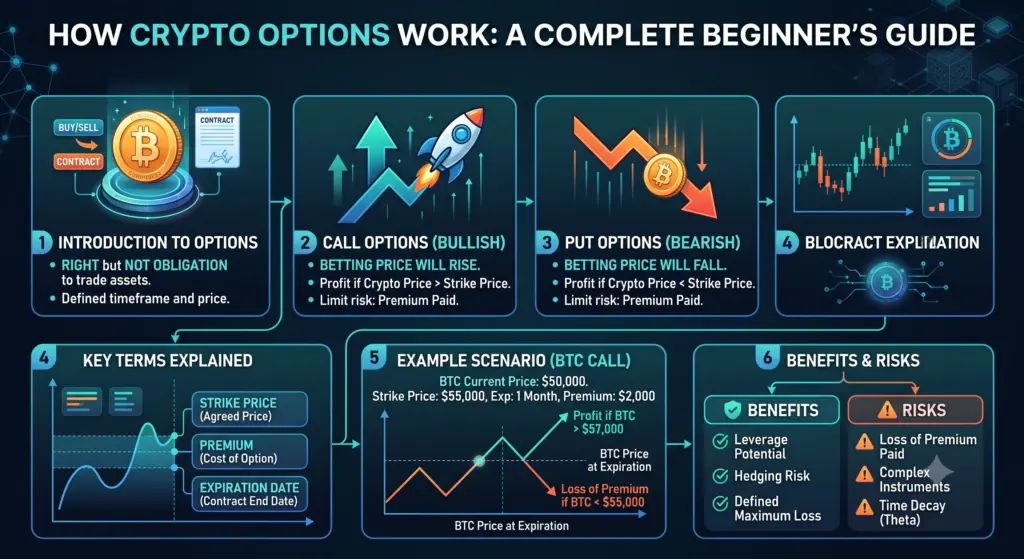
If you have already read “What Are Crypto Options?”, you know the basic idea: a crypto option gives someone the right to buy or sell a cryptocurrency at a predetermined price, without forcing them to do so. If you are entirely new to digital assets, you can start here to build a solid foundation.
But knowing the definition is only the beginning.
The more important question is: What actually happens when a crypto options trade takes place?
Who is the buyer? Who is the seller? What does each person have to do? Where does the money or cryptocurrency go? Why is collateral required? How does an order book match two traders? And when an option expires, does the buyer actually receive Bitcoin or Ethereum, or is the trade simply settled in cash?
The goal is not to teach you another definition. It is to help you understand what happens behind an options trade within the broader crypto market.
👥 1. Start With the Two People in an Options Trade
To understand how crypto options work, forget the complicated terminology for a moment.
Imagine two traders:
- Amit believes Bitcoin will rise, aligning with a long-term Bitcoin wealth strategy.
- Rahul believes the option premium is attractive enough to take the other side of the trade.
Amit buys a Bitcoin call option from Rahul.
Now there are two completely different positions.
Amit is the option buyer
- Amit pays a premium.
- In return, he receives a right.
- For a call option, that right is generally the right to buy Bitcoin at the agreed strike price, subject to the contract’s exercise rules.
- Amit does not have to use the right if doing so would not benefit him.
Rahul is the option seller
- Rahul receives Amit’s premium.
- But Rahul takes on an obligation.
- If the option is exercised under the contract terms, Rahul must meet his side of the contract.
Zenvestai Quick Insight:
In every crypto options trade, the buyer purchases flexibility while the seller sells certainty. The buyer pays an upfront, non-refundable fee for upside participation with strictly capped downside risk, whereas the seller collects immediate cash flow while taking on mandatory contractual performance risk.
This is the most important relationship to understand:
The buyer receives a right. The seller takes on an obligation.
That difference explains much of the risk structure of options.
2. A Simple Example Before Going Deeper
Suppose Bitcoin is trading at:
- ₹60,00,000
You think Bitcoin could rise substantially over the next month.
You buy a call option with:
- Strike price: ₹62,00,000
- Expiration: 30 days
- Premium: ₹60,000
You pay ₹60,000 for the option.
You are not paying ₹62,00,000 to buy Bitcoin immediately.
You are paying ₹60,000 for the right described by the option contract.
Now imagine Bitcoin reaches ₹70,00,000 near expiration.
Your call option has value because you have the right to buy at ₹62,00,000 while Bitcoin is worth ₹70,00,000.
The difference is:
$$\text{₹70,00,000} – \text{₹62,00,000} = \text{₹8,00,000}$$
The option therefore has substantial intrinsic value before considering the premium and the exact settlement method.
Your economic result depends on the premium you paid and the contract’s settlement rules.
If the option expires when Bitcoin is only ₹58,00,000, the call may have no exercise value.
You could simply allow the option to expire.
Your loss would generally be limited to the ₹60,000 premium, ignoring fees and other costs.
This is the basic buyer-side mechanics.
But there is another side.
3. What Happens to the Seller?
Someone had to sell that option to you.
Suppose Rahul sold the call option for ₹60,000.
Rahul receives the premium.
That sounds attractive.
But Rahul has accepted a responsibility in exchange for that premium.
If Bitcoin rises sharply, the option can become valuable to you—and potentially expensive for Rahul.
For example:
- Strike price = ₹62,00,000
- Bitcoin at settlement = ₹70,00,000
- Difference = ₹8,00,000
The seller may have to cover the economic value owed under the contract.
This is why options selling is fundamentally different from simply collecting easy income.
The premium is the seller’s income, but the seller takes on risk in return.
4. Why Does the Seller Need Collateral?
This is where many beginners become confused.
Imagine you sell an option and receive ₹60,000.
What happens if the market suddenly moves heavily against you?
The exchange needs confidence that you can meet your obligation.
That’s where collateral comes in.
Collateral is an asset that is held or reserved to support your position.
Depending on the platform and contract, collateral may be held in:
- USDT
- USDC
- Bitcoin
- another accepted cryptocurrency
- fiat or other eligible assets
The exact collateral rules vary between platforms. Ensuring secure asset custody on platforms requires following strict crypto security practices, including proper wallet security protocols.
Zenvestai Quick Insight:
Collateral acts as an automated solvency guarantee in decentralized and centralized crypto derivatives. Because crypto markets operate 24/7 without traditional credit clearinghouses, exchanges lock seller collateral upfront in smart contracts or margin vaults to guarantee that winning buyers are paid instantly upon contract settlement.
Think of collateral like a security deposit
Suppose you rent a house.
The landlord may ask for a security deposit because they want protection against certain risks.
Options collateral serves a somewhat similar purpose.
It gives the trading system an asset that can help cover the seller’s obligations if the position moves against them.
5. Buyer Collateral vs Seller Collateral
This distinction is important.
When you buy an option, you normally pay the premium upfront.
For a simple long option position, you generally do not face unlimited losses because the option can expire worthless.
Your main economic exposure is the premium you paid, plus fees.
When you sell an option, however, you are taking on an obligation.
Therefore, the platform may require collateral or margin.
The exact amount can depend on factors such as:
- the option type
- strike price
- current underlying price
- time remaining
- volatility
- position size
- whether the seller is hedged
- the platform’s margin system
So you should never assume that every options platform uses the same collateral requirements.
6. What Is an Order Book?
Now let’s move from the trader to the marketplace.
When you open an options trading screen, you may see something called an order book.
An order book is essentially a list of buy and sell orders waiting to be matched.
For example:
📖 Central Limit Order Book Structure
| Side | Bid/Ask Price (INR) | Quantity (Contracts) |
| Buyers (Bids) | ₹60,000 | 2 contracts |
| Buyers (Bids) | ₹58,000 | 3 contracts |
| Buyers (Bids) | ₹55,000 | 5 contracts |
| Sellers (Asks) | ₹65,000 | 2 contracts |
| Sellers (Asks) | ₹67,000 | 4 contracts |
| Sellers (Asks) | ₹70,000 | 5 contracts |
The numbers represent orders that traders are willing to place.
A trade occurs when compatible buy and sell orders are matched according to the exchange’s matching rules, similar to the settlement and ledger logic behind how distributed ledgers modernize finance.
7. The Order Book Does Not Mean the Exchange Is the Opposite Trader
This is another common beginner misunderstanding.
If you buy an option on an exchange, it does not necessarily mean the exchange itself is selling you the option.
An exchange generally provides the marketplace and matching infrastructure.
There can be other traders on the opposite side.
For example:
$$\text{You} \rightarrow \text{Buy Call}$$
$$\text{Another trader} \rightarrow \text{Sell Call}$$
The exchange’s trading system can match those orders.
The exact structure differs by platform, including whether the platform operates a central order book, uses market makers, or employs other liquidity mechanisms.
8. Limit Order vs Market Order
When placing an options order, you may encounter two common order types.
Limit Order
You specify the maximum price you are willing to pay when buying.
For example:
“I will buy this option only if the premium is ₹60,000 or lower.”
Your order waits until a suitable seller is available.
- The advantage: price control.
- The disadvantage: your order may never execute.
Market Order
You tell the system:
“Execute my order at the best available price.”
The order may execute quickly, but the final price can be different from what you expected, especially when the market is thin.
This is called slippage.
For crypto options with low liquidity, this can become particularly important.
9. From Order to Completed Trade
Let’s follow one trade from beginning to end.
Suppose you want to buy a call option.
The contract has:
- Bitcoin price: ₹60,00,000
- Strike: ₹62,00,000
- Expiration: 30 days
- Premium: ₹60,000
- Order Placement: You place an order to buy one contract.
- Counterparty Found: A seller is willing to sell at your price.
- Execution: The exchange’s matching engine matches the orders.
- Settlement of Position: The trade is executed.
Now:
- Buyer: receives the option position.
- Seller: receives the premium and takes on the corresponding obligation.
The exchange or clearing mechanism records the position. Traders frequently use centralized platforms like Binance or automated tools such as the Pionex futures grid bot for broader portfolio execution.
If collateral is required, the appropriate collateral is held or reserved according to the platform’s rules.
From this point forward, the option’s value can change as market conditions change.
10. What Happens to the Premium?
The premium is the price paid for the option.
For the buyer:
$$\text{Premium} = \text{Cost of purchasing the option}$$
For the seller:
$$\text{Premium} = \text{Amount received for selling the option}$$
Suppose the premium is ₹60,000.
The buyer pays ₹60,000.
The seller receives ₹60,000, before considering fees and the platform’s specific settlement mechanics.
But don’t make the mistake of thinking the seller simply keeps the ₹60,000 without further responsibility.
The seller has accepted the obligation attached to the option.
That obligation can become very valuable—or very expensive—depending on what happens to the underlying cryptocurrency.
11. The Option Does Not Stay at the Same Price
Once the option is traded, its market price can change.
Suppose you bought a call option for:
- ₹60,000
A few days later, Bitcoin rises sharply.
Other traders may now be willing to pay:
- ₹1,20,000
Your option has increased in market value.
You could potentially sell the option before expiration, depending on the exchange and contract.
You don’t necessarily have to wait until expiration.
This is an important point:
Buying an option does not always mean holding it until expiry.
You can potentially close your position before expiration by taking the opposite transaction.
12. Why Does an Option’s Price Change?
An option’s premium can change because of several factors.
The most important ones include:
- Price of the underlying cryptocurrency: If Bitcoin rises, a Bitcoin call option may become more valuable. If Bitcoin falls, that call may become less valuable. For put options, the relationship is generally reversed.
- Strike price: An option with a strike closer to the current market price can have a different value from an option far away from the current price.
- Time remaining: An option with 30 days remaining can behave differently from an otherwise similar option with only one day remaining.
- Volatility: Higher expected volatility can increase option premiums because larger price movements become more possible.
- Market demand and supply: If many traders want to buy an option and relatively few want to sell it, its market price can rise. Many modern trading desks analyze these shifts by reviewing how AI transforms crypto trading.
These factors interact with each other, which is why option pricing can appear complicated.
13. Intrinsic Value and Time Value
To understand how an option’s price works, it helps to divide its value into two broad ideas.
Intrinsic value
This is the value the option would have if it were exercised based on the current underlying price, depending on the option type.
For a call: Intrinsic value = max(Current price − Strike price, 0)
For example:
- Bitcoin = ₹70,00,000
- Strike = ₹62,00,000
- Intrinsic value: ₹70,00,000 − ₹62,00,000 = ₹8,00,000
For a put: Intrinsic value = max(Strike price − Current price, 0)
Time value
An option can also have value because there is still time before expiration.
Why?
Because Bitcoin could move significantly before the option expires.
Suppose Bitcoin is currently ₹61,00,000 and the call strike is ₹62,00,000.
The call may still have a premium because Bitcoin could move above ₹62,00,000 before expiration.
That additional value is broadly referred to as time value.
As expiration gets closer, this time component generally declines, all else equal.
14. What Does “In the Money” Mean?
You will frequently see three terms:
- In the money (ITM)
- At the money (ATM)
- Out of the money (OTM)
Let’s keep it simple.
Call option
Suppose:
- Bitcoin = ₹65,00,000
- Call strike = ₹62,00,000
- The call is in the money because Bitcoin is above the strike.
Put option
Suppose:
- Bitcoin = ₹58,00,000
- Put strike = ₹62,00,000
- The put is in the money because Bitcoin is below the strike.
At the money
An option is approximately at the money when the underlying price is close to the strike price.
Out of the money
- A call is generally out of the money when: Market price < Strike price
- A put is generally out of the money when: Market price > Strike price
An out-of-the-money option can still have a premium before expiration because there is still time for the market to move.
15. What Happens at Expiration?
This is where the mechanics become especially important.
Every option contract has an expiration date and time.
At expiration, the contract is evaluated according to its rules.
Depending on the contract, an option may:
- expire worthless
- be automatically exercised
- be cash settled
- result in cryptocurrency delivery
- be otherwise settled according to the exchange’s contract specifications
This is why you should always read the contract specifications before trading.
Do not assume every crypto option works the same way.
16. Cash Settlement: The Simple Explanation
Let’s say you bought a Bitcoin call option.
The contract is cash settled.
Suppose:
- Strike price = ₹62,00,000
- Settlement price = ₹70,00,000
The difference is:
₹70,00,000 – ₹62,00,000 = ₹8,00,000
If the contract represents one unit of Bitcoin, the settlement calculation would be based on that contract’s size and settlement formula.
You may receive the economic value of the difference rather than receiving one actual Bitcoin.
Zenvestai Quick Insight:
Cash settlement eliminates the operational friction of transferring volatile spot cryptocurrencies across blockchain wallets. Traders receive their net profit directly credited in stablecoins or fiat currency, allowing immediate reinvestment, everyday spending with a Binance virtual card, or withdrawal without managing private keys or paying network gas fees.
In simple terms:
Cash settlement pays the value of the option’s profit according to the contract rules instead of delivering the underlying cryptocurrency.
The actual settlement asset could be USDT, USDC, fiat, or another asset depending on the platform.
17. Physical or Coin Delivery Settlement
Now consider another type of contract.
Instead of paying the difference in cash, the contract may require actual cryptocurrency delivery.
Suppose you have a call option giving you the right to acquire Bitcoin at the strike price.
If the option is exercised under a physically settled contract, the buyer may receive the underlying Bitcoin while paying the required strike amount, according to the contract.
This is known as physical settlement or delivery settlement.
The important distinction is:
- Cash settlement: Economic difference is paid.
- Physical settlement: Underlying asset is delivered directly to your crypto wallets or managed with cold storage via an in-depth crypto wallet guide.
Not every crypto options platform offers physical delivery.
18. Why Do Many Traders Prefer Cash Settlement?
Cash settlement can make the process simpler.
Imagine you are trading Bitcoin options but don’t actually want to receive or deliver Bitcoin.
With cash settlement, you can potentially receive or pay the economic difference without moving the full amount of Bitcoin.
This can make options more convenient for traders who primarily want exposure to price movements.
However, cash settlement does not eliminate risk.
It simply changes how the contract is settled.
19. What Is the Settlement Price?
The settlement price is extremely important.
It is the price used by the contract to determine the final payoff.
It may not simply be:
“Whatever Bitcoin is trading at on one exchange at exactly 5:00 PM.”
The exchange may use a specific index, reference price, calculation window, or methodology.
For example, a platform may calculate a reference Bitcoin price using prices from selected markets.
Therefore, before trading an option, check:
- Which index is used?
- What time is settlement?
- Which timezone applies?
- How is the settlement price calculated?
- Is the contract cash settled or physically settled?
- What happens if the underlying market becomes unavailable?
These details can materially affect the final result.
20. European vs American-Style Exercise
Another important part of options mechanics is when the option can be exercised.
European-style option
Generally, the option can be exercised only at expiration.
American-style option
Generally, the option can be exercised at any time before expiration, subject to the contract rules.
The names can confuse beginners.
They do not simply mean that the option is traded in Europe or America.
They describe the exercise rules.
Crypto options platforms can use different contract structures, so check the specific product.
21. Exercise Is Not the Same as Closing a Position
This distinction is very important.
Suppose you bought an option.
You have two different possibilities.
Close the position
- You sell the option back into the market before expiration.
- You are no longer holding the option.
Exercise the option
- You use the contractual right attached to the option.
- Whether exercise is available, automatic, or relevant depends on the option’s exercise style and settlement mechanism.
For many cash-settled options, traders may simply allow the contract to settle rather than physically exercising it.
22. What Happens If the Option Expires Out of the Money?
Suppose you buy this call:
- Strike = ₹62,00,000
- Premium = ₹60,000
At expiration:
- Bitcoin = ₹59,00,000
Your call gives you the right to buy at ₹62,00,000.
But Bitcoin is available in the market for ₹59,00,000.
Why would you use a right to buy at ₹62,00,000 when the market price is ₹59,00,000?
You generally wouldn’t.
The option expires without exercise value.
Your loss as the buyer would generally be the premium:
- ₹60,000
- Plus applicable trading fees and other costs.
23. What Happens If the Option Expires In the Money?
Now suppose Bitcoin finishes at:
- ₹70,00,000
The call strike is:
- ₹62,00,000
The option has ₹8,00,000 of intrinsic value per unit of underlying exposure.
But remember something very important:
Profit is not simply the intrinsic value.
You paid a premium.
If your premium was ₹60,000, your simplified gross economic result before fees would be:
$$\text{₹8,00,000} – \text{₹60,000} = \text{₹7,40,000}$$
This assumes the contract represents one full BTC for simplicity.
Real contracts may have different contract sizes and settlement calculations.
24. Why Contract Size Matters
This is one of the easiest things for beginners to overlook.
Suppose an option contract does not represent one entire Bitcoin.
Instead, it represents:
- 0.01 BTC
Then an ₹8,00,000 price difference does not mean you receive ₹8,00,000.
You would calculate the payoff according to the contract size.
For example:
- ₹8,00,000 × 0.01 = ₹8,000
So before trading any options contract, always check:
How much underlying asset does one contract represent?
Never assume one contract equals one Bitcoin or one Ethereum.
25. The Seller’s Side at Expiration
Now let’s return to Rahul, the seller.
Rahul sold the call.
The strike is ₹62,00,000.
Bitcoin settles at ₹70,00,000.
The option has value to the buyer.
That value represents a liability for the seller, according to the contract’s settlement mechanism.
Rahul received the premium earlier.
But that premium may be much smaller than the amount he now owes.
This is why option sellers need to understand risk carefully.
For an uncovered call, losses can become extremely large if the underlying asset rises dramatically.
This is very different from buying a call.
26. Why Collateral Can Change During the Trade
Crypto markets can move very quickly.
Suppose an option seller has posted collateral.
Bitcoin suddenly rises 15%.
The seller’s position may become riskier.
The platform’s risk system may therefore require more collateral or margin.
This is one reason traders can receive:
- margin calls
- collateral requirements
- liquidation warnings
- position reduction
The exact rules vary by platform.
The important idea is simple:
Collateral requirements are designed to help ensure that traders can meet their financial obligations.
27. What Is Liquidation in Options?
Liquidation is often discussed more with crypto futures, which you can explore in our complete crypto futures guide and guide to futures trading with low capital. However, some crypto options platforms can also have margin positions where risk controls trigger forced liquidation.
Suppose a trader sells options using margin.
The market moves sharply against them.
Their available collateral may no longer be enough according to the platform’s risk model.
The platform may close some or all of the position to reduce the risk of an unpaid obligation.
This is why “I received a premium” does not mean “I have free money.”
The premium comes with responsibility.
28. What Happens When You Buy an Option and the Price Moves Against You?
Suppose you buy a call option for:
- ₹60,000
Bitcoin falls instead of rising.
The option’s market value could fall from:
₹60,00,000 → ₹40,000 → ₹15,000 → ₹0
If it eventually expires worthless, the buyer’s loss is generally limited to the premium paid.
This is one of the key attractions of buying options.
You know your maximum premium outlay before entering the trade, although fees and other costs may also apply.
📊 29. Buying Options vs Selling Options
Here is the simplest comparison:
| Feature | Option Buyer | Option Seller |
| Pays premium | Yes | No |
| Receives premium | No | Yes |
| Gets a right | Yes | No |
| Takes on obligation | Generally no exercise obligation | Yes |
| Collateral usually required | Often limited to premium for a long option | Often required |
| Maximum loss | Generally premium paid | Can be much larger; depends on strategy |
| Main benefit | Defined-risk exposure | Premium income |
| Main danger | Option can expire worthless | Large adverse price movement |
The exact margin treatment depends on the platform and strategy.
30. A Complete Trade Walkthrough
Let’s put everything together.
Imagine Bitcoin is trading at:
- ₹60,00,000
You believe Bitcoin could rise.
You buy a call option:
- Strike = ₹62,00,000
- Expiration = 30 days
- Premium = ₹60,000
- Contract size = 0.01 BTC
- Step 1: You place the order — You submit a buy order for the call option.
- Step 2: A seller is found — Another trader is willing to sell the option at your price.
- Step 3: The order is matched — The exchange’s matching system executes the trade.
- Step 4: You pay the premium — Your account is charged the premium according to the platform’s mechanics.
- Step 5: The seller receives the premium — The seller now has the corresponding short-option position.
- Step 6: The option’s value changes — Bitcoin moves. The option premium may rise or fall.
- Step 7: You close early—or wait — You can potentially close your position before expiration, or hold until settlement, depending on the contract.
- Step 8: Expiration arrives — Suppose Bitcoin’s settlement price is: ₹70,00,000
- Step 9: Calculate intrinsic value — Difference: ₹70,00,000 − ₹62,00,000 = ₹8,00,000
- Step 10: Apply contract size — Contract size: 0.01 BTC. So: ₹8,00,000 × 0.01 = ₹8,000
- Step 11: Compare with premium — Suppose your premium was ₹600 for the 0.01 BTC contract. Simplified gross profit: ₹8,000 − ₹600 = ₹7,400
Then account for fees and the exact settlement formula.
This is how the pieces connect.
31. What If Bitcoin Falls Instead?
Same contract:
- Strike = ₹62,00,000
- Bitcoin settlement price = ₹58,00,000
This call is out of the money.
The difference is:
₹58,00,000 − ₹62,00,000 = −₹4,00,000
Because a call cannot have negative intrinsic value, its intrinsic value is:
- ₹0
If it expires worthless, the buyer loses the premium paid.
If the premium was ₹600:
Maximum simplified loss = ₹600
Again, fees and contract-specific rules may affect the actual result.
32. How a Put Option Works in the Same System
Everything we have discussed also applies to put options, but the price direction changes.
Suppose Bitcoin is:
- ₹60,00,000
You believe Bitcoin could fall.
You buy a put option:
- Strike = ₹58,00,000
- Premium = ₹50,000
If Bitcoin falls to:
- ₹50,00,000
The put becomes valuable because it gives you the right to sell at ₹58,00,000 under the contract terms.
The basic intrinsic-value calculation is:
₹58,00,000 − ₹50,00,000 = ₹8,00,000
The actual payoff then depends on the contract size and settlement method.
33. The Role of Market Makers
You may also hear the term market maker.
A market maker is a participant that helps provide buy and sell liquidity in both centralized exchanges and decentralized liquidity pools.
Instead of waiting for one ordinary trader to appear every time you want to trade an option, market makers can quote prices on both sides of the market.
For example:
- Bid: ₹58,000
- Ask: ₹62,000
The difference between the two is called the bid-ask spread.
A tighter spread generally makes trading easier and less costly.
A wider spread can make entering and exiting a position more expensive.
34. Why Liquidity Matters
Suppose you buy an option for:
- ₹60,000
Later you want to sell it.
But there are very few buyers.
You may discover that the best available bid is only:
- ₹45,000
Even if the theoretical value of your option appears higher, you may not be able to sell it at that theoretical price immediately. In decentralized finance (DeFi), pricing disparities across venues can also be analyzed through crypto arbitrage, including spatial arbitrage strategies and optimal DEX routing methods.
This is a liquidity risk.
Therefore, don’t look only at an option’s price.
Also look at:
- trading volume
- open interest
- bid-ask spread
- order-book depth
- number of active market participants
35. What Is Open Interest?
Open interest refers broadly to the number of outstanding option contracts that remain open.
It is different from trading volume.
- Volume: How much trading activity occurred during a period.
- Open interest: How many contracts remain open.
For example, if traders open many new contracts, open interest can rise.
If existing contracts are closed or expire, open interest can fall.
Open interest can help you understand where participation exists in the options market, but it should not be treated as a standalone signal to buy or sell.
36. Why the Bid and Ask Price Can Be Different
Suppose the order book shows:
- Best buyer: ₹58,000
- Best seller: ₹62,000
There is a ₹4,000 spread.
If you immediately buy, you may pay around the ask.
If you immediately sell, you may receive around the bid.
This difference is one of the hidden costs beginners often overlook.
A trader can be directionally correct but still lose money because of:
- spread
- trading fees
- slippage
- funding or financing costs where applicable
- settlement costs
37. Why Crypto Options Can Be More Complex Than Spot Trading
When you buy Bitcoin in the spot trading market, the basic idea is straightforward:
You pay money and receive Bitcoin.
With an option, you are trading a contract whose value depends on several variables.
You must consider:
- underlying price
- strike price
- expiration
- premium
- volatility
- liquidity
- contract size
- exercise style
- settlement method
- collateral
- fees
That’s why options can be powerful but also more difficult to understand than straightforward token holding, alternative asset wholesale tokenization, or small business tokenization models.
38. The Difference Between Spot and Options
Spot Bitcoin
- You buy Bitcoin.
- If Bitcoin rises, your Bitcoin is worth more.
- If Bitcoin falls, it is worth less.
Bitcoin call option
- You buy a contract that can gain value if Bitcoin rises sufficiently, depending on the strike, premium, time remaining, and settlement rules.
- You don’t necessarily own Bitcoin simply because you bought a call option.
That distinction is fundamental.
39. What Happens When You Close an Option Before Expiration?
Suppose you purchased an option for:
- ₹60,000
Bitcoin rises.
The option is now trading at:
- ₹1,00,000
You decide not to wait for expiration.
You sell the option.
Simplified result:
₹1,00,000 − ₹60,000 = ₹40,000 gross gain
After considering trading fees, spread, and other costs, your actual result may be lower.
Notice that you never needed to exercise the option.
You simply bought the option and later sold it to execute your plan and take profit systematically.
This is how many traders manage option positions.
40. What Happens if the Option’s Premium Falls?
Suppose you bought the option for:
- ₹60,00,000
Later, its market price falls to:
- ₹25,000
If you sell it then, your simplified loss is:
₹60,000 − ₹25,000 = ₹35,000
You don’t necessarily have to wait for expiration.
This is why an option’s market price before expiration matters, not just whether it will eventually expire in the money.
41. The Three Possible Outcomes at Expiration
For a simple option buyer, think about three broad outcomes.
- Outcome 1: Strongly favorable move — The option finishes significantly in the money. The option can have substantial value.
- Outcome 2: Small move — The option may still have some value, but perhaps not enough to recover the premium.
- Outcome 3: No favorable move — The option expires out of the money. The option may expire worthless.
The important lesson is:
Being right about the direction is not always enough.
You also need the price movement to be large enough, and often fast enough, to overcome the premium and other costs.
42. Why Time Matters So Much
Imagine two identical call options.
Both have:
- Strike = ₹62,00,000
- Bitcoin = ₹60,00,000
But:
- Option A expires tomorrow.
- Option B expires in 90 days.
Option B generally has more time for Bitcoin to move above the strike.
Therefore, the two options can have very different premiums.
As expiration approaches, the amount of time available for the trade to work becomes smaller.
This is one reason option buyers can lose value even when the underlying cryptocurrency does not move much.
43. What Is Time Decay?
The gradual loss of an option’s time value as expiration approaches is commonly called time decay.
You can think of it like an ice cube.
The longer it sits in a warm room, the more it melts.
An option’s time value can similarly decline as expiration approaches, all else equal.
Time decay is especially important for short-dated options.
44. Why Volatility Matters
Crypto prices can move very quickly.
Imagine Bitcoin is trading at ₹60,00,000.
A market expecting a large move may assign higher premiums to options because there is a greater possibility of the option becoming valuable.
This is where implied volatility comes into the picture.
You do not need advanced mathematics to understand the basic idea:
Higher expected volatility can make options more expensive because bigger future price movements become more possible.
But volatility can also fall.
And when implied volatility falls, option premiums can decline—even if the underlying asset does not move much.
45. Why an Option Can Lose Value Even When Bitcoin Goes in Your Direction
This surprises many beginners.
Suppose you buy a call.
Bitcoin rises slightly.
You might think:
“Bitcoin went up, so my option must be making money.”
Not necessarily.
Your option’s premium depends on more than Bitcoin’s direction.
For example:
- Bitcoin may rise only slightly.
- Time may pass.
- Implied volatility may fall.
- The option may remain out of the money.
- The bid-ask spread may be wide.
As a result, the option’s market price could still fall.
This is why understanding your risk-to-reward ratio is crucial when managing options positions.
⚙️ 46. The Complete Options Flow
You can think of a crypto options trade as a chain:
Plaintext
1. Contract is created/listed
   ↓
2. Buyers and sellers quote prices
   ↓
3. Orders enter the order book
   ↓
4. Matching engine matches compatible orders
   ↓
5. Buyer pays premium
   ↓
6. Seller receives premium
   ↓
7. Seller's obligation is supported by collateral/margin where required
   ↓
8. Option's market value changes
   ↓
9. Trader may close the position early
   ↓
10. Otherwise the option reaches expiration
   ↓
11. Contract is evaluated using its settlement rules
   ↓
12. Cash or cryptocurrency is delivered/settled
That is the basic lifecycle of a crypto option.
47. What You Should Check Before Trading Any Crypto Option
Before clicking Buy or Sell, check the contract and broader regulatory landscape covered under crypto regulation and the future of crypto regulations.
At minimum, understand these details:
- Underlying asset: Is it Bitcoin, Ethereum, or another cryptocurrency? (Stay updated via network developments like the Ethereum Glamsterdam Platåberget upgrade).
- Strike price: At what price is the option based?
- Expiration: Exactly when does the contract expire?
- Exercise style: Is it European-style or American-style?
- Settlement method: Is it cash settled or physically settled?
- Settlement asset: What asset is used for settlement?
- Contract size: How much cryptocurrency does one contract represent?
- Premium: How much are you paying or receiving?
- Collateral: What collateral is required?
- Margin rules: Can your position require additional margin?
- Settlement price: Which reference price determines the final payoff?
- Fees: What trading and settlement fees apply?
- Liquidity: Is there enough order-book depth to enter and exit efficiently?
These details can be more important than simply looking at the option’s chart.
48. A Beginner-Friendly Mental Model
If all of this feels complicated, remember this simple story.
- The buyer says: “I want the right to benefit if the market moves in my favor. I will pay for that right.”
- The seller says: “I will take the other side of that contract and receive the premium, but I accept the obligation and the associated risk.”
- The exchange says: “I will provide the marketplace where these orders can be matched and the contract can be managed according to the platform’s rules.”
- The collateral system says: “The seller must maintain enough financial backing to meet the obligation.”
- At expiration: The contract is settled according to its rules.
That is the heart of crypto options mechanics.
49. The Most Important Difference: Right vs Obligation
If you remember only one thing from this entire article, remember this:
Buyer = Right
Seller = Obligation
The buyer pays a premium to obtain the right.
The seller receives the premium for accepting the obligation.
That is the foundation of the entire options market.
50. Final Example: From ₹60,000 Premium to Final Settlement
Let’s finish with one complete example.
Bitcoin price:
- ₹60,00,000
You buy a call option.
Contract:
- Strike = ₹62,00,000
- Expiration = 30 days
- Premium = ₹60,000
- Contract size = 0.01 BTC
Scenario A: Bitcoin ends at ₹58,00,000
- Call intrinsic value = ₹0.
- If it expires worthless:
- Buyer loses approximately ₹60,000 premium.
Scenario B: Bitcoin ends at ₹62,00,000
- The call is around the strike.
- Its intrinsic value is approximately ₹0.
- It may expire with little or no exercise value depending on the exact settlement rules.
- The premium paid may therefore not be recovered.
Scenario C: Bitcoin ends at ₹70,00,000
- Intrinsic value per BTC:
- ₹70,00,000 − ₹62,00,000 = ₹8,00,000
- Contract size:
- 0.01 BTC
- Payoff:
- ₹8,00,000 × 0.01 = ₹8,000
- If the premium was ₹600 for that contract, simplified gross profit would be:
- ₹8,00,000 × 0.01 − ₹600 = ₹7,400
- before fees and other costs.
- The actual settlement would depend on the contract’s specifications.
Conclusion: How Crypto Options Really Work
Crypto options may look complicated because they combine several moving parts—buyers, sellers, premiums, strike prices, expiration dates, collateral, order books, volatility, and settlement.
But the basic mechanism is actually easier to understand when you break it into stages.
A buyer pays a premium to obtain a right.
A seller receives the premium and accepts an obligation.
Orders are placed into a market and can be matched through the platform’s trading system.
The option’s value then changes as the underlying cryptocurrency, time, volatility, and market conditions change.
The seller may need to maintain collateral because the obligation can become expensive if the market moves sharply against the position.
When the option is closed before expiration, the trader exits according to the market price at that time.
If the option reaches expiration, it is settled according to its specific contract rules.
That settlement may involve cash or actual cryptocurrency delivery.
So, before trading any crypto option, don’t stop at asking:
“Do I think Bitcoin will go up or down?”
Ask the bigger questions:
- What exactly am I buying?
- What is my strike price?
- When does it expire?
- How much is the premium?
- What is the contract size?
- Who has the obligation?
- What collateral is required?
- How is the settlement price calculated?
- Is the option cash settled or physically settled?
Once you understand these mechanics, crypto options become much less mysterious.
And that understanding should come before risking real money.
📖 Glossary of Crypto Options Terms
- Call Option: A contract giving the holder the right to buy the underlying cryptocurrency at a fixed strike price.
- Put Option: A contract giving the holder the right to sell the underlying cryptocurrency at a fixed strike price.
- Premium: The market price paid by the buyer to the seller for the option contract.
- Strike Price: The agreed target price at which the underlying crypto asset can be bought or sold upon exercise.
- Collateral (Margin): Cryptocurrencies or stablecoins locked by the option seller to guarantee contractual settlement obligations.
- Order Book: A real-time electronic ledger displaying active buy (bid) and sell (ask) limit orders.
- Time Decay (Theta): The rate at which an option loses its time value as it approaches its expiration date.
- Cash Settlement: Contract closure where the net profit difference is credited in stablecoins/fiat without physical crypto delivery.
🎯 The Bottom Line: Mastering Crypto Options
Understanding the foundational mechanics of crypto options trading—from order book matching and margin collateral to cash settlement—is essential before executing derivative trades in volatile markets.
For deeper education across crypto products, continue your journey through our core hubs:
- Foundations & Basics: Explore crypto basics, the basics of the crypto market, what is cryptocurrency, blockchain fundamentals, and our beginner’s guide to crypto and blockchain.
- Trading & Execution: Discover different styles like trading, crypto trading, spot trading, margin trading, crypto futures, and learn crypto methodologies.
- Passive Income & Yield: Master DeFi, generated yield, crypto staking, our complete guide on what is crypto staking, and understand why staking exists.
- Security & Scam Prevention: Protect your funds with security, crypto security, DeFi security, wallet security, and steer clear of crypto scams.
- Market Insights & Future Outlook: Stay informed with research, crypto research, crypto news, Bitcoin news, Ethereum news, breaking crypto stories, top news, trending news, top trending stories today, and the future of cryptocurrency in 2026.
- Governance & Standards: Read our regulatory coverage under regulation and consult our editorial policy, privacy policy, and disclaimer.
Have you started trading crypto options yet, or are you currently evaluating strategies between buying and writing calls? Share your thoughts, questions, or favorite exchange platforms in the comments below!
Frequently Asked Questions
What is the difference between buying and selling crypto options?
Buying gives you the legal right to buy or sell crypto at a set price with risk capped at your premium paid. Selling gives you upfront premium income but obligates you to fulfill the contract, exposing you to significant market risk and requiring collateral.
How to check if a crypto option contract is cash settled or physically delivered?
Review the exchange’s contract specification page before executing a trade. Centralized crypto options platforms (such as Deribit) typically use cash settlement in stablecoins (USDT/USDC) or reverse settlement in Bitcoin/Ethereum, whereas certain spot-linked platforms may deliver the actual underlying coin.
Can I lose more money than my initial investment when trading crypto options?
If you are an option buyer, you cannot lose more than the upfront premium paid (plus platform fees). However, if you are an uncovered option seller (writer), your losses can exceed your initial margin if the market moves significantly against your position.
