Entering the world of crypto derivatives can feel confusing at first. There are many new terms to learn, and words like call, put, American-style, and European-style can make options seem more complicated than they really are. If you are just getting started, exploring what are crypto options helps demystify whether buying an option requires purchasing a costly token or whether an “American” option can only be used by traders in the United States.
The good news is that understanding how crypto options work becomes simple once you master core mechanics. In short: calls and puts explain what right the option gives you, while American-style and European-style explain when that right can be exercised.
In this guide, we will break down each contract structure in clear language, backed by practical examples and easy comparisons. By the end, you will understand how these instruments differ and why traders use crypto options to navigate digital asset markets.
ZenvestAi Explains:- Crypto options are derivative contracts classified along two primary dimensions: direction of right and timing of exercise. A Call option gives you the right to buy an underlying cryptocurrency at a fixed strike price, whereas a Put option grants the right to sell. Regarding timing, an American-style option allows exercise at any point before or on expiration, while a European-style option permits exercise strictly on the expiration date. Most crypto exchanges offer cash-settled European options.

Key Takeaways:-
- Two Core Classifications: Crypto options differ based on what right you receive (Call vs. Put) and when you can exercise that right (American vs. European).
- Call Options: Provide the right, but not the obligation, to buy an underlying asset at a predetermined strike price.
- Put Options: Provide the right, but not the obligation, to sell an underlying asset at a predetermined strike price.
- Exercise Timing: American-style options offer early exercise flexibility before expiry, whereas European-style options are exercisable only at expiry.
- Not Geographic: American and European designations describe contract exercise mechanics, not geographical trading locations.
- Defined Buyer Risk: An option buyer’s loss is generally capped at the upfront premium paid, assuming no secondary liabilities.
- Settlement Distinction: Options can be cash-settled or physically settled independently of whether they are calls, puts, American, or European style.
At a Glance: Crypto Options Classification
| Classification Dimension | Option Type | Primary Function | Ideal Market Outlook | Exercise Flexibility |
| Directional Right | Call Option | Right to Buy crypto | Bullish (Expect price rise) | Depends on style |
| Directional Right | Put Option | Right to Sell crypto | Bearish (Expect price fall / Hedging) | Depends on style |
| Exercise Timing | American-Style | Early Exercise Permitted | Any market condition | Any time before or on expiry |
| Exercise Timing | European-Style | Expiry-Only Exercise | Any market condition | Strictly at expiration date |
Types of Crypto Options: Calls, Puts & Exercise Styles
What This Guide Covers
- The Two-Axis Classification of Crypto Options
- What Is a Crypto Call Option?
- What Is a Crypto Put Option?
- Call vs. Put Options: The Fundamental Differences
- American-Style vs. European-Style Options Explained
- The 4-Box Master Framework
- Exercising an Option vs. Selling the Contract
- Physical Settlement vs. Cash Settlement
- Option Buyer vs. Option Seller Dynamics
- Pre-Trade Checklist for Beginners
- 6 Critical Mistakes to Avoid
- Glossary of Essential Terms
- Frequently Asked Questions (PAA)
- The Bottom Line
How Are Crypto Options Classified?
Crypto options are systematically divided into two distinct functional categories that every trader must recognize before placing an order within modern crypto options trading environments.
                  ┌─────────────────────────────────────────┐
                  │           CRYPTO OPTIONS                │
                  └────────────────────┬────────────────────┘
                                       │
            ┌──────────────────────────┴──────────────────────────┐
            ▼                                                     ▼
┌───────────────────────┐                             ┌───────────────────────┐
│   BY DIRECTION/RIGHT  │                             │   BY EXERCISE TIMING  │
├───────────────────────┤                             ├───────────────────────┤
│ • Call Option (Buy)   │                             │ • American-Style      │
│ • Put Option (Sell)   │                             │ • European-Style      │
└───────────────────────┘                             └───────────────────────┘
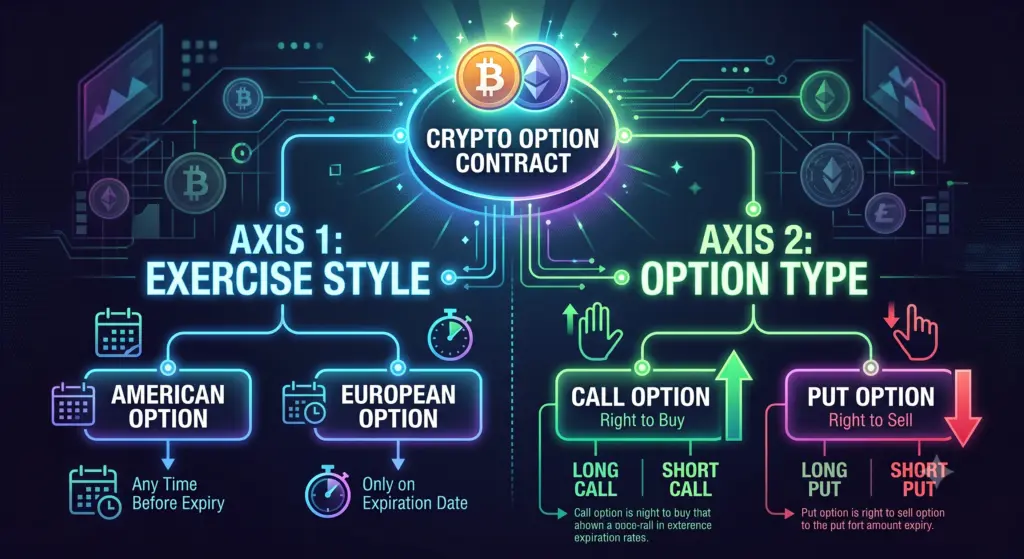
- Based on what the option allows you to do:
- Call Option: Gives you the right to purchase the asset.
- Put Option: Gives you the right to sell the asset.
- Based on when the option can be exercised:
- American-Style Option: Permits early exercise anytime up to the expiration date.
- European-Style Option: Restricts exercise strictly to the expiration date.
Understanding these four types is critical because each combination delivers different legal rights, capital requirements, and portfolio risk management capabilities.
What Is a Crypto Call Option?
A call option gives the buyer the right, but never the obligation, to buy a specific cryptocurrency at a predetermined price known as the strike price. To secure this contractual right, the buyer pays an upfront, non-refundable fee called the premium to the option seller.
The Simple Meaning:- The ownership to buy
Think of a call option from your perspective as:
“I want the guaranteed right to buy this crypto at a fixed price later because I anticipate its market price will rise significantly.”
You are never forced to buy the crypto if the market moves against your expectations.
Example
- Suppose Bitcoin (BTC) is currently trading at ₹60,00,000. (For a breakdown of BTC fundamentals, see what is Bitcoin).
- You decide to purchase a Bitcoin Call Option contract with the following specifications:
- Strike Price: ₹62,00,000
- Premium Paid: ₹1,00,000
- Time to Expiry: 30 days
You have effectively locked in the right to buy Bitcoin at ₹62,00,000 regardless of how high the spot market climbs during this period.
Scenario A: What If Bitcoin Rises to ₹70,00,000?
If Bitcoin rallies to ₹70,00,000, your call option gains substantial intrinsic value. You possess the contractual right to acquire Bitcoin at ₹62,00,000—a full ₹8,00,000 below the going market price.
Scenario B: What If Bitcoin Falls to ₹55,00,000?
If Bitcoin drops to ₹55,00,000, you would naturally have no financial reason to exercise your right to buy at ₹62,00,000 when spot coins are available for ₹55,00,000. Consequently, you simply allow the contract to expire unexercised. Your total loss as the option buyer is strictly capped at the ₹1,00,000 premium paid.
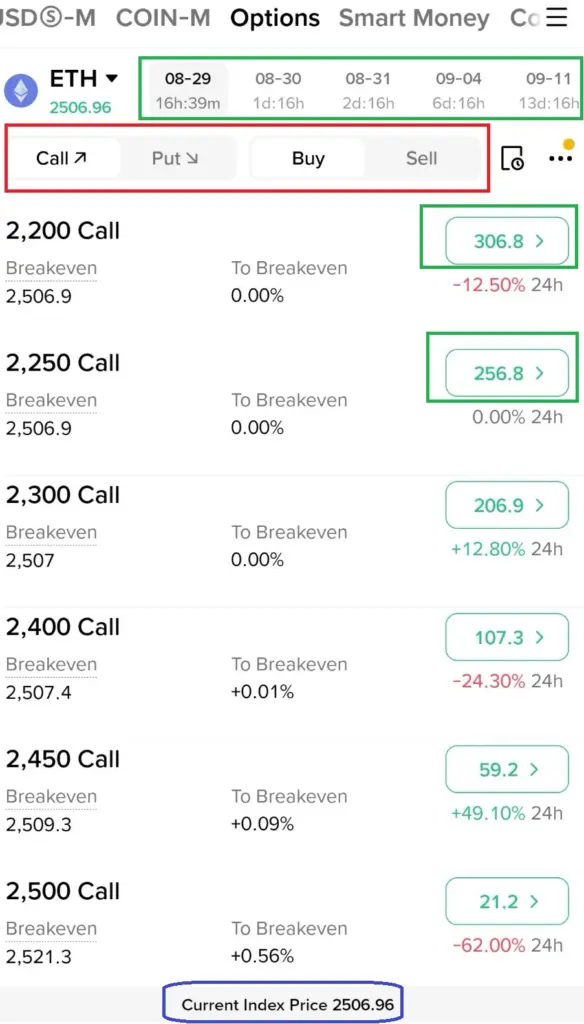
Why Do Traders Buy Call Options?
Traders strategically buy call options when executing a broader Bitcoin wealth strategy to:
- Capture Upward Momentum: Profit from an anticipated bull run in token prices.
- Gain Asymmetric Upside: Participate in price increases without committing the full capital required to purchase physical crypto on the spot trading market.
- Control Downside Risk: Define their maximum loss strictly to the upfront premium, aligning with strict risk-to-reward ratio principles.
- Speculate Efficiently: Maximize capital leverage across spot market swings.
Call Option in One Line:
Call = Right to Buy.
Zenvestai Quick Insight: Call Options – Buying a call option offers asymmetric upside with strictly defined downside risk. If the spot price surges past your strike price plus the premium paid, your profit potential is virtually unlimited. Conversely, if the market plummets, you lose only the premium initially invested.
What Is a Crypto Put Option?
A put option gives the buyer the right, but not the obligation, to sell a specific cryptocurrency at a predetermined strike price. Just like call buyers, put buyers pay an upfront premium to acquire this downside protection.
The Simple Meaning:- The Ownership to Sell
Think of a put option as:
“I want the guaranteed right to sell my crypto at a fixed price because I anticipate the market price may decline.”
The buyer is never compelled to sell if prices unexpectedly surge.
Example
- Suppose Bitcoin is trading at ₹60,00,000.
- You buy a Bitcoin Put Option with:
- Strike Price: ₹58,00,000
- Premium Paid: ₹80,000
- Time to Expiry: 30 days
You now hold the guaranteed right to sell Bitcoin at ₹58,00,000 under contract terms.
Scenario A: What If Bitcoin Crashes to ₹45,00,000?
If Bitcoin falls steeply to ₹45,00,000, your right to sell at ₹58,00,000 becomes exceptionally valuable. You can offload the asset ₹13,00,000 above current market rates, shielding your portfolio from severe capital erosion.
Scenario B: What If Bitcoin Surges to ₹70,00,000?
Selling your Bitcoin at ₹58,00,000 makes no sense when the market is eagerly buying at ₹70,00,000. Therefore, you let the option contract expire quietly. Your maximum financial loss remains strictly limited to the ₹80,000 premium paid.
Why Do Traders Buy Put Options?
Traders purchase put options to:
- Hedge Portfolio Holdings: Safeguard long-term holdings (such as an Ethereum wealth strategy) from severe temporary drawdowns.
- Speculate on Bear Markets: Generate direct returns during steep market declines without taking on unbounded short-selling liabilities found in standard margin trading.
- Fix a Price Floor: Establish a guaranteed minimum selling valuation for mining operations or business reserves.
- Define Risk: Ensure total losses cannot exceed the initial cash outlay while setting disciplined take profit targets.
Put Option in One Line:
Put = Right to Sell.
Zenvestai Quick Insight: Put Options – Put options serve as an insurance policy for crypto investors. By spending a small premium upfront, you set a guaranteed floor price on your portfolio assets, insulating your capital from sudden market corrections or prolonged bear cycles.
Call vs. Put Options: What Is the Fundamental Difference?
The fundamental distinction between calls and puts lies entirely in the specific right granted to the option buyer.
| Option Type | Buyer’s Contractual Right | Typical Market Bias | Profit Trigger Condition | Maximum Buyer Loss |
| Call Option | Right to BUY | Bullish (Expect rise) | Market Price > Strike + Premium | Capped at Premium Paid |
| Put Option | Right to SELL | Bearish (Expect drop) | Market Price < Strike – Premium | Capped at Premium Paid |
                       ┌─────────────────────────┐
                       │  SIMPLE MEMORY FORMULA  │
                       ├─────────────────────────┤
                       │   CALL  ──►  BUY        │
                       │   PUT   ──►  SELL       │
                       └─────────────────────────┘
However, keep in mind that holding a call or put does not guarantee automated profits. Volatility levels, time decay (theta), liquidity depth, and execution timing collectively govern the actual performance of your trade.
American-Style vs. European-Style Crypto Options: Timing Explained ⏳
Traders often mistakenly assume that American and European options relate to geography or exchange jurisdictions. In derivatives trading, these terms describe when an option contract can be officially exercised.
[Diagram Trigger: Timeline Graphic comparing American Early Exercise vs European Expiry-Only Exercise]
1. What Is an American-Style Crypto Option?
An American-style option grants the holder the contractual right to exercise their position at any point prior to or on the expiration date.
Simple Meaning: At any time you can buy or sell
“I can exercise my option contract ahead of expiration if favorable market conditions emerge and the exchange rules permit.”
Practical Example
- Contract: Bitcoin Call Option
- Strike Price: ₹60,00,000
- Expiry Date: 30 September
- Exercise Style: American-style
Suppose five days after entry, unexpected news drives Bitcoin up to ₹75,00,000. Because early exercise is permitted under American-style rules, you can immediately exercise your contractual right to capture that gain without waiting until 30 September.
Key Takeaway: The defining feature of American options is complete exercise timing flexibility before expiration.
2. What Is a European-Style Crypto Option?
A European-style option can only be exercised on its exact expiration date, strictly adhering to the settlement schedule.
Simple Meaning:- You can only buy or sell at expiry
“I must hold the contract until the designated expiration date to execute formal settlement.”
Practical Example
- Contract: Bitcoin Call Option
- Strike Price: ₹60,00,000
- Expiry Date: 30 September
- Exercise Style: European-style
If Bitcoin rockets to ₹75,00,000 on 15 September, you cannot demand immediate contract exercise on that day. Instead, you must wait until the final settlement on 30 September. However, you can still close your position early by selling the option contract back to the market at its prevailing valuation.
Key Takeaway: European-style options strictly restrict official exercise to the final expiration moment.
3. Comparison Between: American vs. European Styles
| Contract Feature | American-Style Options | European-Style Options |
| Exercise Before Expiration | Generally Allowed at any time | Not Allowed prior to expiry |
| Exercise on Expiry Date | Yes | Yes |
| Primary Trading Advantage | Maximum exercise timing flexibility | Cleaner pricing models and tighter spreads |
| Prevalence in Crypto Space | Less common (Specialized platforms) | Industry Standard (Deribit, OKX, Binance) |
| Available as Call? | Yes | Yes |
| Available as Put? | Yes | Yes |
Zenvestai Quick Insight: Exercise Styles – Most institutional and retail crypto derivatives platforms use European-style options because they eliminate early assignment risk for sellers and produce tighter liquidity spreads. Even with European options, traders can exit positions before expiry simply by closing or selling their contracts in the order book.
The 4 Basic Types of Crypto Options
When we combine the two directional rights (Call and Put) with the two exercise mechanisms (American and European), we get four fundamental option structures available across the broader crypto market:
                          ┌───────────────────────────┬───────────────────────────┐
                          │        CALL OPTION        │        PUT OPTION         │
                          │      (Right to BUY)       │      (Right to SELL)      │
┌─────────────────────────┼───────────────────────────┼───────────────────────────┤
│                         │                           │                           │
│     AMERICAN-STYLE      │    American-Style Call    │    American-Style Put     │
│   (Exercise Anytime)    │  Right to Buy + Flexible  │  Right to Sell + Flexible │
│                         │          Timing           │          Timing           │
│                         │                           │                           │
├─────────────────────────┼───────────────────────────┼───────────────────────────┤
│                         │                           │                           │
│     EUROPEAN-STYLE      │    European-Style Call    │    European-Style Put     │
│    (Exercise at End)    │   Right to Buy + Expiry   │   Right to Sell + Expiry  │
│                         │         Only              │         Only              │
│                         │                           │                           │
└─────────────────────────┴───────────────────────────┴───────────────────────────┘
- American-Style Call: Right to buy the underlying crypto at the strike price, exercisable anytime up to expiry.
- American-Style Put: Right to sell the underlying crypto at the strike price, exercisable anytime up to expiry.
- European-Style Call: Right to buy the underlying crypto at the strike price, exercisable only on the expiry date.
- European-Style Put: Right to sell the underlying crypto at the strike price, exercisable only on the expiry date.
Exercising an Option vs. Selling the Contract: A Crucial Distinction
A widespread misconception among beginners in crypto trading is assuming that the only way to monetize an in-the-money option is by exercising it. In live markets, exercising a contract and closing out an open position are two entirely different actions.
                               ┌─────────────────────────────┐
                               │  HOW TO MONETIZE AN OPTION  │
                               └──────────────┬──────────────┘
                                              │
                     ┌────────────────────────┴────────────────────────┐
                     ▼                                                 ▼
        ┌─────────────────────────┐                       ┌─────────────────────────┐
        │   METHOD 1: EXERCISE    │                       │   METHOD 2: TRADE OUT   │
        ├─────────────────────────┤                       ├─────────────────────────┤
        │ Execute the contract    │                       │ Sell the option back to │
        │ right to buy or sell.   │                       │ the order book early.   │
        └─────────────────────────┘                       └─────────────────────────┘
- Method 1: Formal Exercise: You invoke the explicit legal right embedded in your contract. For a call option, this means purchasing the underlying coin at the strike price; for a put, it means selling the coin at the strike price.
- Method 2: Selling / Closing the Position: Rather than exercising the contract, you sell the option back into the open market to realize its accumulated value (both intrinsic value and remaining time value).
Because early exercise often sacrifices remaining time value (extrinsic value), most crypto traders choose to close out profitable positions directly on the exchange order book rather than executing a formal exercise.
Physical Settlement vs. Cash Settlement
How an options trade settles at expiration is an independent structural feature separate from whether it is a call, put, American, or European contract.
- Physical Settlement: The actual underlying cryptocurrency is transferred between counterparties into a secure crypto wallet. If you exercise a Bitcoin call, physical Bitcoin is credited to your wallet in exchange for cash or stablecoins.
- Cash Settlement: No physical delivery of Bitcoin or Ethereum takes place. Instead, the net profit or loss—the price differential between the market index and the strike price—is calculated and paid out directly in a settlement currency such as USDT, USDC, or INR. You can learn more about asset stability in our guide to stablecoins.
For instance, if your Bitcoin option has an intrinsic settlement value of ₹3,00,000 at expiry, a cash-settled contract credits ₹3,00,000 directly to your balance rather than transferring physical Bitcoin.
Option Buyer vs. Option Seller: Rights vs. Obligations ⚖️
Every options contract requires two counterparties: an option buyer (holder) and an option seller (writer). Unlike standard crypto futures trading where both parties carry mandatory settlement obligations, options separate rights from obligations.
| Market Position | Core Definition | Initial Cash Flow | Maximum Potential Profit | Maximum Potential Risk |
| Buy Call (Long Call) | Buys the right to buy | Pays Premium | Unlimited | Capped at Premium Paid |
| Sell Call (Short Call) | Takes obligation to sell | Receives Premium | Capped at Premium | Substantial / Unlimited |
| Buy Put (Long Put) | Buys the right to sell | Pays Premium | Substantial (Down to strike 0) | Capped at Premium Paid |
| Sell Put (Short Put) | Takes obligation to buy | Receives Premium | Capped at Premium | Substantial (Down to strike 0) |
- Option Buyers: Acquire flexible rights with strictly defined maximum losses.
- Option Sellers: Receive upfront premiums but assume legally binding obligations backed by margin, collateral, and advanced portfolio margin financing frameworks.
Complete Pre-Trade Checklist for Beginners 📋
Before committing capital to any crypto options trade, review this 10-point inspection list:
- [ ] 1. Underlying Asset: Is the contract tracking Bitcoin (BTC), Ethereum (ETH), Solana (SOL), or another token?
- [ ] 2. Contract Direction: Are you purchasing a Call (Right to buy) or a Put (Right to sell)?
- [ ] 3. Strike Price: Does the strike price match your realistic technical target?
- [ ] 4. Expiration Date: Have you noted the exact expiration timestamp?
- [ ] 5. Exercise Style: Is the contract American-style or European-style?
- [ ] 6. Settlement Method: Is the option cash-settled or physically delivered?
- [ ] 7. Premium Quoted: What is the total upfront cost of the contract?
- [ ] 8. Contract Multiplier: Does 1 contract represent 1.0 BTC, 0.1 BTC, or a fractional unit?
- [ ] 9. Settlement Asset: Will payouts be distributed in INR, USDT, USDC, BTC, or ETH?
- [ ] 10. Platform Liquidity & Fees: Are order book bid-ask spreads tight enough to allow cost-effective entries and exits? If you trade on major exchanges, ensure you know how to safely set up and secure a Binance account.
6 Costly Beginner Mistakes in Crypto Options (And How to Avoid Them)
┌─────────────────────────────────────────────────────────────────────────┐
│                      COMMON CRYPTO OPTIONS PITFALLS                     │
├─────────────────────────────────────────────────────────────────────────┤
│ ❌ Assuming Calls Guarantee Profit      ──► ✅ Market must clear Breakeven│
│ ❌ Equating Puts with Futures Shorting  ──► ✅ Puts have capped risk    │
│ ❌ Confusing Styles with Geography     ──► ✅ Styles define timing only │
│ ❌ Overlooking Premium Costs            ──► ✅ Premium affects Breakeven│
│ ❌ Ignoring Expiration & Theta Decay   ──► ✅ Time decay accelerates    │
│ ❌ Assuming Uniform Exchange Rules      ──► ✅ Contract specs vary      │
└─────────────────────────────────────────────────────────────────────────┘
- Believing Calls Guarantee Profit: A call provides only the right to buy; if spot prices remain below your breakeven threshold, the option can expire worthless.
- Treating Puts as Identical to Futures Shorts: Puts grant option rights with capped premium losses, whereas shorting in crypto futures entails unbounded liquidation risks if leverage is mismanaged.
- Confusing Exercise Styles with Locations: American and European designations indicate exercise timing mechanics, not physical jurisdictions.
- Ignoring the Premium in Breakeven Calculations: To profit on a call option, the spot price must exceed the strike price plus the premium paid.
- Neglecting Time Decay (Theta): Options are decaying assets; holding contracts close to expiration without favorable momentum erodes contract value rapidly. Automated strategies such as a futures grid bot handle sideways movement differently than decaying options.
- Assuming All Platforms Share Identical Rules: Margin parameters, liquidation triggers, and settlement indexes vary significantly across derivative exchanges.
Glossary: Essential Crypto Options Terms
- Strike Price: The predetermined price at which the option holder can buy (call) or sell (put) the underlying asset.
- Premium: The upfront cash amount paid by the buyer to the seller to purchase the option contract.
- Expiration Date: The exact date and time at which the option contract terminates and settles.
- In-The-Money (ITM): An option that possesses positive intrinsic value based on current spot prices.
- Out-of-The-Money (OTM): An option with no intrinsic value, consisting entirely of time value.
- At-The-Money (ATM): An option whose strike price is identical to the current spot market price.
- Theta (Time Decay): The rate at which an option’s premium declines as expiration approaches.
- Implied Volatility (IV): The market’s forecast of the underlying cryptocurrency’s likely price movement over the contract term.
The Bottom Line: Mastering Crypto Option Types
Crypto options offer traders a versatile, risk-managed way to express directional market views and hedge portfolios. By anchoring your understanding to two fundamental rules—Call vs. Put defines the direction of your right, and American vs. European defines the timing of your exercise—you can navigate derivative markets with clarity and discipline.
Whether you are using call options to participate in a market breakout or deploying put options as portfolio insurance during volatility, always evaluate contract specifications, liquidity, and premium costs before trading. If you are starting fresh, review our crypto beginner starting guide and foundational crypto basics.
Join the Conversation! 💬
Have you explored trading crypto options yet, or are you currently hedging your spot holdings with puts? Drop your questions and strategies in the comments below—let’s discuss!
Crypto Terms & Essential Resources
Deepen your digital asset knowledge across market analysis, derivative trading, decentralized infrastructure, and risk management with these curated resources:
Core Market Concepts & Trading Guides
- Crypto Trading Hub: Complete technical analysis frameworks, strategy deep dives, and market execution tools.
- Start Crypto Futures Trading with Low Capital: Strategic guide to managing leverage and risk with modest initial balances.
- How AI Is Transforming Cryptocurrency Trading: Algorithmic bots, predictive modeling, and automated execution in digital asset markets.
- Options Trading Hub: Advanced volatility analysis, option Greeks, and institutional derivative mechanics.
- Portfolio Margin Trading Hub: Capital efficiency and cross-margin methodologies for high-volume derivative accounts.
- Spatial Arbitrage in Crypto Trading & DEX Routing for Optimal Swap Execution: Cross-exchange spread capture and automated liquidity aggregation.
- Crypto Arbitrage Hub: Market-neutral strategies, funding rate arbitrage, and order book inefficiencies.
- Market Structure Hub: Order flow mechanics, institutional liquidity clusters, and order books.
- Risk Watch & Monitoring: Protocol safety alerts, market drawdowns, and counterparty exposure management.
Blockchain, DeFi & Staking Mechanisms
- Beginner’s Guide to Cryptocurrency and Blockchain: Distributed ledgers, consensus algorithms, and core cryptographic primitives.
- Blockchain Architecture Hub: Layer 1 foundations, rollups, and zero-knowledge execution layers.
- How Distributed Ledgers Are Rewriting Modern Finance: Institutional settlement, programmable money, and disintermediation.
- Understanding Tokenization and Wholesale Digital Assets: Real-world asset (RWA) onboarding and digital capital markets.
- How Tokenization Is Empowering Small Businesses: Fractional asset financing and community-driven capitalization.
- Decentralized Finance (DeFi) Hub: Non-custodial lending protocols, money markets, and algorithmic asset management.
- What Is Crypto Staking? & Why Does Staking Exist?: Proof-of-stake validation, delegation economics, and cryptoeconomic security.
- Crypto Staking Hub, DeFi Yield Hub, & Liquidity Pools: Automated market makers, impermanent loss dynamics, and staking reward structures.
- Ethereum Glamsterdam Upgrade & Platåberget Testnet: Protocol scalability milestones and next-generation EVM architecture.
Security, Regulation & Storage
- The Ultimate Guide to Crypto Wallets: Hardware cold storage vs. self-custody software solutions.
- Crypto Security Hub, Wallet Security, & DeFi Security: Smart contract audit standards, multisig setup, and seed phrase custody.
- Crypto Scams Identification Guide: Protecting digital assets from phishing vectors, malicious approvals, and social engineering.
- The Future of Crypto Regulations & Regulation Hub: Global compliance updates, AML/KYC developments, and jurisdictional guidelines.
- Binance Virtual Card Asia Spending Guide: Real-world off-ramping and card-based crypto payments.
Market News, Research & Learning Portals
- What Is Cryptocurrency? The Ultimate Beginner’s Guide: Token standard structures, cryptography, and network valuations.
- Basics of the Crypto Market & Learn Crypto Portal: Step-by-step digital asset curriculum for new investors.
- Future Trends in Crypto: AI & Blockchain: Emerging macro narratives, autonomous agents, and decentralization.
- Crypto Research Hub & Institutional Research: Fundamental valuation frameworks, on-chain metrics, and market models.
- Crypto News, Top News, Trending News, & Breaking Crypto Stories: Real-time global market dispatches.
- Bitcoin News & Ethereum News: Dedicated ecosystem reporting and network upgrades.
- Crypto in 60 Seconds & Top Trending Market Stories: Fast, snackable market briefings.
- Editorial Policy | Privacy Policy | Financial Disclaimer
