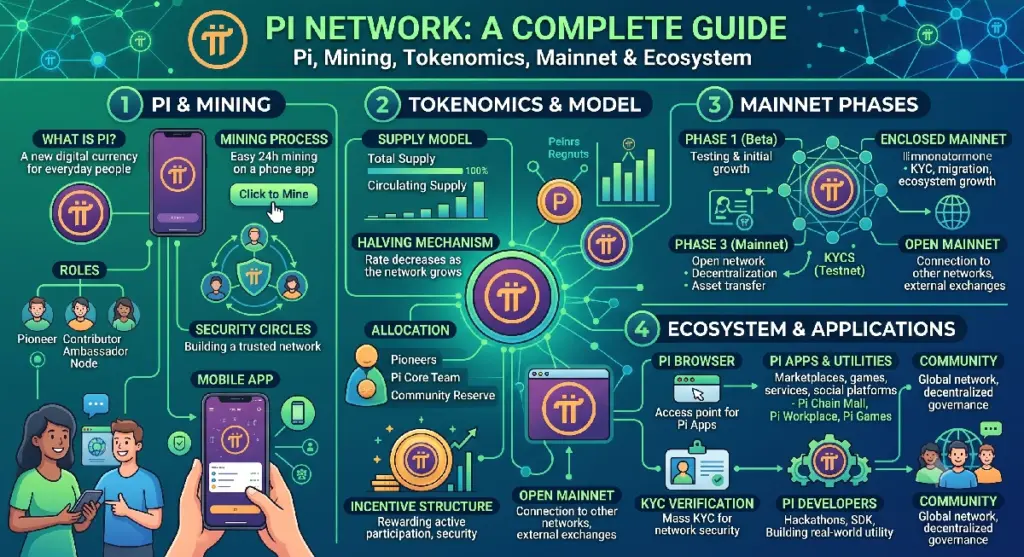
Key Takeaways
- Mobile Participation Model: Pi Network replaces energy-heavy Proof of Work (PoW) hardware with mobile app engagement based on trust relationships.
- Consensus Mechanism: Security operates through the Stellar Consensus Protocol (SCP) and Federated Byzantine Agreement (FBA) via desktop Pi Nodes, not mobile computing calculations.
- Tokenomics Cap: The network sets a hard maximum supply of 100 billion Pi, split 80% to the community and 20% to the Pi Core Team.
- Mainnet Migration Rules: You must complete identity verification (KYC) to transition your mobile balance into a transferable on-chain balance.
- Utility-Driven Ecosystem: Long-term sustainability relies on decentralized applications (Pi Apps), peer-to-peer commerce, and developer participation rather than passive holding.
What the Post Covers
- At a Glance: Core Summary of Pi Network
- Introduction: Making Cryptocurrency Accessible to Everyday People
- The Core Problem: Why Traditional Mining Excluded Everyday Users
- The Solution: How Pi Network Reinvents Blockchain Access
- How Pi Network Works: The 4 Key Participant Roles
- Pi’s Consensus Model: Stellar Consensus Protocol & The Trust Graph
- Pi Mining Explained: Pre-Mainnet vs. Mainnet Reward Formulas
- Pi Tokenomics Breakdown: The 100 Billion Supply Distribution
- Identity & Security: Why KYC Governs Balance Migration
- The Road to Decentralization: Beta, Testnet, and Mainnet Phases
- Ecosystem & Utility: Real-World Goods, Services, and Apps
- Safety & Asset Protection: How to Guard Your Pi Wallet
- Glossary: Essential Pi Network Terms Explained
- The Bottom Line: A Grounded Look at Pi’s Long-Term Value
At a Glance: Key Network Facts
| Feature / Metric | Pi Network Specification |
| Native Cryptocurrency | Pi (PI) |
| Consensus Protocol | Stellar Consensus Protocol (SCP) / FBA |
| Hardware Required | Mobile phone (daily check-in) / Desktop PC (Nodes) |
| Maximum Total Supply | 100 Billion PI |
| Community Allocation | 80% (65B Mining, 10B Ecosystem, 5B Liquidity) |
| Core Team Allocation | 20% (20 Billion PI) |
| Identity Standard | Mandatory KYC verification per individual |
| Roadmap Stages | Phase 1 (Beta) → Phase 2 (Testnet) → Phase 3 (Enclosed/Open Mainnet) |
Can Everyday Users Truly Power a Global Blockchain?
Pi Network stands out as one of the most widely discussed and unconventional projects in the cryptocurrency industry. If you have ever felt locked out of digital assets because Bitcoin mining requires thousands of dollars in noisy, power-hungry ASIC rigs, you are not alone. Pi was designed specifically around the idea of breaking down those high financial barriers and making cryptocurrency participation accessible to ordinary people using everyday mobile devices.
The project began with a fundamental question: Can a cryptocurrency network grow by allowing everyday users to participate without specialized mining hardware or massive upfront capital? That single concept shaped Pi Network’s entire approach to community growth, security architecture, token distribution, and decentralized ecosystem development.
ZenvestAi Explains
Pi Network is a social cryptocurrency and smart-contract platform built on the Stellar Consensus Protocol (SCP). Unlike Bitcoin’s computational Proof of Work, Pi uses mobile check-ins to allocate tokens and desktop nodes to validate transactions, capping total supply at 100 billion Pi. Its core objective is building an inclusive, peer-to-peer digital economy powered by verified everyday users.
Understanding Pi properly requires looking past the casual phrase that users can simply “mine Pi on a phone.” The overall project combines a lightweight mobile interface, a trust-based security model, a custom consensus layer, a native utility token called Pi, a global node infrastructure, and an expanding suite of decentralized applications (dApps) powered by programmable smart contracts.
The Core Problem: Why Traditional Proof-of-Work Mining Excluded the Public
Traditional financial systems have long required centralized intermediaries—such as commercial banks, clearing houses, and payment gateways—to process transactions and maintain ledgers. While how blockchain works introduced a revolutionary alternative through decentralized ledgers, early implementations created unforeseen barriers for regular individuals.
- Heavy Capital Requirements: Bitcoin proved that decentralized trust works at a global scale, but its underlying Proof of Work (PoW) model rapidly industrialized.
- Specialized ASIC Dominance: Mining shifted from standard personal computers to high-end hardware rigs (ASICs) housed in massive data centers.
- Energy Consumption: High electricity demands concentrated block rewards into the hands of institutional mining pools with cheap power access.
- Diminishing Accessibility: Everyday individuals without technical setups or large investment budgets were effectively priced out of network participation.
Because of this industrial centralization, the original vision of broad, democratic cryptocurrency ownership outlined in standard blockchain basics became harder for the average person to reach.
The Solution: How Pi Network Reinvents Blockchain Access
Pi Network addresses this accessibility problem by replacing computational hardware competition with human-centric participation. Instead of burning electricity to solve cryptographic puzzles, the network establishes security through verified human networks and distributed trust circles, demonstrating how distributed ledgers modernize finance without heavy infrastructure overhead.
[ Traditional PoW Mining ]  --> Requires ASICs + Heavy Electricity + High Capital
[ Pi Network Model       ]  --> Requires Mobile Check-in + Security Circles + Desktop SCP Nodes
By leveraging the Stellar Consensus Protocol (SCP) and Federated Byzantine Agreement (FBA) principles, Pi separates user onboarding from transaction validation. Smartphone users tap a button once every 24 hours to prove active participation and verify human presence (proof of personhood), while lightweight desktop computers run the consensus software that seals transaction ledgers.
How Pi Network Works: The 4 Core Participant Roles
Pi combines several distinct structural layers to maintain its network: mobile participation, Security Circles, an interconnected trust graph, Pi Nodes, consensus algorithms, KYC verification, non-custodial wallets, mining reward allocations, and practical web utilities. These components work synchronously across four foundational participant roles:
                  +--------------------------+
                  |       Pi Pioneer         |
                  |  (Daily Mobile Check-in) |
                  +------------+-------------+
                               |
        +----------------------+----------------------+
        |                      |                      |
        v                      v                      v
+---------------+      +---------------+      +---------------+
|  Contributor  |      |  Ambassador   |      |    Pi Node    |
| (Trust Circles|      | (Invites New  |      | (Consensus &  |
|   & Graph)    |      |  Active Users)|      |  Validation)  |
+---------------+      +---------------+      +---------------+
1. Pioneer 📱
A Pioneer represents the entry-level participant in the Pi ecosystem.
- As a Pioneer, you open the mobile application daily to confirm active presence and prove you are a living individual rather than an automated script.
- The application interface remains lightweight, consuming virtually zero battery life or mobile cellular data.
- Pioneers can hold Pi balances, initiate peer-to-peer transactions, and interact directly with utilities within the native Pi Browser.
2. Contributor 🛡️
A Contributor helps strengthen the network’s decentralized trust architecture.
- Contributors build a personal Security Circle by selecting 3 to 5 fellow Pioneers whom they personally know and trust.
- These individual trust lists are aggregated across millions of users to form an overarching global trust graph.
- Instead of relying on a centralized authority to whitelist trustworthy actors, the network derives its security foundation directly from grassroots social connections.
3. Ambassador 🌐
An Ambassador accelerates community expansion by introducing new members to the network.
- Ambassadors establish a Referral Team using an individual invitation code.
- The protocol distributes bonus mining rewards when members of your Referral Team run active mining sessions simultaneously.
- This direct incentive mechanism aligns organic word-of-mouth marketing with the project’s base economic expansion.
4. Pi Node 🖥️
A Node participant operates the dedicated Pi Node software on a personal desktop or laptop computer.
- Nodes carry out the primary technical operations of the underlying blockchain by validating transactions and writing blocks to the distributed ledger.
- Running a Node combines Pioneer and Contributor roles with decentralized consensus participation based on SCP rules.
- This role is designed for users who want to make a direct technical and infrastructural contribution to the blockchain’s stability.
Zenvestai Quick Insight
Pi participants can fulfill multiple roles at the same time. You begin as a Pioneer on your phone, build a Security Circle as a Contributor, invite friends as an Ambassador, and install the desktop node client to validate network transactions simultaneously.
Pi’s Consensus Model: Stellar Consensus Protocol & The Trust Graph
A secure distributed ledger requires consensus—a formal mechanism allowing independent computers to agree on transaction validity and historical block ordering without a central arbiter.
Individual Security Circles
  (Pioneer A trusts B, C, D)
            │
            ▼
Aggregated Trust Graph
  (Overlapping social trust paths across millions of users)
            │
            ▼
Quorum Slices in SCP
  (Nodes configure validator lists based on the Trust Graph)
            │
            ▼
Fault-Tolerant Consensus
  (Pi Blockchain achieves finality without computational Proof of Work)
Bitcoin accomplishes this through computational Proof of Work. In contrast, Pi’s consensus framework utilizes the Stellar Consensus Protocol (SCP) and Federated Byzantine Agreement (FBA).
Under an FBA model, participating nodes do not compete using computing power. Instead, each node independently selects subsets of other nodes—known as quorum slices—to form broader quorums that reach consensus, contrasting with traditional staking architectures detailed in cryptoeconomic security guides.
What Is a Trust Graph?
The Trust Graph serves as the empirical bridge connecting mobile user connections to technical consensus:
- Every Pioneer assembles a private Security Circle of trusted connections.
- The network compiles millions of these discrete circles into a massive web of verified relationships.
- Node operators consult this emergent global trust graph when choosing dependable quorum slices to validate transactions.
- This allows the blockchain to reach high-throughput, energy-efficient consensus anchored by human trust rather than capital-intensive machinery.
Pi Mining Explained: Pre-Mainnet vs. Mainnet Reward Formulas
The definition of “mining” in Pi Network differs fundamentally from traditional Bitcoin mining. It represents an algorithmic incentive distribution that rewards verifiable human participation, social trust building, infrastructure hosting, and ecosystem engagement.
The Original Pre-Mainnet Mining Formula
During the project’s early bootstrapping phase, user mining rates were calculated using a straightforward additive model:
M = I(B, S) + E(I)
Where:
- M: Total Pioneer mining rate per hour.
- I: Individual Pioneer base mining rate.
- B: Systemwide base rate, which began at 3.1415926 Pi/hr and was reduced as active-user milestones were reached.
- S: Security Circle reward boost, maximized with 5 verified connections.
- E: Referral Team bonus multiplier based on active invited members.
The Dynamic Mainnet Mining Formula
To prepare for a functional application economy, the protocol upgraded its reward mechanism on Mainnet. The updated framework rewards multi-dimensional ecosystem utility rather than mere account seniority:
M = I(B, L, S) + E(I) + N(I) + A(I) + X(B)
Where:
- L: Lockup Reward Multiplier, determined by the percentage and duration of Pi committed.
- N: Node Reward, calculated based on desktop node uptime, processing capability, and port stability.
- A: App Usage Reward, earned by engaging with decentralized utilities in the Pi Browser.
- X: Future Contribution Allocation, reserved for upcoming network support mechanisms.
Mainnet Mining Rate (M) Breakdown:
┌──────────────────────────────────────────────────────────┐
│ Base Rate & Multipliers: I(B, L, S)                      │
│   ├── Systemwide Base Rate (B)                           │
│   ├── Lockup Commitment (L)                              │
│   └── Security Circle Connections (S)                    │
├──────────────────────────────────────────────────────────┤
│ Network Bonuses:                                         │
│   ├── Referral Team Active Boost: E(I)                   │
│   ├── Node Uptime & Performance: N(I)                    │
│   ├── Native Pi App Engagement: A(I)                     │
│   └── Future Protocol Contributions: X(B)                │
└──────────────────────────────────────────────────────────┘
Understanding the Lockup Mechanism
The Lockup feature allows you to voluntarily lock a percentage of your transferable Pi for a defined time horizon (such as 2 weeks, 6 months, 1 year, or 3 years) in exchange for a higher mining rate multiplier.
- Supply Moderation: Lockups help prevent immediate market oversupply by dampening sudden sell pressure when balances migrate on-chain.
- Long-Term Alignment: The mechanism incentivizes participants to support the network as applications mature.
- Important Note: Locking up tokens increases your internal mining rate, but it does not guarantee future market value or financial returns.
Pi Tokenomics Breakdown: How the 100 Billion Supply Is Distributed
Clear tokenomics is critical for assessing the long-term design of any digital currency. Just as understanding tokenization models defines institutional asset issuance, Pi Network transitioned from an uncapped pre-Mainnet supply model to a fixed hard cap of 100 billion Pi.
                   100 Billion Total Pi Supply
                   ┌─────────────────────────┐
                   │                         │
            80% Community              20% Core Team
           (80 Billion PI)            (20 Billion PI)
         ┌─────────┴─────────┐
         │         │         │
        65%       10%        5%
       Mining  Ecosystem  Liquidity
      Rewards  & Grants     Pool
       (65B)     (10B)      (5B)
The 80/20 Distribution Model
| Allocation Category | Percentage | Total Tokens (PI) | Strategic Purpose |
| Pioneer Mining Rewards | 65% | 65,000,000,000 | Distributed for past and future mobile/node mining rewards |
| Ecosystem & Community | 10% | 10,000,000,000 | Developer grants, community events, and foundation governance |
| Liquidity Reserve | 5% | 5,000,000,000 | Supporting decentralized liquidity for apps and ecosystem trading |
| Pi Core Team Allocation | 20% | 20,000,000,000 | Protocol engineering, ongoing development, and core operations |
| Total Hard Cap | 100% | 100,000,000,000 | Maximum supply permanently recorded on the blockchain |
1. 65 Billion Pi: Pioneer Mining Pool
This allocation covers all historical pre-Mainnet mining rewards as well as future Mainnet mining distributions. Mainnet mining relies on dynamic halving and logarithmic decay formulas to ensure rewards distribute steadily over decades rather than exhausting quickly.
2. 10 Billion Pi: Ecosystem Development & Grants
Reserved for developer bounties, infrastructure hackathons, ecosystem partnerships, and community-led governance. This pool is structured to be overseen by an independent non-profit foundation to support decentralized growth.
3. 5 Billion Pi: Network Liquidity Pool
A dedicated allocation designed to seed liquidity pools and facilitate seamless asset swaps across decentralized marketplaces, ensuring users and developers experience minimal slippage.
Identity & Security: Why KYC Governs Balance Migration
Pi Network operates on an explicit one-person, one-account philosophy. Navigating emerging crypto regulations and combating malicious bot farms requires strict identity controls to prevent automated scripts from destabilizing the distribution model.
[ Mobile Balance ]
  (Total estimated tokens recorded inside your smartphone app)
       │
       ▼  Pass Native KYC Verification
[ Transferable Balance ]
  (Portion cleared of unverified referral/security dependencies)
       │
       ▼  Execute Mainnet Migration Checklist
[ Mainnet Balance ]
  (On-chain tokens deposited into your non-custodial Pi Wallet)
Understanding Your 3 Wallet Balances
- Mobile Balance: The total estimated figure displayed on your smartphone dashboard. It includes tentative bonuses from unverified referral members.
- Transferable Balance: The verified portion of your balance eligible for on-chain migration once you and your security connections complete identity checks.
- Mainnet Balance: Tokens that have officially migrated to the live blockchain ledger and reside in your non-custodial wallet address.
Zenvestai Quick Insight
Completing KYC (Know Your Customer) is mandatory to migrate your tokens to the live blockchain. If your referral team members fail their identity checks, the corresponding referral bonuses accrued in your mobile balance will not become transferable.
The Road to Decentralization: Beta, Testnet, and Mainnet Phases
Pi’s technical and community evolution is mapped across three distinct development phases:
  Phase 1: Beta               Phase 2: Testnet              Phase 3: Mainnet
 (Dec 2018 - Mar 2020)       (Mar 2020 - Dec 2021)         (Dec 2021 - Present)
 ┌─────────────────────┐     ┌─────────────────────┐     ┌─────────────────────┐
 │ • Alpha App Launch  │ ──> │ • SCP Testnet Nodes │ ──> │ • Enclosed Firewall │
 │ • Initial Whitepaper│     │ • Pi Browser & SDK  │     │ • Mass KYC Migration│
 │ • Bootstrap Audience│     │ • Hackathons/dApps  │     │ • Open Network Gate │
 └─────────────────────┘     └─────────────────────┘     └─────────────────────┘
Phase 1: Beta (2018–2020)
Launched on iOS and Android in late 2018, the Beta phase focused on testing mobile distribution models, gathering user feedback, and bootstrapping an initial global user base. The original project whitepaper was formally published on Pi Day, March 14, 2019.
Phase 2: Testnet (2020–2021)
The Testnet deployed the underlying consensus software. It allowed thousands of community members to install desktop node software, test SCP consensus communication, test blockchain explorers, and build early decentralized applications through the developer SDK.
Phase 3: Mainnet (2021–Present)
Mainnet represents the live, production-grade blockchain environment. To maintain network safety and allow adequate time for mass ecosystem onboarding, the Core Team divided Phase 3 into two distinct operational periods:
- Enclosed Network: The live blockchain operates behind a strict firewall preventing external API connections, third-party wallet access, and centralized exchange listings. During this window, Pioneers pass KYC, migrate balances, and use their tokens strictly within native ecosystem apps.
- Open Network: The firewall is removed, enabling external blockchain bridges, third-party wallets, decentralized liquidity pools, and broader Web3 connectivity across the wider crypto market.
Ecosystem & Utility: Real-World Goods, Services, and Applications
The long-term value of any payment network depends on real utility—what people can buy, build, and exchange using the underlying currency. Speculative trading without functional demand rarely sustains a digital asset over time, as highlighted in current crypto trends.
                         Pi Network Utility Engine
    ┌────────────────────────────────┬────────────────────────────────┐
    │                                │                                │
    ▼                                ▼                                ▼
Peer-to-Peer Commerce         Decentralized Apps               Trust-Based Data
(Exchanging goods, skills,   (Pi Browser dApps, social,       (Decentralized identity,
 and services for PI)         gaming, and utility tools)       microservices, and APIs)
The Pi ecosystem is designed to support several core utility verticals:
- Peer-to-Peer Commerce: Pioneers exchange local goods, freelance services, and physical items directly using Pi as a digital medium of exchange.
- Decentralized App Platform: Independent developers deploy web applications (dApps) inside the native Pi Browser, gaining immediate access to a pre-onboarded, identity-verified community.
- Micro-Transactions & Social Utilities: Small-scale micropayments facilitate community tipping, creator monetization, and social interaction without traditional credit card processing fees.
Comparison: Pi Network vs. Bitcoin
| Parameter | Bitcoin (BTC) | Pi Network (PI) |
| Primary Consensus | Proof of Work (PoW) | Stellar Consensus Protocol (SCP) / FBA |
| Mining Equipment | High-end ASICs & GPUs | Mobile App Check-in & Lightweight Desktop Nodes |
| Energy Consumption | High (Global power grid usage) | Negligible (Eco-friendly cryptographic signaling) |
| Total Max Supply | 21,000,000 BTC | 100,000,000,000 PI |
| Identity Standard | Pseudonymous (No native KYC) | Proof of Personhood (Mandatory native KYC) |
| Primary Value Thesis | Digital Gold / Store of Value | Accessible Medium of Exchange & Social Ecosystem |
Safety & Asset Protection: How to Guard Your Pi Wallet
Because blockchain transactions are permanent and irreversible, maintaining personal wallet hygiene is critical. Following foundational rules from crypto wallet security guides ensures your private keys remain protected at all times.
       ┌────────────────────────────────────────────────────────┐
       │             CRITICAL WALLET SECURITY RULES             │
       ├────────────────────────────────────────────────────────┤
       │ 1. Never share your 24-word passphrase with anyone.   │
       │ 2. Avoid entering passphrases on unverified websites. │
       │ 3. Pi Core Team will NEVER ask for your private key.   │
       │ 4. Beware of fraudulent "pre-sale" or ICO schemes.     │
       └────────────────────────────────────────────────────────┘
- Guard Your 24-Word Passphrase: Your passphrase is the sole master key to your on-chain assets. Store it physically on paper in a secure location; never save it in unencrypted plain text or email drafts.
- Watch for Impersonation Scams: Fraudulent social media profiles and phishing pages actively target users. Staying alert against known crypto scams helps prevent identity theft and drained balances.
- No Unofficial Token Sales: The Pi Core Team has never held an Initial Coin Offering (ICO) or direct crowdfunding presale. Anyone asking you to send funds for “unlocked Mainnet Pi” is operating a scam.
Glossary of Essential Pi Network Terms
- Pioneer: An active user who confirms human presence daily via the official Pi mobile application.
- Security Circle: A curated group of 3 to 5 trusted connections built by a Pioneer to secure the network trust graph.
- Stellar Consensus Protocol (SCP): The underlying mathematical consensus algorithm used by Pi Nodes to validate transactions without computational Proof of Work.
- Federated Byzantine Agreement (FBA): A distributed consensus structure where individual nodes choose their own trusted validator subsets (quorum slices).
- Enclosed Mainnet: The transitional phase of Pi Mainnet where the network is secured by a firewall, allowing internal KYC and ecosystem utility while restricting external connections.
- Open Mainnet: The final roadmap phase where the network firewall is lowered, enabling external wallet integrations, exchange interactions, and open blockchain interoperability.
- Passphrase: A private 24-word cryptographic seed phrase that grants full, exclusive ownership of your on-chain Pi wallet.
The Bottom Line
Pi Network was designed around an ambitious goal: to remove the technical and financial hurdles of early cryptocurrency networks and build an accessible, community-driven digital economy. By replacing energy-heavy Proof of Work with the Stellar Consensus Protocol and mobile trust verification, the project has assembled one of the largest active user bases in the Web3 space.
Ultimately, evaluating Pi requires looking beyond simple token balances. The network’s long-term success will not be measured merely by how many tokens are mined on phones, but by how much real-world utility, developer adoption, decentralized liquidity, and genuine economic commerce take place across its ecosystem over the coming years.
Related Hubs & Topic Pillars
- Explore Core Ecosystem: Pi Network Hub | Layer 1 Blockchains | Layer 2 Scaling Solutions
- Security & Storage: Crypto Security Essentials | Wallet Protection Guide | Crypto Wallets Portal
- Ecosystem Foundations: Blockchain Basics | DeFi Overview | Crypto Regulations
Tags: #PiNetwork #BlockchainBasics #CryptoMining #Tokenomics #Web3 #CryptoSecurity #Layer1 #StellarConsensusProtocol #CryptoEducation