Opinion by ZenvestAI
The latest expansion of SoloHost on Pi Desktop points to an interesting shift in how the Pi ecosystem could use its existing computing infrastructure.
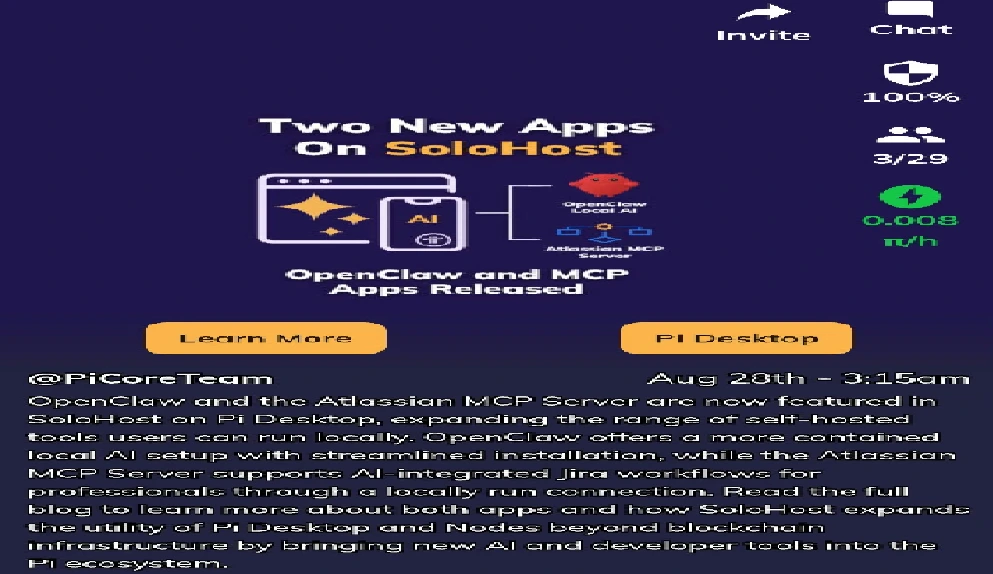
With OpenClaw and the Atlassian MCP Server now featured as SoloHost apps alongside the release of Node 0.6.2, Pi Desktop is moving toward a broader role: not only supporting blockchain infrastructure, but also making self-hosted AI and developer tools easier to deploy.
From ZenvestAI’s perspective, the significance of these additions is less about the individual applications and more about the direction they represent.
If SoloHost can make self-hosted applications easier for ordinary users to discover, install and operate, Pi Desktop could gradually become a practical gateway to locally controlled AI and other computing services.
ZenvestAI Opinion: SoloHost Could Become More Than a Node Utility
Pi has historically positioned its Node and Desktop software around participation in the Pi ecosystem.
SoloHost introduces another layer.
Instead of requiring users to manually configure Docker containers, servers and application environments, SoloHost aims to simplify the process of running self-hosted applications through Pi Desktop.
That matters because self-hosting has traditionally involved a technical barrier.
Users often need to understand:
- Docker and containers
- Port configuration
- Local networking
- Server environments
- Application dependencies
- Security permissions
- Storage requirements
- Updates and maintenance
Reducing some of this complexity could make self-hosted software accessible to a much wider audience.
Our view: the more important development is therefore not simply that two new applications have been added. It is that Pi is experimenting with turning existing computing resources into a broader application platform, much like how distributed ledgers are rewriting modern finance infrastructure.
OpenClaw: Bringing Local AI Agents Closer to the Desktop
OpenClaw is one of the more interesting additions because it represents the rapidly developing category of AI agents.
Unlike a conventional chatbot that primarily responds to individual prompts, an AI agent can be designed to interact with tools and perform tasks within an authorized environment, similar to advancements in AI-driven automation across web3.
OpenClaw can operate using a local AI model when the user’s computer has sufficient hardware, or it can use external models such as ChatGPT or Claude.
That distinction is important.
Local model vs. cloud model
When OpenClaw uses a local model, computation can remain on the user’s computer for supported tasks.
This can provide greater local control over data and computing resources.
However, when OpenClaw is configured to use a cloud-based model, the relevant requests still travel to the infrastructure operated by that model provider.
Therefore, running OpenClaw locally does not automatically mean every piece of AI processing happens locally.
This is an important distinction that users should understand before assuming that a self-hosted AI application provides complete data sovereignty.
Why SoloHost’s Containerized Approach Is Interesting
One of the more practical aspects of running OpenClaw through SoloHost is containment.
The application operates inside a container intended to restrict its default access to the broader computer.
That can reduce unnecessary exposure to unrelated files and system resources compared with an installation that has wider machine-level access by default.
This is particularly relevant for AI agents.
An AI system capable of interacting with files, applications or external services can potentially become much more powerful than a conventional chatbot. But greater capability also means that permissions and isolation become increasingly important.
SoloHost’s approach does not eliminate security risks.
Users still need to understand what permissions they grant and what external services they connect.
The advantage is narrower but meaningful: the application’s default environment can be more contained instead of automatically giving it broad access to the host computer.
OpenClaw vs. Other Local AI Agents
The addition of OpenClaw also expands the choices available to Pi Desktop users.
Pi has already featured Hermes as a local AI agent.
The two projects approach the AI-agent concept differently.
OpenClaw places considerable emphasis on acting as a personal assistant that can connect across tools and messaging channels.
Hermes, meanwhile, places greater emphasis on persistent memory and learning skills through experience.
For users, having multiple options is potentially more valuable than having one officially preferred AI agent.
Different users may prioritize:
- Privacy
- Local model support
- Memory
- Tool integrations
- Messaging integrations
- Customization
- Hardware requirements
- Ease of installation
The growing number of self-hosted AI options could therefore make Pi Desktop more useful as a general-purpose computing environment.
Atlassian MCP Server: A Different Kind of Opportunity
The Atlassian MCP Server addresses a different problem.
Instead of being primarily an AI agent, it acts as a bridge between compatible AI tools and Jira workflows through the Model Context Protocol (MCP).
MCP has become an important concept in the AI ecosystem because it provides a standardized way for compatible AI applications to interact with external tools and data sources.
In the Jira context, this can allow compatible AI applications to work with project-management information through an MCP server.
That opens the door to workflows such as:
- Organizing Jira tasks
- Retrieving project information
- Working with issues
- Automating parts of project workflows
- Connecting AI coding tools with development workflows
The exact capabilities depend on the MCP implementation, permissions and AI client being used.
Why a Self-Hosted MCP Server Could Matter
Atlassian already provides hosted MCP functionality.
However, some organizations may have reasons to consider running their own MCP infrastructure, including greater control over the environment and avoiding certain limitations associated with hosted services.
The SoloHost version allows users to run the MCP server on their own computer or another machine they control.
Compatible AI applications can then communicate with Jira through that local server.
Potentially supported AI clients include tools such as:
- Cursor
- Claude Desktop
- Claude Code
- Codex
This is where the broader significance becomes visible.
The value of MCP isn’t necessarily tied to one AI company.
Instead, it can act as an interoperability layer between AI applications and external services.
That makes MCP particularly relevant as AI moves from simple question-and-answer interfaces toward tool-using workflows.
From AI Chatbots to AI-Connected Workflows
This may be the bigger story behind the Atlassian MCP Server.
The AI market is gradually moving from:
Ask AI → Receive Answer
toward:
Ask AI → Access Context → Use Tools → Perform Task → Return Result
A Jira-connected AI workflow is a good example.
Instead of asking an AI assistant to explain how a project-management task should be handled, an authorized AI tool could potentially interact with the relevant project-management environment.
That is a significant conceptual change.
The AI becomes less of a standalone conversational interface and more of a workflow interface.
For developers and product teams, that could eventually become much more important than the chatbot experience itself.
SoloHost Could Give Pi Desktop a New Role
The most interesting question is what happens if SoloHost continues expanding.
Today, these applications represent different categories:
OpenClaw → AI agent
Hermes → Local AI agent
Atlassian MCP Server → AI/developer infrastructure
Tomorrow, the ecosystem could potentially include a much wider range of self-hosted applications.
For example:
- AI assistants
- Developer tools
- Databases
- Personal cloud applications
- Automation platforms
- Analytics tools
- Web applications
- Local knowledge bases
- AI model servers
- Business utilities
If that happens, Pi Desktop could gradually evolve from being primarily a gateway to Pi-related infrastructure into a self-hosted application platform.
That would be a considerably broader proposition, echoing broader shifts in 2026 AI and blockchain convergence trends.
What This Could Mean for Pi Node Operators
Pi’s large Node community provides an interesting foundation for this experiment.
The basic idea is straightforward:
Existing computer resources → Pi Desktop → SoloHost → Self-hosted applications
Instead of using a computer exclusively for one ecosystem-related function, users could potentially make that hardware useful for additional applications.
This could increase the practical utility of running Pi-related desktop infrastructure. For a technical breakdown of how Pi’s network models stack up against foundational decentralized systems, read our Pi vs Bitcoin architectural case study.
However, it is important not to overstate the current situation.
SoloHost is still in beta, and the availability of applications does not automatically mean that every computer is suitable for running them.
Hardware, storage, bandwidth, security configuration and application requirements will still matter.
The Security Question Should Not Be Ignored
There is also an important trade-off.
Self-hosting gives users greater control, but it also transfers responsibility to the user.
Installing an application on your own computer means you need to think about:
- What the application can access
- What permissions it receives
- Which ports are exposed
- Which external services are connected
- Where credentials are stored
- Whether the application is regularly updated
- Whether the publisher is trustworthy
- What happens if the application is compromised
This becomes particularly important when AI agents are involved.
An AI agent with access to files, APIs, messaging platforms or project-management systems can be considerably more powerful than an isolated chatbot. Applying proper crypto and system security practices is just as critical here as it is when securing decentralized wallets and keys.
More control does not mean zero risk.
It means the user has more responsibility for controlling the environment.
ZenvestAI’s Take: The App Ecosystem Matters More Than Any Single App
From our perspective, the OpenClaw and Atlassian MCP Server additions should be viewed as pieces of a larger experiment.
The real question isn’t:
“Is OpenClaw useful?”
or:
“Is an Atlassian MCP Server useful?”
The more important question is:
Can SoloHost turn Pi Desktop into a simple gateway for self-hosted applications?
If the answer eventually becomes yes, the implications could be much broader.
Pi would then have an ecosystem where users aren’t simply running infrastructure for a blockchain network. They could also use their computing resources for AI, automation, development and other applications.
That could give Pi Desktop a more practical role in everyday computing.
What Could Come Next?
The long-term potential will depend heavily on execution.
Several factors will determine whether SoloHost becomes genuinely useful:
1. More quality applications
Quantity alone won’t be enough.
The ecosystem needs reliable, useful and well-maintained applications.
2. Better security
Self-hosted applications need clear permission boundaries and sensible defaults.
3. Simple installation
The biggest advantage of SoloHost should be reducing technical complexity without hiding important security decisions.
4. Strong documentation
Users need to understand what an application does, what data it accesses and what hardware it requires.
5. Developer participation
An open publisher flow could make it easier for developers to bring new applications into the ecosystem.
6. Real-world utility
Ultimately, users will decide whether SoloHost succeeds by actually using these applications.
Final Verdict: A Small Update With a Potentially Bigger Meaning
The addition of OpenClaw and Atlassian MCP Server may initially look like a relatively small SoloHost update.
ZenvestAI sees something more interesting.
These applications demonstrate two very different directions for self-hosted computing: AI agents that operate closer to the user and infrastructure that connects AI with professional workflows.
Together, they suggest that SoloHost could become more than a convenient application installer.
If Pi continues expanding the platform with useful, secure and well-maintained self-hosted applications, Pi Desktop could gradually develop into a broader computing environment where users can put their existing hardware to work beyond blockchain-related infrastructure.
But the opportunity should be viewed realistically.
SoloHost is still in beta. The applications are not automatically risk-free simply because they are distributed through Pi Desktop, and users should evaluate each package, its permissions and its publisher before installation.
For now, the most important takeaway is not that Pi has added two more apps.
It is that Pi is experimenting with what its desktop and Node ecosystem could become when blockchain infrastructure, AI and self-hosted computing begin to converge.
— ZenvestAI Opinion
📚 Pillar Guides & Foundational Reading
Pi Network & Architecture
Blockchain & AI Infrastructure
🏷️ Related Topics & Clusters
#PiNetwork | #BlockchainBasics | #Layer1 | #Layer2Scaling | #Security | #CryptoResearch | #CryptoNews | #DeFi | #Wallets
