Have you ever lost sleep wondering if the party on the other side of an agreement will actually keep their word? Whether you are buying an asset, signing a partnership, or transferring funds, relying on banks, brokers, or courts can feel slow, expensive, and stressful. But what if you could lock an agreement into digital code that guarantees execution without human delay or manipulation? This guide to Smart Contracts: How Blockchain Programs Work breaks down everything you need to know about programmable, trustless agreements in Web3.
ZenvestAi Explains
A smart contract is a self-executing software program deployed on a decentralized blockchain network like Ethereum. It contains conditional logic (written as “if/then” statements) that automatically triggers verifiable actions—such as moving funds or issuing tokens—the moment verified rules are met. This removes traditional middlemen, reduces counterparty risk, guarantees automated enforcement, and records every state change securely across a shared distributed public ledger.
Key Takeaways:-
- Core Definition: Smart contracts are automated computer programs living at specific blockchain addresses—not legal paper agreements.
- Working Mechanism: They run strictly on conditional rules (Input → Rules Verified → Execution → Final Settlement)
- Execution Engine: Programs compile into EVM bytecode and require gas fees as computational fuel.
- Composability: Known as money Legos, different smart contracts can plug into one another seamlessly.
- Primary Risks: Code bugs, reentrancy attacks, and oracle exploits mean software verification and security audits are critical.
At a Glance: Smart Contracts vs Traditional Agreements
| Feature | Traditional Legal Contracts | Blockchain Smart Contracts |
|---|---|---|
| Execution Medium | Paper, PDF, legal documents | Software code deployed on-chain |
| Enforcement | Courts, attorneys, banks, government bodies | Cryptographic network consensus (Automatic) |
| Middleman Reliance | High (Escrow agents, brokers, notaries) | Low / Zero (Direct peer-to-to-contract) |
| Speed & Availability | Days, weeks, or business hours | Seconds to minutes (24/7/365 global uptime) |
| Alteration Risk | Relies on legal dispute resolution | Immutable by default (Upgradeable only via admin setup) |
| Cost Basis | Retainers, stamp duty, legal & bank fees | Computational Gas Fees per network operation |
Smart Contracts: How Blockchain Programs Work
Outline: What This Guide Covers
- What Is a Smart Contract? (The Vending Machine Model)
- How Do Smart Contracts Work? (Step-by-Step Architecture)
- What Is Gas and Why Is Computation Paid?
- How Blockchains and Smart Contracts Interact
- Real-World Applications: What Can Smart Contracts Do?
- Core Benefits: Why Global Systems Are Shifting to Code
- Critical Risks & Security Vulnerabilities
- Are Smart Contracts Truly Immutable?
- Why Oracles Matter for Real-World Data
- Step-by-Step Security Checklist Before Signing Transactions
- Essential Glossary of Terms
What Is a Smart Contract? 🤖
A smart contract is a computer program stored directly on a decentralized blockchain network that executes actions automatically when predefined conditions are met. If you are exploring a beginner’s guide to cryptocurrency and blockchain technology, you will find that unlike conventional legal agreements, smart contracts rely purely on mathematical verification, cryptoeconomic incentives, and deterministic code.
Imagine buying a snack from a classic vending machine. You insert money, select an item, and the internal logic verifies the balance. If the conditions are met, the machine drops the snack. If not, it rejects the attempt. Smart contracts follow the exact same logic:
Input → Rules Checked → Contract Executes → Blockchain Records the Result
Zenvestai Quick Insight
Smart contracts act as decentralized digital vending machines. Instead of relying on a human manager to approve every step, the blockchain code inspects incoming transaction data and independently executes the final output once criteria are met.
How Do Smart Contracts Work Step-by-Step? ⚙️
Developers write smart contract logic using high-level programming languages to create autonomous, self-executing decentralized applications (dApps).
[Developer Code: Solidity]
          │
          ▼
   (Compilation)
          │
          ▼
   [EVM Bytecode]
          │
          ▼
(Deploy via Gas Fee) ───► [Unique Contract Address on Blockchain]
                                       │
                                       ▼
                              [User Calls Function via Wallet]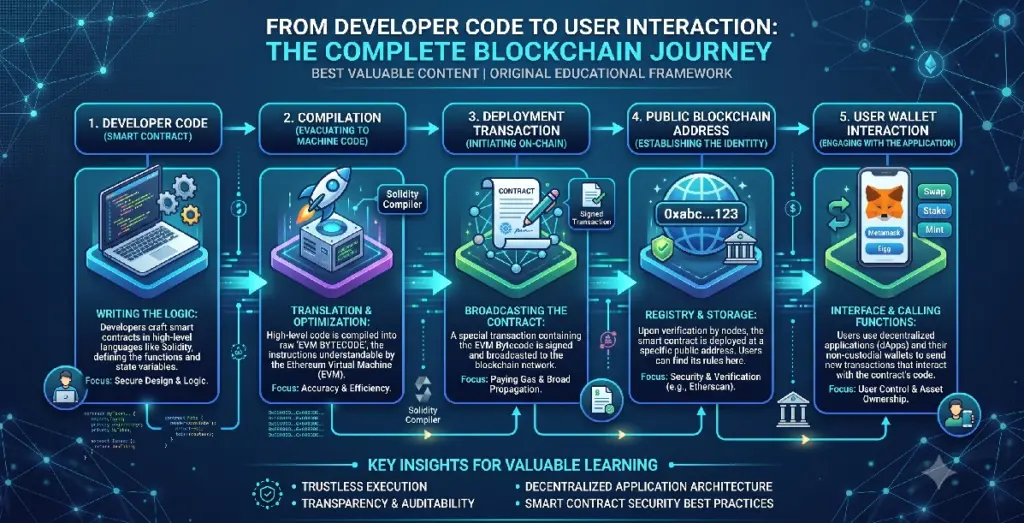
Step 1: Developers Write the Code
Developers write instructions that specify exact outcomes for designated inputs. On Ethereum, Solidity is the primary programming language, alongside alternatives like Vyper. Common rules written include:
- Minting and sending tokens
- Lending and borrowing crypto assets
- Generating unique NFTs
- Operating decentralized exchanges with automated DEX routing
- Managing decentralized autonomous organizations (DAOs)
- Distributing community rewards through crypto staking mechanisms
Step 2: The Code Is Compiled
The Ethereum Virtual Machine (EVM) cannot directly read high-level human-readable code. Therefore, compilers translate the code into machine-readable bytecode. The EVM serves as the shared runtime environment across thousands of global nodes in the network.
Step 3: The Contract Is Deployed
The compiled bytecode is packaged inside an on-chain deployment transaction. Once verified by network nodes according to how blockchain consensus works, the contract is assigned a unique, permanent blockchain address. This deployment consumes computational resources and requires a transaction fee known as gas.
Step 4: Users Interact With the Contract
Users connect via crypto wallets to call specific functions built into the contract. For example, in a decentralized finance (DeFi) portal:
- You connect your non-custodial wallet.
- You approve a deposit of tokens.
- The smart contract validates your balance and conditions.
- The blockchain network permanently logs your updated balance.
What Is Gas and Why Is Network Computation Paid? ⛽
Gas is the internal pricing unit used to measure the computational effort required to execute operations on a blockchain like Ethereum. More complex calculations—such as multi-hop token swaps—demand higher gas limits than simple peer-to-peer transfers.
Blockchain computation is never free. Gas fees enforce an economic barrier that stops bad actors from spamming infinite computational loops across the network. If your transaction runs out of gas mid-execution, the network cancels all state changes and reverts your funds, though the consumed gas fee remains spent. For everyday users, gas costs determine the ultimate operational expense of interacting with Web3 protocols.
Zenvestai Quick Insight
Think of gas as the fuel required to run software on a global, shared computer. It compensates validator nodes for processing your logic and keeps the network safe from spam attacks.
How Smart Contracts and Blockchains Fit Together
A blockchain provides the distributed settlement layer, while smart contracts provide programmable execution.
- Blockchain: The decentralized, shared infrastructure and immutable ledger (explore blockchain basics).
- Smart Contract: The programmable business logic and automated rule-set.
- Crypto Wallet: The identity and signature tool that lets you authorize transactions safely.
- dApp (Decentralized Application): The user-friendly web interface that lets you interact with underlying contracts.
What Can Smart Contracts Do? 🌐
Smart contracts are modular building blocks that combine into complex decentralized ecosystems.
- Decentralized Finance (DeFi): Enables permissionless lending, borrowing, algorithmic trading, yield farming, and automated market making without central banks.
- Non-Fungible Tokens (NFTs): Governs authentic ownership, provable scarcity, metadata references, and automated secondary-market royalty distributions.
- Decentralized Autonomous Organizations (DAOs): Automates on-chain governance votes, membership permissions, proposal execution, and community treasury spending.
- Token Creation & Real-World Assets: Deploys standard fungible tokens with transparent rules, driving institutional adoption through wholesale asset tokenization and empowering local ventures through small business tokenization.
- Web3 Gaming: Controls authentic ownership of in-game items, automated asset trades, and transparent reward drops.
- Trustless Crowdfunding: Holds deposited capital in programmatic escrow and releases capital only when milestones are hit.
This interoperability is known as composability—or “Money Legos”. Developers do not need to build backend banking rails from scratch; they simply combine existing, open-source smart contracts.
What Are the Core Benefits of Smart Contracts?
Smart contracts replace human bottlenecks with deterministic code:
- End-to-End Automation: Programmed actions execute immediately once prerequisite conditions validate.
- Public Transparency: Anyone can independently verify contract rules and historical state transitions on block explorers.
- Reduced Intermediaries: Peer-to-contract transactions remove costly middlemen, clearinghouses, and processing delays.
- Absolute Consistency: The identical code runs deterministically for every user across every global node.
- Composability: Developers can assemble new financial products on top of existing battle-tested smart contracts.
- Global Accessibility: Anyone with an internet connection and a non-custodial wallet can access public contracts without needing institutional permission (bina kisi approval ke).
What Are the Hidden Risks and Vulnerabilities? ⚠️
Software risk is the most significant hazard when dealing with smart contracts. If software logic contains an unpatched bug, malicious actors can drain locked assets irreversibly. Maintaining rigorous DeFi security protocols is essential for protecting capital.
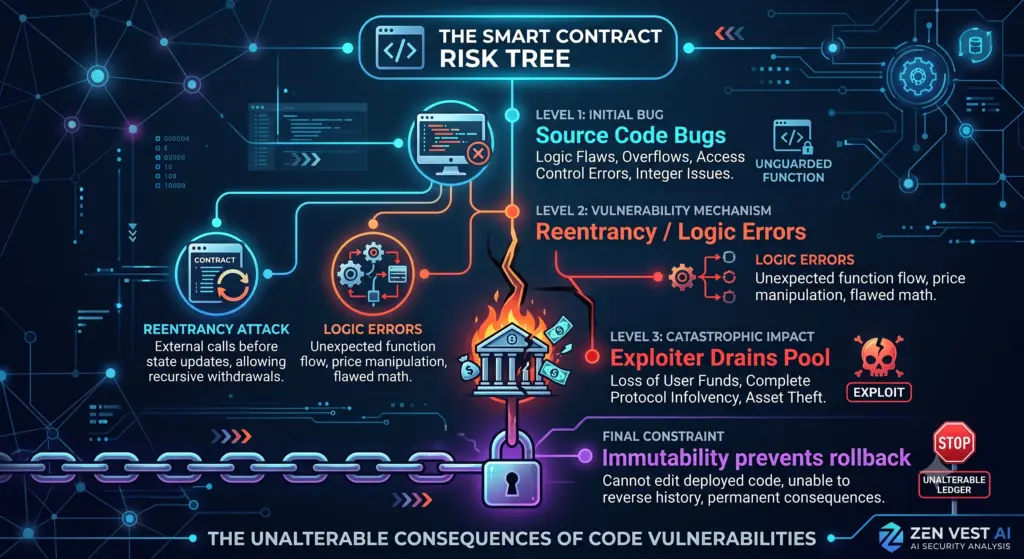
Common Smart Contract Exploits
- Reentrancy Attacks: A malicious contract repeatedly calls a withdrawal function before the original contract updates its internal balance.
- Broken Access Controls: Unprotected administrative functions allow unauthorized attackers to mint tokens or drain liquidity.
- Oracle Manipulation: Attackers manipulate low-liquidity price feeds to trigger false liquidations or cheap collateral purchases.
- Arithmetic & Logic Errors: Calculation flaws that produce unexpected overflow values or edge-case failures.
- Unchecked External Calls: Interacting with untrusted external contracts that hijack the flow of execution.
- Governance Exploits: Flash-loan attacks used to borrow voting power, pass malicious proposals, and drain DAO treasuries.
Because deployed contracts secure billions of dollars in digital assets, flaws are difficult to patch retroactively, and stolen funds cannot be recovered via customer support. Staying educated on known crypto scams and vulnerabilities is critical.
Are Smart Contracts Truly Immutable? 🔒
Smart contracts are immutable by default, meaning deployed bytecode cannot be modified after it is written to the ledger. This guarantees that no single entity can change the rules after you deposit funds.
However, immutability is a double-edged sword: if code contains a bug, developers cannot simply overwrite it with an update. To solve this, many protocols deploy upgradeable contract patterns (such as Proxy contracts). Furthermore, broader network enhancements often depend on protocol hard forks and roadmap upgrades to adapt.
Zenvestai Quick Insight
While classic contracts are permanent, modern protocols often use upgradeable proxy patterns. Always verify whether a protocol is truly immutable or controlled by admin keys before committing funds.
Why Do Smart Contracts Need Blockchain Oracles? 📡
Blockchains are isolated, self-contained networks that cannot directly fetch external data from the broader web. A smart contract cannot independently verify real-world weather data, stock prices, or sports outcomes.
[Real-World Data API] ───► [Decentralized Oracle: Chainlink] ───► [Blockchain Smart Contract]Oracles act as informational bridges, fetching real-world data and submitting it to the smart contract via verified transactions. However, this introduces external reliance: if an oracle feed fails or is manipulated, the dependent smart contract will execute incorrect transactions based on flawed inputs.
The Essential Pre-Transaction Security Checklist
Never interact with a protocol simply because of social media hype. Follow this checklist before signing any transaction:
- [ ] Verify the Contract Address: Ensure the address matches official project documentation, not a phishing link.
- [ ] Check Source-Code Verification: Confirm on block explorers (like Etherscan) that the source code is publicly verified.
- [ ] Review Third-Party Audits: Look for reputable auditing firm reports and verify whether reported vulnerabilities were resolved.
- [ ] Inspect Admin Key Permissions: Check if a single private key can pause the contract, upgrade logic, or withdraw reserves.
- [ ] Identify Oracle Architecture: Confirm whether the contract relies on decentralized data feeds or a fragile single-source oracle.
- [ ] Evaluate Total Value Locked (TVL): Review how much capital the contract actively secures and whether it has a clean operational history.
- [ ] Read Wallet Approval Prompts: Implement robust wallet security practices to ensure you are not granting unlimited token spending approvals to unverified addresses.
Essential Glossary of Smart Contract Terms
- Bytecode: Low-level, machine-readable code executed directly by the EVM.
- Composability: The ability of different smart contracts to interact and build upon each other like software building blocks.
- EVM (Ethereum Virtual Machine): The global, decentralized computation engine that executes smart contract instructions on Ethereum.
- Formal Verification: Mathematical techniques used to prove that a program’s code strictly adheres to its intended logic under all conditions.
- Gas Limit: The maximum amount of computational units you authorize a transaction to consume.
- Immutable: Incapable of being altered or deleted once written to the distributed ledger.
- Oracle: A third-party service that securely feeds off-chain data into on-chain smart contracts.
- Solidity: The most common high-level, object-oriented programming language used for writing Ethereum smart contracts.
The Bottom Line
Smart contracts convert the blockchain from a passive accounting ledger into a programmable global computer. They remove middlemen, automate complex workflows, and establish open-access financial tools. Yet, because code is law on-chain, software vulnerabilities can create permanent financial risks. Protect your digital assets by taking personal responsibility: inspect permissions, confirm verified source code, and never risk capital in contracts you have not thoroughly evaluated as evolving crypto regulations shape the on-chain landscape.
What has been your experience using smart contracts in Web3 or DeFi so far? Drop your questions or personal safety tips in the comments below!
Related Deep-Dives & Recommended Reading
- Learn Crypto Hub: Master foundational blockchain architectures, including Layer 1 Blockchains and foundational Cryptocurrency Fundamentals.
- Crypto Security & Risk Watch: Explore dedicated guides on Risk Watch, Risk-to-Reward Ratios, and Exchange Account Security.
- Market Structure & Trading: Discover Liquidity Pools, Crypto Arbitrage, and Futures Trading Strategies.
- Industry Trends & Ecosystem News: Read about AI & Crypto Trends and testnet upgrades on Ethereum Testnets.
Topic Tags & Exploration
#Blockchain #DeFi #CryptoSecurity #CryptoWallets #CryptoStaking #Ethereum #CryptoResearch #StartHereCrypto
