📌 Key Takeaways:-
- Ethereum is an evolving global network that updates continuously through decentralized Ethereum Improvement Proposals (EIPs) rather than centralized corporate patches.
- The Merge through Fusaka successfully shifted the network to Proof of Stake, lowered Layer 2 data fees via blobs, and expanded default gas capacity.
- Glamsterdam (Targeted Q4 2026) is the next landmark hard fork, introducing enshrined Proposer-Builder Separation (ePBS) and Block-Level Access Lists (BALs).
- Hegotá (Planned 2027) will prioritize censorship resistance through Fork-choice enforced Inclusion Lists (FOCIL) and native account abstraction.
- Everyday ETH holders do not need to take manual action during hard forks, while node operators and developers must update their client software.
⏱️ Ethereum Roadmap at a Glance
| Milestone / Upgrade | Timeline | Core Focus Area | Major Breakthrough Feature |
| The Merge | September 2022 | Consensus Shift | Transition from Proof of Work to Proof of Stake |
| Shapella | April 2023 | Staking Liquidity | Validator staking withdrawals enabled |
| Dencun | March 2024 | Layer 2 Scalability | Proto-Danksharding & Data Blobs (EIP-4844) |
| Pectra | Early 2025 | Staking & UX | Account abstraction stepping stone (EIP-7702) |
| Fusaka | Late 2025 | Data Availability | PeerDAS implementation & 60M gas limit |
| Glamsterdam | Q4 2026 (Targeted) | Execution & Throughput | Enshrined PBS (ePBS) & Block-Level Access Lists |
| Hegotá | 2027 (Planned) | Censorship Resistance | Fork-choice enforced Inclusion Lists (FOCIL) |
🧭 What This Guide Covers
- The real mechanics behind Protocol Hard Forks & Roadmap Upgrades for Ethereum
- Why hard forks are vital engineering solutions for Ethereum’s trilemma
- Step-by-step history: From The Merge to Fusaka
- Deep-dive into Glamsterdam: ePBS, BALs, and sustainable gas limits
- Looking ahead to Hegotá and Ethereum’s long-term settlement role
- Practical guide: What these upgrades mean for regular crypto users
⚡ ZenvestAi Explains
Protocol Hard Forks & Roadmap Upgrades for Ethereum represent coordinated, system-wide software updates designed to improve scalability, security, efficiency, and user experience. Unlike controversial chain splits, scheduled Ethereum hard forks implement consensus-driven Ethereum Improvement Proposals (EIPs) across all participating nodes. As of August 2026, Ethereum has advanced from Proof-of-Stake consensus to high-efficiency data layers like Dencun and Fusaka, setting up the upcoming Glamsterdam and Hegotá upgrades to dramatically expand execution throughput and censorship resistance.
🚀 Protocol Hard Forks & Roadmap Upgrades for Ethereum: Why Continuous Evolution Matters
Have you ever worried that high gas fees or network congestion might permanently slow down Ethereum’s potential? If you have ever felt hesitant about using decentralized applications because of transaction unpredictability, you are not alone.
Ethereum was never built to stay static. Instead, its protocol is engineered to continuously adapt, scale, and secure itself against global-scale demands. For long-term investors building a position, aligning with The Complete Ethereum Wealth Strategy requires understanding these structural transformations and public development milestones.
As of August 2026, Ethereum has completed milestones like The Merge, Shapella, Dencun, Pectra, and Fusaka. The ecosystem is actively focused on Glamsterdam, targeted for Q4 2026, followed by Hegotá in 2027.
🔍 What Are Protocol Hard Forks in Ethereum?
A protocol hard fork is a permanent, backward-incompatible upgrade to the rules governing the Ethereum network.
[ Traditional Blockchain Rules ] ---> [ Hard Fork Block Height ] ---> [ Upgraded Ethereum Protocol Rules ]
                                                                 └──> (Legacy client rules rejected)
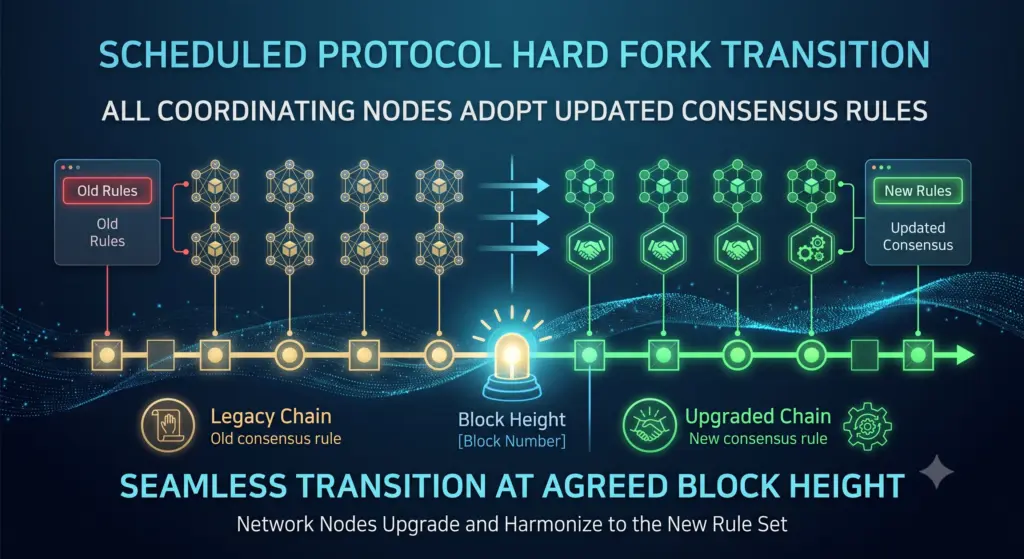
Think of Ethereum as a massive decentralized computer where thousands of independent nodes validate state changes simultaneously. When developers introduce a hard fork, every validator, node operator, exchange, and crypto wallet provider must update their client software to follow the new rules.
Furthermore, a scheduled hard fork does not mean the community splits into competing tokens (chain ka batwara). Because the core community coordinates around shared EIPs, the entire ecosystem transitions together onto the upgraded chain smoothly.
How do EIPs become live hard forks?
Ethereum Improvement Proposals (EIPs) go through extensive public review, algorithmic research, client integration, and public testnet verification before being grouped into a formal hard fork release.
Zenvestai Quick Insight: EIPs serve as open-source engineering drafts. Core developers and researchers test these proposals rigorously on dedicated devnets before validator client teams schedule them for a seamless mainnet activation.
⚖️ Why Does Ethereum Need Frequent Hard Forks?
Ethereum must balance high transaction capacity with decentralization and economic security.
- The Problem: Boosting throughput without optimization causes state bloat, driving up the cost of running a full node. Consequently, independent home validators could be priced out, risking centralization.
- The Solution: Carefully tested hard forks introduce structured data compression, optimized fee markets, and streamlined execution models without overloading node hardware.
Therefore, Ethereum’s modern roadmap focuses on four coordinated pillars:
- Scaling Layer 1 throughput safely
- Expanding blob capacity for Layer 2 rollups
- Enhancing wallet user experience (UX)
- Hardening base-layer security and censorship resistance
📜 From The Merge to Fusaka: Ethereum’s Evolution So Far
Ethereum’s recent upgrade track record shows how consistent open-source engineering solves foundational scaling hurdles.
1. The Merge (September 2022)
The Merge shifted Ethereum from Proof of Work to Proof of Stake. As a result, the network reduced its global energy footprint by over 99.9% and established the cryptographic base for all future scaling.
2. Shapella (April 2023)
Shapella completed the transition by enabling validator staking withdrawals. In addition, it gave institutional and retail stakers liquidity flexibility without compromising consensus stability—a foundational step covered in our guide on crypto staking safety and mechanics.
3. Dencun (March 2024)
Dencun marked Ethereum’s major pivot toward Layer 2 modular scaling. By introducing blobs (EIP-4844 Proto-Danksharding), rollups gained a dedicated, temporary data layer that reduced Layer 2 transaction costs by over 90%.
4. Pectra (Early 2025)
Pectra improved individual validator operations and account usability. Most notably, EIP-7702 introduced flexible smart contract capabilities to standard Externally Owned Accounts (EOAs), unlocking gas sponsorship and transaction batching.
5. Fusaka (Late 2025)
Fusaka expanded Layer 2 data availability through PeerDAS (Peer Data Availability Sampling). Crucially, it also adjusted execution parameters by raising the default gas limit to roughly 60 million, giving the base layer immediate breathing room.
⚙️ Glamsterdam: Ethereum’s Next High-Capacity Upgrade (Targeted Q4 2026)
Glamsterdam combines execution-layer upgrades from Amsterdam with consensus-layer developments from Gloas.
+-------------------------------------------------------------+
|                     GLAMSTERDAM UPGRADE                     |
+------------------------------+------------------------------+
|   Execution Layer (Amsterdam)|   Consensus Layer (Gloas)    |
|   • Block-Level Access Lists |   • Enshrined PBS (ePBS)     |
|   • State Gas Repricing      |   • Target 200M Gas Capacity |
+------------------------------+------------------------------+
1. Enshrined Proposer-Builder Separation (ePBS)
Today, validators rely on third-party relayers and off-protocol tools (like MEV-Boost) to assemble high-value blocks. ePBS brings this separation directly into Ethereum’s native code, eliminating third-party trust assumptions and standardizing block construction safely.
2. Block-Level Access Lists (BALs)
BALs explicitly declare the accounts, contracts, and storage slots a block will read or modify before execution begins. Consequently, the Ethereum Virtual Machine (EVM) can identify transaction dependencies upfront, laying the groundwork for parallel transaction execution.
3. State Growth Control and Gas Repricing
Scaling requires state sustainability. Glamsterdam introduces state-access repricing (including proposals such as EIP-8037 and EIP-8038) to ensure transactions that create permanent storage reflect their true long-term costs. Together with BALs and ePBS, these adjustments support a post-Glamsterdam gas target discussed around 200 million gas.
Zenvestai Quick Insight: Glamsterdam focuses on protocol native efficiency. By building builder separation and access lists directly into core consensus, Ethereum safely handles wider execution blocks without overloading node operators.
🧪 Real-World Glamsterdam Testing: The Platåberget Testnet
Protocol upgrades undergo rigorous testing before reaching mainnet.
Ethereum developers launched the Platåberget testnet to analyze client behavior under high-throughput conditions. Because Glamsterdam raises block gas limits and adjusts access patterns, developers explicitly warned that infrastructure relying on hard-coded gas assumptions—such as indexers, gas estimators, and specific wallet scripts—must update their parameters.
🔮 What Comes After Glamsterdam? The Hegotá Upgrade (2027)
Ethereum’s long-term roadmap extends well beyond 2026. The next scheduled milestone is Hegotá, planned for 2027.
[ Validator Committee ] ---> [ FOCIL Inclusion List ] ---> [ Block Builder ] ---> [ Censorship-Resistant Block ]
- Fork-choice enforced Inclusion Lists (FOCIL): FOCIL allows distributed validator committees to signal transactions that must be included in upcoming blocks, preventing centralized block builders from filtering or censoring user transactions.
- Native Account Abstraction: Hegotá continues moving the EVM toward seamless, smart-contract-first wallets.
- Layer 1 Hardening: Enhanced cryptographic proofs ensure cross-chain rollups settle quickly, securely, and cheaply.
💡 What Do Ethereum Hard Forks Mean for You?
If you are an everyday ETH investor or decentralized app user, you do not need to take manual action during upgrades.
- For Everyday Crypto Users: You do not need to convert or send your ETH anywhere (ETH convert karne ki zaroorat nahi hai). Your wallet balance and tokens automatically carry over.
- For Node Operators & Stakers: You must update your consensus and execution clients to compatible software releases before the target activation block.
- For Smart Contract Developers: You should test gas parameters, state calls, and smart contract execution logic on public testnets like Platåberget.
📖 Ethereum Roadmap Glossary
- Hard Fork: A mandatory network-wide software upgrade that adopts new consensus rules.
- EIP (Ethereum Improvement Proposal): A standardized technical document proposing feature additions or rule updates for Ethereum.
- ePBS (Enshrined Proposer-Builder Separation): Native in-protocol separation between the party that builds a block and the validator that proposes it.
- BALs (Block-Level Access Lists): Pre-declared account access maps that optimize block processing and support parallel execution.
- FOCIL (Fork-choice enforced Inclusion Lists): A consensus mechanism requiring builders to include specified user transactions to resist censorship.
- Blobs: Ephemeral data packages introduced in EIP-4844 that allow Layer 2 rollups to store transaction records cheaply on Ethereum.
🌟 The Bottom Line
Ethereum’s protocol roadmap is a continuous journey of disciplined engineering. By solving execution constraints through Glamsterdam and censorship vectors through Hegotá, Ethereum is positioning itself as the ultra-secure, decentralized settlement foundation for global finance.
💬 What Are Your Thoughts?
Which upcoming Ethereum feature are you most excited to see go live—ePBS for fairer block building, or Block-Level Access Lists for faster execution? Share your thoughts and questions in the comments below!
🔥 Trending Topics & Market Radar