Blockchain technology is often associated with cryptocurrencies, payments, and decentralized finance. But blockchain can also be used for something different: proving that information existed in a particular form at a particular time.
Factom was designed around this idea.
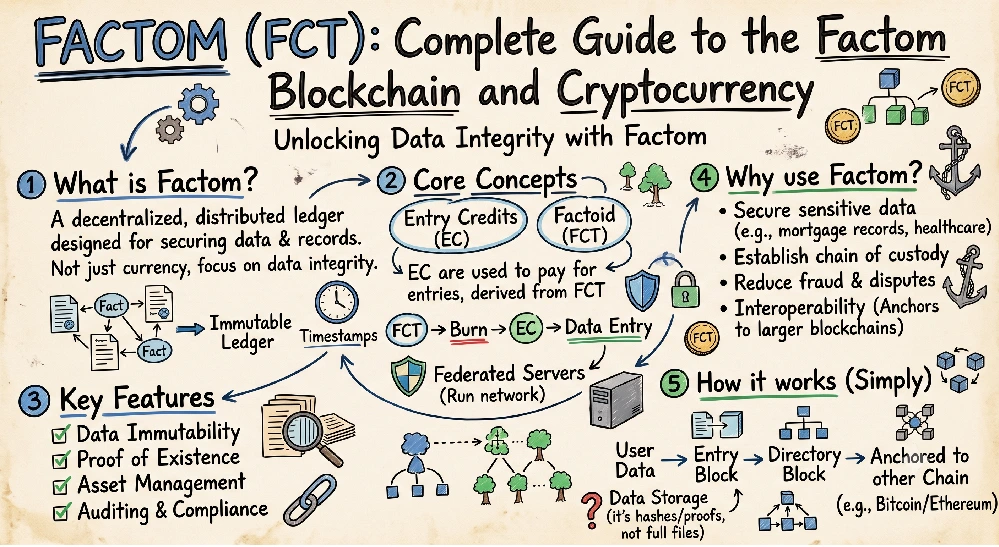
The Factom blockchain is a blockchain-based data integrity system designed to create a permanent, verifiable record of information without requiring every piece of underlying data to be stored directly on the blockchain.
Its native cryptocurrency, Factom (FCT), was originally used within the Factom ecosystem to pay for certain network functions and support the protocol’s data-recording architecture.
Factom is therefore interesting from two perspectives:
- Blockchain technology: using cryptographic records to establish data integrity.
- Cryptocurrency: using FCT as an economic component of the original Factom protocol.
Unlike Bitcoin, whose primary purpose is decentralized digital money, Factom was built primarily around data integrity, auditability, and record management.
Important: Factom’s history includes significant changes in development, governance, and network operation. Readers should distinguish the original Factom protocol and FCT ecosystem from later projects, implementations, and successor efforts that may use related technology or branding.
Key Takeaways
- Factom was designed primarily as a blockchain-based data integrity and record-keeping system.
- Its architecture separated data-recording functions from the underlying Bitcoin blockchain.
- Factom used Entries and Entry Chains as important components of its original design.
- FCT (Factoid) was the native token associated with the original Factom protocol.
- Factom’s architecture was designed to avoid putting every piece of application data directly into Bitcoin blocks.
- Factom could be used for applications involving records, documents, audit trails, compliance information, and other data where integrity matters.
- The system used cryptographic techniques to make unauthorized historical changes detectable.
- Factom was conceptually different from general-purpose smart-contract platforms such as Ethereum.
- The project’s history includes substantial operational and governance changes, so historical descriptions should not automatically be interpreted as describing an actively maintained modern network.
- FCT should not be treated simply as another Bitcoin or Ethereum-style cryptocurrency.
- The technology is most interesting as an early example of blockchain infrastructure for data integrity rather than payments.
ZenvestAI Explains
Factom is a blockchain-based data integrity protocol designed to create tamper-evident records of information.
Instead of putting an entire document or database on-chain, the Factom architecture can record cryptographic representations of information. This makes it possible to later demonstrate that a particular piece of information existed in a particular state at a particular time.
Think of it like creating a digital fingerprint and timestamp for important information.
For example:
Imagine a company has a contract stored in its internal database.
Rather than putting the complete contract on a public blockchain, a system can calculate a cryptographic hash of the document and record information related to that hash.
Later, if someone changes the contract, its hash changes.
The original blockchain record can therefore help demonstrate that:
Original document → Original fingerprint → Blockchain record → Later verification
This concept is commonly described as data integrity or proof of existence.
At a Glance
| Attribute | Factom |
|---|---|
| Project | Factom |
| Native asset | Factoid (FCT) |
| Primary concept | Data integrity and record anchoring |
| Original architecture | Distributed data-recording protocol |
| Major blockchain relationship | Bitcoin anchoring |
| Key structures | Entries and Entry Chains |
| Main objective | Create verifiable, tamper-evident records |
| Primary use cases | Data integrity, audit trails, document verification |
| Cryptocurrency role | Originally used within the Factom protocol’s economic model |
| Smart-contract focus | Not the primary design goal |
| Key distinction | Blockchain infrastructure for information integrity |
What Is Factom?
Factom is a blockchain-based protocol designed to help organizations and applications maintain verifiable records of information.
The basic problem Factom attempted to solve is straightforward:
How can you prove that information has not been secretly altered after it was recorded?
Traditional databases are useful, but they generally depend on administrators, organizations, or trusted third parties.
A database administrator can potentially:
- modify records,
- delete information,
- change timestamps,
- overwrite historical data,
- or control access to audit information.
A blockchain introduces another model.
Once information has been cryptographically committed to a sufficiently secure blockchain, changing the historical record becomes substantially more difficult and detectable.
Factom built infrastructure around this concept.
Factom Is Not Simply a Cryptocurrency
One of the biggest misconceptions is thinking:
Factom = FCT coin
The relationship is more complicated.
Factom was fundamentally a data integrity protocol, while FCT was the cryptocurrency used within its economic architecture.
This distinction is important because the project’s technological purpose was broader than speculation in its token.
History of Factom
Factom emerged during the early expansion of blockchain applications beyond digital currency.
Early Development
The project was associated with David Johnston, Peter Kirby, and other contributors who worked on the idea of using blockchain technology for secure records.
The Factom concept gained attention because it addressed a problem that Bitcoin itself was not designed to solve efficiently:
storing and verifying large amounts of external information.
Bitcoin’s blockchain provides strong security, but storing large volumes of arbitrary application data directly on Bitcoin is inefficient and expensive.
Factom proposed an additional layer.
Instead of recording every document directly on Bitcoin, Factom could organize records and periodically anchor a cryptographic summary into Bitcoin.
Factom’s Early Token Model
Factom introduced its native token, originally called Factoids, with the ticker FCT.
The token served an important role in the protocol’s economic mechanism.
Users could effectively pay for data-recording services through the Factom system without needing to interact with Bitcoin for every individual data record.
Factom Foundation and Governance
Factom’s development involved organizations including the Factom Foundation and Factom, Inc.
The project attracted attention from blockchain investors, enterprise technology communities, and organizations interested in immutable records.
It also explored applications involving:
- government records,
- mortgages,
- financial records,
- healthcare data,
- supply chains,
- identity,
- and audit systems.
Operational and Financial Difficulties
Factom’s history also demonstrates an important lesson in cryptocurrency:
Good technology does not automatically guarantee sustainable operations.
The organization associated with Factom experienced financial and operational difficulties.
This ultimately affected development, governance, and the project’s ability to continue operating in its original form.
Later developments involved changes in the ecosystem and efforts to preserve or continue aspects of the technology.
Therefore, when researching Factom today, it is important to distinguish:
- the original Factom protocol,
- Factom, Inc.,
- Factom Foundation,
- later ecosystem developments,
- and the historical FCT asset.
How Factom Works
The easiest way to understand Factom is to think about a three-layer data integrity process (learn more about how blockchain works).
Layer 1 — Application Data
An application creates information.
Examples:
- invoice,
- medical record,
- legal document,
- financial record,
- sensor data.
Layer 2 — Factom
Factom organizes and records information into its own structures.
Layer 3 — External Blockchain Anchor
Factom can periodically create cryptographic commitments that are anchored into Bitcoin.
This gives the system an additional security foundation.
Simplified Architecture
Application
↓
Factom Entry
↓
Entry Chain
↓
Directory Block
↓
Bitcoin Blockchain
The important idea is that Factom did not need to place every individual document directly inside Bitcoin.
Instead, it could use cryptographic summaries.
Core Components
1. Entries
An Entry represents a piece of data submitted to Factom.
For example:
Document A
↓
Hash / cryptographic representation
↓
Factom Entry
The entry becomes part of Factom’s record structure.
2. Entry Chains
Entries can be organized into Entry Chains.
A chain provides continuity between related records.
For example:
Entry 1
↓
Entry 2
↓
Entry 3
↓
Entry 4
This allows an application to maintain an ordered history.
A company could theoretically use a chain to represent:
Customer → Contract → Amendments → Updates → Final Version
3. Chain IDs
Each Entry Chain has an identifier.
The Chain ID allows the system to distinguish one logical record stream from another.
For example:
Chain A → Property records
Chain B → Medical records
Chain C → Financial records
4. Directory Blocks
Factom used Directory Blocks to organize information from multiple Entry Chains.
Directory Blocks provided a structured representation of what was recorded during a particular period.
5. Bitcoin Anchoring
One of Factom’s most important concepts was anchoring information to Bitcoin.
Rather than storing all application information directly in Bitcoin, Factom could construct a cryptographic representation of its records.
That representation could then be anchored into the Bitcoin blockchain.
Conceptually:
Thousands of records
        ↓
Factom organization
        ↓
Cryptographic summary
        ↓
Bitcoin anchor
This approach allowed Factom to leverage Bitcoin’s security without putting every application record directly onto Bitcoin.
Important Types
Factom’s architecture involves several important concepts that are easy to confuse.
Factoid (FCT)
Factoid was the native cryptocurrency associated with the Factom protocol.
It was designed to provide an economic mechanism for network usage.
Entry Credit
Entry Credits (ECs) were a special mechanism in the original Factom design.
They were used to pay for data entries.
One important feature was that Entry Credits were designed primarily for network usage rather than speculation.
They were not intended to function like a freely traded cryptocurrency in the same way as FCT.
Entries
Entries represent individual records submitted to the protocol.
Entry Chains
Entry Chains group related entries into a continuous logical sequence.
Directory Blocks
Directory Blocks organized references to Entry Chains and supported the system’s anchoring architecture.
Use Cases
Factom’s technology was particularly relevant to applications where data integrity is more important than simply storing data.
1. Document Verification
A document can be cryptographically fingerprinted.
Later, someone can compare the current document’s fingerprint with the historical record.
2. Audit Trails
Companies can use blockchain-based records to strengthen audit systems.
Instead of relying entirely on an internal database, an organization could maintain externally verifiable evidence of historical states.
3. Financial Records
Financial institutions generate enormous quantities of records.
Blockchain anchoring could theoretically help demonstrate that specific records existed at particular times.
4. Mortgage Records
Factom historically explored applications related to mortgage and property information.
The idea was to create more reliable audit trails around documents and transactions.
5. Healthcare Records
Healthcare information requires careful handling.
Factom’s model could theoretically provide integrity verification without publicly exposing sensitive medical information.
The key distinction is:
Store the sensitive information privately; store proof of its integrity publicly.
6. Supply Chains
Supply chains involve multiple participants.
A blockchain-based integrity layer can potentially help establish that records were not changed after submission.
7. Government Records
Government organizations maintain:
- permits,
- certificates,
- land records,
- licenses,
- public documents.
A cryptographic audit layer could help strengthen record verification.
8. IoT Data
Internet-of-Things devices continuously generate information.
Factom-like architectures could theoretically provide integrity proofs for machine-generated records.
Benefits
Data Integrity
The primary benefit is the ability to detect unauthorized modifications.
Auditability
Blockchain-based records can create stronger historical evidence.
Reduced Dependence on a Single Database
Instead of trusting one organization’s database completely, blockchain anchoring provides an additional verification mechanism.
Scalability Through Anchoring
Factom’s architecture attempted to avoid putting every individual record directly onto Bitcoin.
This could significantly reduce the amount of information that needed to be anchored on the underlying blockchain.
Privacy-Friendly Architecture
A system does not necessarily need to publish the underlying sensitive information.
Instead, it can publish a cryptographic commitment.
For example:
Private document
        ↓
SHA-style hash
        ↓
Public blockchain record
The public blockchain can verify integrity without necessarily revealing the document itself.
Risks
Factom’s technology does not eliminate risk.
Technology Risk
Any blockchain protocol can contain:
- software bugs,
- implementation vulnerabilities,
- cryptographic weaknesses,
- consensus problems.
Governance Risk
Decentralized technology can still have organizations, developers, foundations, or communities influencing its direction.
Governance changes can affect the ecosystem.
Token Risk
FCT’s market value can fluctuate significantly.
A technically interesting project can still have a highly volatile token.
Liquidity Risk
A cryptocurrency may become difficult to buy or sell if exchange support declines.
This is especially important for older or less actively developed crypto assets.
Adoption Risk
Enterprise blockchain projects face a fundamental challenge:
Will organizations actually use them at scale?
Technology alone does not guarantee adoption.
Centralization Risk
If critical infrastructure, development, or decision-making becomes concentrated among a small number of participants, the system may not provide the decentralization users expect.
Regulatory Risk
The regulatory treatment of cryptoassets varies by jurisdiction.
Changes in cryptocurrency regulations can affect exchanges, token access, custody, and usage (see our guide on the future of crypto regulations).
How to Get Started With Factom
Because Factom and FCT have a long and complicated history, beginners should start with research rather than purchasing the token immediately.
Step 1: Understand the Technology
Learn:
- Entries,
- Entry Chains,
- Entry Credits,
- Directory Blocks,
- Bitcoin anchoring.
Step 2: Understand FCT
Determine:
- what FCT represented,
- how it was historically used,
- where it was supported,
- and what the current ecosystem status is.
Step 3: Verify Current Infrastructure
Before interacting with an older cryptocurrency, verify:
- active development,
- network status,
- wallet compatibility,
- exchange availability,
- liquidity,
- official documentation,
- and security history.
Step 4: Never Trust an Old Tutorial Blindly
This is particularly important for legacy crypto projects.
A tutorial published several years ago may describe:
- an old wallet,
- an old exchange,
- an old API,
- an old network,
- or an outdated token mechanism.
Always verify current information before sending funds.
Security
Security is especially important with legacy cryptocurrencies.
Use Official Sources
Download crypto wallets and software only from trustworthy, verified sources (read our wallet security guide for best practices).
Protect Private Keys
Never share:
- seed phrases,
- private keys,
- recovery phrases,
- wallet passwords.
Anyone with the private key may be able to control the associated assets.
Verify Addresses
Cryptocurrency transactions are generally difficult or impossible to reverse once confirmed.
Always verify the destination address before sending.
Beware of Fake FCT Websites
Older cryptocurrency projects are attractive targets for crypto scams:
- phishing sites,
- fake wallets,
- fake support accounts,
- fraudulent investment schemes,
- malicious downloads.
Avoid “Guaranteed FCT Returns”
No legitimate blockchain protocol can guarantee a fixed investment return.
Costs
Factom’s economic model historically involved different costs depending on what users were doing.
The key concepts included:
Factom Protocol Usage
Users needed a mechanism to pay for data entries.
Entry Credits
Entry Credits were designed specifically for paying entry costs.
FCT
Factoids provided the underlying economic asset that supported the original system.
Exchange Fees
If FCT is available through a cryptocurrency exchange, users may also encounter:
- trading fees,
- withdrawal fees,
- network fees,
- spreads.
The exact costs can change substantially over time and by platform.
Always verify current fees before making a transaction.
Regulation
Factom exists within the broader cryptocurrency regulatory environment.
The regulatory classification of a cryptoasset can depend on:
- jurisdiction,
- how the asset is marketed,
- how it is used,
- whether it is offered as an investment,
- exchange rules,
- custody arrangements,
- and evolving legislation.
India
For Indian users, cryptocurrency taxation and regulatory treatment should be checked against the latest rules applicable at the time of the transaction.
Do not assume that an older article describing cryptocurrency regulation still reflects current Indian law.
United States
U.S. treatment can involve multiple regulatory frameworks, depending on the activity and circumstances.
This means users should distinguish between:
owning an asset
and
operating, selling, issuing, or providing financial services involving that asset.
Advanced Concepts
Blockchain Anchoring
One of Factom’s most important architectural ideas is anchoring.
Suppose 100,000 records exist.
Putting all 100,000 records directly onto Bitcoin would be inefficient.
Instead:
100,000 Records
        ↓
Factom
        ↓
Merkle-style aggregation / cryptographic summary
        ↓
Single blockchain anchor
        ↓
Bitcoin
This creates a bridge between application-scale records and a highly secure underlying blockchain.
Proof of Existence
A major conceptual use case is proving that information existed at a specific point in time.
This does not necessarily prove that the information itself is true.
It proves something different:
A particular cryptographic representation was recorded.
That distinction is critical.
Integrity vs Truth
Blockchain can help establish:
“This record has not changed since it was committed.”
It does not automatically establish:
“The information in this record was true.”
For example, someone could record a fraudulent document on a blockchain.
The blockchain may prove that the fraudulent document existed.
It cannot automatically prove that the document was legitimate.
Data Availability vs Data Integrity
These are two different concepts.
Data Availability
Can you access the original information?
Data Integrity
Can you demonstrate that the information has not changed?
Factom’s architecture was primarily concerned with the second problem.
Off-Chain Data + On-Chain Proof
This is one of the most useful blockchain architecture patterns.
Sensitive Data
      ↓
Private Storage
      ↓
Cryptographic Hash
      ↓
Blockchain
      ↓
Future Verification
This approach can be more practical than putting sensitive information directly onto a public blockchain.
Common Mistakes
Mistake 1: Treating Factom as Just Another Coin
Factom’s core concept was data integrity infrastructure.
FCT was part of that system.
Mistake 2: Assuming Blockchain Means Truth
Blockchain can protect historical integrity.
It cannot automatically validate the truthfulness of information entered into the system.
Mistake 3: Using Outdated Wallet Instructions
Factom’s long history means old guides can be particularly dangerous.
Always verify current software and network status.
Mistake 4: Ignoring Liquidity
A cryptocurrency can technically exist while having very limited practical market liquidity (review our risk watch insights).
Mistake 5: Buying Because the Token Price Looks Cheap
A low nominal price does not mean an asset is undervalued.
Market capitalization, supply, liquidity, adoption, technology, and future prospects matter more than the price of one token.
Mistake 6: Confusing Historical Factom With Current Ecosystem Status
Many articles online describe Factom as though its historical architecture and ecosystem are unchanged.
Always check the date and source (see also: Factom (FCT) Is Trending).
Related Concepts
Understanding Factom becomes easier if you understand these related blockchain concepts.
Bitcoin
Bitcoin provides the underlying blockchain security that Factom historically used for anchoring.
Blockchain
A distributed ledger that allows participants to maintain a shared historical record. For a full primer, read our beginner’s guide to cryptocurrency and blockchain technology.
Cryptographic Hash
A mathematical fingerprint of data.
Merkle Tree
A data structure that efficiently represents many pieces of information using cryptographic hashes.
Timestamping
Recording evidence that information existed at a particular point in time.
Smart Contracts
Programs running on blockchain networks.
Factom was not primarily designed as a general-purpose smart-contract platform.
Oracle
A system that brings external information into blockchain applications (learn more about Oracle Risk in DeFi).
Factom’s problem is different: it focuses primarily on record integrity, rather than feeding external prices or data into smart contracts.
Glossary
| Term | Meaning |
|---|---|
| Factom | Blockchain-based data integrity protocol |
| FCT | Factoid, the native token associated with the original Factom ecosystem |
| Entry | A piece of data recorded in the Factom system |
| Entry Chain | A sequence of related entries |
| Chain ID | Identifier for an Entry Chain |
| Entry Credit | Original Factom mechanism for paying for entries |
| Directory Block | Structure used to organize references to Factom chains |
| Bitcoin Anchoring | Recording a cryptographic commitment onto Bitcoin |
| Hash | Cryptographic fingerprint of data |
| Data Integrity | Assurance that information has not been altered |
| Timestamping | Establishing evidence of when information existed |
| Audit Trail | Historical record of changes or events |
| On-Chain | Data or activity recorded on a blockchain |
| Off-Chain | Data or activity maintained outside the blockchain |
| Cryptographic Proof | Mathematical evidence supporting a claim about data |
| Liquidity | Ability to buy or sell an asset without substantially moving its price |
Bottom Line
Factom represents an important chapter in the development of blockchain technology.
Its biggest contribution was not simply the creation of another cryptocurrency. The more interesting idea was architectural:
Use blockchain to create verifiable evidence about information without requiring every piece of information to live directly on the blockchain.
The Factom model demonstrated how a blockchain could function as a trust and integrity layer for applications such as documents, records, audits, and databases.
Its architecture also illustrated an important blockchain design principle:
You do not always need to put the data itself on-chain. Sometimes, putting a cryptographic proof of the data on-chain is enough.
For FCT, however, technology and investment analysis must be separated.
A project’s historical technological importance does not automatically mean that its cryptocurrency is currently valuable, liquid, actively developed, or suitable for investment.
Therefore, anyone researching Factom today should examine three separate questions:
- What problem did Factom originally solve?
- How did its architecture solve that problem?
- What is the current status of the Factom/FCT ecosystem?
That distinction makes it possible to study Factom objectively—as both a blockchain technology case study and a cryptocurrency with substantial historical context.
Further Reading & Related Resources
Expand your knowledge of blockchain architecture, security, and market dynamics with these essential guides:
- Blockchain Basics Hub – Fundamental concepts and building blocks of distributed ledgers.
- Crypto Research – Deep dives and technological case studies across crypto ecosystems.
- The Future of Cryptocurrency: Trends, AI & Blockchain – Key architectural shifts shaping the industry.
- Start Here: Crypto Guide – Comprehensive roadmap for understanding digital assets from the ground up.
