Factom (FCT) is an old name in the cryptocurrency market, but it is attracting renewed attention as traders and crypto users search for the project again.
That naturally raises a question: Why is Factom trending now?
A sudden increase in interest does not necessarily mean that a cryptocurrency has entered a new growth phase. In the case of an older and relatively small crypto asset such as FCT, increased attention can come from a combination of price movements, trading activity, social discussions, market scanners and renewed curiosity about a project that was once considered an important blockchain data-infrastructure experiment.
Current market information shows that Factom remains a very small cryptocurrency by market capitalization, with recent data placing its market value in the single-digit millions of dollars. Coinbase also currently indicates that Factom is not tradable on Coinbase, while third-party crypto research data shows limited active-market coverage.
That makes the current interest in FCT worth examining carefully.
Key Takeaways
- Factom is an early blockchain data-integrity project, designed to help businesses verify and timestamp records.
- FCT is the native Factom token, while Entry Credits were designed to provide a more predictable way of paying for data entries.
- A search spike does not automatically mean that Factom’s underlying network activity or adoption has suddenly increased.
- FCT’s relatively small market size means that changes in trading activity can have a much larger effect than they would on major cryptocurrencies.
- Factom’s historical technology remains interesting, but investors should distinguish between renewed attention and genuine fundamental growth.
- Before trading a trending legacy cryptocurrency, check liquidity, exchange availability, development activity and the source of the catalyst.
At a Glance
| Metric / Aspect | Factom (FCT) Profile |
| Launch Year | 2015 |
| Core Value Proposition | Scalable enterprise document and audit trail notarization |
| Consensus Mechanism | Federated Server consensus anchored periodically to Bitcoin |
| Token Mechanism | Dual-tier: Factoids (FCT) & Entry Credits (EC) |
| Market Status | Legacy micro-cap with limited centralized exchange access |
| Primary Trend Driver | Speculative interest, social chatter, and low-float volatility |
What Is Factom (FCT)?
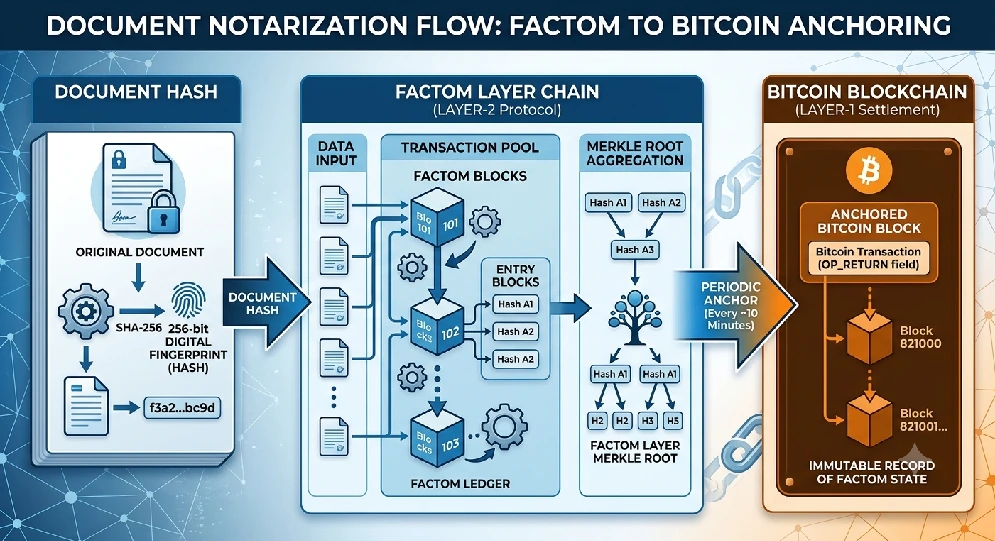
Factom is a blockchain-based data-integrity protocol that was designed to help organizations create verifiable records without putting entire documents directly onto a public blockchain network.
The basic idea is relatively simple.
Instead of storing a complete document on Bitcoin, a system can create a cryptographic representation of the information and use blockchain-based anchoring to provide evidence that the data existed in a particular form.
This approach was aimed at use cases such as:
- business records
- audit trails
- compliance documentation
- property records
- supply-chain information
- legal records
- identity-related information
- other forms of data verification
Factom’s architecture is therefore quite different from that of a typical smart contract blockchain.
It was built around data integrity and verification, rather than trying to become a general-purpose decentralized application platform.
Why Is Factom (FCT) Trending?
There is an important distinction between Factom becoming popular again and Factom receiving genuine fundamental development.
At the time of writing, available market sources do not provide strong evidence of a major new Factom-specific fundamental catalyst. Coinbase’s current Factom page, for example, shows very limited market activity and says FCT is not tradable on Coinbase.
That means several possibilities should be considered.
1. Renewed Interest in an Old Cryptocurrency
Crypto markets regularly revisit older projects, often covered in trending crypto news.
When traders search for previous-generation blockchain projects, Factom can appear because it has a recognizable history and a distinctive use case.
The project was designed around a problem that is still relevant today:
How can digital information be independently verified without placing every piece of information directly on a blockchain?
That question remains relevant as blockchain technology expands into areas such as digital identity, compliance, AI data provenance and enterprise records.
However, renewed interest in the idea does not automatically translate into renewed adoption of the FCT token.
2. Small-Market-Cap Assets Can Attract Disproportionate Attention
Factom is a very small cryptocurrency compared with Bitcoin, Ethereum and other major digital assets.
Recent market data puts its market capitalization in the single-digit millions of dollars.
This matters because small markets can behave very differently from highly liquid cryptocurrencies.
A relatively small amount of buying or selling can produce a noticeable percentage move when there is limited liquidity.
That can create a cycle:
Price movement → trader alerts → more searches → social discussion → additional speculation
But this should not be confused with a fundamental improvement in the underlying protocol.
3. Traders May Be Looking for Legacy Crypto Opportunities
Crypto traders frequently monitor older coins that have been largely forgotten by the broader market.
The attraction is straightforward.
If an asset has a small market capitalization and limited liquidity, even a relatively modest increase in demand can produce a large percentage move.
The problem is that the same mechanism works in both directions.
A token that rises quickly can also fall quickly when buyers disappear.
For that reason, a sudden FCT trend should be viewed as a market signal worth investigating, not automatically as a buy signal.
4. Search Trends Can Create Their Own Momentum
There is another possibility that is easy to overlook.
People do not always search for a cryptocurrency because of a major announcement.
Sometimes the sequence works in reverse.
A trader notices an unusual price or volume movement. A market scanner highlights the token. Other traders see the alert and begin searching for it. Social posts then increase visibility, creating even more searches.
This can create a temporary feedback loop.
Therefore:
Higher search interest ≠ higher network adoption.
Search data tells us that people are paying attention. It does not, by itself, tell us why they are paying attention.
Is There a Major New Factom Announcement?
This is the question investors should ask before interpreting the trend as a fundamental turnaround.
A cryptocurrency can trend for completely different reasons:
| Possible catalyst | What it would mean |
|---|---|
| Major partnership | Potential fundamental development |
| Exchange listing | Increased accessibility and liquidity |
| Protocol upgrade | Possible improvement in technology |
| Developer activity | Evidence of ongoing development |
| Large volume increase | Increased market participation |
| Social-media speculation | Potentially short-lived attention |
| Search-volume spike alone | Interest, but not necessarily adoption |
At present, the available sources I checked do not establish a major new Factom-specific announcement as the clear explanation for the attention.
That distinction is important.
An article about a trending cryptocurrency should not turn an unexplained search spike into an unverified bullish narrative.
How Does Factom Work?
Factom’s original architecture was designed to solve a practical problem: how to prove that data existed without placing the complete data itself on a public blockchain.
A simplified version looks like this:
Business Data → Factom Entries → Chain Structure → Data Aggregation → Bitcoin Anchoring
Step 1: Data Is Submitted
A business or application creates an entry representing information that needs to be recorded or verified.
The underlying information could relate to documents, records or other business processes.
Step 2: Entries Are Organized
Factom uses its own data structures to organize records into chains.
This allows related information to be maintained as a sequence rather than treating every record as an isolated blockchain transaction.
Step 3: Data Is Cryptographically Aggregated
Rather than placing every individual record directly onto Bitcoin, cryptographic commitments can be aggregated.
This makes the anchoring process considerably more efficient.
Step 4: The Commitment Is Anchored to Bitcoin
Factom’s architecture used Bitcoin as an external security and timestamping layer.
The important concept is that Bitcoin does not need to contain the original business document. Instead, the blockchain can provide evidence that a particular cryptographic commitment existed.
This is one of the reasons Factom is historically interesting.
What Are FCT and Entry Credits?
Factom used a two-token economic model.
Factoids (FCT)
FCT is the native cryptocurrency associated with the Factom ecosystem.
It has a market price and can be traded where supported.
Entry Credits (EC)
Entry Credits were designed specifically for using the Factom protocol.
They were intended to provide predictable pricing for data-entry operations rather than requiring businesses to expose themselves directly to the volatility of FCT.
The distinction is important:
FCT = tradable network token
Entry Credits = protocol-use mechanism
This architecture was intended to separate the economics of using the network from the volatility of the cryptocurrency itself.
Why Is FCT Different From Bitcoin and Ethereum?
Factom was never designed to compete directly with Bitcoin as digital money or Ethereum as a general-purpose smart-contract platform.
Its historical focus was much narrower:
data integrity, record verification and blockchain anchoring.
That makes it more useful to compare Factom with modern data-verification and decentralized-storage infrastructure than with conventional payment cryptocurrencies.
| Feature | Factom | Modern Data Infrastructure |
|---|---|---|
| Primary purpose | Data integrity and notarization | Data availability, storage or computation |
| Bitcoin anchoring | Core part of historical architecture | Depends on the project |
| Smart contracts | Not its primary focus | Often supported |
| Enterprise records | Major historical use case | Varies |
| Token role | Network economics | Depends on protocol |
| Market maturity | Legacy project | Many newer ecosystems |
The projects are not necessarily direct substitutes. They often solve different parts of the broader blockchain-data problem.
Does the Factom Trend Mean FCT Is Making a Comeback?
Not necessarily.
This is where investors need to separate attention from adoption.
A genuine fundamental comeback would normally require several things to happen together.
For example:
- sustained developer activity
- growing network usage
- new applications
- meaningful partnerships
- stronger liquidity
- broader exchange support
- increasing demand for the protocol
- transparent and verifiable development
A temporary increase in searches or trading activity would not be enough.
Factom’s current market footprint remains very small, and Coinbase currently lists FCT as not tradable on its platform.
That does not prove that the project has no future. It simply means investors should demand stronger evidence before interpreting a trend as a fundamental revival.
The Liquidity Risk Investors Should Understand
One of the biggest risks with small cryptocurrencies is liquidity.
Imagine an asset appears to be trading at $0.70.
That does not necessarily mean you could sell a large position at $0.70.
If there are not enough buyers close to the displayed price, a large market order may move through several price levels.
The result can be significant slippage.
This is particularly important for older or thinly traded cryptocurrencies.
Recent third-party data has placed Factom’s market capitalization around the single-digit-million-dollar range, illustrating just how small the asset is relative to the broader crypto market.
What Should You Check Before Trading FCT?
If you discovered Factom because it is suddenly appearing in search results, do not stop at the price chart. You should understand proper risk watch management before placing trades.
Check these five areas first.
1. Trading Volume
Look at actual 24-hour trading volume and determine whether it is spread across multiple markets or concentrated in one venue.
2. Order-Book Liquidity
A large displayed volume number does not necessarily mean that you can execute a large order efficiently.
Check the depth of the order book where possible, especially if utilizing spot trading.
3. Exchange Support
Confirm which exchanges currently support FCT deposits, withdrawals and trading.
Do not assume that an old exchange listing is still active.
4. Development Activity
Look for evidence of current development rather than relying on historical announcements.
An old partnership is not the same as an active partnership.
5. The Actual Catalyst
Ask one simple question:
What changed?
If you cannot identify a verifiable event, be careful about assuming that the price or search trend represents a fundamental turnaround.
Factom vs. FOMO
A trending cryptocurrency can create a powerful psychological effect.
You see:
“FCT is trending.”
Then:
“The price is moving.”
Then:
“Maybe something big is happening.”
And finally:
“I need to buy before everyone else.”
That is exactly where investors need to slow down.
Trending does not mean undervalued.
Trending does not mean guaranteed upside.
Trending does not mean institutional adoption.
And trending certainly does not eliminate liquidity risk.
A better approach is to investigate the catalyst first and make the investment decision second, employing sound risk-to-reward ratio principles.
Key Risks and Common Mistakes
Understanding the structural realities of legacy tokens prevents costly portfolio mistakes:
- The Illiquidity Trap: Selling out of a large position in an asset with negligible trading volume often leads to severe negative slippage, meaning you cannot exit at the quoted display price.
- Exchange Delisting & Custody Hurdles: Major global exchanges have phased out support for older enterprise tokens. Transferring or storing these tokens requires specific legacy crypto wallets with little to no customer support.
- Opportunity Cost: Allocating capital to unmaintained protocols locks funds away from active ecosystems with liquid markets, ongoing developer funding, and institutional backing.
Practical Checklist: What to Check Before Trading Trending Legacy Tokens
- Verify On-Chain Metrics: Check active block production, transaction volume, and authentic FCT burn rates rather than relying solely on exchange pricing charts.
- Inspect 24-Hour Trading Volume: Confirm whether the trading volume is distributed across reputable exchanges or concentrated on a single unverified order book.
- Review Developer Repositories: Check GitHub repositories to see if core development is active, updated, and addressing modern security standards.
- Audit Official Social Channels: Confirm whether any sudden price movement is tied to a verified governance announcement or merely unverified market rumors and avoid falling for common crypto scams.
The Bottom Line
Factom is an interesting piece of blockchain history because it tackled a problem that remains relevant: how to establish the integrity and existence of digital information without storing every piece of information directly on a public blockchain.
Its recent appearance in crypto searches is therefore worth watching, but investors should be careful about assigning too much meaning to the trend.
The most important question is not simply:
“Why is Factom trending?”
It is:
“Is the increased attention supported by a real change in the Factom ecosystem?”
That means checking development activity, network usage, trading liquidity, exchange availability and verified announcements before reaching a conclusion.
For a small and relatively illiquid legacy cryptocurrency, attention can arrive much faster than fundamentals.
So if FCT is suddenly appearing on your crypto watchlist, treat the trend as a reason to investigate—not as a reason to buy.
ZenvestAI view: A trending cryptocurrency deserves research before it deserves capital.
Market data and exchange availability can change quickly. Always verify current figures and trading support before making a financial decision. Review our Disclaimer and Editorial Policy for more details.
Related Articles & Market Insights
📌 Blockchain & Fundamentals