Table of Contents
- What Is the FSB Crypto Regulation Framework?
- Origins and Core Financial Stability Mandate
- The Two Pillars of the FSB Framework
- How the FSB Mitigates Systemic Transmission Channels
- Global Stablecoin Arrangements (GSAs): Core Standards
- Global Implementation & Cross-Border Fragmentation
- Impact on Crypto Businesses and Market Participants
- 2026 Strategic Focus: Multi-Jurisdictional Vulnerabilities
- Frequently Asked Questions
What Is the FSB Crypto Regulation Framework?
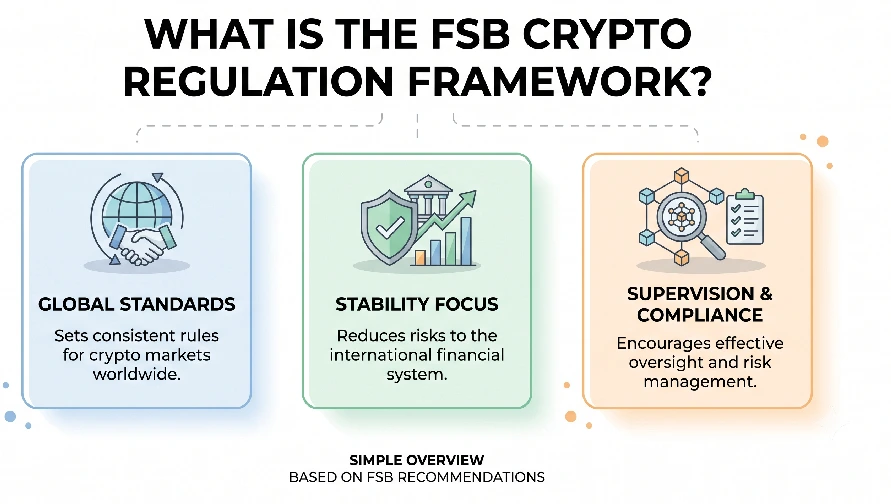
The Financial Stability Board (FSB) crypto regulation framework is a comprehensive international standard established in July 2023 to protect global financial stability from digital asset contagion. Built on the core doctrine of “same activity, same risk, same regulation,” it delivers a harmonized regulatory baseline requiring crypto-asset service providers and global stablecoin issuers to maintain strict risk controls, comprehensive reserve backing, and cross-border operational transparency.
Crypto regulation has expanded beyond localized exchange registration or debates over digital asset bans. As decentralized protocols, stable coins, and centralized platforms become integrated with commercial banking, international clearing, and payment corridors, systemic risk escalates across jurisdictions.
The FSB does not serve as a transnational licensing agency or issue direct corporate penalties. Instead, it functions as the standard-setter and coordinator for the G20, central banks, and financial regulatory agencies worldwide. Its recommendations define the structural benchmarks that national authorities must codify into sovereign statutory legislation.
- Financial Stability First: The framework mitigates systemic contagion and institutional spillover rather than serving as a retail consumer code.
- Two Structural Pillars: Establishes nine high-level recommendations for general crypto-asset markets (CASPs) and ten supervisory expectations for Global Stablecoin Arrangements (GSAs).
- Same Activity, Same Risk, Same Regulation: Enforces standard financial risk metrics regardless of whether an institution executes via centralized databases or smart contracts.
- Strict Stablecoin Backing: Mandates that stablecoin arrangements provide robust redemption rights, high-quality liquid asset (HQLA) reserves, and bankruptcy-remote asset segregation.
- Elimination of Regulatory Arbitrage: Prevents multi-jurisdictional crypto conglomerates from exploiting geographic discrepancies between supervisory regimes.
The Operational Reality: For global crypto firms, complying with localized regulations is no longer sufficient; their corporate governance, liquidity reserves, and balance-sheet exposures must now align with sovereign banking-level resilience standards.
Origins and Core Financial Stability Mandate
For more than a decade, institutional regulators treated crypto assets as an isolated asset class with minimal capacity to influence macro-financial stability. This perspective permanently dissolved throughout the solvency and liquidity crises of 2022 and early 2023.
The rapid collapse of algorithmic stablecoin ecosystems (such as Terra/UST) and centralized trading groups (such as Alameda Research and FTX) demonstrated how unhedged balance-sheet leverage, corporate co-mingling, and liquidity runs could wipe out tens of billions of dollars within days. When the stress subsequently transmitted into crypto-friendly commercial banks like Silvergate, Signature, and Silicon Valley Bank, international standard-setters recognized that crypto risks could cross directly into traditional banking networks.
| Structural Feature | FSB Global Baseline Standard | National Regulatory Impact |
|---|---|---|
| Regulatory Jurisdiction | International coordinating body (G20, Basel, IOSCO) | Implemented through sovereign domestic statutes |
| Primary Mandate | Mitigate systemic contagion and institutional run risk | Enforces operational compliance, capital, and tax rules |
| Technology Stance | Technology-neutral (governs economic activities) | Focuses on code, smart contracts, or centralized APIs |
| Direct Corporate Powers | Does not issue licenses or register CASPs directly | Issues, suspends, or revokes legal operating licenses |
| Scope of Oversight | Covers CASPs, DeFi interconnections, and GSAs | Enforces statutory boundaries within territorial borders |
Core Checkpoint: The FSB’s technology-neutral posture means that wrapping a traditional financial instrument inside a cryptographic smart contract does not exempt it from banking, securities, or capital reserve laws. This foundation directly shapes the structural pillars of the framework.
The Two Pillars of the FSB Framework
The FSB’s 2023 final package divides global crypto activity into two distinct operational regimes: broad crypto-asset activities and dedicated global stablecoin systems.
Pillar 1: Crypto-Asset Activities and Markets (CASPs)
The first pillar delivers nine high-level recommendations targeted at authorities supervising Crypto-Asset Service Providers (CASPs), covering exchanges, brokerages, lending operations, and asset custodians. These recommendations mandate:
- Comprehensive Regulatory Powers: Authorities must possess the legal authority to monitor, license, and sanction entities servicing digital assets within their economic zone.
- Asset Safeguarding and Segregation: Strict operational separation between corporate company assets and client-deposited funds to eliminate balance-sheet rehypothecation.
- Conflict of Interest Resolution: Direct organizational firewalls or structural separations across entities combining retail trading, proprietary market-making, and custody.
- Prudential Risk & Governance: Enforced risk-management protocols, robust internal controls, and verifiable balance-sheet reporting submitted periodically to sovereign supervisors.
Pillar 2: Global Stablecoin Arrangements (GSAs)
The second pillar introduces ten dedicated supervisory requirements for stablecoins that possess systemic, multi-jurisdictional scale. Because global stablecoins can function as alternative settlement assets and payment rails, a run on a major stablecoin presents financial-stability implications identical to a run on commercial paper or money market funds.
Key mandates enforce direct, unambiguous legal claims for all token holders against the issuer or underlying reserves, the maintenance of high-quality liquid assets (cash equivalents and short-dated sovereign paper) held in segregated bankruptcy-remote custody, and tested recovery-and-resolution mechanics ready to execute during severe market dislocation.
What this means in practice: Centralized crypto companies can no longer operate under informal organizational lines. For multi-jurisdictional entities, Pillar 1 mandates corporate restructuring, while Pillar 2 transforms major stablecoin issuers into prudentially supervised monetary institutions. The immediate outcome is a substantial reduction in systemic risk transmission.
How the FSB Mitigates Systemic Transmission Channels
The FSB targets seven primary channels through which digital asset stress spreads into commercial banking, clearing infrastructure, and capital markets.
1. Liquidity Mismatch and Rapid Redemption Runs
When crypto market sentiment deteriorates, holders demand immediate liquidation into fiat. If an issuing institution holds underlying reserves in illiquid, long-duration instruments or low-grade corporate credit, rapid redemptions trigger fire sales. The FSB requires reserve compositions that match the redemption timeline of outstanding circulating supply at all times.
2. Unhedged Balance-Sheet Leverage and Credit Contagion
In unmonitored markets, institutions deploy leverage through complex layers of borrowing, re-pledging the same collateral across centralized lenders and decentralized liquidity pools. If market asset prices drop sharply, automated liquidations cascade across counterparties. The framework requires supervisors to enforce transparent capital margins, haircut controls, and consolidated balance-sheet reporting.
3. Operational and Smart Contract Vulnerability
Unlike traditional markets that operate with human clearing houses and manual intervention points, digital asset markets depend entirely on algorithmic execution, smart contract integrity, and private key custody. The FSB establishes strict cyber-resilience benchmarks and emergency operational protocols to safeguard core market plumbing during technical attacks or chain partitions.
4. Inter-Platform Market Contagion
Crypto markets share concentrated pools of liquidity. A solvency crisis at one major central custodian or exchange immediately affects market makers, liquidity providers, and derivative venues globally. The FSB framework mandates standardized disclosure of inter-firm exposures to isolate failures before market-wide liquidity freezes occur.
5. Traditional Financial Interconnections (TradFi Spillovers)
Commercial banks maintain deposit relationships with stablecoin issuers, offer crypto custody, and issue credit facilities backed by digital assets. If a multi-billion-dollar crypto intermediary fails, its commercial banking partners face sudden deposit flight and credit defaults. The FSB works in lockstep with the Basel Committee on Banking Supervision (BCBS) to place conservative capital weighting constraints on bank crypto-asset exposures.
6. Governance Deficits and Multifunction Conglomerates
The concentration of contradictory services under one corporate roof—such as operating an exchange, executing proprietary market making, issuing platform tokens, and offering custodial lending—creates severe conflicts of interest. The FSB mandates either legal separation of these divisions or strict functional firewalls to prevent insider front-running and customer asset misappropriation.
7. Off-Chain Data Blindspots
While public blockchain distributed ledgers supply transparent on-chain settlement data, they do not reveal off-chain liabilities, bilateral OTC credit terms, cross-border corporate holdings, or internal rehypothecation. The FSB requires comprehensive regulatory data pipelines so supervisors can assess total counterparty exposure in real time.
The Core Checkpoint: Preventing systemic contagion requires strict oversight of asset reserves and corporate governance. These challenges are most prominent in global stablecoin systems, which serve as the primary liquidity bridge between traditional currencies and digital assets.
Global Stablecoin Arrangements (GSAs): Core Standards
Stablecoins represent the primary transmission line between fiat economies and the digital asset sector. Because major stablecoins register billions of dollars in daily turnover and settlement volume, a breakdown in their peg stability directly threatens broader market solvency.
The FSB explicitly separates small-scale payment tokens from Global Stablecoins. An arrangement is classified as a GSA based on quantitative scale: its total market capitalization, transaction velocity, international cross-border payment corridors, reserve size, and its degree of integration with payment clearing systems.
In developing economies, wide adoption of foreign-currency-pegged stablecoins (primarily USD-pegged tokens) can accelerate unofficial dollarization. This drains domestic fiat bank deposits, disrupts monetary sovereignty, and weakens central bank control over local currency exchange rates. The FSB and the International Monetary Fund (IMF) coordinate to help developing jurisdictions restrict or closely supervise cross-border stablecoin capital flows.
Under the FSB’s GSA standards, stablecoin issuers must adhere to three non-negotiable operational requirements:
- 100% High-Quality Reserve Backing: Issuers cannot back stablecoins with unhedged crypto assets, volatile algorithmic stabilization mechanisms, or illiquid credit instruments. Reserves must consist of cash deposits at prudentially regulated banks or short-dated government securities.
- Direct, Unconditional Redemption Rights: Every token holder must maintain a legally enforceable claim to redeem the token at par value directly against the issuer or its segregated reserve trust within a standard settlement window.
- Pre-Operational Regulatory Authorization: An issuer cannot launch or distribute a stablecoin in any jurisdiction until it satisfies all domestic licensing, supervisory, and AML requirements across that market.
What this means in practice: Unbacked and algorithmic stablecoins cannot qualify for institutional banking integration under the FSB standard. Issuers must operate with transparency levels comparable to regulated money market funds. However, turning these standards into binding law requires individual nations to execute them across disparate legal systems.
Global Implementation & Cross-Border Fragmentation
Because the FSB establishes international standards rather than statutory law, individual jurisdictions implement these recommendations through their own domestic legislative systems. This dynamic has driven varied regulatory speeds across major trading regions.
European Union: Markets in Crypto-Assets (MiCA)
The European Union represents the most synchronized implementation of the FSB’s guidance. Under the Markets in Crypto-Assets Regulation (MiCA), the EU enacted strict guidelines for Asset-Referenced Tokens (ARTs) and E-Money Tokens (EMTs). MiCA mirrors the FSB framework by requiring segregated reserve management, mandatory par-value redemption rights, and rigorous operational stress-testing for significant stablecoins operating within the 27 member states.
United States: Multi-Agency Oversight
The United States maintains a dual federal-state supervisory model. While domestic agencies—including the Securities and Exchange Commission (SEC), Commodity Futures Trading Commission (CFTC), and the Federal Reserve—align with the FSB’s risk priorities, legislative codification remains decentralized across federal banking statutes, state-level licensing regimes (such as the NYDFS BitLicense), and targeted stablecoin bills.
Asia-Pacific & India: Licensing, Supervision, and Capital Controls
Financial hubs such as Singapore and Hong Kong have introduced tailored statutory licensing frameworks that mandate complete asset segregation, external reserve audits, and capital buffers. In India, policy focuses on macroeconomic stability, domestic tax tracking, and anti-money laundering registration under the Financial Intelligence Unit (FIU-IND), ensuring domestic crypto exchanges adhere to international reporting benchmarks while safeguarding capital flow controls.
| Global Standard Setter | Core Regulatory Mandate | Interaction with FSB Framework |
|---|---|---|
| FSB | Systemic Financial Stability & Cross-Border Coordination | Establishes global baseline framework for CASPs and GSAs |
| FATF | AML / Counter-Terrorist Financing & Travel Rule | Supplements FSB standards by tracking illicit financial flows |
| IOSCO | Market Integrity, Investor Protection & Securities | Coordinates with FSB to prevent market manipulation & fraud |
| Basel Committee (BCBS) | Prudential Bank Capital & Liquidity Requirements | Enforces 1,250% risk-weighting ceilings on unbacked crypto |
| IMF / World Bank | Macroeconomic Stability & Emerging Market Capital | Analyzes stablecoin impacts on domestic monetary policy |
The Operational Bottleneck: The FSB’s 2025 thematic peer review identified notable progress in basic CASP authorization, but persistent regulatory fragmentation in cross-border stablecoin rules. This regulatory divergence enables businesses to relocate legal entities into loosely supervised regimes while still servicing users globally.
Impact on Crypto Businesses and Market Participants
The global rollout of the FSB framework affects every tier of the digital asset industry, shifting operating models from informal tech operations to regulated financial institutions.
Centralized Exchanges (CEXs) & Trading Desks
Centralized exchanges must prepare for comprehensive regulatory audits, strict customer asset segregation, and balance-sheet transparency. Firms can no longer use proprietary trading arms to make markets on their own order books without structural firewalls and external oversight.
Institutional Custodians & Lending Desks
Custodians face rising capital adequacy thresholds and legally defined bankruptcy-remote custody structures. For crypto lending platforms, operating high-leverage lending or rehypothecating collateral without capital buffers is largely restricted by national regulators enacting FSB and Basel committee recommendations.
Retail Investors & Traders
Retail users benefit indirectly through lower counterparty credit risk and cleaner exchange operations. However, regulatory compliance also implies stricter identity verification, travel rule monitoring on personal transfers, and the phase-out of non-compliant stablecoin pairs on licensed platforms.
Investor Risk Checkpoint: Stronger regulatory frameworks reduce the probability of systemic exchange insolvencies, but they do not eliminate market volatility. Bitcoin, Ethereum, and digital assets remain exposed to macro liquidity shifts, requiring investors to apply sound personal risk management regardless of exchange licensing.
2026 Strategic Focus: Multi-Jurisdictional Vulnerabilities
The international regulatory agenda has moved from conceptual framework design into real-world supervisory enforcement. The FSB’s active 2026 work programme concentrates on the operational risks created by multi-jurisdictional stablecoins and cross-border arbitrage.
Key areas of regulatory scrutiny include:
- Multi-Jurisdictional Stablecoin Stress Testing: Evaluating how stablecoins operating across dozens of legal environments settle reserves when one local banking partner freezes wire rails.
- Cross-Border Information-Sharing Networks: Closing the information gap where an entity incorporates corporate shells across different offshore jurisdictions to obscure total leverage.
- DeFi Governance Interfaces: Investigating the centralized infrastructure points supporting decentralized finance—such as development teams, front-end web hosts, and price oracle nodes—to apply activity-based risk principles.
- Emerging Market Currency Protection: Supporting emerging economies with tools to prevent local monetary disruption driven by rapid foreign-currency stablecoin adoption.
The Final Perspective: The FSB framework is establishing a common international regulatory baseline for digital assets. For the global market, compliance is shifting from an administrative checkmark to a fundamental requirement for institutional liquidity, banking access, and long-term viability.
Frequently Asked Questions
Does the FSB regulate Bitcoin directly?
No. The FSB does not regulate individual crypto assets, mints, or network protocols. It develops international supervisory standards aimed at the intermediaries, centralized exchanges, and institutions that interact with Bitcoin to mitigate systemic financial stability risks.
Can the FSB ban crypto companies or exchanges?
No. The FSB possesses no legal or statutory licensing power to issue bans or corporate sanctions. Individual national jurisdictions decide what digital asset activities are permitted, restricted, or prohibited under their own legal systems.
Does the FSB framework cover Central Bank Digital Currencies (CBDCs)?
No. The FSB’s 2023 recommendations explicitly exclude CBDCs. Central Bank Digital Currencies represent direct digital liabilities of sovereign central banks, placing them under the monetary authority of their respective governments.
What is regulatory arbitrage in global crypto markets?
Regulatory arbitrage occurs when a crypto firm relocates its legal corporate entity or reserve infrastructure to a jurisdiction with loose oversight, while continuing to market products to users located in strictly regulated economies. The FSB framework reduces this by establishing unified international supervisory baselines.
How does the FSB framework view Decentralized Finance (DeFi)?
The FSB assesses DeFi based on its economic activity rather than its technological interface. Where decentralized protocols feature centralized touchpoints—such as administrative keys, governance token concentrations, front-end websites, or oracle dependencies—authorities apply the “same activity, same risk, same regulation” principle.
Related ZenvestAI Intelligence Guides
Deepen your understanding of global crypto policy, asset architecture, and market risk with these dedicated research guides:
- Stablecoin Architecture: How Reserves, Pegs, and Liquidity Work
- Global Crypto Regulation: International Policy and Market Frameworks
- MiCA Regulation Guide: European Crypto Framework Explained
- FATF Crypto Standards, VASP Licensing, and the Travel Rule
- Institutional Custody and Crypto Wallet Security Standards
- Crypto Market Structure: Liquidity, Clearing, and Trading Mechanics
Important Disclosure
Educational & Research Resource: This publication is prepared strictly for educational, informational, and research purposes. It analyzes international financial stability policies and does not constitute legal, compliance, tax, investment, or financial advice. The recommendations of the Financial Stability Board represent supervisory standards rather than direct statutory law. Digital asset markets involve significant volatility, counterparty exposures, and regulatory risks. Market participants must verify domestic laws applicable within their jurisdiction and consult qualified legal and financial counsel before making financial decisions.
