Imagine someone sends you Bitcoin, Ethereum, or another crypto asset.
Where does it go?
Many beginners think the crypto goes inside a digital wallet in the same way that cash goes inside a physical wallet.
That is not exactly how it works.
Your crypto is recorded on a blockchain. A crypto wallet gives you the tools and keys needed to access and control those assets. It can help you receive crypto, send crypto, connect to blockchain apps, and approve transactions.
That is why understanding a crypto wallet is one of the first things you should learn before using cryptocurrency.
A wallet can look simple on your phone or computer. You may see a Send button, a Receive button, and your balance. Behind those simple buttons, however, several important things are happening.
Your wallet works with addresses, private keys, digital signatures, blockchain networks, and transactions.
The good news is that you do not need to be a computer expert to understand them.
Think of this guide as a classroom lesson. We will start with the basic idea and then slowly move toward the more advanced parts.
By the end, you should understand not only what a crypto wallet is, but also how it works, what it stores, what a private key does, why a seed phrase matters, how a transaction moves across a blockchain, and how different wallet types compare.
Before diving into storage, it is helpful to have a firm grasp of what cryptocurrency is and how digital assets exist on the ledger. If you are entirely new to Web3, our start here guide maps out the fundamental milestones you should explore first.
ZenvestAI Explains
A crypto wallet is a tool that helps you manage the keys used to control crypto assets on a blockchain.
It may be:
- A mobile app
- A desktop application
- A browser extension
- A hardware device
- A wallet built into another service
- A smart-contract-based wallet
The wallet does not normally contain your cryptocurrency like a physical wallet contains cash.
Instead:
Blockchain = records the assets and transactions
Wallet = manages the keys and gives you an interface to interact with the blockchain
Private key = proves that you are authorized to control assets linked to that key
Wallet address = public destination used to receive crypto
This is the first idea to remember.
Bitcoin.org explains that Bitcoin wallets manage private keys and that bitcoins exist as records on the blockchain rather than being physically stored inside the wallet.
Ethereum makes a similar distinction and also explains that an account and a wallet are not exactly the same thing. A wallet is an interface that lets you interact with an account.
Key Takeaways
If you remember only a few points from this guide, remember these:
- A crypto wallet is not a digital box containing coins.
- Your crypto assets are recorded on a blockchain.
- A wallet manages the keys that let you control those assets.
- A wallet address can normally be shared to receive crypto.
- A private key must remain secret.
- A seed phrase is extremely important for many self-custody wallets because it can restore wallet access.
- Sending crypto normally involves creating, signing, broadcasting, and confirming a transaction.
- Hot wallets are generally connected to the internet, while cold wallets are designed to keep keys offline.
- Custodial and non-custodial wallets have different responsibilities and risks.
- In self-custody, protecting your recovery information is your responsibility.
At a Glance
| Question | Simple answer |
|---|---|
| What is a crypto wallet? | A tool for managing keys and interacting with blockchain networks |
| Does a wallet store crypto? | The blockchain records the assets; the wallet manages access to them |
| What is a wallet address? | A public address used to receive crypto |
| What is a private key? | A secret key used to authorize transactions |
| What is a seed phrase? | A backup phrase that can restore many self-custody wallets |
| What is a hot wallet? | A wallet designed for online or connected use |
| What is a cold wallet? | A setup designed to keep keys offline |
| What is a custodial wallet? | A service where another party controls custody of the keys |
| What is a non-custodial wallet? | A wallet where you control the keys |
| Can a wallet be hacked? | The wallet, device, keys, or user can be exposed to different attacks |
| Can a lost wallet be recovered? | Often, if the correct recovery method is available |
| Can a lost seed phrase be recovered? | Usually not in a standard self-custody setup if no other recovery method exists |
What Is a Crypto Wallet?
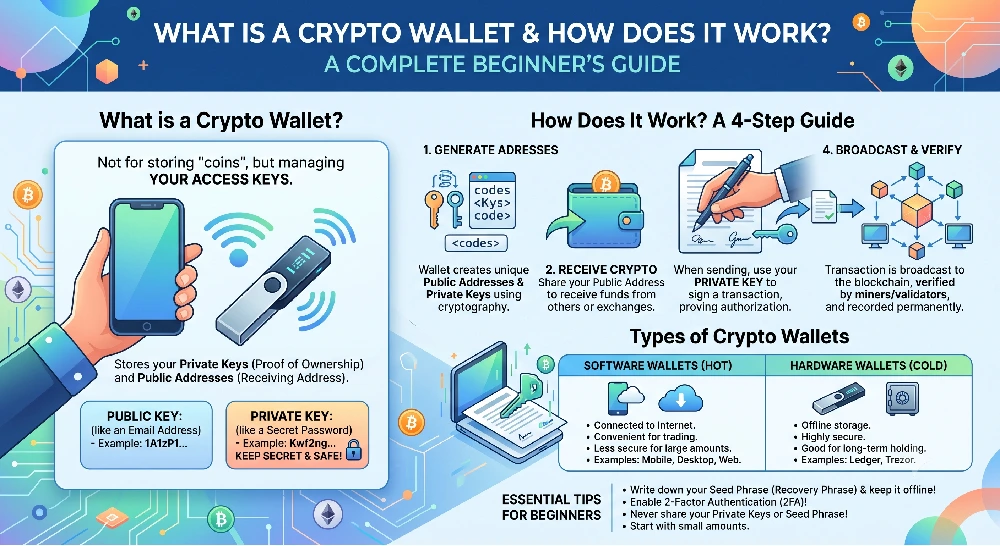
A crypto wallet is software, hardware, or another wallet interface that lets you interact with a blockchain and manage the cryptographic keys connected to your assets.
The easiest way to understand it is to compare it with online banking.
When you open a bank app, the app shows your account balance and gives you buttons to send or receive money.
A crypto wallet can provide a similar user interface, but the system behind it is different.
There is usually no central bank keeping your crypto balance for you.
Instead, a blockchain maintains the transaction records.
The wallet helps you interact with that blockchain.
For example, a Bitcoin wallet can generate receiving addresses, show your balance, prepare transactions, and use private keys to sign transactions. Bitcoin.org describes a wallet as an application that manages the private keys needed to spend bitcoins.
An Ethereum wallet can do more than send and receive ETH. It can also help users interact with tokens, decentralized applications, smart contracts, and other blockchain services.
Ethereum.org describes wallets as interfaces that allow users to interact with their accounts and applications.
The simplest definition
A crypto wallet is your tool for accessing and controlling blockchain-based assets and services.
It does not mean the coins are physically sitting inside the wallet.
What Does a Crypto Wallet Actually Store?
This is one of the most important questions for a beginner.
The answer depends on the wallet, but in a self-custody wallet, the main thing being protected is your private key or the information from which your keys can be recovered.
The blockchain contains the records of transactions and asset ownership.
Your wallet keeps or manages the information needed to prove that you have the right to perform certain actions.
Ethereum’s documentation puts the idea simply: users do not literally hold the cryptocurrency itself; they hold the private keys that control funds recorded on the Ethereum ledger.
Think of it like this
Imagine a house.
The blockchain is like the public property record.
Your wallet is like the system that manages your keys.
Your address is like the location people use to identify where to send something.
Your private key is like a secret key that proves you have control.
The comparison is not perfect, but it gives a useful starting point.
Beyond simple holding, a Web3 wallet lets you interact with decentralized applications, swap tokens via DEXes, or earn yields by staking crypto directly from your wallet. If you want to spend crypto on real-world purchases rather than hold long-term, tools like the Binance virtual card bridge on-chain assets with everyday retail point-of-sale systems.
How Does a Crypto Wallet Work?
Now we reach the main question.
How does a crypto wallet actually work?
The process can be explained in several simple steps.
Step 1: The wallet creates or receives key information
A self-custody wallet normally creates cryptographic key information when you set it up.
The private key is secret.
From the private key, the wallet can derive public information used to create or identify your blockchain address.
On Ethereum, an externally owned account is based on a public and private key pair. The private key is used to sign transactions.
Step 2: The wallet gives you an address
The wallet provides a public receiving address.
You can give this address to someone who wants to send you crypto.
For example:
You: “Send me 0.01 BTC.”
Sender: enters your Bitcoin address.
The sender does not need your private key.
Your private key must remain secret.
Ethereum.org compares a receiving address to something like an account number or home address because it can be shared so others can send assets to you.
Step 3: The sender creates a transaction
Suppose Alice wants to send Bob some cryptocurrency.
Alice enters:
- Bob’s address
- The amount
- Any required transaction settings
The wallet prepares the transaction.
Step 4: The wallet signs the transaction
This is a very important step.
The wallet uses Alice’s private key to create a digital signature.
The private key does not need to be publicly revealed.
The signature provides mathematical proof that the transaction was authorized by the holder of the relevant key.
Bitcoin.org explains that private keys are used to sign transactions and that the signature helps prove that the transaction came from the authorized wallet.
Step 5: The transaction is sent to the network
The signed transaction is broadcast to the relevant blockchain network.
The network receives it and checks whether it follows the rules.
Step 6: The network verifies the transaction
The network checks things such as whether the transaction is valid and whether the sender is authorized to spend the relevant assets.
Different blockchains use different methods to reach agreement about valid transactions.
Bitcoin uses proof-of-work mining as part of its consensus system, while many newer networks use other designs, including proof-of-stake.
The exact process depends on the blockchain.
Step 7: The transaction is recorded
Once the transaction is included and confirmed according to the network’s rules, the blockchain records the change.
Your wallet can then read blockchain data and show the updated balance.
The whole process
Create transaction → Sign transaction → Broadcast → Network checks → Confirmation → Blockchain record → Wallet displays updated state
That is the basic idea behind a crypto transaction.
A Simple Example: Sending Bitcoin
Suppose Alice has Bitcoin and wants to send Bob 0.01 BTC.
Here is what happens.
1. Bob gives Alice his Bitcoin address
Bob does not give Alice his private key.
He only provides the address needed to receive the Bitcoin.
2. Alice opens her wallet
She chooses Send.
3. Alice enters Bob’s address
She enters the amount:
0.01 BTC
4. The wallet prepares the transaction
The wallet calculates the information needed to send the Bitcoin.
It may also show a network fee.
5. Alice approves the transaction
The wallet signs it using the relevant private key.
6. The transaction reaches the Bitcoin network
Network participants check it.
7. The transaction is included in the blockchain
After the required confirmation process, Bob’s wallet can show the received Bitcoin.
Bitcoin.org describes Bitcoin’s blockchain as a shared public ledger containing confirmed transactions, while the wallet uses private keys to authorize spending.
A common misconception is that your wallet stores your actual coins. Instead, your tokens live on a decentralized ledger. To see this mechanism in detail, explore our primer on how blockchain works. Your wallet simply stores the cryptographic keys used to sign transactions. Browse our dedicated crypto wallets hub for deeper technical overviews.
Main Components of a Crypto Wallet
To understand wallets properly, you should know the main parts.
Private Key
A private key is secret cryptographic information that can authorize transactions.
It is one of the most important pieces of information in a self-custody wallet.
If another person gets your private key, they may be able to control the assets connected to it.
Never send your private key to someone claiming to be support.
Ethereum.org specifically warns that legitimate services and support agents will not ask for your private key or recovery phrase.
Public Key
A public key is related mathematically to the private key.
It is used as part of the system that allows others and the network to verify signatures.
You do not need to calculate public keys yourself. Your wallet normally handles this automatically.
Wallet Address
A wallet address is the public identifier used for receiving assets on a particular network.
Think of it as the destination you give to someone who wants to send you crypto.
Addresses are not universal.
A Bitcoin address and an Ethereum address are not automatically interchangeable.
Ethereum.org notes that Bitcoin uses a different address system from Ethereum and that network compatibility must be checked.
Seed Phrase or Recovery Phrase
A seed phrase is a series of words used by many wallets as a backup for recovering wallet access.
It is sometimes called:
- Seed phrase
- Recovery phrase
- Secret recovery phrase
- Mnemonic phrase
The exact wallet design matters, but for many self-custody wallets, this phrase is extremely important.
Anyone who gets the recovery phrase may be able to access the wallet’s assets.
Ethereum.org currently describes the recovery phrase as a master key to the wallet and warns users to keep it private.
Wallet Software
Wallet software is the application or interface you use.
It may show:
- Your addresses
- Your balances
- Your transaction history
- Send options
- Receive options
- Network choices
- dApp connections
- Transaction approval screens
Blockchain Network Connection
A wallet needs access to blockchain information.
Depending on its design, it may connect directly to a network or use other infrastructure to obtain blockchain data.
Some lightweight wallets use external servers for blockchain information. This can create different privacy and trust considerations.
Public Key vs Private Key vs Wallet Address
These three terms are often mixed up.
| Term | Simple meaning | Should you share it? |
|---|---|---|
| Private key | Secret information used to authorize actions | Never |
| Public key | Public cryptographic information related to the private key | Generally shareable, depending on the use |
| Wallet address | Public destination for receiving crypto | Normally yes |
The most important rule is:
Address can be shared. Private key cannot.
What Is a Crypto Wallet Address?
A crypto wallet address is the information you normally give someone when you want them to send cryptocurrency to you.
For example, instead of giving someone your private key, you give them your receiving address.
The wallet may display it as:
Receive → Copy address
You can then send the address to the person who is paying you.
Why must you check the address?
Because crypto transactions are generally not like ordinary bank transfers that can sometimes be reversed through a bank.
If you send assets to the wrong address, recovery may be difficult or impossible.
So always check:
- The address
- The network
- The asset
- The amount
Before confirming a transaction.
What Is a Private Key?
A private key is a secret that gives control over the assets associated with the relevant blockchain account.
Think of it as a very powerful digital authorization key.
You should never:
- Send it to another person
- Post it online
- Put it into a random website
- Share it with fake support
- Store it casually in cloud notes
A person who obtains the private key may be able to move the assets it controls.
Bitcoin.org describes a private key as secret information that proves the right to spend bitcoins from a specific wallet through a cryptographic signature.
What Is a Seed Phrase?
A seed phrase is a group of words used by many wallets to back up and restore wallet access.
For example, a wallet might present a series of words during setup.
These words should be treated as highly sensitive information.
Why is it so important?
Imagine your phone breaks.
If your wallet uses a standard recovery phrase and you still have the correct phrase, you may be able to restore the wallet on a compatible wallet application or device.
If you lose both the device and the recovery information, recovering a self-custodied wallet may be impossible.
Ethereum.org explains that a wallet can often be restored using the seed phrase and warns users to protect it carefully.
Never store your seed phrase casually
Avoid:
- Screenshots
- Social media messages
- Email drafts
- Cloud notes
- Random websites
- Untrusted password forms
Ethereum.org warns against taking screenshots of seed phrases because they may be synchronized to cloud services and exposed.
The most critical rule of self-custody is securing your recovery phrase. Review our comprehensive checklist on best practices for wallet security
. In addition, never sign unverified smart contract approvals; staying informed on common crypto scams and phishing attacks is your best defense against wallet drainers.
How Does Sending Crypto From a Wallet Work?
Sending crypto normally follows this basic flow:
1. Choose the asset
For example: BTC, ETH, or another supported token.
2. Enter the receiving address
You enter the destination address.
3. Enter the amount
For example: 0.01 BTC
4. Review the network
This is very important when an asset can exist on different networks.
5. Review the transaction fee
Blockchain transactions can require network fees.
The amount and fee system depend on the blockchain.
6. Confirm the transaction
You approve the transaction in the wallet.
7. The wallet signs it
The relevant key creates the digital signature.
8. The transaction is broadcast
The transaction is sent to the blockchain network.
9. The network processes it
The network checks and processes the transaction according to its rules.
10. The blockchain records the result
Once confirmed, the transaction becomes part of the blockchain’s recorded history.
How Does Receiving Crypto Work?
Receiving crypto is usually simpler.
Step 1
Open your wallet.
Step 2
Choose the asset you want to receive.
Step 3
Select Receive.
Step 4
Copy your address.
Step 5
Give the address to the sender.
Step 6
The sender creates and sends the transaction.
Step 7
The network processes it.
Step 8
Your wallet reads the blockchain and displays the updated balance.
The important point is that the sender does not transfer the crypto into an app database controlled by your wallet.
The blockchain records the transaction.
Your wallet helps you view and control the assets associated with your keys.
How Does a Wallet Connect to a dApp?
A crypto wallet can do much more than send and receive assets.
It can also connect to decentralized applications, often called dApps.
A dApp might be:
- A decentralized exchange
- An NFT marketplace
- A lending application
- A blockchain game
- A staking application
- A decentralized identity service
- A Web3 application
The basic process is:
dApp → asks to connect → wallet shows request → user approves → wallet and dApp interact
When an action requires authorization, the wallet can ask you to approve a message or transaction.
On Ethereum, wallet-based authentication can work through a signed message. The user proves control of an address by signing a message with the private key.
For smart-contract actions, the wallet handles transaction signing rather than giving the dApp direct access to your private key.
What Happens When You Sign a Message?
This is slightly different from sending crypto.
A website may ask you to Sign a message.
That does not automatically mean you are sending cryptocurrency.
A message signature can be used to prove that you control a wallet address.
However, you should still read what you are signing.
Not every signature request is harmless.
Some malicious applications can trick users into approving actions that put assets at risk.
So:
Never blindly click “Sign.”
Read the request and understand what the wallet is asking you to approve.
Types of Crypto Wallets
There is no single way to classify crypto wallets.
Two of the most useful ways are:
- Hot vs cold
- Custodial vs non-custodial
There are also different device types, such as mobile, desktop, browser and hardware wallets.
Ethereum.org currently lists browser, desktop, mobile and hardware wallet options and evaluates wallet listings using factors such as security, self-custody and network support.
Hot Wallets
A hot wallet is generally connected to the internet or designed for convenient online use.
Common examples include:
- Mobile wallets
- Browser extension wallets
- Desktop wallets
- Web-based wallet interfaces
Advantages
Hot wallets are convenient.
You can often:
- Send crypto quickly
- Receive crypto quickly
- Connect to dApps
- Trade or swap assets
- Use Web3 services
Risks
Because the wallet is connected to an internet-connected device, it can face risks such as:
- Malware
- Phishing
- Fake websites
- Browser attacks
- Malicious applications
- Device theft
A hot wallet can be useful for everyday activity, but convenience should not be confused with complete security.
Cold Wallets
A cold wallet is designed to keep the relevant private keys offline or away from normal internet exposure.
Hardware wallets are a common example.
Ethereum.org describes hardware wallets as devices that keep private keys offline and notes that this can greatly reduce certain online hacking risks.
Advantages
Cold storage can reduce exposure to certain online attacks.
It can be useful for people holding assets for longer periods.
Limitations
Cold storage does not remove every risk.
A hardware wallet can:
- Be lost
- Be damaged
- Be stolen
- Be purchased from an unsafe source
- Be used incorrectly
- Have recovery information exposed
Ethereum’s recent security research also points out that hardware wallets have their own risks, including loss, theft and possible supply-chain concerns.
Software Wallets
A software wallet is a wallet application that runs on a computer, phone or browser.
Examples include:
- Mobile wallets
- Desktop wallets
- Browser wallets
Software wallets are usually convenient and easy to access.
But the security of the wallet also depends on the security of the device and the user’s behavior.
Hardware Wallets
A hardware wallet is a physical device designed to protect private keys.
One important advantage is that the private key can remain within the device rather than being exposed directly to an internet-connected computer.
When you approve a transaction, the hardware wallet can sign it using the protected key.
This provides an additional security layer.
But remember:
Hardware wallet does not mean risk-free wallet.
You still need to protect the device, PIN, recovery information and transaction approvals.
Custodial Wallets
With a custodial wallet, another company or service controls the private keys on your behalf.
A crypto exchange is a common example of a custodial setup for assets held on the platform.
This can be convenient.
If you forget your login password, the company may provide account recovery options.
But you are trusting the company.
You depend on it to:
- Protect the assets
- Maintain access
- Process withdrawals
- Follow its policies
- Remain financially and operationally capable
Bitcoin.org explains that using a custodian introduces counterparty risk because the user depends on the third party’s security and solvency.
Non-Custodial Wallets
A non-custodial wallet gives you control of the private keys.
This is often called self-custody.
The main benefit is direct control.
But direct control comes with responsibility.
If you lose the recovery information or approve a malicious transaction, there may be no central company that can simply reverse the mistake.
Bitcoin.org describes this idea as being your own bank: you control your keys, but you also take responsibility for protecting them.
Custodial vs Non-Custodial Wallets
| Feature | Custodial | Non-custodial |
|---|---|---|
| Who controls keys? | Service provider | User |
| Password recovery | Often available | Usually limited |
| User responsibility | Lower for key storage | Higher |
| Third-party risk | Higher | Lower in terms of custodian dependence |
| Self-custody | No | Yes |
| Convenience | Often high | Depends on wallet |
| Key-loss risk | Handled partly by provider | Mainly user’s responsibility |
Neither model is automatically perfect.
The right choice depends on your needs, experience, risk tolerance and how you want to manage your assets.
Custodial wallets are usually managed by centralized exchanges. While convenient, they require trusting a third party. If you choose this route, follow our step-by-step tutorial to set up an account on Binance
with mandatory two-factor authentication enabled. For an exhaustive hardware-versus-software breakdown, consult our ultimate guide to crypto wallets.
Hot Wallet vs Cold Wallet
| Feature | Hot Wallet | Cold Wallet |
|---|---|---|
| Internet connection | Usually connected | Designed for offline key storage |
| Convenience | High | Lower |
| Everyday use | Suitable | Less convenient |
| Online attack exposure | Generally higher | Generally lower |
| Long-term storage | May be less suitable for large holdings | Often considered useful |
| User responsibility | High in self-custody | High in self-custody |
Cold storage can reduce certain online risks, but it does not remove the need for good security practices.
Crypto Wallet vs Crypto Exchange
A crypto wallet and a crypto exchange are not the same thing.
Crypto wallet
A wallet gives you tools to manage keys and interact with blockchain networks.
Crypto exchange
An exchange provides a platform where users can generally buy, sell, trade, or hold crypto through an exchange account.
When assets remain in a custodial exchange account, the exchange may control the private keys.
That means:
Exchange account ≠ automatically self-custody wallet
This is why you should understand who controls the keys.
Crypto Wallet vs Blockchain vs Cryptocurrency
These three terms are easy to confuse.
Cryptocurrency
This is the digital asset.
Examples include:
- Bitcoin
- Ether
- Stablecoins
- Other crypto tokens
Blockchain
The blockchain is the network and ledger system that records transactions and related state.
Wallet
The wallet is the tool that helps you manage keys and interact with the blockchain.
Simple relationship
Cryptocurrency → asset
Blockchain → record and network
Wallet → access and interaction tool
This simple model makes many crypto concepts easier to understand.
Are Crypto Wallets Anonymous?
Not necessarily.
Many blockchain transactions are publicly visible.
A blockchain address may not directly show your name, but that does not mean your activity is automatically anonymous.
Bitcoin.org explains that Bitcoin addresses are not inherently tied to real-world identities, but addresses and transactions can sometimes be linked to individuals depending on how Bitcoin is used.
So it is better to think:
Pseudonymous does not mean completely anonymous.
Privacy depends on:
- The blockchain
- How you use the wallet
- Whether your address is linked to your identity
- Exchange records
- Blockchain analysis
- Network infrastructure
- Your privacy practices
Are Crypto Wallets Safe?
A crypto wallet can be secure, but no wallet is automatically safe just because it has the word “wallet” in its name.
Security depends on several things.
Wallet security
Is the wallet software trustworthy?
Device security
Is your phone or computer protected?
Key security
Are your private keys protected?
Recovery security
Is your seed phrase stored safely?
User behavior
Do you avoid phishing and fake websites?
Transaction safety
Do you check what you are approving?
Network safety
Are you using the correct blockchain network?
Bitcoin.org notes that user error is one of the important risks in Bitcoin security.
How to Keep a Crypto Wallet Safe
Good wallet security is not complicated, but it requires discipline.
Protect your seed phrase
Treat it like a master key.
Do not share it.
Never share your private key
No legitimate wallet support team should need your private key.
Avoid screenshots
A screenshot can be automatically backed up to cloud storage.
Ethereum.org specifically warns about this risk.
Use strong device security
Protect your phone and computer with appropriate security controls.
Keep software updated
Updates can fix security problems.
Bitcoin.org recommends keeping wallet software up to date.
Verify wallet software
Download wallets from legitimate sources.
Fake wallet applications can be dangerous.
Check addresses carefully
Before confirming a transaction, compare the destination address.
Check the network
Sending an asset through the wrong network can create serious problems.
Be careful with dApps
Do not connect your wallet to random websites.
Read signing requests
Do not blindly approve:
- Transactions
- Token approvals
- Contract interactions
- Signature requests
Consider hardware storage for appropriate holdings
Hardware wallets can provide additional protection for private keys, especially for longer-term holdings, although they still require careful use.
What Happens If You Lose Your Phone?
Losing your phone does not necessarily mean losing your crypto.
The important question is:
Do you still have the required recovery information?
If your wallet uses a recoverable seed phrase and you have it safely stored, you may be able to restore the wallet on another compatible device or wallet application.
Ethereum.org explains that users can often recover a wallet using the seed phrase rather than needing the original physical device.
But recovery depends on the wallet design.
Some newer wallets use different recovery systems.
So always understand how your particular wallet handles recovery before putting significant funds into it.
What Happens If You Lose Your Seed Phrase?
This is more serious.
For a standard self-custody wallet that relies on a seed phrase, losing both the wallet device and the recovery phrase can mean losing access permanently.
There is generally no central company that can simply reset the blockchain and give you your funds back.
Bitcoin.org warns that funds permanently lost from a self-custodied wallet may not be recoverable by developers, miners, wallet providers or exchanges.
That is why recovery planning is part of wallet security.
Can You Have More Than One Crypto Wallet?
Yes.
There is no rule that says you must use only one wallet.
You might use:
- One wallet for everyday transactions
- One hardware wallet for long-term holdings
- One wallet for testing Web3 applications
- One wallet for NFTs
- One wallet for a specific blockchain
Different wallets can serve different purposes.
But using more wallets also means more recovery information and more security responsibilities.
More wallets do not automatically mean more safety.
Can One Wallet Hold Different Cryptocurrencies?
Many modern wallets support multiple assets and networks.
However, support is not universal.
A wallet might support:
- Bitcoin
- Ethereum
- Stablecoins
- Tokens
- NFTs
- Layer-2 networks
- Other blockchain networks
Always check whether the wallet supports the exact asset and network you want to use.
Do not assume that because two networks have similar names, an asset can safely be sent between them.
Why Network Choice Matters
This is a common beginner mistake.
The same token name may exist on multiple blockchain networks.
For example, a stablecoin may be available across several networks.
You might see:
USDT
But the network could be different.
The receiving wallet must support the network used for the transfer.
Therefore, before sending crypto, check:
Asset + Network + Address
All three matter.
What Are Transaction Fees?
Many blockchains require users to pay network fees when submitting transactions.
These fees help pay for network resources or transaction processing.
The exact fee system differs between blockchains.
Some networks have relatively low fees.
Others can become expensive when network demand is high.
Fees may also vary by transaction type.
For example, interacting with a smart contract can require more network resources than a simple transfer.
Always review the fee before confirming a transaction.
What Is a Digital Signature?
A digital signature is a mathematical proof created using a private key.
It helps prove that the person or system controlling the relevant private key authorized the transaction or message.
You do not need to manually create the signature.
Your wallet normally handles it.
The simple idea is:
Private key → creates signature
Public information → allows verification
This is one of the key technologies that makes blockchain transactions possible.
What Is a Blockchain Confirmation?
A confirmation means that a transaction has been included in the blockchain according to the network’s rules.
The meaning of “confirmed” differs between blockchain systems.
Some networks have blocks produced every few seconds.
Others take longer.
The more confirmations a blockchain or service requires, the more confidence it may have that the transaction is settled under its rules.
Do not assume every blockchain uses the same confirmation model.
What Is Self-Custody?
Self-custody means you control the private keys rather than handing key control to a third-party custodian.
It provides more direct control.
But there is a trade-off.
You gain:
- More direct control
- Less dependence on a custodian
- Direct interaction with blockchain networks
You take on:
- Key protection
- Recovery planning
- Transaction checking
- Scam prevention
- Device security
Self-custody is not simply “better.”
It changes who carries the responsibility.
What Is a Smart Contract Wallet?
A smart contract wallet is different from a simple account controlled directly by one private key.
Instead of relying only on a traditional externally owned account model, the wallet can use programmable rules.
Depending on the design, it may support features such as:
- Multiple owners
- Spending limits
- Recovery methods
- Transaction batching
- More flexible approval rules
- Different security controls
These wallets can make blockchain accounts more flexible.
But they also introduce additional technical details.
For beginners, the most important point is:
Not every blockchain wallet works in exactly the same way.
Ethereum’s documentation distinguishes traditional externally owned accounts from contract accounts and notes that a wallet is an interface used to interact with them.
What Is Multi-Signature Wallet Security?
A multi-signature, often called multisig, wallet can require more than one key to approve a transaction.
Imagine a company wallet with three authorized people.
The rules might require:
2 of 3 approvals
before funds can move.
This can reduce the risk of one compromised key controlling everything.
Multisig can be useful for:
- Businesses
- DAOs
- Crypto teams
- Treasury management
- Shared funds
It is more advanced than a normal beginner wallet, but the idea is simple:
One key may not be enough to move the funds.
Bitcoin.org lists multi-signature as one of the wallet security approaches users can consider.
What Is Wallet-Based Authentication?
Traditional websites often use:
Username + password
Some blockchain applications can use:
Wallet address + cryptographic signature
The wallet proves that the user controls a particular address by signing a message.
Ethereum’s documentation describes this model and explains how a dApp can request a wallet connection, generate a challenge, receive a signed message and verify the signature.
This is an important part of Web3.
It means a wallet can act as more than a place for crypto transactions.
It can also act as a way to prove control of a blockchain identity.
Real-World Applications of Crypto Wallets
Crypto wallets are used for many purposes.
Sending and receiving cryptocurrency
This is the basic use.
Users can send and receive supported assets.
Holding crypto assets
Users can manage assets associated with their blockchain accounts.
DeFi
Wallets can connect users to decentralized finance applications.
These can include:
- Decentralized exchanges
- Lending
- Borrowing
- Liquidity services
- Staking-related applications
NFTs
Wallets can hold and interact with supported NFTs.
Blockchain gaming
Some blockchain games use wallets to connect users with digital assets and in-game systems.
DAO participation
Wallets can be used to interact with decentralized organizations and their voting systems.
Web3 login
A wallet can sometimes be used to prove control of an address without using a traditional password.
Business treasury management
Companies and organizations can use multisig or other wallet systems to manage shared blockchain funds.
Advanced Concepts You Should Know
Once you understand the basics, several advanced wallet concepts become easier.
Hierarchical Deterministic Wallets
Many modern wallets use systems that can derive many addresses from a common recovery source.
This allows one backup to restore a large set of related keys.
Bitcoin.org notes that many modern wallets are deterministic and that a single recovery phrase can be enough to restore addresses generated by that wallet, depending on its design.
Derivation Paths
A derivation path tells a wallet how to derive specific keys and addresses from a seed.
Different wallets may use different derivation standards.
This is one reason why restoring a wallet can sometimes require more than simply entering the seed phrase.
Token Approvals
On smart-contract networks, you may sometimes approve a smart contract to use a certain token.
This is different from simply receiving or sending a token.
Users should review approvals carefully because unnecessary or risky approvals can create security problems.
Gas and Network Fees
On networks such as Ethereum, users may need to pay network fees for transactions and smart-contract interactions.
The fee system can change with network conditions.
Layer-2 Networks
Some blockchain ecosystems use Layer-2 networks to process transactions with different cost and speed characteristics.
Wallets may support multiple networks.
Users must still make sure that the asset and network are correct.
Account Abstraction
Account abstraction is a broader approach that makes blockchain accounts more programmable.
It can enable features such as:
- Flexible recovery
- Different authorization rules
- Transaction batching
- Sponsored fees in some designs
- More user-friendly account systems
It is an important area of wallet development because it can make blockchain accounts feel more like familiar digital accounts.
Hardware Wallet Signing
With a hardware wallet, the signing process can happen on the hardware device while the connected computer or phone handles the user interface.
This can reduce exposure of private keys to the connected computer.
But the user still needs to check what they are signing.
Common Crypto Wallet Mistakes
Beginners often make mistakes not because crypto is impossible to understand, but because one small action can have a large result.
Mistake 1: Thinking the crypto is physically inside the wallet
The wallet manages access to blockchain-recorded assets.
Mistake 2: Sharing the seed phrase
Never share it.
Mistake 3: Sharing the private key
Never share it.
Mistake 4: Sending crypto to the wrong address
Always verify the destination.
Mistake 5: Choosing the wrong network
Check the network before sending.
Mistake 6: Trusting fake support
Scammers often pretend to be wallet or exchange support.
Mistake 7: Downloading fake wallet software
Use trusted sources.
Mistake 8: Signing without reading
A signature request deserves attention.
Mistake 9: Assuming a hardware wallet is impossible to compromise
Hardware wallets reduce certain risks, but they do not eliminate all risks.
Mistake 10: Keeping the seed phrase in a screenshot
Cloud backups can create another attack path.
Mistake 11: Keeping everything on one wallet
Separating everyday activity from long-term holdings can sometimes reduce the impact of a single mistake.
Mistake 12: Forgetting recovery planning
A wallet is only as recoverable as the recovery method you have safely maintained.
Crypto Wallet Security Checklist
Before using a self-custody wallet, ask yourself:
- Do I understand what my private key is?
- Do I understand what my recovery phrase is?
- Do I know where my recovery information is stored?
- Is it protected from other people?
- Am I using official wallet software?
- Is my device secure?
- Do I check addresses before sending?
- Do I check networks before sending?
- Do I read transaction requests?
- Do I understand what I am signing?
- Do I have a recovery plan?
- Have I tested the recovery process with a small amount where appropriate?
If you cannot answer these questions, slow down before putting significant funds into the wallet.
Crypto Wallet Glossary
Address
A public destination used to receive crypto on a particular blockchain or network.
Blockchain
A distributed system that records transactions and other blockchain state according to the network’s rules.
Cryptocurrency
A digital asset that operates through blockchain or related cryptographic systems.
Cold Wallet
A wallet setup designed to keep private keys offline or away from normal online exposure.
Custodial Wallet
A wallet service where another party controls custody of the private keys.
dApp
A decentralized application that interacts with blockchain networks.
Digital Signature
A cryptographic proof created using a private key to authorize or prove control.
Hardware Wallet
A physical device designed to protect private keys and sign transactions.
Hot Wallet
A wallet designed for connected or online use.
Private Key
Secret cryptographic information used to authorize transactions.
Public Key
Cryptographic information related to a private key that can be used for verification and address-related functions.
Recovery Phrase
A sequence of words used by many wallets to restore access to wallet accounts.
Self-Custody
A setup where the user controls the private keys.
Seed Phrase
Another common name for a recovery phrase.
Smart Contract
Blockchain-based code that can execute rules when its conditions are met.
Transaction
A signed instruction that changes blockchain state, such as transferring assets.
Wallet
A tool or interface used to manage keys and interact with blockchain networks.
Wallet Address
A public identifier used to receive assets.
Bottom Line
A crypto wallet is much more than an app with a Send and Receive button.
It is a tool that helps you interact with blockchain networks and manage the cryptographic keys connected to your assets.
The most important idea is this:
Your crypto is recorded on the blockchain. Your wallet manages the keys that allow you to control and use it.
When you receive crypto, you normally provide a public address.
When you send crypto, your wallet creates and signs a transaction.
The blockchain network then processes the transaction and records the result.
Once you understand that basic flow, many other crypto concepts become easier.
You can then understand the difference between hot and cold wallets, custodial and non-custodial wallets, private keys and public addresses, simple transfers and smart-contract interactions.
The biggest lesson is also the simplest:
In self-custody, control comes with responsibility.
Protect your private keys.
Protect your recovery phrase.
Check addresses.
Check networks.
Read transaction and signature requests.
And never assume that a crypto transaction can always be reversed if something goes wrong.
That foundation will help you use wallets more safely and understand the wider world of Bitcoin, Ethereum, DeFi, Web3 and blockchain technology.
Setting up your first wallet is the gateway to decentralized finance. Continue your learning path with our structuredLearn Crypto knowledge baseto explore safe trading, market structures, and blockchain fundamentals.
Sources Used for Accuracy
The article is based primarily on current official documentation from Bitcoin.org and Ethereum.org, including their wallet, account, transaction, security, recovery and smart-contract guidance.
