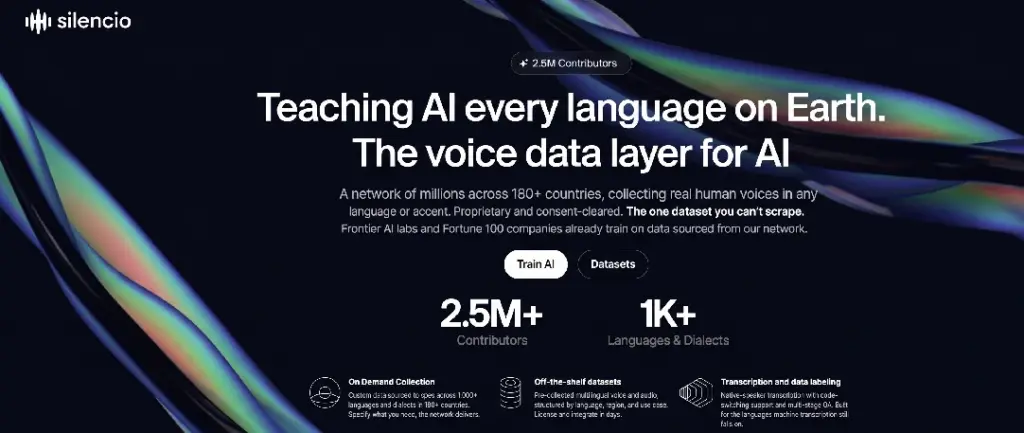
SLC is the native token associated with Silencio, a decentralized data network focused on real-world audio. The project began with a simple idea: use smartphones and other devices to collect information about the sound around us. Over time, Silencio expanded that vision toward voice and audio data for artificial intelligence, machine learning, robotics and other applications.
That evolution is important.
If you first heard about Silencio because of its noise-mapping technology, you may know it as a project that uses smartphones to measure environmental noise. Today, Silencio presents itself more broadly as a voice and audio data network for AI, with contributors providing real human speech and other audio data under an opt-in model.
The basic idea is straightforward:
People contribute useful real-world data → the network verifies and organizes that data → businesses and AI developers can use the data → contributors receive rewards.
The SLC token is designed to connect participants with this broader ecosystem.
However, SLC is still a relatively small cryptocurrency. Current market data shows a much smaller market capitalization than major cryptocurrencies, and its trading activity can be considerably more volatile. CoinGecko currently lists Silencio among smaller-cap assets, while CoinMarketCap reports a maximum supply of roughly 98.31 billion SLC.
That means the interesting question is not simply:
“Will SLC go up?”
A better research question is:
“Can Silencio build a valuable real-world data network, create sustainable demand for its ecosystem, and translate that network growth into long-term value for SLC?”
This guide examines that question from the technology, market, tokenomics, adoption, risk and investment perspectives.
Key Findings
There are several important things to understand about SLC before looking at its price.
First, SLC is not Fantom’s native cryptocurrency.
This is especially important because some readers may discover SLC while discussing Fantom or other cryptocurrencies. SLC and Fantom’s FTM are different assets serving different ecosystems.
Second, Silencio is more than a cryptocurrency project.
The project is building infrastructure around real-world audio and voice data. Its current platform focuses heavily on AI training data, including speech, languages, accents, dialects and real-world audio.
Third, the project has a DePIN-style model.
DePIN stands for Decentralized Physical Infrastructure Networks. Instead of relying only on centralized infrastructure, DePIN projects use a large number of contributors, devices or physical resources distributed across the real world.
Silencio uses smartphones, browsers and other devices as part of its data-collection network. Its whitepaper describes this as a decentralized infrastructure for collecting real-world audio data.
Fourth, real-world data is the central idea.
AI models need large amounts of useful data. But not all data is equally valuable. Scraped, synthetic or low-quality data can have limitations.
Silencio is trying to create datasets based on real people, real voices, real environments and multiple languages. Its current website says its network covers more than 1,000 languages and dialects across more than 180 countries.
Fifth, SLC remains a high-risk cryptocurrency.
The project may have an interesting use case, but an interesting use case does not automatically make a token a good investment.
Investors also need to consider:
- Token supply
- Circulating supply
- Unlocks
- Liquidity
- Trading volume
- Exchange availability
- Network adoption
- Competition
- Regulatory issues
- Token utility
- Whether business demand actually creates sustainable token demand
Scope & Methodology
This article looks at SLC from both a technology perspective and an investment-research perspective.
Instead of focusing only on the current price, we will examine the complete picture:
- What Silencio is building
- How its network works
- Why audio data matters
- How contributors participate
- What SLC does inside the ecosystem
- How the token supply is structured
- Where SLC trades
- Its historical market performance
- Adoption drivers
- Major risks
- Competition
- Regulatory considerations
- Possible future scenarios
- Bull, base and bear cases
- What investors should monitor
Market statistics can change quickly, especially for a small-cap cryptocurrency. Therefore, price, market capitalization, supply and trading-volume figures should always be treated as time-sensitive data, rather than permanent facts.
For example, CoinMarketCap currently reports approximately 17.43 billion SLC in circulating supply against a maximum supply of about 98.31 billion SLC, while CoinGecko currently reports different circulating-supply data.
That difference itself is a useful reminder: investors should verify token-supply data across multiple sources before making a decision.
Current State of Silencio
Silencio has an interesting history because the project’s focus has developed over time.
The project says it was founded in 2021 with the goal of building a large noise-pollution database. Its network used contributors around the world to collect sound-related information. Later, as demand for real-world AI training data increased, Silencio expanded toward voice and broader audio data.
Today, the project describes itself as a voice and audio data network for AI.
Its current platform highlights several areas:
- Voice AI training
- Speech recognition
- Voice agents
- Speech translation
- Robotics
- Wearables
- Low-resource language models
- Voice biometrics
- Text-to-speech
- Real-world audio datasets
The project’s website says it has more than 2.5 million contributors across 180+ countries, while its datasets platform highlights more than 1,000 languages and dialects.
There is therefore a major change in how investors should understand Silencio.
It is no longer accurate to describe the project simply as:
“A crypto project that measures noise.”
A more complete description would be:
Silencio is building a decentralized real-world audio and voice-data network, with roots in environmental noise mapping and an expanding focus on AI and robotics.
That distinction will be important when evaluating the project’s future potential.
Historical Development
The history of Silencio helps explain why the project looks different today from its original concept.
The Early Noise-Mapping Idea
Silencio initially focused on environmental noise.
The concept was relatively simple.
A smartphone already has a microphone, location capabilities and internet connectivity. Instead of requiring expensive professional sound sensors everywhere, a decentralized network could potentially use smartphones to collect large numbers of measurements.
The result could be a much broader picture of noise levels across cities and locations.
Silencio’s Sound Check product measures noise levels in dB(A) and, according to its technical documentation, does not record or analyze raw audio content for that product.
This created potential applications such as:
- Noise pollution mapping
- Urban planning
- Real-estate analysis
- Travel information
- Environmental research
- Location intelligence
The Move Toward Voice and Audio AI
The next major step was expanding beyond noise levels.
AI systems increasingly need real-world speech and audio data.
A model trained primarily on a limited set of languages or standardized recordings may struggle with:
- Regional accents
- Dialects
- Different speaking styles
- Background environments
- Less-represented languages
- Natural conversations
Silencio’s newer direction is designed to address this problem.
Its Voice AI platform allows contributors to provide different forms of speech data, including scripted readings, spontaneous speech and task-based commands.
This gives Silencio a potentially much larger market than its original noise-mapping use case.
The Problem Silencio Is Trying to Solve
To understand Silencio, it helps to understand the problem before looking at the token.
AI needs data.
But the demand for high-quality data is changing.
For many years, AI companies could collect enormous amounts of information from the internet. However, not every type of useful AI data is freely available online.
Real-world voice data is a good example.
A person speaking naturally in a local language, with a particular accent, in a particular environment, is different from a perfectly clean studio recording.
That real-world variation can be valuable for AI systems.
For example, imagine an AI assistant that needs to understand an Indian user speaking English with a regional accent.
A dataset containing only standardized American English may not be enough.
Now imagine the same problem across thousands of languages and dialects.
This creates a huge data challenge.
Silencio’s thesis is that a distributed network of people can help collect this information at scale.
Why Real-World Audio Data Matters
Audio is becoming increasingly important in artificial intelligence.
People do not communicate only through text.
We speak to:
- Smartphones
- Voice assistants
- Cars
- Customer-service systems
- Robots
- Wearable devices
- AI agents
As these systems become more capable, they need to understand how people actually speak in the real world.
That includes more than vocabulary.
It can include:
- Accent
- Tone
- Emotion
- Background noise
- Speaking speed
- Pronunciation
- Regional expressions
- Different languages
- Code-switching between languages
Silencio is attempting to create datasets containing this type of diversity.
Its current website says the network covers more than 1,000 languages and dialects and more than 180 countries.
How Silencio Fits Into the DePIN Model
Silencio can also be understood through the DePIN concept.
A traditional infrastructure company might build a large number of physical sensors and operate them centrally.
That can be expensive.
A decentralized network can take a different approach.
Instead of owning every device, it can allow thousands or millions of participants to contribute resources through devices they already own.
For Silencio, smartphones and browser-based participation can become part of this distributed infrastructure.
The basic model looks like this:
Contributor
↓
Smartphone / Browser / Device
↓
Real-World Audio Data
↓
Verification & Quality Control
↓
Data Network
↓
AI Companies / Businesses / Researchers
↓
Commercial Data Demand
↓
Rewards & Ecosystem Value
This is the part that makes Silencio more interesting than simply another speculative token.
The project is attempting to connect a real-world data marketplace with a decentralized contributor network.
How Does Silencio (SLC) Work?
At a high level, the process can be broken into several stages.
Step 1: People Contribute Data
Users participate through Silencio’s products.
Depending on the product and task, contributors may provide:
- Noise measurements
- Scripted speech
- Natural speech
- Commands
- Transcriptions
- Other audio-related information
The important point is that participation is designed to be voluntary.
Silencio says its Voice AI data collection operates with explicit consent, while its Sound Check product focuses on dB(A) noise measurements rather than recording raw audio.
Step 2: The Network Checks Data Quality
Simply collecting millions of recordings or measurements is not enough.
The data must also be useful.
Poor-quality, duplicated, manipulated or fraudulent contributions can reduce the value of a dataset.
Silencio describes a combination of automated and human quality-control processes.
For voice data, its technical documentation describes automated checks for audio quality, pronunciation and alignment, with additional human review where necessary.
This creates an important part of the network:
More contributors are useful only if the network can maintain data quality.
Step 3: Data Is Organized
Raw data has limited value if nobody can use it.
Silencio therefore organizes contributions into datasets.
Data can be structured according to factors such as:
- Language
- Accent
- Location
- Speaker characteristics
- Recording environment
- Type of speech
- Metadata
This makes the information more useful to businesses and AI developers.
Step 4: Businesses Can Use the Data
The ultimate purpose is demand.
AI companies, research organizations and businesses can use datasets for applications such as:
- Speech recognition
- Voice assistants
- Translation
- Conversational AI
- Text-to-speech
- Robotics
- AI research
Silencio says its datasets can be licensed to enterprises and research organizations.
This creates the possibility of a commercial data marketplace.
Step 5: Contributors Receive Rewards
The network then needs to reward the people providing the data.
This is where token incentives become important.
Silencio’s documentation describes $SLC as part of its reward and ecosystem model. However, its current contributor page also says contributors can receive USDC when their data is sold, while completed tasks can provide raffle tickets for SLC rewards.
This is an important detail for anyone researching the token.
The relationship between SLC, contributor rewards and actual business revenue needs to be understood rather than assuming that every contribution automatically produces SLC.
What Is the SLC Token Used For?
SLC is designed to connect participants and economic activity within the Silencio ecosystem.
Its potential roles include:
Rewards: Contributors can receive token-related incentives for participating in the network.
Ecosystem participation: SLC can act as part of the economic layer connecting contributors, data and buyers.
Network incentives: Token rewards can encourage people to continue contributing useful data.
Value capture: If commercial demand for Silencio’s data grows, the project aims for economic value to flow back into the network.
Silencio’s whitepaper describes a model in which contributors provide data, the network verifies it, datasets are made available to buyers, and economic activity feeds back into the ecosystem.
However, this is where investors need to make an important distinction:
A project’s token utility is not the same thing as guaranteed token value.
A token can have a real use case and still fall in price if demand for the token is weak, supply increases quickly, liquidity falls or the wider crypto market turns bearish.
SLC Token Economics
Tokenomics is one of the most important sections for a small-cap cryptocurrency.
Why?
Because the price of a token is influenced not only by demand but also by how many tokens exist and how many can enter circulation.
Current market-data providers show a maximum supply of roughly 98.31 billion SLC. However, reported circulating supply differs between providers, which is something investors should verify before making calculations.
For example, CoinMarketCap currently reports approximately:
- Maximum supply: 98.31 billion SLC
- Circulating supply: about 17.43 billion SLC
This means a significant portion of the maximum supply is not currently circulating according to that source.
That creates an important question:
What happens when more tokens become available?
Why Circulating Supply Matters
Suppose a cryptocurrency has a price of $0.001.
That number by itself tells you very little.
You need to know how many tokens exist.
A token with 1 billion coins at $0.001 has a different valuation from a token with 100 billion coins at the same price.
The calculation is simple:
Market Capitalization = Token Price × Circulating Supply
The fully diluted valuation uses the total or maximum supply instead.
This is why investors should not look at a very small token price and automatically conclude:
“It is cheap.”
A token priced at a fraction of a cent can still become expensive if its supply is enormous.
Token Unlocks and Future Supply
Another issue is token unlocks.
If additional tokens are scheduled to enter circulation, the available supply can increase.
If demand does not grow at the same pace, additional supply can create selling pressure.
Therefore, an SLC investor should monitor:
- Current circulating supply
- Remaining locked supply
- Unlock schedule
- Team allocation
- Investor allocation
- Ecosystem allocation
- Community rewards
- Treasury holdings
- Future emissions
This is one area where tokenomics can matter as much as technology.
A strong project with poorly managed token supply can still face pressure on its token price.
Market Structure
SLC currently sits firmly in the small-cap cryptocurrency category.
CoinGecko’s current data places Silencio at a market capitalization of only a few million dollars, with trading volume also relatively small compared with major cryptocurrencies.
This creates both opportunity and risk.
A small market capitalization means that relatively small amounts of buying pressure can sometimes produce large percentage movements.
But the reverse is also true.
Large sellers can cause sharp declines.
This is why SLC should not be analyzed in the same way as Bitcoin or Ethereum.
The market structure is fundamentally different.
Key Players in the Silencio Ecosystem
The Silencio ecosystem involves several different groups.
Contributors
These are the people providing data.
They are essential because without contributors, the network has little data to offer.
AI Companies
AI developers can potentially use the collected voice and audio datasets to train or improve models.
Businesses
Companies can use data for specific commercial applications, including voice interfaces and other AI products.
Researchers
Universities and research organizations can use structured datasets for experiments and development.
Developers
Developers can potentially build applications around Silencio’s data infrastructure.
Token Holders
Token holders represent the crypto-economic side of the ecosystem.
But these groups do not necessarily have the same incentives.
That is something investors should watch carefully.
A successful network must balance the interests of:
contributors + data buyers + developers + token holders.
Data Analysis: What Should Investors Watch?
For SLC, price alone is not enough.
A better research dashboard would track several categories.
Network Growth
Watch:
- Number of contributors
- Active contributors
- Geographic coverage
- Languages covered
- Amount of data collected
- Number of datasets
- Data quality
Commercial Demand
Watch:
- Number of customers
- Dataset sales
- Enterprise partnerships
- Recurring revenue
- Data licensing activity
Token Activity
Watch:
- Circulating supply
- Unlocks
- Trading volume
- Liquidity
- Exchange listings
- Wallet concentration
- Token transactions
Product Development
Watch:
- Voice AI expansion
- Sound Check development
- Live Audio development
- API integrations
- AI partnerships
- Robotics applications
This is a much stronger way to evaluate SLC than looking at a green candle and assuming the project is becoming successful.
Major Drivers of SLC Adoption
Several factors could influence Silencio’s future.
Growth of AI
If demand for voice AI and real-world audio data continues to increase, Silencio could potentially benefit.
The project’s current strategy is heavily connected to this trend.
More Contributors
A larger contributor network can potentially provide:
- More languages
- More accents
- More locations
- More data
- More diversity
That can make the network more attractive to data buyers.
Enterprise Demand
This may be one of the most important drivers.
A large community is impressive.
But sustainable business demand is more important.
If companies repeatedly pay for Silencio’s datasets, that would provide stronger evidence that the network has real economic utility.
Real-World Utility
The project’s potential applications extend beyond cryptocurrencies.
Its documentation discusses applications involving:
- AI
- Robotics
- Autonomous systems
- Urban planning
- Speech recognition
- Translation
- Voice assistants
That gives the project exposure to several growing technology sectors.
The Most Important Question for SLC
After studying the technology, tokenomics and market structure, one question stands above everything else:
Can Silencio turn its growing contributor network into sustainable commercial demand?
This is the key investment question.
Millions of users alone do not guarantee token value.
Likewise, a large dataset does not automatically create a successful business.
The strongest version of the Silencio thesis would look something like this:
More contributors → better data → more enterprise demand → more revenue → stronger ecosystem activity → greater token utility and demand.
But if the cycle breaks anywhere, the investment case becomes weaker.
For example:
More users → but little commercial demand
would not necessarily create sustainable token value.
That is why the next sections of this research should focus heavily on market structure, tokenomics, revenue, risks and future scenarios rather than simply promoting the project.
ZenvestAI Research Perspective So Far
From a research perspective, SLC is interesting because it sits at the intersection of several major themes:
Crypto + DePIN + AI + real-world data + voice technology.
That combination gives Silencio a potentially differentiated narrative that aligns with emerging AI and crypto trends in 2026.
But narrative is only the beginning.
The real test will be whether the project can convert its technology and contributor base into repeatable economic activity.
For investors, the distinction between these two statements is critical:
“Silencio has an interesting technology.”
and
“SLC is a good investment.”
The first can potentially be supported by the project’s technology and development.
The second requires much more evidence.
SLC vs Fantom (FTM): Are They Connected?
This is one of the most important questions for readers who discovered SLC while discussing Fantom.
The short answer is no.
Silencio (SLC) and Fantom (FTM) are separate crypto projects with different purposes. SLC is the native utility token of the Silencio ecosystem, while FTM was the native token of the Fantom network. Fantom subsequently transitioned toward Sonic, whose native token is S. Sonic’s official documentation describes the FTM-to-S migration path and the different role of the S token.
So, if someone asks:
“Is SLC the new Fantom coin?”
The answer is no.
SLC should not be confused with either FTM or S.
What Is Fantom?
Fantom was a blockchain network designed to support decentralized applications, smart contracts and DeFi.
Its original native cryptocurrency was FTM.
FTM was used for functions such as:
- Paying transaction fees
- Staking
- Network security
- Governance
Fantom’s ecosystem later evolved into Sonic.
The Sonic network uses S as its native token. Sonic’s documentation explains that S is used for transaction fees, staking, validators and governance.
What Is Silencio?
Silencio has a completely different focus.
Instead of building a general-purpose Layer-1 blockchain like Fantom/Sonic, Silencio focuses on real-world audio and voice data.
Its network allows people to contribute data through devices such as smartphones and other interfaces.
The project started with environmental noise data and has expanded toward voice AI and audio datasets.
This gives the two projects very different purposes.
| Feature | Silencio | Fantom/Sonic |
|---|---|---|
| Token | SLC | FTM / S |
| Main focus | Audio and voice data | Blockchain infrastructure |
| Category | DePIN / Data Network | Layer-1 Blockchain |
| Main users | Data contributors, AI companies, businesses | Developers, validators, DeFi users |
| Core utility | Data-network incentives and ecosystem functions | Fees, staking, governance |
| Main technology focus | Real-world audio data | Smart contracts and blockchain infrastructure |
The key point is simple:
SLC is a data-network token. FTM/S is a blockchain-network token.
Is SLC Built on Fantom?
This is where confusion can happen.
The fact that two tokens may appear in discussions, wallets, exchanges or crypto communities does not mean they belong to the same blockchain ecosystem.
Silencio’s SLC token is associated with its own ecosystem and is available on supported networks and markets. Current token information identifies SLC separately from Sonic’s S token. The Silencio project also identifies SLC as its native utility token.
Therefore, investors should not assume:
SLC = Fantom
or
SLC = Sonic
They are separate assets.
SLC vs Sonic (S)
The distinction becomes even more important after Fantom’s transition to Sonic.
Sonic’s native token is S.
S is used for:
- Network transaction fees
- Staking
- Validator operations
- Governance
Sonic’s official documentation states that FTM holders were able to exchange FTM for S as part of the transition.
SLC has a different purpose.
Its tokenomics documentation describes SLC as the transferable token representing utility and governance functions within the Silencio protocol.
So, despite the similar-looking crypto tickers, there is no reason to treat SLC and S as versions of the same asset.
Why Did People Start Mentioning SLC Alongside Fantom?
There can be several reasons.
Crypto communities often discuss multiple altcoins together because they are:
- Trending at the same time
- Listed on similar exchanges
- Part of broader market narratives
- Available on decentralized exchanges
- Mentioned by traders
- Included in social-media discussions
- Moving sharply in price
This can create confusion.
A reader seeing:
Fantom → Sonic → SLC → DePIN
may assume that all of these projects are connected.
They are not.
The safest approach is always to check:
- Token name
- Ticker
- Blockchain/network
- Contract address
- Official project website
This is particularly important with small-cap cryptocurrencies because tickers are not unique identifiers.
SLC Tokenomics in Detail
Tokenomics is one of the most important parts of the SLC investment story.
The reason is simple.
A cryptocurrency’s price depends on both:
Demand
and
Supply.
If demand increases while available supply remains relatively limited, price can potentially benefit.
But if the number of tokens entering circulation grows faster than demand, the token can face selling pressure.
SLC Maximum Supply
Silencio’s tokenomics documentation describes a total supply of 100 billion SLC. A third-party tokenomics database also reports 100 billion as the total supply and provides a detailed allocation breakdown.
That is a large number.
However, the number itself should not scare investors.
The important question is:
How are those 100 billion tokens distributed and released?
SLC Token Distribution
The published tokenomics breakdown includes several major categories.
According to Tokenomics.com, the allocations include:
- Community Reserve — 32.5%
- Core Contributors — 14%
- Investors — 11%
- Initial Community Campaigns — 11%
- Reserve — 10%
- Beta Airdrop — 7.5%
- CEX & DEX Liquidity — 7%
- Expansion Reserve — 4%
- Advisors — 3%
The source groups these allocations into broader community, foundation, insider and investor categories.
This tells us something important about Silencio’s design.
A substantial portion of the token supply is intended for the community and network ecosystem, rather than being allocated entirely to private investors or the founding team.
According to the same breakdown, community-focused allocations account for about 51% of the total supply.
Why the Community Allocation Matters
Silencio is trying to build a contributor-driven network.
That means it needs people to participate.
If contributors collect data but receive no economic incentive, it can become difficult to maintain long-term participation.
SLC is therefore part of the incentive structure.
Silencio explains that contributors accumulate in-app Coins based on activities that add value to the network. These Coins influence participation in SLC distributions.
This creates a simple economic loop:
Users contribute
↓
Users earn in-app Coins
↓
Contribution influences SLC rewards
↓
More people are encouraged to participate
↓
The network grows
The challenge is whether this incentive system can remain sustainable as the network gets larger.
SLC Token Unlocks
Token unlocks are particularly important for SLC.
A token can have a strong community and good technology, but if a large amount of previously locked supply enters the market, selling pressure can increase.
Published tokenomics data shows different vesting arrangements for different allocation groups.
For example:
- Core contributors: 12-month cliff followed by linear vesting
- Investors: 12-month cliff followed by 18-month linear vesting
- Advisors: 12-month cliff followed by 20-month linear vesting
- Beta airdrop: part released at TGE and the remainder vested over six months
- CEX/DEX liquidity: allocated for liquidity purposes
This is why investors should never look only at maximum supply.
They should also examine:
How much is circulating today?
How much is locked?
When will additional tokens enter circulation?
Who receives those tokens?
Community Reward Emissions
Silencio’s own documentation provides another important detail.
The project originally planned a shorter community-reward period but later extended the distribution period from five years to 10 years, while keeping the overall community-reward allocation unchanged. The project said the change was intended to support longer-term sustainability and community engagement.
This is an important tokenomics development.
A longer distribution period can reduce the speed at which community rewards enter circulation.
But it does not eliminate supply risk.
Investors still need to monitor the actual emission schedule.
SLC Liquidity Allocation
Silencio’s tokenomics documentation states that 7 billion SLC were allocated for CEX and DEX liquidity.
The stated purpose is to support trading liquidity, reduce slippage and help create healthier market conditions as the ecosystem develops.
This matters because liquidity is particularly important for smaller cryptocurrencies.
If a token has low liquidity, even relatively modest orders can move the price substantially.
SLC Market Capitalization
Market capitalization is more useful than looking at the token’s unit price alone.
The calculation is:
Market Cap = SLC Price × Circulating Supply
For example, imagine a token trading at:
$0.001
If there were 10 billion circulating tokens, the market capitalization would be:
$10 million
But if 50 billion tokens were circulating, the same $0.001 price would imply:
$50 million
This is why statements such as:
“SLC is only a fraction of a cent, so it can easily reach $1”
are misleading.
Can SLC Reach $1?
This is one of the questions investors are likely to ask.
The correct way to analyze it is through market capitalization.
If SLC reached:
$1 per token
and the full 100 billion token supply were considered, the implied fully diluted valuation would be approximately:
$100 billion.
That would be an enormous valuation compared with the project’s current scale.
It does not mean $1 is mathematically impossible.
It means that reaching $1 would require a dramatically larger network, much stronger demand, major market expansion and a valuation capable of supporting that price.
Therefore, a $1 target should be treated as a high-end scenario requiring extraordinary growth, not as a normal expectation.
Where Can You Buy or Trade SLC?
SLC is available through multiple crypto trading venues.
Silencio’s own token page currently lists exchanges including:
- KuCoin
- Gate.io
- MEXC
- BitMart
- BingX
The project also says that additional CEX and DEX listings are being planned.
Availability can change, so readers should verify the current listing directly before trading.
CEX vs DEX for SLC
There are two broad ways to trade a token.
Centralized exchanges (CEXs) provide an account-based trading experience.
Examples include exchanges such as KuCoin and Gate.io.
A decentralized exchange (DEX) allows users to trade directly from a compatible crypto wallet, often utilizing automated liquidity pools to execute swaps.
DEX trading can provide more direct control over funds, but it also introduces additional risks.
These can include:
- Wrong contract address
- Wrong blockchain
- Low liquidity
- High slippage
- Fake tokens
- Smart-contract risk
Always Verify the SLC Contract Address
This is one of the most important warnings in this entire article.
Never buy a cryptocurrency simply because the ticker says SLC.
A ticker is not enough.
Different projects can use the same ticker.
Before buying, verify:
Official project → official token contract → correct blockchain → exchange/wallet support
Silencio’s official documentation should be treated as the primary reference for identifying the legitimate token and avoiding potential crypto scams.
This is especially important because searching only for “SLC coin” can produce multiple results.
SLC on Base
Current wallet and market data identifies a Silencio SLC token on Base, with Phantom showing a Base contract for SLC.
That means users should pay attention to the network selected when depositing or withdrawing on Layer 2 networks.
Sending tokens through the wrong network can result in funds becoming inaccessible or requiring additional recovery steps.
For beginners, prioritizing basic wallet security is essential:
Never guess the network.
Always check the exchange deposit page and the project’s official token information before transferring funds.
SLC Price History and Market Performance
Price history can tell us how the market has treated SLC, but it should not be used alone to predict the future.
Small-cap cryptocurrencies can experience extremely large price movements.
A token may rise rapidly because of:
- New exchange listings
- Social-media attention
- New partnerships
- Market-wide altcoin rallies
- Speculation
- New product announcements
The same token can later fall sharply because of:
- Profit-taking
- Low liquidity
- Token unlocks
- Weak demand
- Broader crypto sell-offs
- Loss of market attention
That is why SLC’s price chart should be studied alongside volume, liquidity, supply and fundamental developments.
SLC All-Time High and All-Time Low
The exact ATH and ATL figures can differ slightly between data providers because exchanges may record different trading pairs and liquidity conditions.
For a live article on ZenvestAI, it is better to pull the latest ATH, ATL, current price, market cap and 24-hour volume directly from a market-data provider immediately before publication.
This avoids publishing a number that becomes outdated.
The more important research question is:
What caused major SLC price movements?
Rather than simply:
“How much did SLC rise?”
Trading Volume
Trading volume is particularly important for SLC because it is a smaller-cap token.
Higher volume can generally indicate stronger market participation.
But volume should be examined carefully.
Investors should look for:
- Consistent volume
- Multiple exchanges
- Healthy order books
- Reasonable spreads
- Sufficient liquidity
A sudden one-day volume spike does not necessarily mean long-term adoption.
Volatility
SLC should be treated as a high-volatility asset.
A small-cap token can move much faster than Bitcoin or Ethereum.
That can create attractive opportunities for traders, but it also increases the possibility of large losses.
For long-term investors, volatility means position sizing becomes especially important.
A project can be fundamentally promising and still experience a 50% or larger drawdown during a difficult market period.
What Could Drive SLC Adoption?
The next stage of Silencio’s story depends heavily on adoption.
AI Data Demand
This is potentially the biggest long-term opportunity.
AI companies need increasingly diverse datasets.
If Silencio can become a useful source of real-world voice and audio data, demand could grow.
The project specifically positions its data for AI, robotics, voice assistants and related applications.
More Languages and Dialects
One major advantage of a global contributor network is diversity.
A decentralized network can potentially collect data from regions that are poorly represented in traditional datasets.
That could become increasingly valuable as AI systems expand into more countries.
Contributor Growth
A larger contributor base can potentially create a stronger network effect.
More contributors can mean:
More data → greater diversity → better datasets → more potential buyers → more revenue opportunities.
But again, the critical word is potential.
The network needs actual buyers.
Enterprise Partnerships
Enterprise adoption could be one of the strongest signals for investors.
If major companies begin repeatedly purchasing Silencio datasets, that would provide stronger evidence that the project’s data has commercial value.
Investors should therefore monitor:
- New enterprise customers
- Dataset purchases
- Partnerships
- Licensing agreements
- Revenue growth
These indicators may ultimately matter more than social-media follower counts.
Risks of Investing in SLC
SLC has an interesting narrative, but the risks are significant.
Small-Cap Volatility
Small market capitalization can produce large price movements.
That works in both directions.
A 100% gain can happen quickly.
So can a 50% decline.
Liquidity Risk
Lower liquidity can make it difficult to enter or exit large positions without affecting the market price.
This is particularly important for traders.
Always check:
- Order-book depth
- 24-hour volume
- Bid/ask spread
- Exchange liquidity
Token Unlock Risk
Additional tokens entering circulation can increase supply.
If demand does not grow fast enough, the market may absorb the new supply poorly.
This makes the unlock schedule an important part of ongoing SLC research.
Adoption Risk
The biggest fundamental risk is simple:
What if businesses do not pay enough for the data?
A network can have millions of contributors and still struggle to create a sustainable business model.
This is why commercial demand is one of the most important metrics to monitor.
Smart-Contract and Network Risk
SLC also carries the normal risks associated with crypto assets and blockchain infrastructure.
These can include:
- Smart-contract vulnerabilities
- Bridge or infrastructure risk
- Wallet errors
- Exchange risk
- Network congestion
- Cybersecurity attacks
Competition Risk
Silencio is not operating alone.
The AI-data market is becoming increasingly competitive.
Other companies and decentralized networks may attempt to collect:
- Voice data
- Image data
- Sensor data
- Location data
- Human-generated datasets
Silencio therefore needs to demonstrate that its network provides something difficult for competitors to reproduce.
Privacy and Data Risk
Audio and voice data are sensitive from a privacy perspective.
Silencio says its Voice AI collection operates with explicit consent and describes privacy protections in its documentation. Its Sound Check product is designed around noise measurements rather than recording raw audio.
However, investors should still monitor:
- Data-consent practices
- Data storage
- Data ownership
- Regional privacy laws
- Enterprise compliance
- AI-data regulations
This could become increasingly important as governments introduce more rules around AI and personal data.
Regulatory Environment
Silencio operates at the intersection of several regulatory areas.
That makes regulation an important long-term consideration.
The project involves:
- Crypto
- Data
- AI
- Voice
- Privacy
Each area can have its own regulatory requirements.
The regulatory treatment of the SLC token may also differ between countries.
For Indian readers, this is particularly important.
Crypto taxation, reporting and regulatory treatment can change, so Indian investors should not assume that the rules applying to SLC today will remain unchanged indefinitely.
ZenvestAI should therefore avoid describing SLC as:
“legal everywhere”
or
“fully regulated.”
A better approach is to encourage readers to check the rules applicable in their own jurisdiction before buying or trading.
Technology: Why Silencio’s Model Is Interesting
The technology story is not simply about blockchain.
The more interesting combination is:
Mobile devices + real-world data + decentralized contributors + AI + token incentives.
Blockchain provides the economic and coordination layer.
The devices provide access to the physical world.
Contributors provide the data.
AI companies provide potential demand.
SLC provides the token-based incentive layer.
That combination is what makes Silencio a DePIN-style project worth watching.
SLC vs Other DePIN Projects
Silencio belongs to a broader DePIN trend.
But not every DePIN project does the same thing.
Some focus on:
- Computing
- Storage
- Wireless connectivity
- Mapping
- Sensors
- Energy
- Mobility
- Data
Silencio is more focused on audio and voice data.
This gives it a potentially differentiated position.
Its competitive advantage, if it succeeds, could come from the size and diversity of its dataset.
For example:
More countries + more languages + more accents + more real-world environments
could potentially create a dataset that is difficult for a centralized competitor to reproduce quickly.
But this advantage only becomes meaningful if customers actually want to buy that data.
Future Scenarios for SLC
Predicting a precise SLC price years into the future would create false certainty.
A better approach is to examine three scenarios.
Bull Case
In a bullish scenario, Silencio successfully becomes a significant provider of real-world audio and voice data.
Possible developments could include:
- Strong contributor growth
- Major AI partnerships
- Significant enterprise demand
- Growing dataset sales
- More languages and regions
- Higher network activity
- Strong exchange liquidity
- Sustainable token utility
- Broader DePIN adoption
In this situation, the market could begin valuing SLC based on actual network activity rather than speculation alone.
Base Case
In the base case, Silencio continues developing but adoption grows gradually.
The project may build a meaningful contributor network but face competition from other data providers.
Enterprise demand could grow without becoming dominant.
SLC could remain a speculative small-cap asset whose price is strongly influenced by the broader crypto cycle.
This may be the most realistic scenario to use when there is not yet enough evidence to justify an extreme bullish prediction.
Bear Case
In a bearish scenario:
- Enterprise demand remains weak
- Contributor growth slows
- Token supply creates selling pressure
- Competition increases
- Liquidity remains limited
- Crypto markets enter a prolonged downturn
- The project struggles to convert data into recurring revenue
In that situation, SLC could experience substantial downside.
This is why investors should never buy simply because the token has a very small unit price.
ZenvestAI Research View
From a ZenvestAI research perspective, SLC is interesting but speculative.
The strongest part of the thesis is not the token price.
It is the underlying idea of creating a decentralized network for real-world audio and voice data.
The project sits at the intersection of several major technology trends:
DePIN
Artificial Intelligence
Voice AI
Real-World Data
Decentralized Networks
That combination gives Silencio a potentially attractive long-term narrative.
However, the investment case still needs to prove several things.
The most important are:
Can the network generate sustainable commercial demand?
Can Silencio maintain data quality?
Can contributor incentives remain sustainable?
Can token supply be managed effectively?
Can SLC develop meaningful utility beyond speculative trading?
Until those questions are answered through measurable adoption and commercial activity, SLC should be considered a high-risk, high-uncertainty crypto asset.
What to Watch
If you are following SLC over the next several months, don’t watch only the price.
Create an SLC research checklist.
Network Metrics
Watch:
- Contributor growth
- Active users
- Data volume
- Geographic coverage
- Language coverage
Business Metrics
Watch:
- Enterprise customers
- Dataset sales
- Revenue
- Partnerships
- Repeat buyers
Token Metrics
Watch:
- Circulating supply
- Token unlocks
- SLC emissions
- Trading volume
- Liquidity
- Exchange listings
Technology Metrics
Watch:
- Voice AI development
- New datasets
- API availability
- AI integrations
- Robotics applications
Market Metrics
Watch:
- BTC trend
- Altcoin market strength
- DePIN sector performance
- SLC liquidity
- SLC market capitalization
The best investors do not ask only:
“Is SLC going up?”
They also ask:
“Is the underlying network becoming stronger?”
Conclusion
SLC is an interesting example of how the crypto industry is moving beyond simple payment tokens.
Silencio began with an idea around decentralized noise data and has expanded toward a broader vision involving voice, audio, AI and real-world data.
That gives the project exposure to some of the fastest-developing areas of technology.
But potential does not equal guaranteed success.
SLC remains a small-cap and highly speculative cryptocurrency. Its future will depend on whether Silencio can convert its contributor network and data infrastructure into real commercial demand.
The most important relationship to watch is:
More contributors
↓
More high-quality data
↓
More useful datasets
↓
More enterprise demand
↓
More economic activity
↓
Stronger ecosystem
If that cycle develops successfully, Silencio could become an interesting player in the decentralized data and AI economy.
If the network grows mainly through incentives but fails to generate sustainable commercial demand, the long-term token thesis becomes much weaker.
For that reason, ZenvestAI’s view is:
SLC is worth watching, but it should be approached as a high-risk research opportunity rather than a guaranteed investment opportunity.
And one final clarification for readers coming from your Fantom post:
SLC is not Fantom’s FTM token, and SLC is not Sonic’s S token. They are separate crypto assets with different purposes.
Frequently Asked Questions
What is SLC coin?
SLC is the native utility token associated with the Silencio Network, a decentralized network focused on real-world audio and voice data. Its ecosystem uses token incentives to encourage network participation.
What is Silencio?
Silencio is a decentralized data network that originally focused on environmental noise measurements and has expanded toward voice and audio data for AI, robotics and related applications.
What is SLC used for?
SLC is used as part of Silencio’s token-based reward and utility system. The project’s documentation describes SLC as a transferable token associated with utility and governance functions within the protocol.
Is SLC related to Fantom?
No. SLC and Fantom’s FTM are separate crypto assets. Fantom’s ecosystem transitioned toward Sonic, whose native token is S.
Is SLC on Binance?
Exchange availability can change, so investors should check Binance’s current markets directly rather than relying on an old listing claim. SLC’s own token page currently lists several exchanges, including KuCoin, Gate.io, MEXC, BitMart and BingX.
Where can I buy SLC?
SLC is traded on supported centralized and decentralized markets. The project’s current token page lists several centralized exchanges, while users should verify the correct network and official contract before using a DEX.
What is the SLC contract address?
The correct contract address depends on the blockchain/network being used. For example, current wallet data identifies a Silencio SLC token on Base.
Because fake tokens can use the same ticker, always obtain the contract address from Silencio’s official documentation or another trusted source before transferring funds.
Does SLC have a future?
SLC has potential if Silencio can grow its real-world audio network, attract data buyers and create sustainable commercial demand. However, its future is uncertain and depends on adoption, competition, tokenomics and the broader crypto market.
Is SLC a good investment?
There is no universal answer.
SLC may appeal to investors who understand and accept small-cap crypto risk, but it should not be treated like a low-risk asset. Investors should study tokenomics, liquidity, adoption and commercial demand before making a decision.
Can SLC reach $1?
It is mathematically possible for a cryptocurrency to trade at $1, but the more important question is the valuation required.
With a 100-billion-token total supply, a $1 SLC price would imply approximately $100 billion in fully diluted valuation.
That would require an enormous increase in network value and demand compared with today’s scale.
Therefore, $1 should be treated as a highly ambitious scenario, not a guaranteed or normal price target.
Sources
For the final ZenvestAI publication, the strongest sources to keep at the bottom are the Silencio Whitepaper, Silencio official token page, Silencio datasets/platform documentation, and established market-data sources such as CoinMarketCap and CoinGecko. The project’s own documentation is particularly important for token utility, contributor rewards and tokenomics.
Research note: SLC supply figures currently vary between data providers, so the article should use a clearly dated market-data snapshot when publishing this article, circulating supply, market cap, ATH/ATL and volume figures.
