Ethereum is more than just ETH or a cryptocurrency to trade. It is a programmable blockchain ecosystem with a growing role in decentralized finance, digital assets, and the broader digital economy.
In this complete guide, you will learn how Ethereum works, why it was created, how ETH fits into the ecosystem, the opportunities and risks involved, and how to build a disciplined long-term wealth strategy around Ethereum.
The Complete Ethereum Wealth Strategy: Build Long-Term Digital Wealth
Key Takeaways:
- ETH vs Ethereum: Ethereum is the programmable network; ETH is the native economic asset used for gas and staking.
- Staking is not Risk-Free: Earning yield requires locking ETH to secure the network, which introduces smart-contract and liquidity risks.
- Network Effects Matter: Ethereum’s value comes from its unmatched ecosystem of developers, decentralized finance (DeFi), and Layer 2 (L2) scaling solutions.
- Focus on the Wealth Cycle: A successful strategy relies on accumulating, compounding, and protecting assets, rather than emotional trading.
- Security is paramount: Self-custody and understanding smart-contract approvals are non-negotiable for long-term holders.
Why I Created This Ethereum Guide
As a former bank branch manager who transitioned into crypto futures trading in 2018, I have learned one thing very clearly: the crypto market is incredibly vast, and there is always more to learn.
Even after years of studying financial markets, trading, and the evolution of blockchain technology, I still believe that no one can honestly claim to know everything about this space. Markets change, technology evolves, new applications emerge, and risks continue to develop.
That is exactly why I created this guide.
I have brought together nearly a decade of learning, market experience, mistakes, observations, and practical knowledge to make Ethereum easier to understand for you—the readers of ZenvestAI.com.
My goal is not to predict where ETH will go next or make unrealistic promises about future returns. Instead, I want to help you understand the bigger picture:
How does Ethereum work? Why was it created? Why does ETH matter? What opportunities does the ecosystem offer? What risks should investors understand? And how can Ethereum fit into a disciplined long-term wealth strategy?
We all want financial freedom. But lasting wealth is rarely built by finding the next big trade, chasing hype, or predicting the perfect entry point.
The crypto market can be overwhelming. It combines technology, finance, speculation, innovation, volatility, and rapidly changing market conditions—often all at the same time.
Therefore, this guide is designed as a roadmap—not for chasing prices, but for building knowledge, managing risk, and developing a disciplined long-term wealth strategy around Ethereum. 🎯
As you go through this guide, take your time. Understand the concepts. Question every assumption. Look beyond the headlines. Most importantly, make financial decisions based on knowledge, risk awareness, and your own circumstances—not hype or fear of missing out (FOMO).
Welcome to the ZenvestAI Ethereum Wealth Strategy.
Let’s understand Ethereum—not just as a cryptocurrency, but as a technology, an economic network, and a potential component of a long-term wealth-building system.
ZenvestAI Quick Read
- Ethereum in one sentence: A decentralized blockchain designed to run programmable applications and financial systems without requiring a central operator.
- ETH in one sentence: The native asset of Ethereum used for transaction fees, network security through staking, collateral, settlement, and economic activity across the ecosystem.
- The Ethereum Wealth Thesis:- A long-term Ethereum investor is effectively evaluating several things at once: Ethereum Network Growth + ETH Utility + Economic Activity + Security + Developer Adoption + Institutional Adoption + Monetary Dynamics + Risk Management. The investment thesis becomes stronger when several of these factors improve together.
Ethereum is more than a cryptocurrency. It is a programmable financial network, a settlement layer for digital assets, a platform for decentralized applications, and one of the most important pieces of infrastructure in the emerging on-chain economy.
For investors, however, understanding Ethereum is only the beginning.
The bigger question is:
How can Ethereum and ETH become part of a disciplined, diversified, long-term wealth strategy?
This guide presents the complete Ethereum Wealth Strategy—from the basics of Ethereum and ETH to staking, DeFi, Layer 2 networks, tokenomics, valuation, portfolio construction, risk management, market cycles, institutional adoption, and advanced strategies.
The goal is not to predict the next ETH price.
The goal is to understand the economic machine behind Ethereum and build a strategy that can survive different market environments.
ZenvestAi Explains:
Ethereum is far more than just a cryptocurrency; it is a global, decentralized infrastructure designed for programmable money, smart contracts, and decentralized applications. While Bitcoin serves as digital gold, Ethereum functions as a digital economy. By understanding ETH’s core utility in staking, decentralized finance (DeFi), and Layer 2 scaling, investors can build a highly sustainable wealth strategy. This strategy strictly focuses on long-term value capture, diligent risk management, and understanding market cycles rather than relying on short-term price predictions.
What This Post Covers
- What Is Ethereum?
- What is Ethereum and ETH?
- Why Was Ethereum Created?
- What is Ethereum’s Core Idea
- How Ethereum Works?
- What Is the Ethereum Virtual Machine?
- Ethereum Economics: Supply, Burn, and Staking
- The Ecosystem: DeFi, Tokenization, and Layer 2
- Investment Strategies and Market Cycles
- Risk Management and Security
- Advanced Wealth Strategy and Legacy
1. What Is Ethereum?
Ethereum is a decentralized blockchain network that allows developers to build and run applications using smart contracts.
Unlike traditional websites and financial systems, Ethereum does not depend on a single company, server, or institution.
Instead, it runs on a global network of computers that work together to maintain the system.
This makes Ethereum a powerful platform for building decentralized applications and financial services.
No single organization controls the entire network.
Smart contracts make Ethereum especially powerful. They are programs stored on the blockchain that can automatically execute predefined rules when certain conditions are met.
Because of this, Ethereum has become a foundation for many areas of the digital economy, including decentralized finance (DeFi), digital assets, NFTs, gaming, and decentralized applications.
In simple words, Bitcoin introduced decentralized digital money, while Ethereum expanded this idea by creating a programmable blockchain where people can build applications, financial services, and digital ecosystems.
These applications can include:
- Decentralized exchanges
- Lending platforms
- Stablecoins
- Tokenized assets
- NFTs
- Gaming applications
- Prediction markets
- Decentralized autonomous organizations
- Payment systems
- Financial products
- Digital identity systems
- Infrastructure services
- Institutional financial applications
Ethereum therefore should not be viewed only as a cryptocurrency. Therefore, it is better understood as a programmable settlement and application platform.
2. What is Ethereum and ETH?
Ethereum and ETH are two terms that often confuse beginners. Although they are closely connected, they are not the same thing.
So, let’s understand the difference in simple steps.
One of the most important concepts for beginners is understanding the difference between Ethereum and ETH.
Ethereum
Ethereum is the blockchain network and its broader ecosystem. It provides the infrastructure that allows developers to build and run smart contracts, decentralized applications (dApps), and other blockchain-based services.
ETH
ETH, also called Ether, is the native cryptocurrency of the Ethereum network.
A simple way to remember it is:
Ethereum = the network
ETH = the native asset of the network
ETH has several important roles within Ethereum. It is used to pay transaction fees, commonly known as gas fees. And it is also used to help secure the Ethereum network through its Proof-of-Stake system.
In simple words, Ethereum is the platform, while ETH is the digital asset that powers the platform.
🌟 Featured Article
Understanding Tokenization and Wholesale Digital Assets in 2026
An in-depth look at understanding tokenization and the evolving landscape of wholesale digital assets in 2026.
3. Why Was Ethereum Created?
After understanding what Ethereum and ETH are, the next natural question is: Why was Ethereum created?
Let’s understand it in simple words.
Bitcoin demonstrated that decentralized digital money could exist without the control of a central bank or financial institution.
Ethereum took this idea one step further.
Instead of creating a blockchain focused mainly on digital money, Ethereum was designed as a programmable blockchain where developers could build applications, financial services, and other digital systems using smart contracts.
This created an important shift in the blockchain industry:
Bitcoin → Decentralized Digital Money
Ethereum → Decentralized Programmable Applications
Ethereum made it possible to use blockchain technology for much more than sending and receiving digital currency. Developers could write smart contracts that automatically execute predefined rules on the blockchain.
As a result, an entire ecosystem began to develop around Ethereum, including decentralized finance (DeFi), NFTs, decentralized applications (dApps), blockchain gaming, tokenized assets, and other digital services.
In simple words, Bitcoin showed that money could operate without a central authority, while Ethereum showed that applications and financial systems could also be built on decentralized infrastructure.
That is the fundamental reason Ethereum was created: to turn blockchain from a system primarily focused on digital money into a programmable platform for building decentralized applications and services.
4. What is Ethereum’s Core Idea
It Before going deeper into Ethereum, it is important to understand why the project was created and what it is ultimately trying to achieve.
When we understand the purpose behind a technology, it becomes much easier to understand its value, limitations, and potential. Therefore, let’s break down the core idea of Ethereum step by step.
The simplest way to understand Ethereum is:
Ethereum aims to provide a global, programmable blockchain environment that anyone can access, use, and build on.
Unlike traditional systems, Ethereum is designed so that developers can create and deploy applications without asking a central authority for permission.
For example:
- A developer can deploy a smart contract on the Ethereum blockchain without needing approval from a central platform.
- A user can interact with decentralized financial applications without necessarily relying on a traditional bank or financial institution.
- A digital or tokenized asset can be represented and transferred directly on the blockchain.
- A decentralized exchange (DEX) can allow users to trade digital assets through blockchain-based smart contracts rather than relying entirely on a traditional centralized exchange.
This is the bigger idea behind Ethereum: moving certain types of applications, agreements, assets, and financial activities from centralized systems toward open, programmable, and decentralized infrastructure.
However, decentralization does not mean that Ethereum eliminates every intermediary, removes every risk, or makes every application automatically trustworthy. Instead, its goal is to provide open infrastructure where rules can be enforced by blockchain-based code rather than depending entirely on a single organization.
In simple words, Ethereum is trying to make blockchain programmable—not just for transferring value, but for building an entire ecosystem of decentralized applications and digital services.
📚 Expand Your Crypto Knowledge
Ready to dive deeper? Check out our other essential guides to master the future of finance:
5. How Ethereum Works?
After understanding what Ethereum is, what ETH is, and why Ethereum was created, the next important question is:
How does Ethereum actually work?
At first, Ethereum can look complicated because it combines blockchain technology, cryptography, smart contracts, decentralized networks, and Proof-of-Stake consensus.
But if we break the system into its major components, the picture becomes much easier to understand.
In simple words, Ethereum is a distributed computer network that maintains a shared blockchain and allows users and applications to execute programmable transactions and smart contracts without relying on a single central authority.
Let’s understand the major components one by one.
5.1 Ethereum Blockchain
The Ethereum blockchain is the shared record maintained by the network.
It stores information about accounts, transactions, smart contracts, token balances, and the overall state of the Ethereum system.
When someone sends ETH or interacts with a smart contract, the resulting state change is recorded through Ethereum’s blockchain.
Unlike a traditional database controlled by one company, Ethereum’s blockchain is maintained across a distributed network of independent computers.
The blockchain is organized into blocks. Each block contains transactions and other information required for the network to maintain a consistent history.
However, Ethereum is more than a simple transaction ledger.
Bitcoin is primarily designed around transferring and securing digital money. Ethereum maintains a broader state that represents the condition of accounts and smart contracts across the network.
This is one of the reasons Ethereum can support complex applications.
In simple words:
Blockchain = Ethereum’s shared record of transactions and state.
5.2 Ethereum Accounts
To understand Ethereum properly, it is important to understand its accounts.
Ethereum has two main types of accounts:
- Externally Owned Accounts (EOAs)
- Contract Accounts
An Externally Owned Account is controlled through a private key. It can hold ETH and other assets and can initiate transactions.
A contract account is controlled by smart-contract code rather than a private key. It contains code and can store data and assets.
This distinction is important because Ethereum applications are created through interactions between users and smart contracts.
For example, when a user interacts with a decentralized exchange, the user’s account sends a transaction that calls functions in one or more smart contracts.
5.3 Nodes
Ethereum is maintained by a large network of independent computers called nodes.
A node participates in maintaining, verifying, and sharing information across the Ethereum network.
Nodes communicate with one another through Ethereum’s peer-to-peer network.
Different node configurations can perform different roles. In particular, Ethereum’s current architecture separates the major consensus and execution responsibilities between the consensus layer and the execution layer.
A full node can independently verify the blockchain according to Ethereum’s rules rather than simply trusting another computer.
This distributed architecture helps Ethereum operate without one central server controlling the network.
In simple words:
Nodes = Computers that participate in maintaining and verifying Ethereum.
5.4 Validators and Proof of Stake
Ethereum currently uses Proof of Stake (PoS) to reach consensus.
Instead of relying on energy-intensive mining, Ethereum uses validators to participate in proposing and attesting to blocks.
Validators deposit ETH into the staking system and are economically incentivized to follow the protocol’s rules.
A validator can be selected to propose a block, while other validators attest to the validity of blocks and the chain’s state.
The system uses economic incentives and penalties to encourage honest participation.
Validators that perform their duties correctly can receive rewards. Validators that violate protocol rules can face penalties, and certain serious forms of dishonest behavior can result in slashing, where part of their staked ETH is destroyed or otherwise penalized.
Ethereum’s Proof-of-Stake system therefore combines:
- Economic incentives
- Cryptographic verification
- Validator participation
- Network rules
- Penalties for certain malicious behavior
This creates a mechanism through which thousands of independent participants can agree on the valid state of the blockchain.
In simple words:
Validators + Proof of Stake = The mechanism Ethereum uses to secure the network and reach consensus.
5.5 Consensus Layer and Execution Layer
A deeper understanding of Ethereum requires knowing that the network is broadly divided into two major protocol layers.
Execution Layer
The execution layer processes transactions and executes smart-contract code.
It is responsible for maintaining Ethereum’s state and running the transactions included in blocks.
This is where the Ethereum Virtual Machine (EVM) plays a central role.
Consensus Layer
The consensus layer coordinates validators and determines how the network agrees on the canonical chain.
It handles Proof-of-Stake consensus, validator duties, block proposals, attestations, and related consensus processes.
The two layers work together.
Execution layer → Executes transactions and smart contracts
Consensus layer → Coordinates validators and consensus
This separation became a major part of Ethereum’s architecture after the transition to Proof of Stake.
5.6 Smart Contracts
Smart contracts are programs stored and executed on the Ethereum blockchain.
They contain predefined rules and functions that determine how they behave when users or other contracts interact with them.
For example, a smart contract could be designed to:
- Transfer tokens
- Issue digital assets
- Manage decentralized lending
- Facilitate token swaps
- Create NFTs
- Manage decentralized organizations
- Implement financial rules
Once deployed, a smart contract operates according to its programmed logic.
However, it is important to understand that smart contracts are not automatically safe or trustworthy simply because they run on a blockchain.
A programming error or vulnerability in a smart contract can create significant risks. Therefore, code quality, security audits, governance, and application design remain extremely important.
In simple words:
Smart contract = A blockchain-based program that automatically executes according to its coded rules.
5.7 Ethereum Virtual Machine (EVM)
The Ethereum Virtual Machine (EVM) is one of the most important components of Ethereum.
The EVM provides the execution environment in which Ethereum smart-contract code runs.
It can be thought of as a standardized computational environment shared across Ethereum nodes.
When a smart contract transaction is processed, the EVM executes the relevant instructions and produces a resulting state change.
Smart contracts are commonly written in higher-level programming languages such as Solidity and are compiled into EVM bytecode that the Ethereum execution environment can process.
The EVM is important because it gives developers a common environment for building programmable applications on Ethereum.
The EVM concept has also influenced and been adopted by many other blockchain networks.
In simple words:
EVM = The computational environment that executes Ethereum smart contracts.
5.8 Transactions
A transaction is an instruction submitted to Ethereum.
A transaction can be used to:
- Send ETH
- Call a smart-contract function
- Deploy a smart contract
- Interact with decentralized applications
- Trigger changes in blockchain state
A typical Ethereum transaction contains information such as the sender, recipient or contract destination, value, transaction data, gas-related parameters, and a cryptographic signature.
The sender signs the transaction using the private key associated with the account.
The network then verifies the transaction according to Ethereum’s rules before it can be included in a block.
This is one of the fundamental processes through which users interact with Ethereum.
5.9 Gas
Gas is a measurement of the computational work required to perform operations on Ethereum.
Different operations require different amounts of computational resources.
For example, a simple ETH transfer generally requires less computational work than a complex smart-contract interaction.
Users pay for this computation through transaction fees.
The fee mechanism includes a base fee, which is determined by the protocol and burned, and a priority fee, commonly called a tip, that users can offer to incentivize validators.
The total transaction fee depends on the amount of gas used and the applicable gas price components.
A simplified representation is:
Transaction Fee = Gas Used × Effective Gas Price
Gas serves an important purpose. It helps prevent users from consuming unlimited computational resources and provides an economic mechanism for pricing network usage.
In simple words:
Gas = The unit used to measure computational work on Ethereum.
5.10 ETH — The Economic Asset of Ethereum
ETH, or Ether, is the native asset of the Ethereum network.
ETH has several important functions within the Ethereum ecosystem.
It is used to:
- Pay transaction fees
- Pay for computation
- Participate in Proof-of-Stake through staking
- Transfer value
- Serve as collateral in various applications
- Support economic activity across Ethereum-based applications
ETH is therefore not simply another cryptocurrency.
It is deeply connected to the operation and security of the Ethereum network.
For example, users need ETH to pay transaction fees, while validators use ETH as part of Ethereum’s Proof-of-Stake security mechanism.
In simple words:
ETH = The native economic asset that helps power, secure, and coordinate the Ethereum network.
5.11 Blocks
Ethereum transactions are organized into blocks.
A block contains transactions and information related to the state and consensus of the network.
Blocks are produced at regular intervals under Ethereum’s Proof-of-Stake system.
A validator selected by the protocol proposes a block, while other validators participate in confirming its validity through attestations.
Once blocks become sufficiently finalized under Ethereum’s consensus rules, reversing them becomes economically and technically difficult without a major failure of the consensus system.
This process creates a continuously growing and verifiable history of Ethereum’s state.
5.12 State
One of the most important concepts that separates Ethereum from a simple payment network is the idea of state.
Ethereum’s state represents the current condition of the network.
It includes information such as:
- Account balances
- Smart-contract code
- Smart-contract storage
- Account-related information
- Other data required by the protocol
When transactions are executed, Ethereum moves from one valid state to another.
For example:
Previous State → Transaction Execution → New State
This concept is fundamental to understanding how decentralized applications operate on Ethereum.
5.13 Cryptography and Digital Signatures
Ethereum uses cryptographic techniques to authenticate transactions and protect accounts.
When a user controls an Ethereum account through a private key, that private key can be used to create a digital signature for transactions.
The network can verify the signature without needing to know the user’s private key.
This provides a mechanism for proving that a transaction was authorized by the account controlling the relevant cryptographic credentials.
The most important practical rule for users is simple:
Your private key or seed phrase must remain under your control and should never be shared.
5.14 Decentralized Applications (dApps)
Ethereum’s architecture allows developers to build decentralized applications, commonly called dApps.
A dApp can combine:
- Smart contracts
- User wallets
- Blockchain data
- Front-end interfaces
- Tokens
- Off-chain infrastructure
The smart-contract portion operates on the blockchain, while the user interface may look similar to a traditional website.
This means that a user can interact with a blockchain application through a familiar web interface while the underlying transactions and rules are handled partly by Ethereum smart contracts.
Examples of Ethereum-based application categories include:
- Decentralized finance (DeFi)
- Decentralized exchanges
- Lending and borrowing
- Stablecoins
- NFTs
- Gaming
- Tokenization
- Decentralized organizations
- Blockchain-based infrastructure
The Complete Ethereum Process
Now let’s connect all these components together.
Suppose Alice wants to swap one digital asset for another through a decentralized exchange.
The process can broadly look like this:
1. Alice connects her wallet
Her Ethereum account is connected to the decentralized application.
2. Alice approves or initiates a transaction
Her wallet creates and digitally signs the transaction.
3. The transaction enters the network
The transaction is propagated through Ethereum’s network.
4. Nodes verify the transaction
The transaction must satisfy Ethereum’s protocol rules.
5. A validator proposes a block
The transaction can be included in a block proposed through Ethereum’s Proof-of-Stake system.
6. The transaction is executed
The Ethereum execution layer processes the transaction and executes the relevant smart-contract code.
7. Gas is consumed
The computation requires gas, and the applicable transaction fee is paid in ETH.
8. Ethereum’s state changes
The balances, contract storage, or other relevant information are updated.
9. Validators attest to the block
Validators participate in Ethereum’s consensus process.
10. The transaction becomes part of Ethereum’s history
As the chain progresses and reaches the appropriate consensus milestones, the transaction becomes increasingly finalized.
This entire process happens without requiring a traditional bank or centralized database to maintain the application’s core blockchain state.
Ethereum in One Simple Framework
You can remember the entire Ethereum architecture through this simple framework:
Users
↓
Wallets & Transactions
↓
Ethereum Network / Nodes
↓
Execution Layer
↓
EVM + Smart Contracts
↓
State Change
↓
Consensus Layer + Validators
↓
Blocks & Finalized Ethereum State
And ETH + Gas provide the economic mechanism that supports activity and security throughout the system.
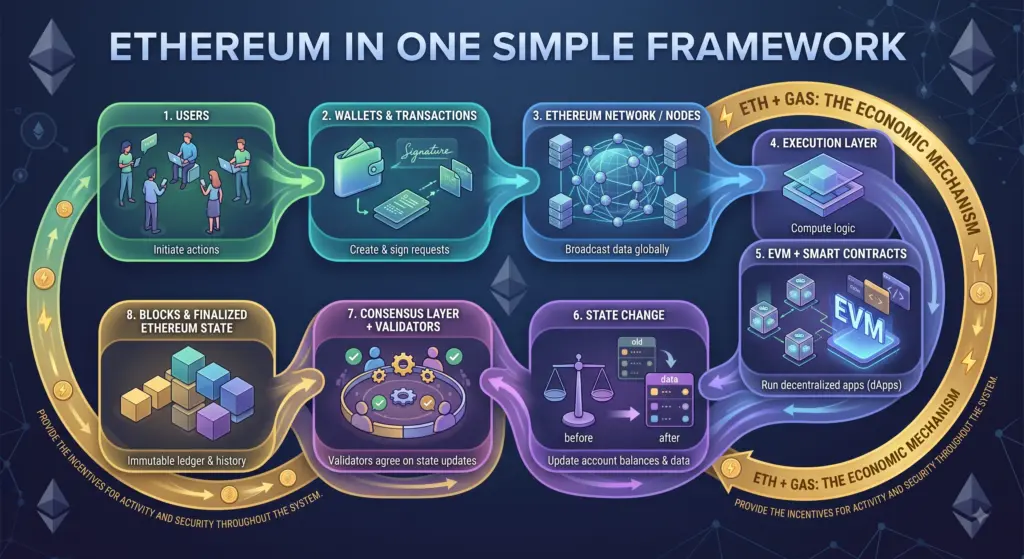
The Bigger Picture Of Ethereum Network
When we look at Ethereum as a whole, it becomes easier to understand why it is much more than a cryptocurrency.
Blockchain provides the shared record.
Nodes help maintain and verify the network.
Validators participate in Proof-of-Stake consensus.
Smart contracts provide programmable rules.
The EVM provides the environment for executing those programs.
Transactions allow users and applications to request state changes.
Gas measures and prices computational work.
ETH provides the native economic asset used for fees, staking, and value transfer.
Together, these components create a programmable blockchain platform on which developers can build decentralized applications and digital financial systems.
In simple words, Ethereum works by combining blockchain, cryptography, smart contracts, distributed computing, and Proof-of-Stake consensus into one open network where users can transfer value and interact with programmable applications without depending entirely on a central authority.
📚 Getting Started with Crypto
- A Beginners Guide to Cryptocurrency and Blockchain TechnologyA foundational guide explaining the basics of digital currencies and the blockchain technology that powers them.
- Basics of the Crypto MarketAn essential breakdown of how the cryptocurrency market operates for new investors.
- The Ultimate Guide to Crypto WalletsA complete guide on how to choose, set up, and secure cryptocurrency wallets.
6. What Is the Ethereum Virtual Machine?
After understanding Ethereum’s blockchain, nodes, validators, smart contracts, transactions, and gas, we now come to one of the most important technical components of Ethereum:
The Ethereum Virtual Machine, or EVM.
The EVM may sound highly technical at first, but its basic idea is simple.
The EVM is the computational environment that executes Ethereum smart contracts according to the rules of the Ethereum protocol.
Think of it as the execution engine of Ethereum.
When a user interacts with a smart contract, the EVM processes the contract’s instructions and calculates the resulting changes to Ethereum’s state.
How Does the EVM Work?
Developers usually write Ethereum smart contracts using programming languages such as Solidity.
However, the EVM does not directly execute Solidity source code.
The smart-contract code is compiled into EVM bytecode, which consists of instructions that the EVM can execute.
The basic process is:
Solidity Code
↓
Compilation
↓
EVM Bytecode
↓
EVM Executes the Instructions
↓
Ethereum State Changes
For example, a smart contract might contain a rule that allows one user to exchange one token for another.
When a user sends a valid transaction to that contract, the EVM executes the relevant instructions and produces a new result according to the contract’s code and Ethereum’s protocol rules.
The EVM Is a Deterministic Environment
One of the most important characteristics of the EVM is deterministic execution.
This means that, given the same starting state and the same valid transaction, Ethereum nodes should arrive at the same result.
This property is essential for a decentralized blockchain.
Imagine if different nodes calculated different results from the same transaction. The network would quickly become inconsistent.
The EVM helps prevent this by providing a standardized execution environment in which smart-contract instructions are processed according to defined rules.
In simple words:
Same starting state + same transaction + same rules = same execution result.
The EVM and Ethereum’s State
The EVM does not simply perform calculations and forget the result.
Smart-contract execution can change Ethereum’s state.
For example, executing a transaction may:
- Transfer ETH
- Change token balances
- Update smart-contract storage
- Create a new contract
- Change ownership information
- Trigger another smart contract
- Update other blockchain data
Therefore, the EVM plays a central role in moving Ethereum from one valid state to another.
Previous State → EVM Execution → New State
This is one of the most important concepts for understanding how Ethereum actually works.
The EVM and Smart Contracts
Smart contracts are programs deployed on Ethereum, and the EVM provides the environment in which those programs execute.
A smart contract can contain functions and rules that determine what happens when users interact with it.
For example, a decentralized lending application may use smart contracts to manage:
- Deposits
- Withdrawals
- Borrowing
- Repayment
- Collateral
- Interest calculations
- Liquidation rules
When users interact with these functions, the EVM executes the relevant contract instructions.
This is what makes Ethereum programmable.
Instead of using blockchain only to record transfers, Ethereum can use programmable logic to create complex applications.
Why Is Gas Necessary for the EVM?
Every computational operation performed by the EVM consumes gas.
Gas provides a way to measure the computational resources required to execute an operation.
Simple operations generally require less gas, while more complex computations can require more.
Gas serves several important purposes.
First, it gives computation an economic cost.
Second, it helps prevent malicious or accidental programs from consuming unlimited computational resources.
Third, it helps manage the finite computational capacity available in each block.
Users ultimately pay transaction fees in ETH based on the amount of gas consumed and the applicable fee parameters.
In simple words:
Gas puts a price on computation.
The EVM Is More Than a Calculator
It is tempting to think of the EVM as simply a calculator that runs smart contracts.
That would be incomplete.
The EVM is a virtualized execution environment with a defined instruction set, memory model, storage model, execution rules, and gas accounting system.
It provides the standardized rules that Ethereum clients follow when executing transactions and smart contracts.
The EVM operates with several types of data and execution resources, including:
- Stack — temporary data used during computation
- Memory — temporary, expandable data used during execution
- Storage — persistent data associated with a smart contract
- Calldata — data supplied with a transaction or contract call
- Bytecode — the instructions executed by the EVM
Understanding the difference between memory and storage is particularly important.
Memory exists only during execution, while contract storage persists as part of Ethereum’s state.
EVM and Contract Creation
The EVM is also involved when new smart contracts are deployed.
A contract deployment transaction contains initialization code.
When Ethereum executes that deployment, the EVM processes the initialization code and produces the contract’s runtime bytecode.
The resulting contract is then associated with an address on Ethereum.
After deployment, users and other contracts can interact with that contract by sending transactions or contract calls that invoke its functions.
This is how Ethereum turns software code into persistent blockchain-based applications.
Why Is the EVM So Important?
The EVM is one of the fundamental reasons Ethereum became a programmable blockchain.
Without a standardized execution environment, developers would have difficulty creating applications that could be executed consistently across a decentralized network.
The EVM provides a common computational framework.
This has helped create a large ecosystem of:
- Decentralized finance (DeFi)
- Stablecoins
- NFTs
- Decentralized exchanges
- Lending protocols
- Blockchain games
- Tokenized assets
- DAOs
- Wallets
- Other decentralized applications
The EVM has also influenced many other blockchain networks that aim to provide compatibility with Ethereum-based smart contracts and developer tools.
EVM Compatibility
You will often hear the term “EVM-compatible” in the crypto industry.
Generally, this means that another blockchain or execution environment supports Ethereum-style smart-contract execution or provides compatibility with Ethereum’s tooling and programming environment.
This can make it easier for developers to deploy or adapt applications across compatible networks.
However, EVM-compatible does not mean identical to Ethereum.
Different networks can have different:
- Consensus mechanisms
- Validators
- Security assumptions
- Fees
- Performance characteristics
- Governance structures
- Decentralization levels
Therefore, investors should not assume that an EVM-compatible network automatically has the same security or decentralization properties as Ethereum.
EVM: The Simple Mental Model
If you want to remember the EVM in the easiest possible way:
Ethereum Blockchain = The shared state and history
Smart Contracts = The programmable rules
EVM = The execution environment
Gas = The cost of computation
ETH = The native economic asset
Together, these components allow Ethereum to function as a programmable blockchain.
The Bigger Picture On EVM
The importance of the EVM becomes clear when we look at the complete process.
A developer writes a smart contract.
↓
The contract is compiled into EVM bytecode.
↓
The contract is deployed to Ethereum.
↓
A user sends a transaction to interact with it.
↓
Ethereum processes the transaction.
↓
The EVM executes the required instructions.
↓
Gas measures the computational work.
↓
The execution produces a valid state transition.
↓
The resulting state is incorporated into Ethereum’s blockchain through the network’s consensus process.
This entire process happens through a decentralized network rather than through a single company’s server.
In Simple Words
The Ethereum Virtual Machine is the engine that makes Ethereum programmable. It provides a standardized environment where smart-contract code can be executed, computational resources can be measured through gas, and transactions can produce verifiable changes to Ethereum’s state.
Without the EVM, Ethereum would not have the same general-purpose programmability that allows developers to build complex decentralized applications and financial systems on top of the blockchain.
ZenvestAI Insight:
Smart contracts are automated programs deployed on the blockchain that execute predefined rules without human intervention. While they eliminate the need for a middleman, they are not automatically safe and can contain coding errors or logic bugs. Decentralization changes the type of risk; it does not eliminate it. 💡
📈 Trading & Spending
- How to Start Crypto Futures Trading with Low Capital?Actionable strategies and tips for beginners to start trading crypto futures with minimal capital.
- Why the Binance Virtual Card is the Smartest Way to Spend Crypto in Asia (2026 Guide)A comprehensive guide on using the Binance Virtual Card for crypto spending across Asia in 2026.
7. Ethereum Economics: Supply, Burn, and Staking
Understanding Ethereum’s supply system is essential for understanding its long-term investment potential.
Unlike Bitcoin, which has a fixed maximum supply of 21 million BTC, Ethereum does not have a permanently fixed supply cap. Instead, the amount of ETH in circulation changes over time based on two major forces:
- New ETH issuance — primarily through the Proof-of-Stake system.
- ETH burning — ETH that is permanently removed from circulation through the network’s fee mechanism.
This makes Ethereum’s monetary system more dynamic than Bitcoin’s.
The Ethereum Transition to Proof of Stake
Ethereum originally used Proof of Work (PoW), where miners used computing power and electricity to secure the network and earn ETH rewards.
That changed in September 2022 with The Merge.
The Merge moved Ethereum’s consensus mechanism from Proof of Work to Proof of Stake (PoS). Under Proof of Stake, validators deposit ETH as a form of economic security and participate in confirming transactions and maintaining network consensus.
This transition dramatically reduced Ethereum’s new ETH issuance compared with the previous mining-based system.
How Does Ethereum Staking Work?
Staking means committing ETH to Ethereum’s Proof-of-Stake system to help secure the network.
Validators are responsible for proposing and validating blocks. In return for performing these duties correctly, they can receive ETH rewards.
There are several ways to participate in Ethereum staking:
- Run your own validator: A solo validator requires 32 ETH and appropriate technical infrastructure.
- Staking-as-a-service: A third-party provider operates the validator infrastructure on your behalf.
- Pooled staking: Investors can participate with smaller amounts of ETH through staking pools or other staking services.
However, staking should never be treated as risk-free income.
The potential rewards compensate participants for providing capital and taking on risks. These risks can include:
- Validator downtime
- Slashing penalties
- Operational and technical failures
- Custody risks
- Smart-contract risks when using third-party staking protocols
- Counterparty or platform risks
Therefore, the headline staking yield should never be considered the same as a guaranteed interest rate from a bank deposit.
Is ETH Permanently Deflationary?
No.
This is one of the most important concepts to understand about Ethereum’s economics.
Ethereum does not have a fixed maximum supply like Bitcoin. Instead, ETH supply can increase or decrease depending on the relationship between new ETH issuance and ETH burned by the network.
Ethereum’s fee system was significantly changed by EIP-1559. Under this mechanism, the base fee paid for transactions is burned, meaning that portion of ETH is permanently removed from circulation.
At the same time, the Proof-of-Stake system issues new ETH to validators as protocol rewards.
Therefore:
Net ETH Supply Change = New ETH Issued − ETH Burned
If Ethereum burns more ETH than it issues over a particular period, the total ETH supply decreases.
If Ethereum issues more ETH than it burns, the total supply increases.
This means ETH can become net deflationary during periods of strong network activity, when demand for Ethereum blockspace causes enough ETH to be burned.
However, investors should not assume that ETH is permanently deflationary. Its supply can change over time depending on network usage, transaction activity, fee levels, staking participation, and protocol parameters.
Why Ethereum’s Supply Model Matters to Investors
Ethereum’s monetary system creates an important connection between network usage and ETH economics.
When people use Ethereum for decentralized applications, DeFi, token transfers, stablecoins, NFTs, and other activities, they compete for limited blockspace.
Greater demand for blockspace can lead to higher transaction fees and potentially greater ETH burning.
This creates an interesting economic relationship:
More network activity → Greater demand for blockspace → More fees → More ETH burned
However, this relationship is not automatic or permanent. Ethereum’s actual supply dynamics depend on both ETH issuance and ETH burn.
Therefore, investors should focus on the net supply change rather than simply describing ETH as “deflationary.”
Ethereum as a Digital Commodity
ETH has several important economic functions within the Ethereum ecosystem.
| Function | Description |
|---|---|
| Digital Asset | ETH can be held and transferred as a native digital asset on the Ethereum network. |
| Network Resource | ETH is required to pay transaction fees, commonly called gas fees, for using Ethereum blockspace. |
| Staking Asset | ETH can be staked to participate in Ethereum’s Proof-of-Stake consensus and help secure the network. |
| DeFi Collateral | ETH is widely used as collateral across many decentralized finance applications, although the specific risks and use cases vary by protocol. |
| Economic Security | Staked ETH provides economic security to the Ethereum network because validators have capital at risk. |
The Bigger Picture
Ethereum’s economic model is different from Bitcoin’s.
Bitcoin emphasizes predictable scarcity and a fixed maximum supply, while Ethereum uses a more dynamic monetary model that combines ETH issuance with ETH burning.
For long-term investors, this distinction matters.
ETH’s value proposition is not based solely on scarcity. It also depends on Ethereum’s role as a programmable blockchain, the demand for its blockspace, the growth of applications built on the network, staking participation, and the broader adoption of the Ethereum ecosystem.
The key question is therefore not simply:
“Is ETH deflationary?”
A better question is:
“How are Ethereum’s network usage, ETH issuance, and ETH burn interacting over the long term?”
That is the more useful framework for understanding Ethereum’s economics.
🏢 Business, Tokenization & Regulations
- How Tokenization is Empowering Small Businesses in 2026An exploration of how small businesses are leveraging asset tokenization for growth and fundraising in 2026.
- The Future of Crypto RegulationsAn overview of the upcoming legal and regulatory frameworks shaping the global cryptocurrency market.
8. The Ethereum Ecosystem: DeFi, Tokenization, and Layer 2
Ethereum is more than a cryptocurrency. It is a programmable blockchain that supports a large ecosystem of financial applications, digital assets, and decentralized services.
Three areas are particularly important when evaluating Ethereum’s long-term potential:
- Decentralized Finance (DeFi)
- Tokenization of Real-World Assets (RWAs)
- Layer 2 (L2) scaling networks
Together, these developments can influence the long-term demand for Ethereum and its native asset, ETH.
Ethereum and Decentralized Finance (DeFi)
Decentralized Finance (DeFi) refers to financial applications that use blockchain-based smart contracts to provide services such as trading, lending, borrowing, and asset management without relying entirely on traditional financial intermediaries.
Ethereum became one of the most important foundations of the DeFi ecosystem because its smart-contract infrastructure allows developers to build programmable financial applications.
For example, decentralized exchanges (DEXs) allow users to trade digital assets through smart-contract-based liquidity systems rather than relying solely on traditional centralized order books.
However, DeFi does not eliminate financial risk.
Users may face risks such as:
- Smart-contract vulnerabilities
- Slippage
- Oracle failures
- Liquidity risk
- Impermanent loss
- Protocol exploits
- Stablecoin risks
- Private-key and wallet-security risks
Therefore, self-custody and decentralization can provide greater control, but they also place more responsibility on the user.
Why Do Layer 2 Networks Matter for ETH Investors?
Ethereum’s main network has limited blockspace, which can make transactions expensive during periods of high demand.
Layer 2 (L2) networks are designed to process transactions more efficiently while using Ethereum for important parts of security, data availability, or settlement, depending on the specific L2 architecture.
The basic idea is simple:
Ethereum Layer 1 → Security and settlement foundation
Layer 2 → Higher transaction capacity and potentially lower user costs
This creates an important question for ETH investors:
If users move to cheaper Layer 2 networks, does that reduce Ethereum’s value?
The answer is more complicated.
Lower-cost L2 networks can reduce the amount individual users pay for transactions on Ethereum’s Layer 1. However, L2s can also expand Ethereum’s overall capacity, improve the user experience, support new applications, and potentially bring more users and economic activity into the broader Ethereum ecosystem.
Therefore, investors should not evaluate Ethereum only by looking at Layer 1 transaction fees.
A more complete framework is:
More L2 adoption → Greater Ethereum ecosystem capacity → More applications and users → Potentially greater demand for Ethereum infrastructure
However, this does not automatically mean higher ETH prices. The economic relationship between L2 activity, Ethereum fee revenue, ETH burn, ETH issuance, and ETH value is complex and continues to evolve.
Ethereum and the Tokenization of Real-World Assets
One of the most important long-term blockchain narratives is the tokenization of Real-World Assets (RWAs).
Tokenization involves representing ownership or economic rights to traditional assets on blockchain infrastructure.
Potential examples include:
- U.S. Treasury securities
- Private credit
- Funds
- Real estate
- Commodities
- Other financial instruments
Ethereum and Ethereum-compatible networks are among the platforms being used to develop and operate tokenized financial products.
The potential advantage is that blockchain infrastructure can enable programmable ownership, automated settlement, transparent transaction records, and potentially faster movement of assets.
This has attracted increasing interest from financial institutions and technology companies.
However, tokenization also comes with important challenges, including regulation, custody, legal ownership, liquidity, compliance, and the connection between on-chain tokens and real-world assets.
Will Ethereum Become a Foundation of Global Finance?
Ethereum has the potential to become an important part of future digital financial infrastructure, but it is too early to say that it will definitely become the foundation of global finance.
The future financial system could involve a combination of:
- Ethereum
- Other public blockchains
- Layer 2 networks
- Permissioned blockchains
- Centralized financial infrastructure
- Traditional banking systems
- Government and institutional digital-asset infrastructure
Ethereum’s long-term opportunity therefore depends on whether developers, institutions, businesses, and users continue choosing its ecosystem for meaningful economic activity.
Account Abstraction and the Future User Experience
Another important development is account abstraction and improvements to Ethereum accounts.
Technologies and upgrades such as EIP-7702 are designed to give externally owned accounts (EOAs) greater flexibility and smart-contract-like capabilities.
These developments can support features such as:
- Transaction batching
- Gas sponsorship
- More flexible transaction authorization
- Better wallet experiences
- Greater automation
- Improved security and recovery mechanisms through appropriate wallet designs
The long-term goal is to make blockchain applications easier for ordinary users to understand and use.
Today, many blockchain interactions still require users to understand concepts such as gas fees, private keys, network selection, wallet addresses, and transaction signing.
A better user experience could hide much of this technical complexity.
If Ethereum-based applications become as easy to use as mainstream internet applications, the potential user base could expand significantly.
However, this is a long-term possibility, not a guaranteed outcome.
ZenvestAI Insight
Ethereum’s investment thesis should not depend on a single narrative such as DeFi, Layer 2, or tokenization.
The stronger thesis is the combination of network adoption, developer activity, stablecoins, DeFi, tokenized assets, Layer 2 growth, staking, and Ethereum’s role as a settlement and data infrastructure layer.
At the same time, investors should remember an important principle:
Ecosystem growth does not automatically equal ETH price appreciation.
ETH ultimately needs a sustainable economic relationship with the activity taking place across Ethereum and its broader ecosystem.
9. Ethereum Investment Strategies and Market Cycles
Investing in Ethereum requires a different approach from investing in traditional stocks.
Traditional valuation models such as price-to-earnings ratios do not directly apply to ETH because Ethereum is not a company that generates corporate earnings in the traditional sense.
Instead, investors can use a multi-factor framework that combines network activity, monetary economics, market valuation, and ecosystem growth.
What Should Ethereum Investors Monitor?
Rather than looking only at the ETH price, investors can monitor several important indicators:
1. Network Activity
Look at metrics such as transaction activity, active addresses, gas usage, and overall demand for Ethereum blockspace.
2. Ethereum Security
Monitor the amount of ETH participating in Proof of Stake and the overall health of the validator ecosystem.
3. Monetary Economics
Pay attention to:
- New ETH issuance
- ETH burned through network activity
- Net changes in ETH supply
- Staking participation
4. Ecosystem Growth
Consider developments in:
- DeFi
- Stablecoins
- Layer 2 networks
- Tokenized Real-World Assets
- Developer activity
- Institutional adoption
5. Market Valuation and Sentiment
Price should be evaluated alongside fundamentals and market sentiment.
A rapidly rising price combined with extreme optimism may indicate an overheated market. Conversely, severe pessimism and falling prices do not automatically mean ETH is undervalued.
The goal is not to predict the exact top or bottom.
The goal is to understand whether price, fundamentals, and market expectations are moving together or becoming significantly disconnected.
What Is a Practical Way to Accumulate ETH?
There is no single “best” method for every investor. Your strategy should depend on your income, risk tolerance, investment horizon, and financial goals.
One of the simplest approaches is Dollar-Cost Averaging (DCA).
DCA means investing a fixed amount at regular intervals regardless of short-term price movements.
For example:
Invest ₹10,000 in ETH every month.
When prices are high, the same ₹10,000 purchases less ETH.
When prices are lower, the same ₹10,000 purchases more ETH.
Over time, this approach reduces the pressure to predict the perfect entry point and encourages consistent investing.
However, DCA does not eliminate risk. If Ethereum experiences a prolonged decline, the investor can still experience significant losses.
Value-Based Accumulation
More experienced investors may use a value-based accumulation strategy.
Instead of investing exactly the same amount regardless of market conditions, they adjust their purchases according to valuation, market conditions, and their assessment of Ethereum’s long-term fundamentals.
For example:
- Normal conditions: Maintain regular purchases.
- Extended weakness: Consider increasing purchases if the long-term thesis remains intact.
- Extreme optimism: Consider reducing new purchases or increasing cash reserves.
- Fundamental deterioration: Reassess the investment thesis before buying more.
This approach can potentially improve capital allocation, but it requires greater discipline and a reliable framework for assessing valuation.
Understanding Ethereum Market Cycles
Crypto markets historically move through periods of accumulation, expansion, euphoria, correction, and renewed accumulation.
These phases are not perfectly predictable, and real markets do not always follow a fixed sequence. Nevertheless, understanding the general cycle can help investors manage expectations and avoid emotional decision-making.
Stage 1: Accumulation
Weak Sentiment
Prices have fallen significantly from previous highs. News and sentiment may remain negative, while many investors have little interest in the market.
Long-term investors may gradually build positions because they believe the fundamental thesis remains intact.
Investor mindset: Patience and disciplined accumulation.
Stage 2: Recovery
Fundamentals Begin Improving
Selling pressure starts to decline. Network activity, liquidity, developer activity, or broader market conditions may begin improving.
Prices may recover gradually, but investor confidence is still relatively low.
This phase can be difficult because the market may still experience sharp pullbacks.
Investor mindset: Continue following the plan rather than chasing short-term price movements.
Stage 3: Bull Market
Expansion and Momentum
Prices begin rising more strongly. Market participation increases, positive narratives spread, and media attention grows.
More investors become interested in Ethereum and the broader crypto ecosystem.
However, rising prices can also encourage excessive leverage and speculative behavior.
Investor mindset: Stay disciplined and avoid allowing rising prices to change your risk limits.
Stage 4: Euphoria
Extreme Optimism
Market confidence becomes very high. Investors may begin assuming that prices can only continue rising.
Speculative projects attract significant attention, leverage can increase, and valuation expectations may become increasingly optimistic.
This is when risk management becomes especially important.
Investor mindset: Protect capital and avoid FOMO.
Stage 5: Distribution
Selling Pressure Increases
After a major period of appreciation, some long-term investors may begin reducing their positions or taking profits.
Volatility can increase significantly as market participants disagree about future valuations.
The transition from a bull market to a bear market is not always obvious while it is happening.
Investor mindset: Follow predetermined risk-management and portfolio-rebalancing rules rather than emotional decisions.
Stage 6: Correction and Bear Market
Reset
Prices can fall substantially as excessive optimism disappears.
Speculative activity declines, weak projects may fail, leverage is reduced, and investor sentiment becomes increasingly negative.
For investors with a long-term thesis, this phase can create opportunities—but only if the underlying fundamentals remain healthy.
Investor mindset: Reassess the thesis, preserve capital, and prepare for the next cycle rather than assuming every decline is automatically a buying opportunity.
How Should You Structure an Ethereum Portfolio?
One practical framework is the Core-Satellite strategy.
The Core
The Core consists of your primary long-term ETH allocation.
The purpose of the core is to provide long-term exposure to Ethereum without requiring frequent trading.
Depending on the investor, the core may simply consist of ETH held with a long-term investment horizon.
The Satellites
The Satellite portion consists of smaller, higher-risk positions that may provide exposure to specific areas of the Ethereum ecosystem.
Examples could include:
- Selected DeFi protocols
- Layer 2 ecosystems
- Infrastructure projects
- Other carefully researched digital assets
The satellite allocation should generally be much smaller than the core because these assets can carry substantially higher risks, including smart-contract risk, liquidity risk, regulatory risk, technological risk, and project-specific failure.
The Golden Rule of Core-Satellite Investing
The satellite should never be large enough to threaten the financial foundation of the portfolio.
In other words:
Protect the Core → Control the Satellites → Rebalance Periodically
This framework helps investors participate in higher-growth opportunities without allowing speculative positions to dominate the entire portfolio.
ETH and Bitcoin: Complementary but Different
Bitcoin and Ethereum can be viewed as two different types of exposure within the digital-asset market.
Bitcoin primarily emphasizes:
- Monetary scarcity
- Decentralized digital money
- Long-term store-of-value characteristics
- A highly predictable issuance schedule
Ethereum emphasizes:
- Programmable blockchain infrastructure
- Smart contracts
- DeFi
- Stablecoins
- Tokenization
- Layer 2 ecosystems
- Proof-of-Stake network security
Therefore, owning both does not necessarily mean owning the same investment thesis twice.
They represent different approaches to the development of the digital-asset economy.
ZenvestAI Investment Principle
Do not invest in ETH simply because you expect the price to rise.
Understand what you are buying.
Study Ethereum’s network activity, monetary economics, ecosystem development, competitive position, market cycles, and risks.
Then create an investment plan that determines:
How much to invest → When to invest → How much risk to take → When to rebalance → When to reconsider the thesis
The objective is not to perfectly predict every Ethereum market cycle.
The objective is to build a disciplined system that can survive them.
10. Ethereum Risk Management and Security
Ethereum can offer significant long-term opportunities, but it also comes with substantial risks. A successful investment strategy is therefore not only about finding opportunities—it is also about protecting capital.
The most important risks include:
- Market volatility
- Leverage and liquidation
- Smart-contract vulnerabilities
- Staking and validator risks
- Exchange and custody risks
- Private-key and wallet-security risks
- Liquidity risks
- Regulatory uncertainty
- Stablecoin and counterparty risks
Understanding these risks before investing is just as important as understanding Ethereum’s potential.
Why Is Leverage Dangerous?
Leverage magnifies both gains and losses.
For example, with 2× leverage, a 20% adverse movement in the underlying position can have a substantially larger impact on your trading capital, before considering fees, funding costs, and liquidation mechanics.
In highly volatile crypto markets, liquidation can occur much faster than an investor expects.
Therefore:
Leverage should be treated as a risk-management and trading tool—not as a shortcut to wealth.
If you cannot clearly calculate your maximum potential loss, liquidation price, position size, and funding costs, you should reconsider using leverage.
Be Careful When Using ETH as Collateral
ETH can be used as collateral in various decentralized finance (DeFi) protocols to borrow other assets, including stablecoins.
However, borrowing against ETH introduces additional risks.
If the price of ETH falls significantly, your collateral value decreases while your debt remains.
This can increase your loan-to-value (LTV) ratio and potentially trigger liquidation.
For this reason, investors should never borrow the maximum amount simply because a protocol allows it.
A more conservative approach is to maintain a substantial safety margin between your actual borrowing level and the protocol’s liquidation threshold.
Protocol maximum ≠ Safe borrowing level.
How Can You Safely Custody Ethereum?
Self-custody means controlling your own private keys rather than relying entirely on an exchange or another third party to hold your assets.
It can reduce certain forms of counterparty and exchange-custody risk, but it also creates another responsibility:
You become responsible for protecting access to your assets.
If you lose your recovery information or authorize a malicious transaction, there may be no centralized institution that can reverse the transaction for you.
For significant long-term holdings, many investors consider hardware wallets because they can keep private keys isolated from many online threats.
However, a hardware wallet is not a complete security solution. The security of your Ethereum ultimately depends on how carefully you manage your wallet, recovery information, devices, and transactions.
Protect Your Recovery Phrase
Your seed phrase or recovery phrase is one of the most important pieces of information controlling access to your wallet.
Follow these basic principles:
- Never share your recovery phrase with anyone.
- Never store it in cloud storage.
- Never email or message it to yourself.
- Never photograph or screenshot it.
- Never enter it into a website unless you fully understand why it is required.
- Never give it to someone claiming to be wallet or exchange support.
- Keep a secure offline backup.
- Consider appropriate physical protection against loss, theft, or damage.
Remember:
Anyone who obtains your recovery phrase may be able to control the assets associated with that wallet.
Legitimate support personnel should never need your recovery phrase or private key.
The ZenvestAI Ethereum Risk Pyramid
Not all ETH strategies carry the same level of risk.
As additional layers of complexity are added, the number of potential failure points can also increase.
Level 1 — Spot ETH
Primary risks:
- ETH price volatility
- Market cycles
- Liquidity and exchange risks
- Regulatory uncertainty
Spot ETH does not involve liquidation from leverage, but the asset itself can experience large price movements.
Level 2 — Staking
Additional risks:
- Validator performance
- Slashing
- Operational risks
- Staking-provider or custody risks
Staking can generate protocol rewards, but those rewards are compensation for participating in network security and taking associated risks—not guaranteed interest.
Level 3 — Liquid Staking
Liquid staking can provide greater flexibility because users may receive a token representing their staked position.
However, it introduces additional risks, including:
- Smart-contract vulnerabilities
- Liquidity risk
- Depeg risk
- Protocol-specific risks
- Additional counterparty or governance risks, depending on the design
Level 4 — DeFi, Restaking, and Complex Strategies
At the higher-risk end of the pyramid, investors may combine ETH with lending, borrowing, liquidity provision, restaking, derivatives, or multiple protocols.
Potential risks can include:
- Smart-contract exploits
- Oracle failures
- Liquidation
- Slashing
- Liquidity shortages
- Protocol failures
- Counterparty risk
- Correlated losses across interconnected protocols
More complexity does not automatically mean higher returns.
It often means more variables that can go wrong.
The ZenvestAI Capital Protection Rule
A strong investment strategy should allow you to remain financially and emotionally comfortable during major market declines.
If an ETH allocation is so large that a significant price drop would cause you to panic, sell at the worst possible time, or disrupt your financial obligations, the position may be too large for your personal risk tolerance.
This leads to an important principle:
The right allocation is not the maximum allocation you can afford. It is the allocation you can realistically hold through extreme volatility.
Protecting Profits Through Rebalancing
During major market appreciation, investors may become emotionally attached to rising prices.
However, a gain on paper is not the same as protected wealth.
Rebalancing means periodically adjusting your portfolio back toward your intended asset allocation.
For example, if ETH grows from 20% of a portfolio to 35% because of a major price increase, an investor may decide to reduce the ETH position and move some capital into other assets or cash, depending on their investment plan.
This can help control concentration risk and protect accumulated gains.
Rebalancing does not guarantee profits, and selling too early can also have an opportunity cost. The important point is to establish rules before emotions become intense.
### ZenvestAI Insight
Making money and keeping money are two different skills.
In Ethereum investing, opportunity and risk always exist together. The objective is not to eliminate every risk—that is impossible.
The objective is to understand the risks, control position size, avoid unnecessary leverage, protect your private keys, diversify where appropriate, and maintain enough financial flexibility to survive major market cycles.
Protect the capital first. Let compounding work second.
A disciplined investor does not ask only, “How much can I make?”
The better question is:
“How much can I afford to lose without damaging my long-term financial plan?”
11. Advanced Wealth Strategy and Legacy
Building wealth with Ethereum is not simply about owning a large amount of ETH.
True financial freedom comes from building a financial system that can support your life without making you completely dependent on active employment income or the price of a single asset.
ETH may play an important role in that system, but it should be viewed as one component of a broader wealth strategy.
A resilient financial plan may include:
- Active income and business income
- Emergency savings
- Equities and other productive assets
- Bonds and fixed-income investments
- Real estate, where appropriate
- Digital assets such as ETH
- Insurance and risk protection
- Cash reserves
- A properly structured estate and succession plan
The objective is not to put everything into Ethereum.
The objective is to build a diversified financial system in which Ethereum can potentially contribute to long-term wealth creation without putting your entire financial future at risk.
What Is the Ethereum Wealth Flywheel?
The Ethereum Wealth Flywheel is a disciplined framework for turning income and savings into long-term wealth while continuously managing risk.
A simple version of the flywheel is:
Earn → Save → Accumulate → Stake Where Appropriate → Compound → Rebalance → Protect → Repeat
Let’s understand each stage.
1. Earn
Wealth creation begins with income.
Your salary, business income, professional skills, or other legitimate sources of cash flow provide the capital that can eventually be allocated toward investments.
The first wealth-building asset is often your ability to earn.
Do not neglect career development or business growth simply because you are investing in crypto.
2. Save
Before aggressively accumulating volatile assets, build financial stability.
Maintain an appropriate emergency reserve and avoid investing money that you may need for essential expenses in the near future.
A strong savings foundation gives you something extremely valuable:
the ability to stay invested without being forced to sell during a market downturn.
3. Accumulate ETH
Once your financial foundation is reasonably strong, you can determine whether ETH deserves a place in your portfolio.
The approach should be based on:
- Your financial goals
- Risk tolerance
- Investment horizon
- Existing assets
- Cash-flow requirements
- Overall portfolio allocation
Instead of trying to predict every short-term price movement, some long-term investors may use a disciplined accumulation approach.
The important principle is:
Position size matters as much as asset selection.
Even an asset you strongly believe in can become dangerous if it represents too large a portion of your total wealth.
4. Stake Where Appropriate
Ethereum’s Proof-of-Stake system allows eligible ETH to participate in network security through staking.
Staking may provide rewards, but it is not free money and should not automatically be treated as guaranteed income.
Depending on how staking is performed, investors may face risks related to:
- Lock-up or liquidity considerations
- Validator performance
- Slashing
- Smart contracts
- Counterparty risk
- Custody
- Platform risk
- Changing network conditions
Therefore, staking should be considered only after understanding the specific risks and mechanics involved.
Stake because it fits your strategy—not simply because it offers a yield.
5. Compound
Over long periods, reinvesting investment returns can create a compounding effect.
With Ethereum, this can potentially involve retaining or reinvesting staking rewards rather than immediately spending them.
However, compounding does not remove market risk.
If ETH’s market value falls substantially, the value of accumulated rewards can also decline when measured in fiat currency.
Therefore:
Compounding can accelerate wealth creation, but it does not eliminate risk.
6. Rebalance
Markets move.
As ETH appreciates or declines relative to your other investments, its percentage of your total portfolio can change significantly.
For example, suppose your target allocation to digital assets is 15%, but a strong crypto bull market causes it to become 30%.
Your portfolio may now carry substantially more risk than you originally intended.
Rebalancing brings the portfolio closer to your planned allocation.
This creates an important discipline:
Do not allow a successful investment to quietly become an oversized risk.
7. Protect Capital
Making money and keeping money are two different skills.
As your portfolio grows, capital protection becomes increasingly important.
Risk management may include:
- Appropriate asset allocation
- Diversification
- Secure custody
- Strong wallet security
- Emergency liquidity
- Avoiding excessive leverage
- Avoiding concentration
- Maintaining proper records
- Reviewing portfolio exposure regularly
The objective is simple:
Survive the bad years so you can participate in the good years.
8. Repeat
Wealth building is not a one-time transaction.
You earn, save, invest, manage, rebalance, protect, and repeat.
Over many years, this process can become a wealth-building system rather than a series of emotional investment decisions.
That is the real purpose of the flywheel.
From Wealth Creation to Wealth Preservation
At a certain point, the question changes.
In the early stage, you may ask:
“How can I build wealth?”
Later, the more important question becomes:
“How can I protect and transfer the wealth I have built?”
This is where legacy planning becomes important.
A large digital-asset portfolio without a proper succession plan can create serious problems for a family.
Your beneficiaries may not know:
- Which assets you own
- Where those assets are held
- Which wallets exist
- How your assets are structured
- Which platforms you use
- Where important documents are stored
- What legal arrangements apply
- How your digital assets should be accessed or transferred
Therefore, wealth creation should eventually be followed by wealth organization and wealth transfer planning.
Ethereum and Digital-Asset Legacy Planning
A mature Ethereum wealth strategy should include a secure and legally appropriate system for documenting your digital assets.
Depending on your circumstances and jurisdiction, this may involve:
Asset Inventory
Maintain an up-to-date record of your major financial and digital assets.
This can include ETH holdings, other digital assets, brokerage investments, bank accounts, real estate, and other significant assets.
Legal Documentation
Work with qualified legal and tax professionals to understand appropriate wills, trusts, nominations, succession arrangements, and inheritance requirements applicable to your jurisdiction.
Crypto assets can create unique succession challenges, so generic estate planning may not always address every practical issue.
Secure Recovery Planning
Your beneficiaries need a legitimate and secure way to access assets if something happens to you.
However, this does not mean writing your seed phrase or private keys into an ordinary document, email, or unsecured cloud storage.
Private keys and seed phrases are extremely sensitive credentials.
A good legacy system should balance:
Accessibility for the right person + protection from unauthorized access.
Beneficiary Education
Simply leaving someone a wallet address is not enough.
A beneficiary may need to understand what the asset is, where it is held, what documentation exists, and whom to contact for professional assistance.
This is particularly important because digital assets do not always work like traditional bank accounts.
The Final Stage of the Ethereum Wealth Strategy
The ultimate goal is not:
Accumulate more ETH → Accumulate more ETH → Accumulate more ETH.
The mature wealth cycle is broader:
Earn → Save → Invest → Accumulate → Compound → Rebalance → Protect → Preserve → Transfer → Repeat Across Generations
This is where an investment strategy becomes a wealth strategy.
Your ETH holdings should serve your broader financial goals—not control them.
You may accumulate ETH during your wealth-building years, reduce risk as your circumstances change, diversify into other productive assets, and eventually transfer a portion of your wealth to the next generation.
The goal is not simply to leave behind a wallet containing cryptocurrency.
The goal is to leave behind an organized, protected, understandable, and responsibly transferable financial legacy.
The ZenvestAI Principle
At ZenvestAI, we believe that wealth is built in stages.
First, build income.
Then, build savings.
Then, build assets.
Then, manage risk.
Then, protect capital.
Finally, build a legacy.
Ethereum can potentially be an important part of that journey, but it should never become the entire journey.
Own assets. Build resilience. Control risk. Protect capital. Think beyond yourself.
That is the difference between simply owning ETH and building a true Ethereum Wealth Strategy.
The Seven Rules of ZenvestAIEthereum Wealth:
- Never invest money you cannot afford to lose.
- Understand ETH before buying ETH.
- Never confuse staking yield with guaranteed income.
- Avoid unnecessary leverage.
- Protect your private keys at all costs.
- Diversify your wealth, not just your crypto.
- Think in years, not days. 📈
The Bottom Line
Ethereum should not be viewed simply as another cryptocurrency to speculate on. It represents one of the most ambitious experiments in building a decentralized, programmable economic network—with ETH at the center as the network’s native asset for transaction fees, staking, collateral, and value transfer.
But understanding Ethereum is only the beginning.
Building wealth with Ethereum requires a strategy.
Your financial plan should not depend on predicting where ETH will move next week or next month. Short-term price movements are unpredictable. Instead, focus on understanding Ethereum’s long-term economic role, managing risk with discipline, accumulating intelligently, and protecting your capital through different market cycles.
At ZenvestAI, we believe that wealth is not built by chasing every market move. It is built through knowledge, patience, risk management, and consistency.
So before you ask:
“How high can ETH go?”
Ask the more important questions:
“Why does Ethereum matter?”
“What role can ETH play in my portfolio?”
“How much risk can I responsibly take?”
“What is my strategy if the market rises, falls, or moves sideways?”
That shift—from price prediction to wealth strategy—is where intelligent investing begins.
Your Next Step
Continue exploring the ZenvestAI Ethereum Wealth Strategy to understand Ethereum’s investment thesis, ETH accumulation strategies, portfolio allocation, market cycles, staking, risk management, and capital-protection principles.
Learn first. Plan second. Invest with discipline. Build wealth for the long term.
Welcome to the ZenvestAI approach to Ethereum.

Pingback: What Is Crypto Staking? The Complete Guide to Earning Rewards Safely
Pingback: The Ultimate Risk-to-Reward Ratio Guide: Master Crypto Risk and Protect Your Capital