Key Takeaways
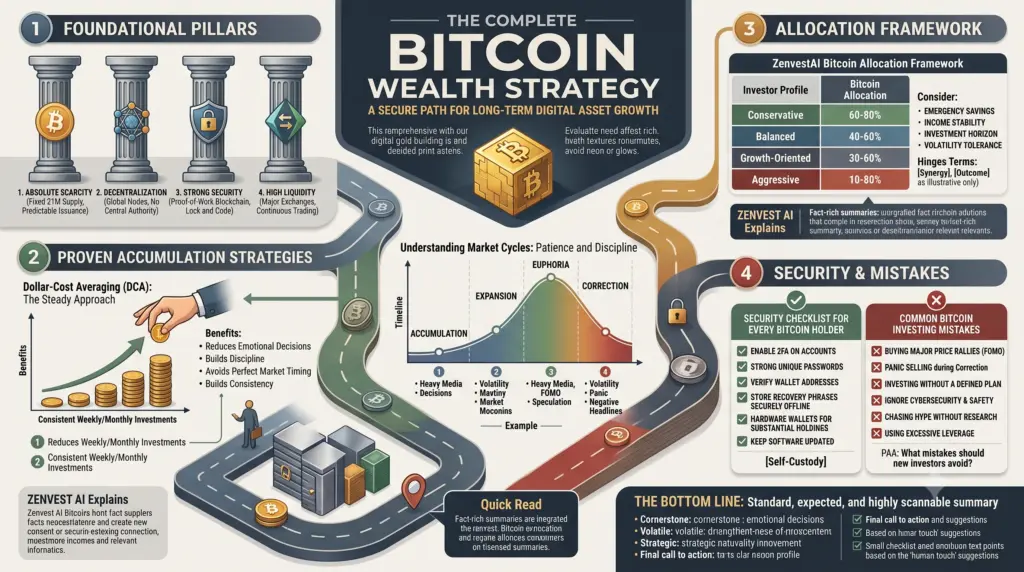
- Bitcoin operates on a decentralized, transparent network, free from central bank control.
- The total supply is permanently capped at
21 million, driving its absolute digital scarcity. - Long-term holding through
Dollar-Cost Averaging (DCA)reduces risk and emotional trading. - Understanding market cycles prevents panic selling during standard market corrections.
- Self-custody and strict security protocols are mandatory for preserving digital wealth.
📌 Author’s Note (August 2026)
We are currently witnessing a profound structural shift in how the world treats digital assets. With U.S. spot Bitcoin ETFs now collectively managing over $100 billion in assets and corporate treasuries officially treating Bitcoin as a standard reserve asset, the “Wild West” era of crypto speculation is over. Today’s market is dominated by institutional capital relying on the exact same disciplined, long-term Dollar-Cost Averaging strategies I advocate for in this guide. Bitcoin is no longer an experiment—it is the established foundation of modern digital wealth.
— Deepak Kumar
🚀 Stop watching from the sidelines and start building your digital wealth. Put your long-term DCA strategy into action today on the world’s leading crypto exchange.
👉 Create Your Free Binance Account
ZenvestAI Quick Read
- The Problem: Traditional savings lose purchasing power due to continuous fiat inflation.
- The Solution: Bitcoin serves as a scarce, decentralized [Nivesh] (investment) foundation to protect and grow long-term capital.
- The Strategy: Avoid short-term speculation; instead, build wealth steadily using the ZenvestAI Bitcoin Rules and a proven allocation framework.
What This Post Covers
- The fundamental definition and long-term purpose of Bitcoin.
- The five unshakeable pillars that make Bitcoin unique.
- The ZenvestAI Bitcoin Allocation Framework for different risk profiles.
- Five proven accumulation strategies, including DCA.
- How to navigate market cycles without emotion.
- A crucial security checklist for digital asset protection.
Have you ever felt like traditional savings just aren’t keeping up with the rising cost of living? You are not alone. The Complete Bitcoin Wealth Strategy: Why Bitcoin Has Become the Foundation of Modern Digital Wealth is here to guide you.
“Wealth is rarely built by chasing every opportunity. It is often built by consistently owning the right assets for a very long time.”
For millions of investors around the world, Bitcoin is no longer just another cryptocurrency. It has evolved into the foundation of a long-term digital asset strategy.
ZenvestAi Explains
Bitcoin represents a foundational shift in how we store and transfer wealth in the modern digital economy. It operates without a central authority, relying on a secure, decentralized global network.
By capping its total supply at 21 million coins, Bitcoin creates absolute digital scarcity, offering a unique alternative to traditional fiat currencies subject to inflation.
While historical volatility remains a prominent factor, patient investors increasingly utilize structured strategies like Dollar-Cost Averaging to build long-term exposure, preserve purchasing power, and create a powerful [Synergy] with their traditional assets.

Why Every Investor Should Understand Bitcoin
Imagine you were introduced to the internet in 1995. Some people ignored it, some laughed at it, while some believed it would change everything. Today, the internet powers almost every aspect of our daily lives.
Bitcoin may or may not become as transformative as the internet, but its impact on finance has already been substantial.
Since its launch in 2009, Bitcoin has grown from an experimental digital currency into a globally traded asset.
It is now held by individual investors, public companies, asset managers, family offices, pension funds, governments, and financial institutions.
Whether you choose to invest or not, understanding Bitcoin has become an important part of financial literacy in the digital age.
🛡️ Ready to secure your digital future? Start accumulating Bitcoin with confidence and immense liquidity on the world’s largest exchange.
👉 Start Your Bitcoin Journey on Binance
How does Bitcoin differ from traditional fiat money?
Bitcoin operates independently of any central bank or government [Single Window System]. Unlike fiat currencies, which can be printed in unlimited quantities causing inflation, Bitcoin’s strict protocol limits its maximum supply to 21 million. This mathematically enforced scarcity is why it is often called
"digital gold."
What Is Bitcoin?
Bitcoin is the world’s first decentralized cryptocurrency. It was introduced in 2009 by an anonymous creator using the name Satoshi Nakamoto.
Bitcoin allows people to send and receive value directly over the internet without relying on a central authority such as a bank.
Every transaction is verified by thousands of independent computers around the world.
These computers collectively maintain what is called the Bitcoin blockchain, a public ledger that records every transaction.
Because no single organization controls the network, Bitcoin operates differently from traditional financial systems.
This decentralized design is one of the primary reasons it has attracted investors globally.
📚 Deepen Your Digital Wealth Knowledge
Continue your ZenvestAI journey by mastering these essential crypto concepts:
-
🌱 For the Absolute Beginner:
“Before mastering wealth creation, you must master the fundamentals.”
👉 What Is Cryptocurrency? The Ultimate Beginner’s Guide -
⚙️ The Tech Behind the Money:
“Bitcoin is the asset, but the underlying blockchain is the true revolution.”
👉 How Distributed Ledgers Are Radically Rewriting the Rules of Modern Finance -
💳 Real-World Utility:
“What good is digital wealth if you cannot spend it easily in the real world?”
👉 Why the Binance Virtual Card is the Smartest Way to Spend Crypto in Asia (2026 Guide) -
📈 Active Market Strategies:
“For those ready to actively manage risk and leverage market volatility.”
👉 How to Start Crypto Futures Trading with Low Capital?
Bitcoin Is More Than a Cryptocurrency
Many beginners think Bitcoin is simply another digital coin to trade for quick profits.
Long-term investors often see something much bigger and far more profound.
Instead of focusing solely on daily price movements, experienced investors evaluate Bitcoin based on its long-term characteristics.
Bitcoin can be viewed as:
- A scarce digital asset.
- A decentralized monetary network.
- A global payment system.
- A long-term savings technology.
- A portfolio diversification asset.
- A hedge considered by some investors against currency debasement (though outcomes are not guaranteed).
What makes Bitcoin a valuable wealth-building asset?
Bitcoin’s value is derived from its unique combination of absolute scarcity, global liquidity, and decentralized security. Because it cannot be inflated away or seized easily by centralized authorities, it serves as a highly resilient digital property for long-term wealth preservation.
Understanding Bitcoin’s Role in Wealth Creation
Building wealth requires owning assets that have the potential to grow over time while fitting your financial goals and risk tolerance.
Bitcoin has become one such asset for many investors because it combines several unique features.
Unlike traditional currencies, Bitcoin’s total supply will never exceed 21 million coins.
This fixed supply is written into Bitcoin’s protocol and cannot be changed without broad network agreement.
Scarcity alone does not guarantee price appreciation, but many investors believe it is an important characteristic when evaluating Bitcoin’s long-term potential.
These features include its limited supply, global accessibility, strong network effects, high liquidity, decentralized ownership, and transparent monetary policy.
The Five Pillars That Make Bitcoin Unique
The foundation of Bitcoin’s value rests on five specific technological and economic pillars. Understanding these pillars helps clarify why it stands apart from both traditional assets and thousands of other digital tokens. 🎯
1. Absolute Scarcity: Scarcity has always influenced the value of assets. Gold is valuable partly because it is difficult to produce, and real estate derives value partly from limited land availability. Bitcoin introduces digital scarcity, as only 21 million Bitcoin will ever exist. This predictable supply distinguishes Bitcoin from most fiat currencies, whose supply can expand over time through monetary policy.
2. Decentralization: Traditional financial systems depend on centralized institutions, but Bitcoin does not. Thousands of nodes distributed across the world independently verify and maintain the network. No government, company, or individual has unilateral control over Bitcoin, and this decentralization contributes heavily to its resilience.
3. Security: Bitcoin’s security is supported by its Proof-of-Work consensus mechanism and a globally distributed mining network. Over time, this architecture has demonstrated a strong security record, though no technology is completely immune to risks. Investors should still protect their own accounts, wallets, and recovery phrases.
4. Transparency: Every Bitcoin transaction is recorded on a public blockchain. Anyone can inspect the ledger and verify transactions at any time. This level of transparency is incredibly uncommon in traditional, closed-loop financial systems.
5. Liquidity: Bitcoin trades continuously on major cryptocurrency exchanges worldwide. High liquidity generally allows investors to buy or sell more easily than many smaller digital assets, though prices can still move quickly.
💡 Take the first step toward long-term wealth:
Join Binance Today
Why Many Long-Term Investors Start With Bitcoin
New investors often ask, “Which cryptocurrency will make me rich?”, whereas experienced investors ask, “Which digital asset has the strongest long-term foundation?”
The difference between these questions reflects two completely different mindsets. One seeks rapid gains, while the other seeks durability.
Bitcoin is frequently chosen as a starting point because it has the longest operating history among major cryptocurrencies.
Furthermore, it boasts broad global recognition, deep market liquidity, extensive infrastructure, and widespread institutional attention.
For many investors, Bitcoin serves as the core allocation around which other crypto investments are thoughtfully built.
The ZenvestAI Bitcoin Allocation Framework
Every investor has different objectives, financial responsibilities, and risk tolerance levels. For that reason, there is no universal allocation suitable for everyone. You must align your strategy with your personal long-term financial [Outcome].
| Investor Profile | Suggested Crypto Allocation* | Best Suited For |
| Conservative | 60–80% of crypto portfolio in Bitcoin | Investors prioritizing stability over high-risk altcoins. |
| Balanced | 40–60% of crypto portfolio in Bitcoin | Those seeking a mix of steady growth and diversification. |
| Growth-Oriented | 25–50% of crypto portfolio in Bitcoin | Investors with a higher risk appetite for emerging digital assets. |
| Aggressive | 20–40% of crypto portfolio in Bitcoin | High-risk takers actively managing broader crypto portfolios. |
*Illustrative ranges only. These are not financial advice and should not replace personalized financial planning.
When deciding an allocation, it is important to note that you must consider your emergency savings and existing investments.
Additionally, evaluate your income stability, investment horizon, ability to tolerate market volatility, and overall diversification across asset classes.
Five Proven Ways to Accumulate Bitcoin
Executing your investment strategy correctly is just as crucial as selecting the right asset. Here are the structural methods disciplined investors use to build their holdings.
1. Dollar-Cost Averaging (DCA):
Dollar-Cost Averaging involves investing a fixed amount at regular intervals regardless of the market price. For example, you might invest ₹5,000 every month, ₹10,000 every month, or $100 every week. This encourages disciplined investing, reduces emotional decision-making, and avoids relying on perfect market timing.
2. Lump-Sum Investing:
Some investors choose to invest a larger amount immediately. This approach can be appropriate for investors with a long-term horizon and sufficient risk tolerance, but it also exposes the investment to short-term price fluctuations. Therefore, many investors combine a lump-sum investment with ongoing DCA.
3. Buying During Market Corrections:
Significant price declines can be emotionally challenging, but they present unique opportunities. Some long-term investors choose to gradually add to their positions during broad market corrections rather than chasing strong rallies. This approach requires patience, discipline, and thoughtful risk management.
4. Reinvesting Investment Gains:
Rather than withdrawing all profits, some investors consciously reinvest a portion of their gains. Reinvestment may increase exposure to future growth, but as a result, it also increases exposure to overall market risk.
5. Increasing Contributions as Income Grows:
As income rises over time, some investors proportionally increase the amount they contribute while maintaining their target portfolio allocation. This approach naturally aligns your investing habits with your long-term financial progress.
My Real-World DCA Results (2022–2026)
Theory is great, but let me show you what this looks like with real money. When the market crashed in 2022, a lot of people panicked and left crypto entirely. Instead of stressing over the daily price drops, I set up an automated SIP of ₹5,000 every single month.
I didn’t try to time the absolute bottom. I just kept buying steadily through the brutal bear market of 2022, the slow recovery of 2023, the halving expansion of 2024, and straight into today’s 2026 market.
Here is exactly how that ₹5,000/month strategy performed over 56 months (Jan 2022 to August 2026):
| Year | Monthly SIP | Yearly Invested | Market Phase | Average Buying Price (INR) |
| 2022 | ₹5,000 | ₹60,000 | Brutal Bear Market (FTX crash) | ~₹24,50,000 |
| 2023 | ₹5,000 | ₹60,000 | Slow, Quiet Recovery | ~₹23,80,000 |
| 2024 | ₹5,000 | ₹60,000 | Bull Expansion & ETF Launch | ~₹53,00,000 |
| 2025 | ₹5,000 | ₹60,000 | Post-Halving Momentum | ~₹61,00,000 |
| 2026 (Jan-Aug) | ₹5,000 | ₹40,000 | Institutional Consolidation | ~₹58,50,000 |
The Bottom Line of My DCA Strategy:
- Total Capital Invested: ₹2,80,000
- Total Bitcoin Accumulated: ~0.08 BTC
- Current Portfolio Value (at ₹62L/BTC): ~₹4,96,000
- Total Profit: +77% (₹2,16,000)
By doing absolutely nothing except automating a small monthly transfer, my portfolio grew by 77% despite starting right at the beginning of one of the worst crypto winters in history. That is the true, undeniable power of treating Bitcoin as a long-term savings asset rather than a short-term casino.
Understanding Bitcoin Market Cycles
Bitcoin has historically experienced periods of rapid expansion and deep contraction. While future cycles may differ from the past, many investors use a simplified four-phase framework to stay disciplined and avoid emotional trading. 📊
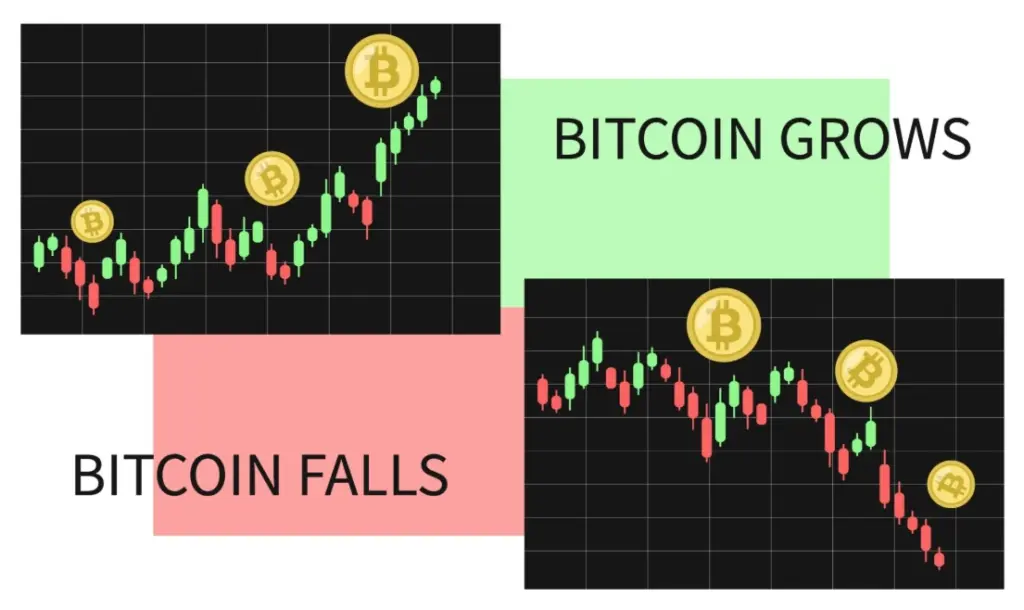
Phase 1: Accumulation
Post-Correction
Characterized by lower prices, reduced public attention, and gradual, quiet buying by long-term, high-conviction investors.
Phase 2: Expansion
Bull Market Genesis
Defined by growing adoption, improving market sentiment, and steadily rising prices as new capital enters the network.
Phase 3: Euphoria
Market Peak
Marked by heavy mainstream media coverage, widespread optimism, intense FOMO (Fear Of Missing Out), and highly speculative activity.
Phase 4: Correction
Bear Market
Driven by sharp declines, heightened volatility, and negative headlines. Meanwhile, disciplined investors reassess fundamentals rather than reacting solely to price changes.
Recognizing these phases can help investors avoid emotionally driven decisions, though no framework can predict future market movements perfectly.
The ZenvestAI Bitcoin Rules
To navigate this volatile landscape successfully, strict rules are required. 💡
- ✔ Think in years rather than weeks.
- ✔ Invest only money you can afford to keep invested over your chosen time horizon.
- ✔ Avoid emotional buying and selling.
- ✔ Maintain a written investment plan.
- ✔ Review your portfolio periodically instead of reacting to every price movement.
- ✔ Prioritize secure storage and account protection.
- ✔ Continue learning as technology, regulation, and markets evolve.
Common Bitcoin Investing Mistakes
Even experienced investors can make critical mistakes if they abandon their core strategy. Learning to avoid these mistakes can be just as valuable as identifying good investment opportunities.
A Personal Lesson from 2018: When I first entered the crypto market in 2018, I bought Bitcoin at around $7,000 and quickly sold it to lock in a small, short-term profit. However, I watched in regret as the price eventually surged toward $60,000. That expensive mistake taught me firsthand that Bitcoin is not a short-term trading game; it requires immense patience, and the most substantial wealth is built by holding for the long term.
To protect your digital wealth, common pitfalls to avoid include:
- Panic selling during standard market corrections instead of trusting your long-term thesis.
- Buying only after major price rallies due to FOMO (Fear Of Missing Out).
- Investing without a clearly defined plan or exit strategy.
- Ignoring basic cybersecurity and wallet safety protocols.
- Concentrating an entire portfolio in a single, highly volatile asset without proper diversification.
- Chasing social media hype without doing independent, foundational research.
- Using excessive leverage to trade, which amplifies both gains and devastating losses.
- Investing money needed for immediate, short-term expenses, forcing you to sell at a loss during down cycles.
A Tale of Two Investors
Imagine two investors with similar incomes trying to build digital wealth.
Investor A constantly follows news headlines, frequently buys and sells based on emotion, and continuously attempts to predict short-term price movements. In contrast, Investor B utilizes a strict DCA strategy, investing a fixed amount every month.
Investor B periodically reviews the portfolio, maintains diversification, and bravely stays invested through multiple market cycles.
Neither approach guarantees a particular outcome. However, disciplined investing often reduces emotional decision-making and may produce more consistent long-term behavior than constant trading.
Security Checklist for Every Bitcoin Holder
Protecting your assets is absolutely just as important as choosing them. Before investing significant amounts, you must actively review this crucial checklist. 🛡️
- Enable two-factor authentication (2FA) on all exchange accounts.
- Use strong, unique passwords generated by a reliable password manager.
- Verify wallet addresses visually before finalizing every single transaction.
- Store recovery phrases securely offline (never take a digital photo of them).
- Consider hardware wallets (cold storage) for substantial long-term holdings.
- Keep wallet and device software updated to the latest security patches.
- Be cautious of phishing emails, fake websites, and fraudulent mobile apps.
- Never share your private keys or recovery phrase with anyone.
2026 Cryptocurrency Glossary
To help you navigate the modern landscape, here are key terms relevant to the current 2026 ecosystem:
- Spot ETF: Exchange-Traded Funds holding actual Bitcoin, allowing institutional-grade investment without direct custody.
- Halving: An event occurring roughly every four years where the new supply of Bitcoin mined is cut in half (the most recent occurring in 2024, shaping the 2025/2026 supply shock).
- Cold Storage: Keeping Bitcoin private keys completely offline, typically on a dedicated hardware device, protecting them from hackers.
- Self-Custody: Holding your own private keys rather than trusting a third-party exchange, ensuring true ownership of the asset.
The Bottom Line
Bitcoin has become the cornerstone of many digital asset portfolios because of its absolute scarcity, decentralization, security, transparency, liquidity, and global recognition.
At the same time, it remains a highly volatile asset whose future performance is uncertain. Successful wealth building with Bitcoin depends less on finding the perfect entry price and more on developing a disciplined investment process.
By managing risk thoughtfully, protecting your holdings with strong security practices, maintaining appropriate diversification, and remaining committed to a long-term strategy aligned with your personal financial goals, you can navigate the digital economy with confidence.
Are you ready to stop checking daily prices and start building a resilient, long-term digital strategy today?
Frequently Asked Questions
1. Is Bitcoin guaranteed to increase in value?
No. Bitcoin is highly volatile, and future returns cannot be guaranteed. Market conditions, regulatory shifts, and macroeconomic factors play a massive role in its valuation.
2. Is Bitcoin suitable for everyone?
Not necessarily. Suitability depends entirely on your specific financial goals, investment horizon, risk tolerance, and overall financial situation.
3. Can I start with a small amount?
Yes. Many platforms allow purchases of fractional Bitcoin (called Satoshis), seamlessly enabling investors to begin with relatively small amounts, such as ₹500 or $10.
4. Should I trade Bitcoin every day?
Daily trading carries significant additional risks and requires immense time, skill, and discipline. Consequently, many investors instead prefer a long-term approach based on regular investing and periodic portfolio reviews.
5. How often should I review my Bitcoin allocation?
Many long-term investors review their portfolios quarterly, semi-annually, or annually rather than responding emotionally to every daily market fluctuation.

Pingback: The Complete Ethereum Wealth Strategy: Build Long-Term Digital Wealth
Pingback: What Is Crypto Futures Trading? A Complete Beginner’s Guide
Pingback: What Is Take Profit (TP)? The Ultimate Step-by-Step Guide to Locking in Crypto Trading Profits with Discipline
Pingback: How to Safely Set Up and Secure an Account on Binance
Pingback: The Ultimate Guide to Spatial Arbitrage in Crypto Trading