Are you tired of watching your capital get locked up in inefficient trades? Imagine a scenario where a sudden market dip wipes out a perfectly good position simply because your account couldn’t share its underlying collateral. It is a frustrating, stressful experience that many traders face daily.
There is where, Crypto portfolio margin financing solves this exact problem by looking at your entire balance sheet as one living, breathing ecosystem. Instead of looking at every position in isolation, portfolio margin evaluates your entire balance sheet as an interconnected financial system. It considers your assets, liabilities, collateral, leverage, hedges, volatility, liquidity, and potential risk offsets together.
The goal isn’t simply to give you more leverage. The goal is to determine how much capital your portfolio can responsibly deploy while maintaining a sufficient margin of safety.
In this comprehensive guide, we will walk you through exactly how portfolio-based leverage works, how to manage your risk, and how to safely unlock capital efficiency.
📚 Essential Related Reading
-
💡 Why Does Staking Exist? The Ultimate Guide to Cryptoeconomic Security
Key Takeaway: Earning passive income sounds great, but understanding why networks pay you helps you pick safer staking platforms and avoid unsustainable, high-risk yields. -
📈 What Is Crypto Futures Trading? A Complete Beginner’s Guide
Key Takeaway: Futures trading allows you to amplify your exposure and profit from both rising and falling markets, but doing it safely requires a solid grasp of margin mechanics and liquidation thresholds. -
⚖️ The Ultimate Risk-to-Reward Ratio Guide: Master Crypto Risk and Protect Your Capital
Key Takeaway: The secret to surviving crypto volatility isn’t winning every single trade—it’s using a strict risk-to-reward ratio so your winning trades mathematically outpace your inevitable losses. -
🎯 What Is Take Profit (TP)? Locking in Crypto Trading Profits with Discipline
Key Takeaway: Greed is the ultimate enemy of profit. Setting automated Take Profit (TP) levels removes emotion from trading and ensures you lock in your gains before the market reverses. -
🔐 How to Safely Set Up and Secure an Account on Binance
Key Takeaway: Your trading strategy means nothing if your funds aren’t safe. Properly securing your exchange account with 2FA and anti-phishing codes is your first and best defense against crypto theft.
ZenvestAI Explains: The Portfolio Margin Approach
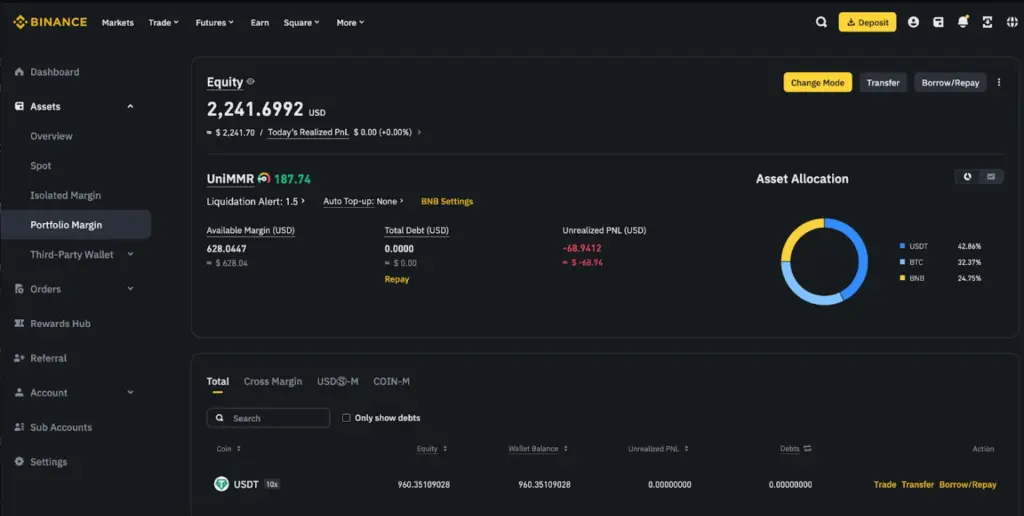
Crypto portfolio margin financingis a way of checking the risk of your whole crypto portfolio, instead of looking at each trade separately. Portfolio Margin is an advanced trading mode designed for experienced traders seeking increased leverage and flexibility.Rather than treating every trade independently, it evaluates your entire portfolio’s net risk. It can look at your Bitcoin and other crypto holdings, stablecoins, futures, options, and hedging positions together. By recognizing offsetting positions—where a short trade hedges a long holding—the system reduces unnecessary collateral requirements.
It consolidates your “USDⓈ-M”, “COIN-M”, and “Cross Margin” assets into one unified collateral pool. Ultimately, it determines how much additional exposure your portfolio can responsibly support without triggering liquidations.
Key Takeaways 💡
- Unified Collateral: You can trade across Margin and Futures markets using a shared pool of supported assets.
- Net Risk Matters: The system calculates margin and risk using the Unified Maintenance Margin Ratio (uniMMR), offering a comprehensive view of your exposure.
- Operational Efficiency: Unifying margin calculations simplifies opening, monitoring, and closing positions.
- Margin Check Service (MCS): A built-in safety tool evaluates if planned positions meet margin requirements before execution.
- Liquidation Dangers: Cross-collateralization means one bad trade can expose your entire portfolio.
- Stress Testing: Professional financing prioritizes survivability over maximum leverage.
ZenvestAI Important Point
Portfolio Margin is not supported on Lite Trading. Use Binance App version 2.64.1 or newer to access Portfolio Margin.
The Problem: The Trap of Traditional Margin Trading
Traditional margin systems can be incredibly inefficient for experienced traders. For instance, if you hold a $100,000 Bitcoin (BTC) long position and a $100,000 BTC short position, a traditional system views this as $200,000 in gross exposure.
Because of this, the exchange demands high collateral for both trades separately. As a result, your capital is locked up, limiting your ability to take advantage of new market opportunities. You are forced to add more funds just to keep hedged positions open, which creates unnecessary financial strain.
How Does Portfolio Margin Differ From Ordinary Margin?
Understanding the differences between margin types is crucial for your risk management strategy. Here is a breakdown:
| Feature | Isolated Margin | Cross Margin | Portfolio Margin |
| Collateral | Position-specific | Shared pool | Portfolio-level |
| Risk Assessment | Individual position | Shared account | Combined portfolio |
| Hedge Recognition | Limited | Some | Highly sophisticated |
| Capital Efficiency | Lower | Medium | Potentially higher |
The Core Mathematical Components
Every professional financing framework relies on a few fundamental layers and strict, dynamic calculations. Here are the foundational metrics you must understand to survive and thrive.
1. Portfolio Equity & Collateral Haircuts
First, you must determine your actual available capital. Net Portfolio Equity equals your total assets minus your total liabilities, representing the capital available to absorb potential market losses. Not every asset holds the same value in the eyes of a lender. Platforms apply “haircuts” (discounts) to riskier assets, meaning your recognized collateral will be lower than the actual market value.
2. Unified Maintenance Margin Ratio (uniMMR)
Portfolio Margin uses uniMMR to assess the health of your combined accounts. You must keep your uniMMR strictly above 1.05 (105%) to avoid liquidation. The ratio is calculated as:
uniMMR = (Sum of Adjusted Equity) / (Sum of Maintenance Margin)
Adjusted Equity is the combined value of all assets, factoring in unrealized profits/losses and adjusting for potential loss (Open Loss) when changing collateral assets. Maintenance Margin (MM) is the minimum margin required to keep positions open.
3. Margin Check Service (MCS)
The MCS periodically checks if you have sufficient collateral. To place a new order, your required Initial Margin (IM) must be lower than your Virtual Available Margin.
Virtual Available Balance
Virtual Available Balance = MAX(Adjusted Equity − Total Initial Margin, 0)
Where:
Total Initial Margin = Futures Initial Margin + Margin Initial Margin
The total Initial Margin requirement combines the margin requirements from both Futures Accounts and Margin Accounts.
Futures Initial Margin
Futures Initial Margin = (Position Size × Mark Price) ÷ Leverage
Margin Initial Margin
Margin Initial Margin = Borrowed Amount ÷ (Leverage − 1)
In Simple Terms
The Virtual Available Balance represents the amount of equity that remains available after accounting for the total Initial Margin required by both Futures and Margin positions. The value cannot be negative, so the minimum Virtual Available Balance is zero.
📚 Essential Related Reading
-
🔗 How Distributed Ledgers Are Radically Rewriting the Rules of Modern Finance
Key Takeaway: Distributed ledgers remove the need for centralized banks and middlemen, creating a transparent, immutable financial system that reduces costs and instantly processes global transactions. -
🤖 How AI Is Transforming Cryptocurrency Trading in 2026
Key Takeaway: Artificial intelligence is revolutionizing the crypto space by predicting market trends, executing automated strategies, and completely eliminating emotional decision-making in volatile conditions. -
🔰 What Is Cryptocurrency? The Ultimate Beginner’s Guide
Key Takeaway: Before diving into advanced trading or staking, building a rock-solid foundation on how digital currencies and blockchain mechanics actually work is essential to avoid costly beginner mistakes. -
₿ The Complete Bitcoin Wealth Strategy
Key Takeaway: Bitcoin is widely considered a digital store of value. A proper wealth strategy shifts your focus from short-term day trading to long-term accumulation, self-custody, and navigating macroeconomic cycles. -
🔷 The Complete Ethereum Wealth Strategy
Key Takeaway: Growing wealth on Ethereum goes far beyond simply holding the coin; it requires a strategic understanding of decentralized finance (DeFi), smart contract utility, and navigating network gas fees. -
💸 What Is Crypto Staking? The Complete Guide to Earning Rewards Safely
Key Takeaway: Staking allows you to put your idle crypto to work, generating passive yields while actively contributing to the security, decentralization, and daily operations of a blockchain network.
4. Negative Balances & Total Debt
Because collateral is shared, you can carry a negative balance on your USDⓈ-M and COIN-M Futures accounts as long as your overall uniMMR stays above 105%. However, if your negative balances exceed the platform’s threshold, you will incur a daily interest fee charged at 00:00 UTC.
Interest Fee = |Negative Balance| × Daily Interest Rate
Where:
|Negative Balance| = The absolute value of the negative balance.
Negative Balance = The amount by which the account balance is below zero.
Daily Interest Rate = The applicable interest rate charged per day.
If you have sufficient assets in your Cross Margin account, the system will automatically attempt to repay your negative balances two hours before the interest is charged.
Advanced Calculations: Margin Available for Orders
Placing Cross Margin orders under Portfolio Margin involves specific calculations based on the Collateral Rate (CR) of the asset you are selling (CR1) versus the asset you are buying (CR2).
Here is how the system determines your available margin in normal or Auto-Repay modes:
| Scenario | Calculation Formula |
| CR1 > CR2 | Available for Order = MIN [ X ÷ (CR1 − CR2), Available Asset Balance ] Where: X = The amount of available collateral or equity used in the calculation. CR1 = The first applicable collateral or risk ratio. CR2 = The second applicable collateral or risk ratio. Available Asset Balance = The asset balance currently available for placing new orders. MIN = Selects the smaller of the two calculated values. |
| CR1 ≤ CR2 | Available for Order = Available Asset Balance |
Note: For Buy Orders:
X = Available Balance ÷ Quote Asset Index Price
For Sell Orders:
X = Available Balance ÷ Base Asset Index Price
Real-World Example
Imagine you are trading BTC/USDT with an Available Balance of $1,000. Your wallet holds 20,000 USDT and 0.01 BTC. The quote asset index price is 1, and the base asset index price is 28,000. BTC has a Collateral Rate of 80%, and USDT is 100%.
- If you place a Buy Order (Selling USDT to buy BTC): CR1 (USDT) = 100% and CR2 (BTC) = 80%. Because CR1 > CR2, the formula restricts your available order size based on the difference in collateral quality, giving you a maximum available order of 5,000 USDT.
- If you place a Sell Order (Selling BTC to buy USDT): CR1 (BTC) = 80% and CR2 (USDT) = 100%. Because CR1 < CR2, your available order is simply your Available Asset Balance: 0.01 BTC.
The Hidden Risks & System Restrictions ⚠️
Capital efficiency is amazing, but it can easily become a trap if you mistake it for free money. Navigating the system requires strict adherence to platform parameters.
- Correlation Risks: Holding ten different cryptocurrencies does not guarantee true diversification. During a market crash, almost all crypto assets tend to fall together. Consequently, the hedge that protected you might fail completely.
- Liquidation Reality: Because portfolio margin is dynamic, your required margin changes as volatility spikes or collateral values drop. Your portfolio can face margin calls long before a specific price target is hit.
- App Requirements:
Portfolio Margin is not supported on Lite Trading. You must use app version 2.64.1 or newer.
- Auto Top-Up: You can enable automatic account replenishment to maintain consistent margin levels and avoid liquidation alerts.
- Delisted Assets Management: If a borrowed margin asset is delisted, the system prohibits new borrowing and activates a “reduce-only” mode. The system will automatically liquidate delisted assets into USDT to balance the account and repay outstanding loans, protecting you from unexpected losses due to unsupported collateral.
- Isolated Margin Exclusion: Assets held in your Isolated Margin Wallet are completely walled off. They will not be counted toward your Portfolio Margin collateral or your uniMMR calculations.
ZenvestAI Quick Insight: Never use your newly freed capital just to open more highly leveraged trades. Treat your unused margin as a survival buffer against sudden market crashes. Protect your downside first.
📚 Essential Related Reading
-
📊 Basics of the Crypto Market
Key Takeaway: Understanding the fundamental cycles, supply mechanics, and market psychology is crucial before risking capital in the highly volatile cryptocurrency space. -
🛡️ The Ultimate Guide to Crypto Wallets
Key Takeaway: Not your keys, not your coins. Choosing the right cold or hot wallet setup is the single most important step you will take to protect your digital assets from exchange failures and hacks. -
🔮 The Future of Cryptocurrency in 2026
Key Takeaway: The crypto landscape is shifting rapidly beyond basic speculation toward AI integration, real-world asset tokenization, and massive institutional adoption, offering entirely new avenues for long-term growth. -
⚡ How to Start Crypto Futures Trading with Low Capital?
Key Takeaway: You don’t need a massive bankroll to trade futures; with strict leverage controls and disciplined risk management, starting with a small account is the smartest way to master market mechanics safely. -
💳 Why the Binance Virtual Card is the Smartest Way to Spend Crypto in Asia (2026 Guide)
Key Takeaway: Bridging the gap between digital assets and daily expenses is easier than ever, allowing you to instantly convert and spend your crypto for everyday purchases with zero friction across Asia.
The ZenvestAI 7-Pillar Framework for Portfolio Financing 📊
To succeed, you need a systematic approach. Follow these core pillars:
- Capital Quality: Evaluate how easily you can liquidate your assets.
- Total Exposure: Always measure your net exposure, not just your gross exposure.
- Concentration Risk: Ensure one single asset failure won’t destroy your balance sheet.
- Volatility Tracking: Monitor market stress and implied volatility constantly.
- Liquidity Assessment: Confirm that you can exit positions without massive slippage.
- Financing Costs: Track your borrowing rates and perpetual funding costs.
- Survival Stress Testing: Ask yourself: Will my portfolio survive a sudden 30% market drop?
At a Glance: Glossary of Key Terms
- Gross Exposure: The absolute total size of all your open positions combined.
- Net Exposure: Your actual directional risk after subtracting offsetting trades.
- uniMMR: Unified Maintenance Margin Ratio; the ultimate health metric of your combined portfolio.
- Margin Check Service (MCS): The systemic gatekeeper that verifies you have enough virtual available margin before allowing a new order.
- Cross-Collateralization: Using a basket of different supported cryptocurrencies to back trades across entirely different markets (Futures and Margin).
- Rehypothecation: When a platform reuses your posted collateral for other financing activities.
- Total Debt: The combined USD value of borrowed assets and negative futures balances, including any unpaid interest.
The Bottom Line 🎯
Crypto portfolio margin financing represents a massive evolution from basic position-based trading to institutional-level risk management. It uses dynamic mathematical models to reward you with higher capital efficiency when your trades actively hedge one another. However, it demands strict discipline.
The winners in the digital asset economy are not the traders who blindly maximize their borrowing power. Instead, they are the professionals who track their uniMMR, understand the impact of collateral haircuts, and maintain wide survival buffers against market volatility. Protect your downside first, and let the efficiency of the unified portfolio work to your long-term advantage.