At a Glance
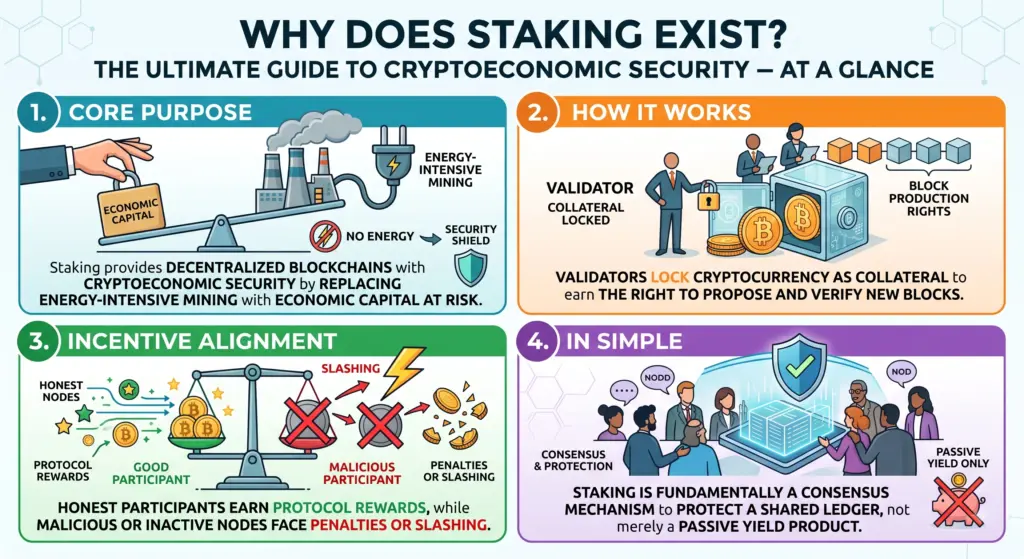
1. Core Purpose: Staking provides decentralized blockchains with cryptoeconomic security by replacing energy-intensive mining with economic capital at risk.
2. How it works: Validators lock cryptocurrency as collateral to earn the right to propose and verify new blocks.
3. Incentive Alignment: Honest participants earn protocol rewards, while malicious or inactive nodes face penalties or slashing.
4. In Simple: Staking is fundamentally a consensus mechanism to protect a shared ledger, not merely a passive yield product.
Key Takeaways:-
📌 1. Staking Solves the Trust Problem: Distributed networks use economic stake to verify transactions without needing a central bank or server.
📌 2. Capital Replaces Electricity: Proof of Stake (PoS) achieves consensus using financial collateral rather than massive computational power.
📌 3. Rewards Drive Honest Behavior: Protocol rewards incentivize validators to keep nodes online and check transactions accurately [Outcome].
📌 4. Penalties Prevent Attacks: Slashing destroys staked tokens if validators attempt to double-sign or corrupt the blockchain history.
📌 5. Yield Includes Risk: Staking returns depend on token price volatility, inflation rates, unbonding periods, and validator reliability.
ZenvestAI Quick Read:- Why Does Staking Exist?
Staking exists to solve the consensus problem in decentralized networks without relying on central banks or energy-heavy mining.
By locking cryptocurrency as economic collateral, validators gain the authority to verify transactions and propose blocks.
Honest participation yields protocol rewards, whereas malicious behavior triggers slashing penalties.
Ultimately,
staking transformsfinancial value into a robust, cryptoeconomic security system for public blockchains.
Why Does Staking Exist? The Ultimate Guide to Cryptoeconomic Security 💡
Hello! Have you ever wondered why millions of people lock up billions of dollars in cryptocurrency just to let a blockchain run smoothly?
If you have ever pondered why someone would freeze their assets rather than keep them liquid, the answer boils down to one fundamental challenge: who gets to decide which transactions are valid?
A decentralized blockchain has no central server, government office, or traditional bank approving transactions.
Instead, thousands of independent computers across the globe must agree on the exact state of the digital ledger without trusting each other.
In this comprehensive guide titled Why Does Staking Exist?
You will discover how Proof of Stake transforms financial capital into digital security, ensuring global networks remain safe, fast, and decentralized in the crypto ecosystem.
📌 Related Deep Dives on ZenvestAI:
ZenvestAi Explains
Stakingexists because decentralized blockchains require an uncheatable mechanism to agree on transaction history without relying on central authorities or excessive energy consumption.In Proof of Stake networks, participants known as validators lock up cryptocurrency as financial collateral.
This capital creates a cryptoeconomic security model where honest validation is rewarded with newly minted tokens and transaction fees, while dishonest behavior results in severe financial penalties or token destruction.
Ultimately, staking turns economic value into the foundation of blockchain consensus and network defense.
What This Post Covers
- What Problem Does Proof of Stake Solve?
- What Is Blockchain Consensus and Why Does It Matter?
- What Is Proof of Stake (PoS) in Cryptocurrency?
- How Does Economic Stake Secure a Blockchain Network?
- What Do Validators Do in Network Consensus?
- What Happens When Validators Behave Honestly vs. Improperly?
- How Does Staking Support Blockchain Decentralization?
- What Does Staking Guarantee—and What Are the Real Risks?
- The ZenvestAI Perspective: How Should You Evaluate Staking Opportunities?
- Glossary of Cryptocurrency Terms
- Frequently Asked Questions
1. What Problem Does Proof of Stake Solve?
Blockchains operate as shared accounting ledgers across thousands of independent computers.
Imagine ten thousand people maintaining the exact same digital record simultaneously.
If Ram claims he sent 2 ETH to Jay, but Charlie claims Ram sent those same funds to him, the network faces an immediate conflict.
Traditional finance relies on a central bank to settle disputes and maintain the master record.
In contrast, public blockchains eliminate central authority, forcing independent nodes to reach agreement through predefined software rules.
Without a unified rulebook, the network becomes vulnerable to double-spending, conflicting entries, and malicious fraud.
Proof of Stake solves this synchronization dilemma by shifting the core question of network authority. Rather than asking which participant possesses the most computational hardware, Proof of Stake asks which participants have committed real economic value to protect the ledger.
By forcing participants to put financial skin in the game, PoS ensures that updating the blockchain requires genuine financial commitment.
Zenvestai Quick Insight:-
Blockchainslack central authorities to verify transactions, creating the risk of double-spending and conflicting ledger entries. Proof of Stake solves this problem by requiring participants to commit financial value as collateral, ensuring all nodes reach an honest, automated agreement on valid transactions.
![Real-world example of exchange-based native staking for Ethereum (ETH) and Solana (SOL) with liquid tokens like WBETH and BNSOL.]](https://zenvestai.com/wp-content/uploads/2026/08/Real-world-example-of-exchange-based-native-staking-for-Ethereum-ETH-and-Solana-SOL-with-liquid-tokens-like-WBETH-and-BNSOL-730x1024.jpeg)
2. What Is Blockchain Consensus and Why Does It Matter?
Consensus represents the formal process through which distributed computers agree on a single, immutable state of a shared ledger.
Think of a blockchain as a continuous notebook where each page is a block linked to the one before it.
[Block 1] ---> [Block 2] ---> [Block 3] ---> [Block 4]
To maintain continuity, every participating computer must maintain an identical view of this chain history. If Node A believes Arjun holds 10 coins while Node B believes he holds 0 coins, the entire system collapses due to a lack of trust.
Consensus mechanisms establish explicit rules governing who can propose the next block, how transactions are verified, and how disputes are settled.
Consequently, consensus is the foundational engine that keeps decentralized networks secure, operational, and synchronized across global borders.
3. What Is Proof of Stake (PoS)?
Proof of Stake (PoS) is a consensus framework where participants commit cryptocurrency as economic collateral to earn the right to validate transactions. These active participants are called validators.
[Deposit Stake] ---> [Validator Status] ---> [Propose / Attest Block] ---> [Network Consensus] ---> [Receive Reward or Slashing]
Instead of running energy-intensive mining hardware, validators run specialized software that checks incoming transaction data against protocol rules.
The protocol selects validators to propose or verify blocks based on their total committed capital and randomized selection algorithms.
Staking Is Not Merely “Locking Coins for Interest”
Many beginners mistake staking for a standard savings account that pays passive interest.
In reality, native staking is an active contribution to blockchain security and operational consensus.
Protocol rewards represent compensation for performing vital validation duties, not risk-free interest paid by a financial intermediary.
A Simple Staking Example
Suppose a blockchain network has a total of 100,000 tokens active in its staking contract.
If you stake 1,000 tokens, your deposit represents exactly 1% of the total economic value securing the network.
The protocol incorporates your 1% weight when assigning validation responsibilities, distributing proportional rewards when you fulfill duties, or issuing penalties if your node breaks consensus rules.
Comparison: Proof of Work vs. Proof of Stake
| Feature | Proof of Work (PoW) | Proof of Stake (PoS) |
| Primary Resource | High-end mining hardware & electricity | Committed cryptocurrency tokens (Capital) |
| Key Participants | Miners | Validators & Delegators |
| Block Selection | Competitive computational solving | Algorithmic selection based on stake weight |
| Network Security | Cost of physical energy and hardware | Financial value placed at risk (Collateral) |
| Protocol Penalties | Stranded hardware & wasted electricity costs | Direct token destruction (Slashing) |
| Energy Consumption | High environmental footprint | Minimal energy requirement (up to 99.9% lower) |
| 2026 Ecosystem Examples | Bitcoin, Litecoin | Ethereum, Solana, Cardano, Cosmos |
4. How Economic Stake Helps Secure a Network 🎯
Proof of Stake replaces physical proof with financial exposure to build a robust defense model.
Instead of relying on vague promises of good behavior, the system forces validators to lock up valuable assets before granting them voting power.
The fundamental security principle relies on a strict mathematical equation:
The cost of attacking the network should be greater than the potential economic benefit of the attack.
When acquiring enough tokens to control the network becomes prohibitively expensive, attacking the blockchain becomes financially irrational.
Furthermore, an attacker who acquires a majority stake would destroy the market value of the very asset they hold, effectively wiping out their own fortune.
Validators act honestly because they have significant financial capital to lose.
If a validator attempts to alter transaction histories or approve fake balances, the protocol detects the violation and confiscates their committed capital.
Therefore, PoS creates cryptoeconomic alignment where protecting the network is always more profitable than attacking it.
Zenvestai Quick Insight: Proof of Stake secures networks by making attacks economically irrational. Because validators must lock up valuable tokens as collateral, any attempt to corrupt the ledger results in immediate financial penalties, ensuring that honest validation remains the most profitable path.
5. What Do Validators Do in Network Consensus?
Validators serve as the active infrastructure providers of a Proof of Stake network. They perform several critical technical duties to keep the blockchain synchronized:
- Checking Transactions: Verifying digital signatures, account balances, and smart contract execution logic.
- Proposing Blocks: Bundling valid transactions into new blocks and broadcasting them to the network.
- Attesting to Blocks: Voting on the validity of blocks proposed by other network validators.
- Maintaining Uptime: Running dedicated server hardware 24/7/365 to prevent network delays.
[User Submits Transaction]
          │
          ▼
[Validator Verifies Signature & Balance]
          │
          ▼
[Block Proposer Bundles Transactions]
          │
          ▼
[Validator Committee Attests to Block]
          │
          ▼
[Block Added to Chain & Finalized]
Proposers, Attestations, and Economic Finality
The protocol periodically selects a block proposer to assemble the next set of transactions.
Once proposed, a broader committee of validators reviews the block and submits digital attestations confirming its validity.
Over time, these attestations accumulate until the block reaches economic finality.
Once finality is achieved, altering or reverting that block becomes cryptographically impossible without burning a massive percentage of all staked tokens on the network.
💡 Master the Crypto Ecosystem with These Guides:
• New to Digital Assets? Start from the basics with our step-by-step primer: What Is Cryptocurrency? The Ultimate Beginner’s Guide.
• Explore Next-Gen Technology: Discover how blockchain infrastructure is replacing traditional banking in How Distributed Ledgers Are Radically Rewriting the Rules of Modern Finance.
• Automate Your Strategy: Learn how smart algorithms optimize trade execution in How AI Is Transforming Cryptocurrency Trading in 2026.
• Active Trading Strategies: Learn risk management and leverage rules for small budgets in How to Start Crypto Futures Trading with Low Capital?.
• Real-World Crypto Spending: Use your digital assets for everyday purchases using our guide on Why the Binance Virtual Card is the Smartest Way to Spend Crypto in Asia (2026 Guide).
6. What Happens When Validators Behave Honestly vs. Improperly?
The behavior of network validators directly determines their financial outcomes under PoS protocol rules.
                  ┌───> Honest Behavior ────> Earns Protocol Rewards
                  │
[Validator Node] ──┼───> Minor Inactivity ───> Misses Rewards / Small Penalty
                  │
                  └───> Malicious Action ───> Severe Slashing (Tokens Destroyed)
Honest Participation
When validators follow protocol guidelines, maintain high uptime, and attest correctly, they earn protocol rewards.
These rewards consist of newly minted tokens and transaction fees paid by network users.
Rewards compensate validators for operating server hardware, maintaining software client diversity, and absorbing market lock-up risks.
Delegated Staking for Everyday Users
If you do not wish to run server hardware yourself, many PoS blockchains support delegated staking.
In this model, you delegate your voting weight to a professional validator node without relinquishing ownership of your private keys.
The validator performs consensus duties on your behalf and shares a portion of the protocol rewards with you after deducting a service fee.
Inactivity Penalties vs. Slashing
Protocols distinguish between accidental technical errors and deliberate malicious attacks:
- Inactivity Penalties: If a validator node goes offline due to a power outage or internet failure, it simply misses out on rewards or incurs minor downtime penalties.
- Slashing Penalties: If a validator commits serious protocol violations—such as double-signing two different blocks at the same height—the protocol automatically burns or confiscates a portion of its locked capital.
Zenvestai Quick Insight: Honest validators receive transaction fees and block rewards for keeping the network secure. Conversely, offline nodes face minor downtime fees, while malicious actors committing double-signing violations suffer severe slashing penalties that permanently burn their locked cryptocurrency.
7. How Does Staking Support Blockchain Decentralization? 🛡️
Decentralization measures how widely power, control, and validation authority are distributed across a global network.
Staking can enhance decentralization by allowing anyone with tokens to participate in network validation or delegation.
[Global Token Holders] ──> [Diverse Validator Pool] ──> [Decentralized Ledger]
However, Proof of Stake networks face potential centralization risks if stake concentration is ignored.
If a few institutional custodians, centralized exchanges, or giant staking pools accumulate the vast majority of active tokens, they gain disproportionate influence over consensus and governance decisions.
A resilient Proof of Stake ecosystem requires broad distribution across multiple operational dimensions:
- Independent Validators: A high count of distinct individuals and organizations running nodes.
- Geographic Spread: Hosting servers across multiple countries and legal jurisdictions to resist censorship.
- Client Diversity: Utilizing different software implementations (e.g., Prysm, Lighthouse, Teku) to prevent single-bug network crashes.
- Hardware Independence: Avoiding reliance on a single cloud service provider like AWS or Hetzner.
8. What Does Staking Guarantee—and What Are the Real Risks?
While staking offers earning potential, it is not a risk-free investment strategy. Staking rewards should never be confused with guaranteed fixed income in fiat terms.
[Staking Yield (%)] - [Token Price Drop (%)] - [Inflation (%)] = Real Economic Return
Real-World Staking Risks
- Market Price Volatility: Earning an 8% annual token yield will not protect you if the underlying token drops 40% in market value.
- Unbonding & Lock-Up Periods: Many networks require a multi-week unbonding period during which your assets cannot be moved or sold.
- Slashing & Performance Risk: Delegating to an unreliable validator can result in lost rewards or slashed principal.
- Smart Contract & Custodial Risk: Using liquid staking protocols or centralized exchanges introduces smart contract bug risks and platform insolvency risks.
9. The ZenvestAI Perspective: How Should You Evaluate Staking Opportunities?
At ZenvestAI, we believe responsible crypto participation begins with understanding core architecture rather than chasing the highest advertised APY.
High nominal yields often mask hyper-inflationary tokenomics or dangerous security vulnerabilities.
[Evaluate Architecture] ──> [Analyze Tokenomics] ──> [Assess Validator Safety] ──> [Decision]
The ZenvestAI Staking Checklist 📌
Before locking your capital into any Proof of Stake protocol, ask yourself these essential evaluation questions:
- [ ] Network Purpose: What real-world problem does this specific PoS blockchain solve?
- [ ] Slashing Terms: What exact validator mistakes trigger slashing on this chain?
- [ ] Unbonding Period: How many days or weeks does it take to unstake your funds?
- [ ] Custody Control: Are you staking natively from a self-custody wallet or using a centralized third party?
- [ ] Token Inflation: Where do the staking rewards originate—real transaction fees or aggressive token minting?
- [ ] Stake Concentration: Is the validator pool well-distributed, or dominated by 2–3 large entities?
Glossary of Cryptocurrency Terms
- Validator: An independent computer node responsible for verifying, proposing, and attesting to new blocks in a PoS network.
- Consensus Mechanism: The set of protocol rules that enables distributed nodes to agree on a shared ledger state.
- Slashing: The permanent destruction or confiscation of a validator’s staked collateral due to severe protocol violations.
- Delegation: The process where token holders assign their staking weight to a professional validator without transferring asset ownership.
- Unbonding Period: The mandatory waiting timeframe required when removing tokens from a staking contract.
- Attestation: A cryptographic vote cast by a validator confirming that a proposed block is valid according to consensus rules.
- Double-Signing: A severe protocol infraction where a validator signs two conflicting blocks for the same slot, triggering slashing.
The Bottom Line
Staking is not just a passive income feature; it is the fundamental cryptoeconomic engine that replaces banks and centralized servers with distributed security.
By tying consensus rights to economic capital at risk, Proof of Stake aligns the financial self-interest of individual validators with the long-term health and integrity of the entire blockchain network.
Final Thoughts
As the cryptocurrency ecosystem matures through 2026 and beyond, understanding the mechanics behind blockchain security empowers you to make smarter, safer investment decisions.
Whether you choose to run a native validator node or delegate tokens through a self-custodial wallet, always prioritize network health, validator reliability, and risk management over raw yield figures.
What has been your experience with cryptocurrency staking so far? Have you tried native validation or delegation? Share your thoughts, questions, and experiences in the comments section below!
Frequently Asked Questions
What is the main reason why staking exists in crypto?
Staking exists primarily to provide decentralized networks with security and consensus. By requiring validators to lock up cryptocurrency as collateral, Proof of Stake ensures that participating nodes have a financial incentive to validate transactions accurately and protect the blockchain from malicious attacks.
Can you lose money while staking crypto?
Yes, you can lose money while staking cryptocurrency. Your asset value can decline due to market price volatility, slashing penalties caused by validator misconduct, smart contract vulnerabilities in liquid staking protocols, or platform failure if using centralized exchanges.
How does Proof of Stake differ from Proof of Work?
Proof of Stake relies on financial capital locked as collateral to validate transactions, consuming minimal energy. Proof of Work requires specialized computers solving complex mathematical puzzles using large amounts of electricity to secure the network.
Is staking crypto the same as earning interest in a bank?
No, staking is fundamentally different from bank interest. Bank interest is paid by financial institutions lending out your fiat currency, whereas staking rewards are distributed directly by blockchain protocols to compensate users for securing the decentralized network.
What is a slashing penalty in crypto staking?
A slashing penalty is an automated protocol action that burns or confiscates a portion of a validator’s locked tokens. Slashing occurs when a validator commits severe consensus infractions, such as signing conflicting blocks or attempting to double-spend transactions.



Pingback: Ultimate Guide: What Is Crypto Portfolio Margin Financing?