💡 Key Takeaways:
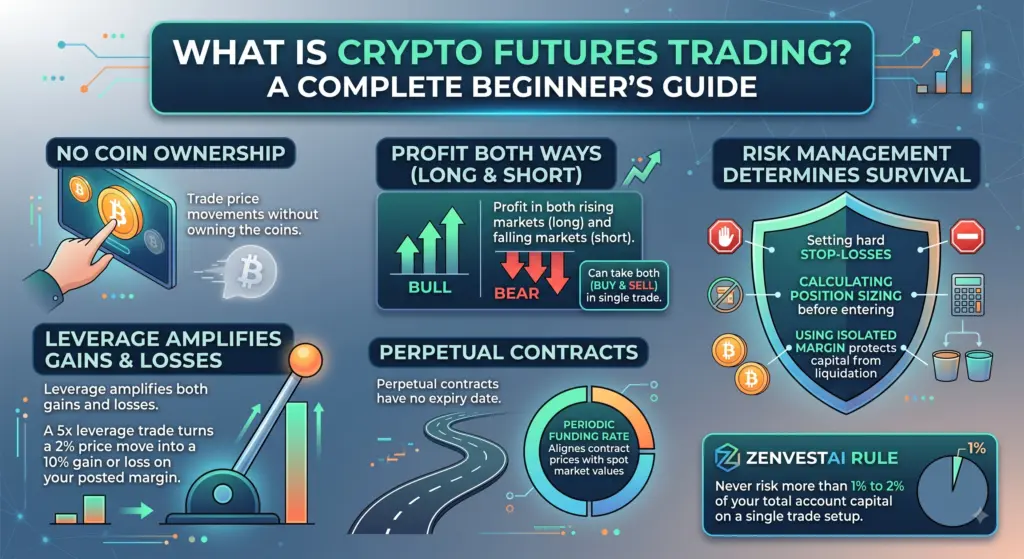
- Crypto futures let you trade price movements without owning the coins. You can profit in both rising markets (long) and falling markets (short). You can take both (BUY & SELL) in single trade.
- Leverage amplifies both gains and losses. A 5× leverage trade turns a 2% price move into a 10% gain or loss on your posted margin.
- Perpetual contracts have no expiry date. Instead, they rely on a periodic funding rate to keep contract prices aligned with spot market values.
- Risk management determines survival. Setting hard stop-losses, calculating position sizing before entering, and using isolated margin protect your capital from sudden liquidation.
- ZenvestAI Rule: Never risk more than 1% to 2% of your total account capital on a single trade setup.
What Is Crypto Futures Trading? A Complete Beginner’s Guide
ZenvestAI Quick Read
| Key Metric / Concept | Quick Summary |
| Instrument Type | Financial derivative contract (Perpetual & Traditional Futures) |
| Market Direction | Bi-directional: Long (Bullish) and Short (Bearish) |
| Capital Requirement | Margin-based with customizable leverage (1× to 20×+) |
| Core Risk Factor | Forced liquidation when available margin falls below maintenance threshold |
| Holding Mechanism | 8-hour / 1-hour funding rates for perpetual swaps |
| Best Suited For | Active traders, portfolio hedging, short-term speculation |
💡 Strategy Insight
Trading vs. Long-Term Wealth: While BTC perpetual futures are great for short-term price speculation, true compounding comes from disciplined spot accumulation and cold-storage security.
Master the Foundation: The Complete Bitcoin Wealth Strategy →Why Most Traders Get Futures Wrong
Have you ever watched Bitcoin plunge $5,000 in minutes and wished you could turn that drop into an opportunity?
Trading spot crypto feels straightforward when markets climb, but watching a portfolio bleed during a bear trend is painful.
This exact frustration leads millions of curious investors to explore derivative markets every year.
In this comprehensive guide, we unpack What Is Crypto Futures Trading?
A Complete Beginner’s Guide to help you understand the mechanics, leverage dynamics, and risk frameworks required to trade safely.
You will learn how contracts work, how to protect your hard-earned funds, and why survival always comes before profit.
ZenvestAI Explains
Crypto futures trading is a digital asset derivative mechanism where traders contractually agree to trade price movements of cryptocurrencies like Bitcoin and Ethereum without holding physical tokens.
Traders deploy margin to control leveraged long positions for rising prices or short positions for falling markets.
Unlike spot assets, perpetual crypto futures run continuously without expiration dates, utilizing periodic funding rates between longs and shorts to maintain spot price parity.
While leverage offers capital efficiency, it exponentially magnifies downside risk and forced liquidation.
📌 “What Is Crypto Futures Trading? A Complete Beginner’s Guide “Covers
- What is Crypto Futures Trading?
How Does Crypto Futures Trading Work?- What Is the Difference Between a Long and Short Position?
- Perpetual Futures & The Funding Rate Mechanism
- Understanding Liquidation and Mark Price
Spot Trading vs. Crypto Futures- Isolated Margin vs. Cross Margin
- The Hidden Costs of Futures (Fees, Slippage, Spreads)
- The ZenvestAI Golden Rules: The 9-Step Capital Preservation & Execution Framework
- 8 Critical Mistakes Beginners Make and How to Avoid Them
- 2026 Crypto Ecosystem Context & Regulatory Landscape
Master 24/7 Market Psychology & Avoid the 5 Deadly Traps- The ZenvestAI Philosophy: Capital Preservation First
- The ZenvestAI Daily Pre-Trade & Post-Trade Checklist
- Glossary of Crypto Futures Terms
- The Bottom Line
What Is Crypto Futures Trading?
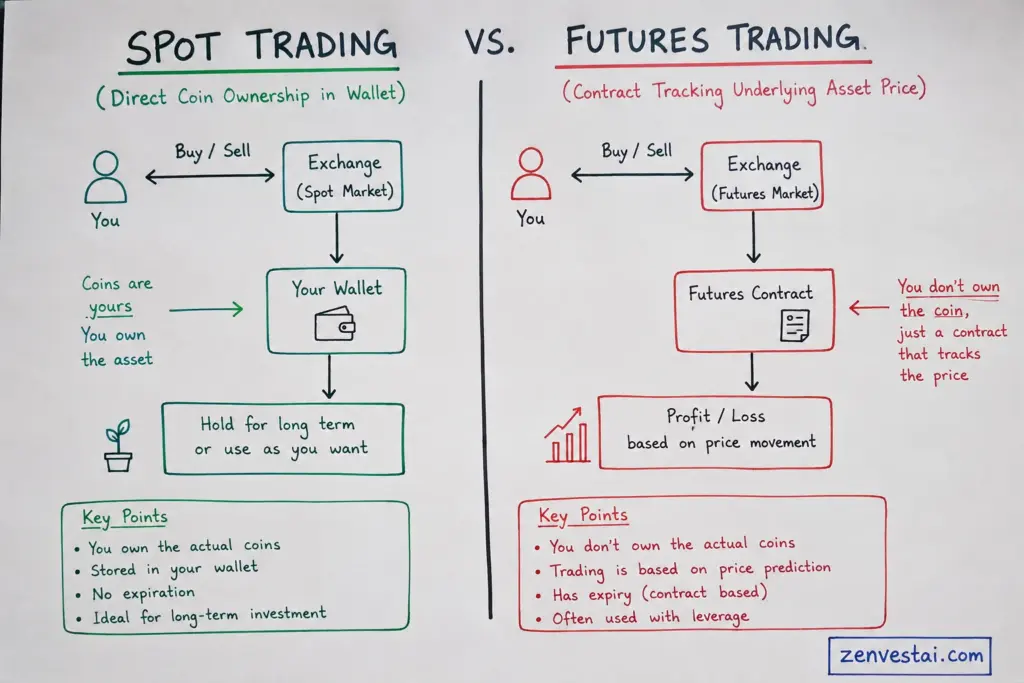
Crypto futures trading simply means agreeing on a contract based on where a coin’s price will move next.
You do not need to buy, transfer, or store the underlying cryptocurrency in a personal hardware wallet.
Instead, you trade a derivative contract whose price closely mirrors the real-time spot price of tokens like Bitcoin (BTC), Ethereum (ETH), Solana (SOL), or Ripple (XRP).
Imagine Bitcoin is currently trading at $100,000.
- If you expect Bitcoin to rise to $105,000, you open a long position. If your analysis is correct, you capture the profit from that $5,000 increase.
- If you believe market momentum is weakening and Bitcoin will slide to $95,000, you open a short position. If the price drops, your short position gains value.
This two-way flexibility is what makes futures so attractive to active traders.
However, remember that futures contracts do not give you free money.
The exact same mechanics that multiply gains will accelerate your losses if the market moves against your setup.
📊 Essential Background
Looking to trade Ethereum perpetuals? Master the fundamental supply dynamics, DeFi ecosystem drivers, and long-term valuation models behind ETH.
Read Guide: The Complete Ethereum Wealth Strategy →How Does Crypto Futures Trading Work?
Every crypto futures contract operates on four core mechanical pillars.
Understanding these mechanics prevents costly platform mistakes and unexpected liquidations.
1. The Underlying Asset
The underlying asset represents the real-world cryptocurrency tracked by the contract.
Major liquid instruments include Bitcoin (BTC), Ethereum (ETH), Solana (SOL), and Binance Coin (BNB).
The contract gets its fair value directly from index feeds aggregated across top spot exchanges.
2. The Futures Contract
The contract is the binding financial agreement that establishes your exposure to price changes.
In traditional financial markets, contracts feature a fixed expiration date (like quarterly expiries).
In modern crypto markets, however, most volume flows through perpetual futures (perps), which remain open indefinitely until you choose to close them or your margin runs out.
3. Margin
Margin represents the actual collateral you deposit from your wallet to open and maintain a leveraged trade.
If you possess $1,000 in your trading account and decide to open a $5,000 position, your initial collateral of $1,000 serves as the initial margin.
4. Leverage
Leverage acts as a financial multiplier provided by the trading exchange. It allows you to control a sizable position with a fraction of total capital.
Position Size = Margin × Leverage
Example
If your Margin = ₹10,000 and Leverage = 10×:
Position Size = ₹10,000 × 10 = ₹1,00,000
Therefore, a ₹10,000 margin with 10× leverage gives you a ₹1,00,000 position size.
🛡️ Passive Alternative
Tired of high-volatility liquidation stress? Contrast active futures trading with automated, low-risk reward compounding across major Proof-of-Stake networks.
Explore: What Is Crypto Staking & How to Earn Safely →What Is the Difference Between a Long and Short Position?
- Opening a Long (Buy Low, Sell High): When you identify bullish technical indicators or strong market catalysts, you go long. If the asset price climbs, your unrealized profit increases.
- Opening a Short (Sell High, Buy Low): When market sentiment turns bearish or key support levels break, you enter a short trade. If the price falls, you buy back the contract at a cheaper price and pocket the difference.
🎯 Zenvestai Quick Insight
A long position anticipates rising prices and profits when the asset climbs above the entry price.
A short position anticipates declining prices and profits when the asset falls below entry.
Both can be executed instantly with leverage on derivative exchanges.
A Detailed Look at Leverage:
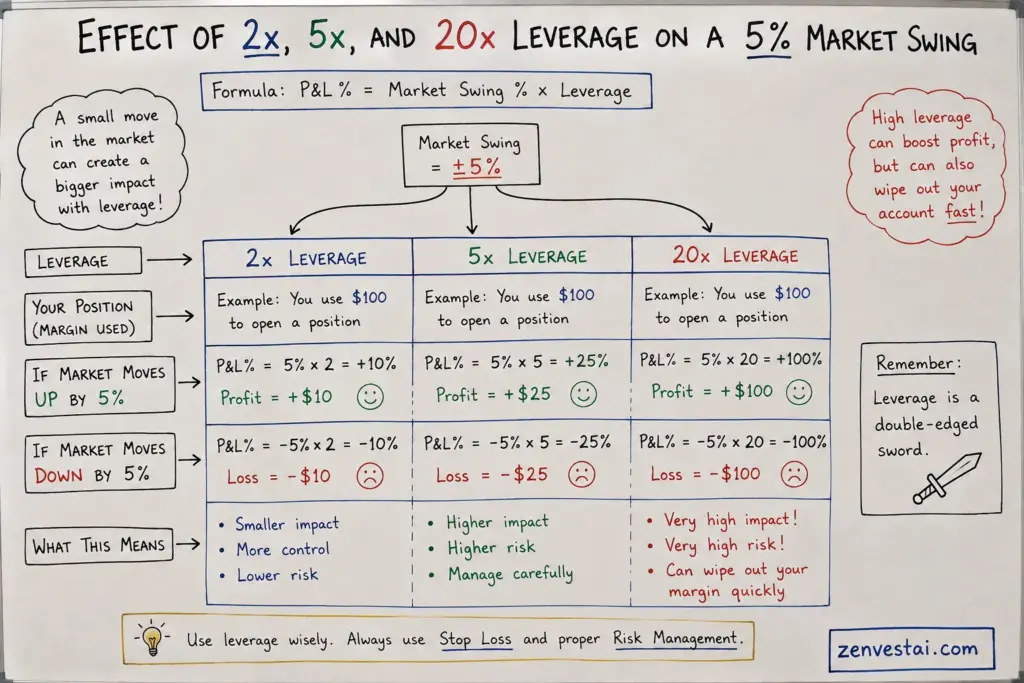
Leverage magnifies the impact of every micro percentage move in the market.
Let us look at a side-by-side mathematical comparison to see how leverage impacts a $1,000 capital balance.
Breakdown Table
| Trading Metric | Conservative Trade (2×) | Moderate Trade (5×) | Aggressive Trade (20×) |
| Trader Capital (Margin) | $1,000 | $1,000 | $1,000 |
| Total Position Size | $2,000 | $5,000 | $20,000 |
| Asset Entry Price (BTC) | $100,000 | $100,000 | $100,000 |
| Gain on +2% Price Move | +$40 (+4% on margin) | +$100 (+10% on margin) | +$400 (+40% on margin) |
| Loss on -2% Price Move | -$40 (-4% on margin) | -$100 (-10% on margin) | -$400 (-40% on margin) |
| Price Drop to Wipe Margin | -50% | -20% | -5% |
As the numbers clearly reveal, a high leverage multiplier of 20 times leverage leaves virtually zero room for normal market volatility.
A minor 5% wick against your position completely wipes out your entire margin deposit.
🔍 Market Mechanics
Understanding the benchmark yields that drive futures funding rates starts with consensus security. Discover how capital bonding protects decentralized blockchains.
Deep Dive: Why Does Staking Exist? Cryptoeconomic Security →Perpetual Futures and the Crucial Funding Rate
Perpetual contracts do not expire at the end of a month or quarter.
Because perpetual futures run continuously, exchanges require a balanced balancing mechanism to ensure the contract’s price does not detach from the physical spot market price.
That mechanism is known as the funding rate.
How Funding Rates Work
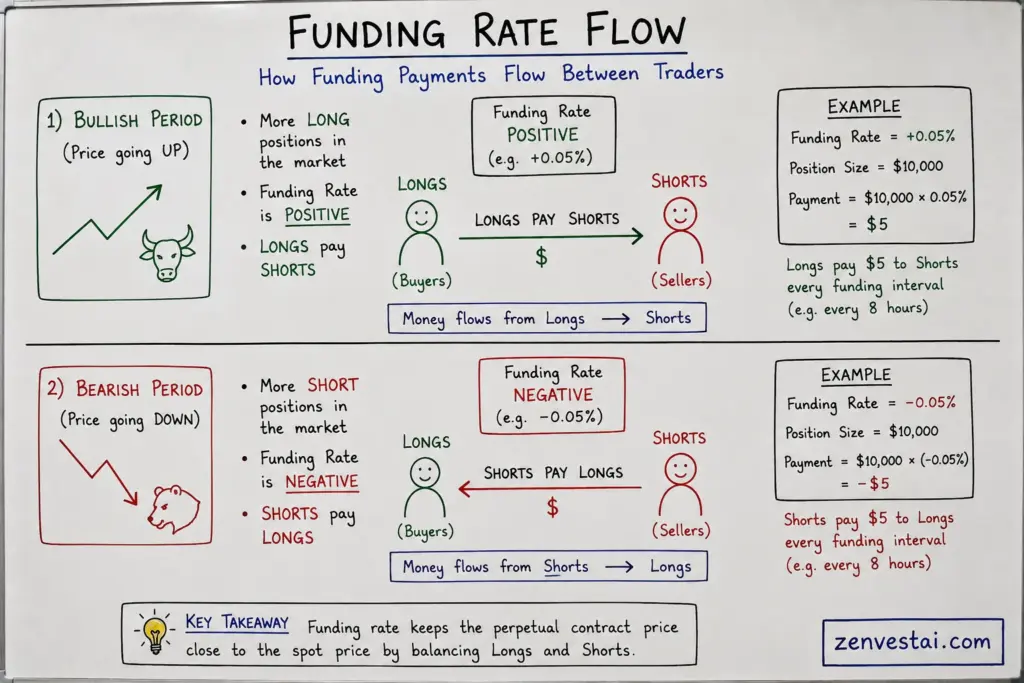
Funding payments are periodic transfers sent directly between long and short traders (typically occurring every 8 hours or 1 hour depending on the platform).
The exchange does not keep this fee; it merely redistributes it.
- Positive Funding Rate: When the perpetual contract price trades higher than the spot index price, bullish sentiment is dominant. In this case, longs pay shorts.
- Negative Funding Rate: When the perpetual contract price trades at a discount to the spot index price, bearish sentiment is dominant. In this case, shorts pay longs.
📚 New to Crypto?
Master the basic mechanics of digital tokens, decentralized consensus, and blockchain networks before trading complex financial derivatives.
Read: What Is Cryptocurrency? The Ultimate Beginner’s Guide →Why Long-Term Position Holders Must Monitor Funding
Holding a perpetual position for weeks during extreme market euphoria can accumulate significant funding fees.
Even if the price moves sideways, your capital will slowly drain away.
Net Trade Outcome = Gross Price Profit/Loss − Trading Fees ± Funding Payments − Slippage
The Costliest Lesson I Ever Learned:“Early in my trading journey, my biggest weakness was not technical analysis—it was ego. I remember opening a leveraged position that slowly began drifting against me.
Instead of accepting the invalidation level and taking a modest $50 loss, I convinced myself that the price would bounce. I kept manually dragging my stop-loss lower and lower to ‘give the trade more breathing room.’
The bounce never came. What should have been a minor, controlled paper cut turned into a devastating loss that wiped out weeks of steady gains in a single afternoon.
That experience forced me to rethink my entire approach. I realized that successful trading is never about proving you are right on every trade; it is about keeping your losses small when you are wrong so you never put your portfolio at risk.”
📊 Essential Market Knowledge
Understand market capitalization, volatility drivers, and spot order types to better anticipate contract price swings and liquidations.
Explore: Basics of the Crypto Market →What Is Liquidation and Why Does It Happen?
Forced liquidation takes place when your position’s unrealized losses exceed your maintenance margin threshold.
When your posted capital is insufficient to cover potential losses, the exchange’s risk engine steps in and automatically closes your contract at the prevailing market price.
Zenvestai Quick Insight: How Does Mark Price Prevent Unfair Liquidations?
Mark price uses a blended average of global spot prices and moving averages rather than volatile order book wicks. This safeguards traders from scam wicks or temporary exchange illiquidity triggering premature forced liquidations.
The formula for approximate liquidation can be understood as:
Distance to Liquidation ≈ (1 ÷ Leverage Multiplier) × 100%
Examples
- At 2× leverage, the market must move approximately 50% against your position before liquidation may occur.
- At 10× leverage, a market move of approximately 10% against your position may trigger liquidation.
- At 50× leverage, a move of approximately 2% against your position can put the position at severe liquidation risk.
Important: These are simplified estimates. Actual liquidation levels vary depending on the exchange, maintenance margin, fees, funding payments, position size, and whether the position uses isolated or cross margin.
The U.S. Commodity Futures Trading Commission (CFTC) consistently issues warnings to retail participants that virtual currency derivatives involve extreme volatility and that high leverage guarantees magnified risk of total capital loss.
🔍 Infrastructure Deep Dive
See how blockchain settlement layers eliminate intermediary clearing delays and enable instant liquidation engines across modern derivatives exchanges.
Read: How Distributed Ledgers Rewrite Modern Finance →Spot Trading vs. Crypto Futures
Many beginners struggle to choose between buying coins on the spot market and trading derivatives. The following structured matrix provides complete clarity.
| Feature / Attribute | Spot Crypto Trading | Crypto Futures Trading |
| Coin Ownership | Yes, you own the private keys and actual tokens | No, you hold a derivative tracking price action |
| Directional Exposure | Profit only when prices rise (Long) | Profit in rising (Long) or falling (Short) markets |
| Available Leverage | None (1:1 direct purchase) | Up to 10×, 20×, 50×, or 100× depending on venue |
| Forced Liquidation | None (you hold coins regardless of price drop) | Yes, if position losses breach margin limits |
| Holding Costs | Free (zero ongoing holding or funding costs) | Funding rate charges apply on perpetual swaps |
| Contract Expiration | Never expires | Perpetual (ongoing) or Dated Quarterly contracts |
| Complexity Level | Simple, beginner-friendly [Entry Level] | Advanced, requires active risk management |
| Ideal Use Case | Long-term investing, HODLing, Staking | Short-term swing trading, Day trading, Hedging |
Isolated Margin vs. Cross Margin: Which Should You Use?
Choosing the wrong margin configuration on your exchange settings can accidentally jeopardize your entire wallet balance.
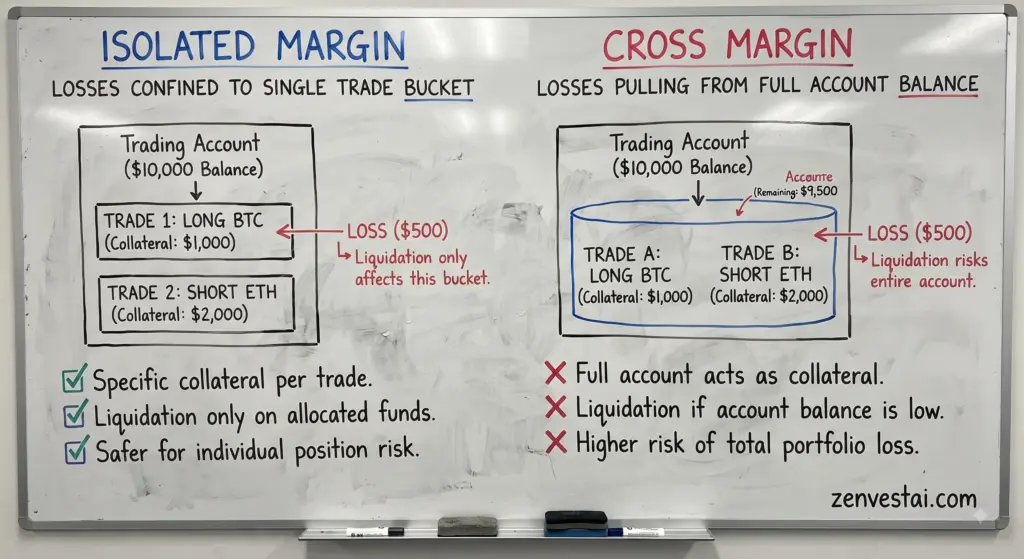
1. Isolated Margin (Recommended for Beginners)
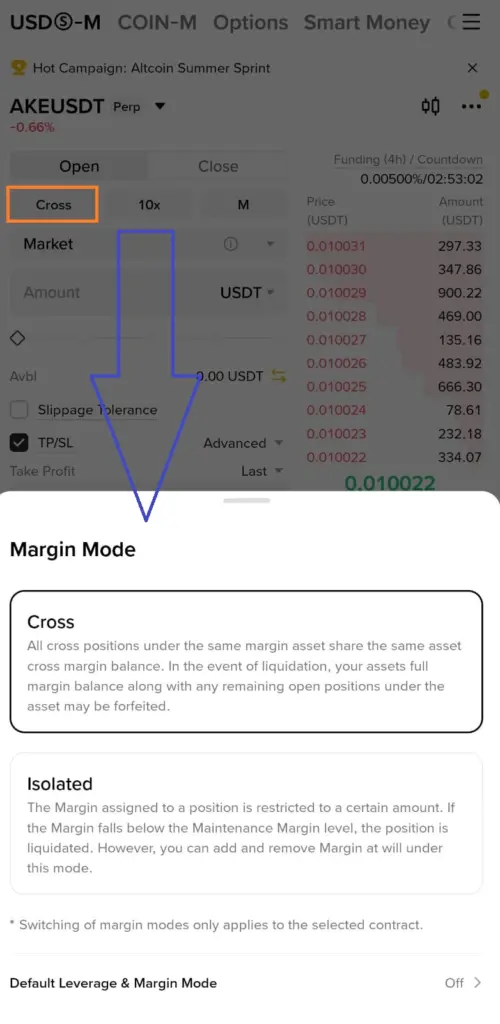
Isolated margin restricts your financial risk strictly to the capital allocated to that specific trade.
If you possess a $5,000 account balance and allocate $300 to an isolated trade, the absolute maximum amount you can lose if liquidated is strictly $300. Your remaining $4,700 stays protected.
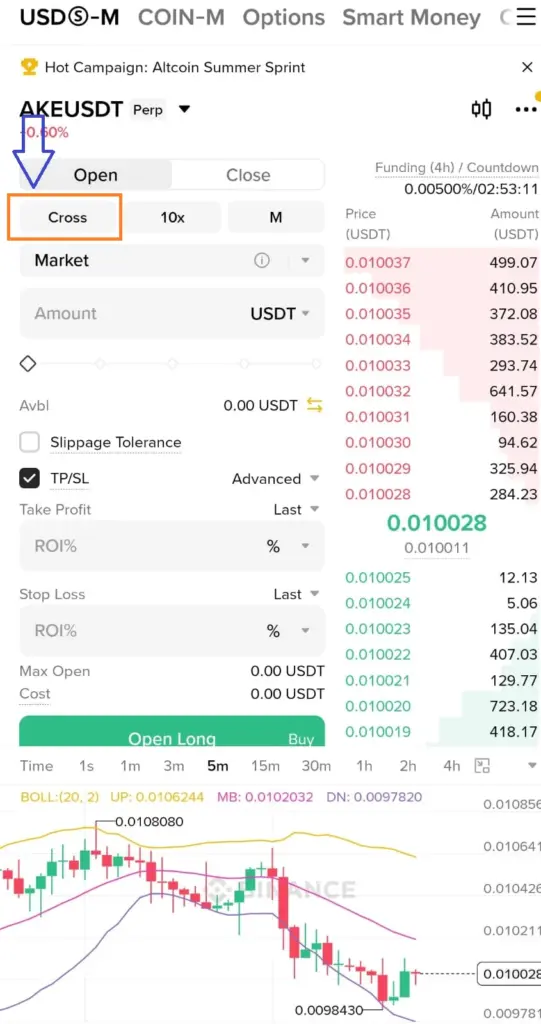
2. Cross Margin (Advanced Traders Only)
Cross margin shares your entire account balance across all open trades to prevent premature liquidations during volatile price spikes.
While this gives positions more breathing room, a runaway trend can drain your entire account balance down to zero across multiple correlated losses.
💰 Low-Capital Blueprint
Learn step-by-step risk management rules, micro-lot sizing, and leverage constraints designed specifically for accounts under $100.
Read Guide: How to Start Futures Trading with Low Capital →The Hidden Costs of Futures Trading
Profitable trading requires looking past surface-level profit and loss statements. A trade that looks green on paper can easily turn negative once operational execution costs are deducted.
- Maker and Taker Fees: Exchanges charge maker fees when you add liquidity with limit orders and higher taker fees when you execute immediate market orders.
- Contract Slippage: In fast-moving markets, your stop-loss or market order may fill several dollars away from your intended price.
- Bid-Ask Spreads: The difference between the highest price a buyer is willing to pay and the lowest price a seller will accept adds an implicit transaction cost to every entry and exit.
- Conversion & On-Ramp Costs: Converting between fiat currencies, stablecoins (USDT/USDC), and collateral assets involves network gas and conversion spreads.
The ZenvestAI Golden Rules: The 9-Step Capital Preservation & Execution Framework
(Forged from 8+ Years of Real Market Data, Trading Journals, and Discipline Protocols)
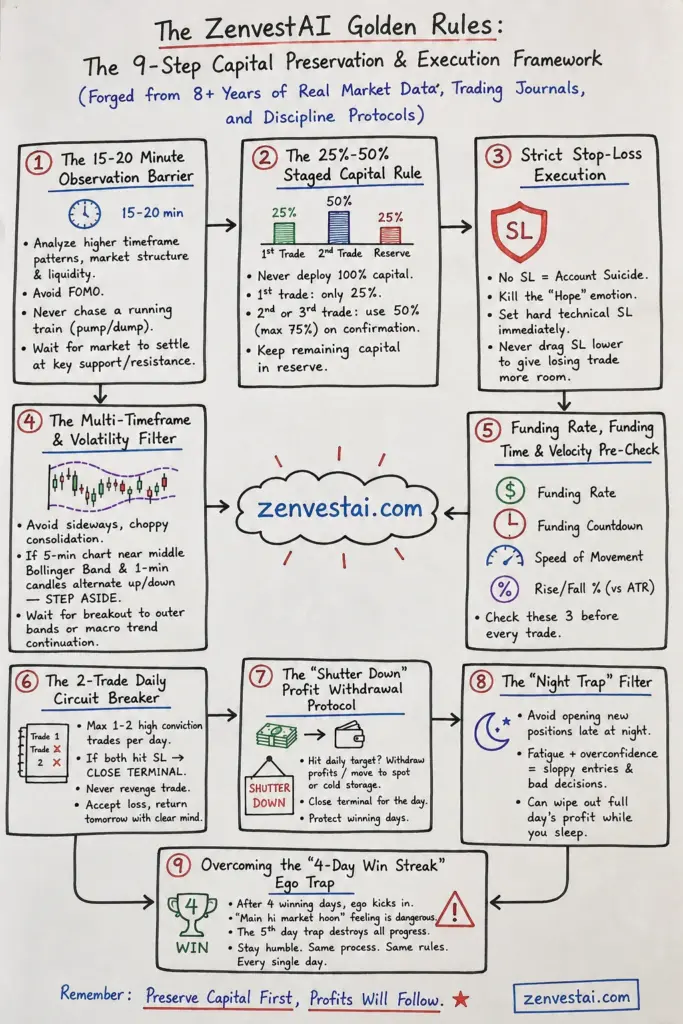
1. The 15–20 Minute Observation Barrier (Never Chase a Running Train)
- First Rule of the Session: When you log in to your exchange terminal, do not take an immediate trade. Spend the first 15 to 20 minutes strictly analyzing higher timeframe chart patterns, market structure, and liquidity.
- Avoid the FOMO Trap: Never jump onto a rapidly pumping or dumping green/red candle [Chalti Train Mein Nahi Chadna]. Fast-moving spikes are usually liquidity traps set by institutional algorithms. Wait for the market to settle at key support or resistance before planning an entry.
2. The 25%–50% Staged Capital Rule (Partial Deployment)
- Never Deploy 100% Capital: Risking your full wallet balance in one position triggers panic, clouding your judgment and forcing emotional mistakes.
- Staged Execution:
- Open your 1st trade with only 25% of your allocated capital.
- Use 50% (maximum 75%) only on 2nd or 3rd confirmation setups when the trend is undeniable.
- Keep the remaining capital strictly in reserve to absorb market variance.
3. Strict Stop-Loss Execution: No SL = Account Suicide
- Non-Negotiable Armor: Entering a leveraged futures trade without a hard stop-loss is financial self-sabotage [Suraksha Kavach].
- Kill the ‘Hope’ Emotion: The moment your mind says, “The price will definitely bounce from here,” recognize that this is emotional Hope [Ummeed] talking. Hope drains trading accounts.
- Hard Rule: Set your hard technical stop-loss immediately upon entry and never drag it lower to give a losing trade more room.
4. The Multi-Timeframe & Volatility Filter (Avoid Choppy Sideways Noise)
- Filter Sideways Consolidation: Do not trade during low-volume, choppy sideways ranges [Sideways Range Trap].
- Bollinger Band & Candle Check: If the 5-minute chart is hovering around the middle Bollinger Band and 1-minute candles alternate erratically (one up, one down), step aside. Wait for a decisive breakout to the outer bands or clear macro trend continuation before committing funds.
5. Funding Rate, Funding Time & Velocity Pre-Check
- Evaluate Derivative Mechanics: Before clicking buy or sell, always check three vital metrics on your perpetual terminal:
- Funding Rate & Countdown Timer: Avoid opening crowded long positions when funding rates are heavily positive right before the payout window.
- Speed of Movement: Distinguish between organic trend volume and erratic algorithmic spikes.
- Rise/Fall Percentage: Check how extended the coin already is relative to its daily average range (ATR).
6. The 2-Trade Daily Circuit Breaker (Zero Revenge Trading)
- Cap Your Exposure: Take a maximum of 1 to 2 high-conviction trades per session.
- Activate the Circuit Breaker: If both trades hit your stop-loss, immediately close the terminal and walk away.
- Never Revenge Trade: Trying to “win back” lost money immediately after a loss [Revenge Trading] is the single biggest cause of total account wipeout. Accept the small loss and return tomorrow with a clear mind.
7. The “Shutter Down” Profit Withdrawal Protocol
- Lock In Real Gains: If you achieve your daily target profit, withdraw your earnings or move them out of the futures wallet into spot/cold storage.
- Close the Terminal for the Day: Once profits are withdrawn, trading for that day is officially closed [Shutter Down].
- Protect Winning Days: Re-entering the market after a successful withdrawal out of greed is the easiest way to surrender hard-won gains back to the exchange.
8. The “Night Trap” Filter (Fatigued Mind = Account Drain)
- Avoid Late-Night Trading: If you have already booked profits during the day, do not open new positions late at night.
- Fatigue & Overconfidence: A tired brain combined with late-night overconfidence will lead to sloppy entries and impulsive decisions that wipe out an entire day’s earnings while you sleep.
9. Overcoming the “4-Day Win Streak” Ego Trap
- Beware the God Complex: After 4 consecutive winning days, traders naturally begin to feel invincible [“Main hi market hoon”].
- The 5th Day Trap: Overconfidence causes traders to abandon position sizing, skip stop-losses, and take oversized gambles on the 5th day, destroying all weekly progress. Treat every single trading day with the exact same humility and discipline as your first.
🤖 Algorithmic & AI Trading
Explore how automated bots, predictive indicators, and AI risk models help futures traders manage fast market movements and funding rate arbitrage.
Discover: How AI Is Transforming Crypto Trading in 2026 →Practical ZenvestAI Example: Real Portfolio Risk Allocation
Let us examine how a disciplined trader structures a low-risk trade using a ₹10,000 (INR) or equivalent $120 (USD) trading account.
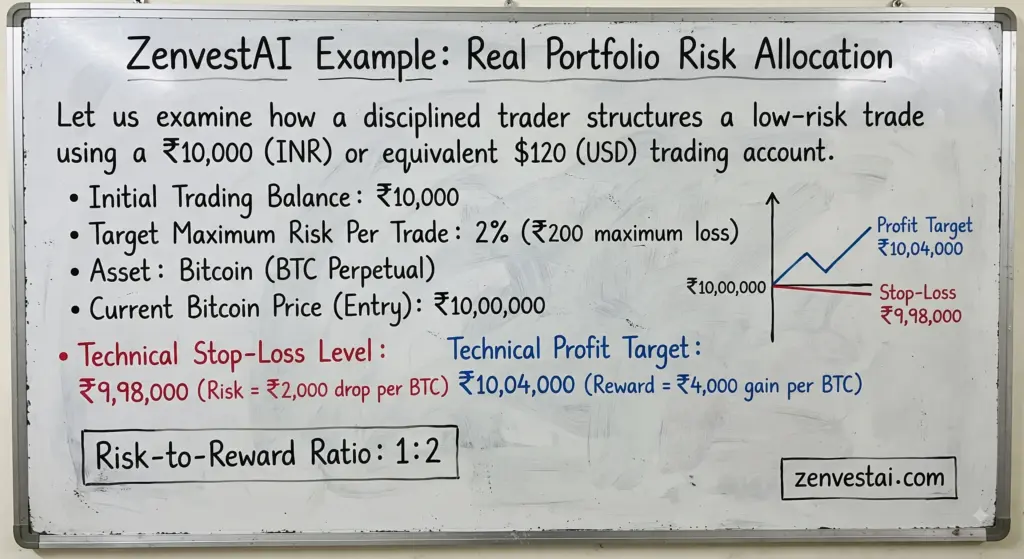
Current Bitcoin Price (Entry): ₹10,00,000
Technical Stop-Loss Level: ₹9,98,000 (Risk = ₹2,000 drop per BTC)
Technical Profit Target: ₹10,04,000 (Reward = ₹4,000 gain per BTC)
Risk-to-Reward Ratio: 1:2
Maximum Acceptable Risk = ₹200
Price Risk Per BTC Unit = ₹2,000
Calculated Position Size Exposure = ₹200 / ₹2,000 = 0.1 BTC exposure (₹1,00,000 notional position value)
Required Margin at 10x Leverage = ₹10,000 / 10 = ₹1,000 allocated margin
If Bitcoin drops to ₹9,98,000, your stop-loss triggers and closes the trade with exactly a ₹200 loss (2% of your overall capital). If Bitcoin rallies to ₹10,04,000, you book a solid ₹400 profit (4% overall portfolio gain).
Notice the crucial mindset shift: We did not ask, “How much leverage can we push?” We asked, “What position size keeps our maximum risk capped at ₹200?” This disciplined synergy between math and risk management defines institutional-grade trading.
📈 Macro Trends & Outlook
Anticipate the major narrative shifts, regulatory frameworks, and institutional liquidity flows shaping crypto market cycles this year.
Explore: The Future of Cryptocurrency in 2026 →8 Critical Mistakes Beginners Make and How to Avoid Them
1. Over-Leveraging: Utilizing 20× to 100× leverage on small accounts guarantees eventual liquidation during regular market spikes.
2. Trading Without Hard Stop-Losses: Hoping a losing trade turns around is the fastest route to account destruction.
3. Revenge Trading: Doubling position sizes immediately following a loss to “make money back” leads to emotional spiral and complete ruin.
4. Ignoring Funding Rate Drains: Holding crowded trades through multiple 8-hour funding intervals significantly erodes trading margins.
5. Trading Illiquid Altcoins: Low-cap tokens have shallow order book depth, leading to massive slippage during rapid sell-offs.
6. Overtrading 24/7: Constantly feeling the urge to be in a position leads to low-quality entries and mental burnout.
7. Chasing Guaranteed Signal Groups: Scammers lure beginners with screenshots of 1000% returns; reliable trading relies on edge and probability, not magic signals.
8. Moving Stop-Losses Further Away: Widening your stop-loss when price approaches your invalidation level breaks your risk plan and amplifies losses.
🛡️ Security Rule #1
Never store your full portfolio on an exchange. Protect your trading gains with self-custody solutions, hardware wallets, and multisig security.
Read: The Ultimate Guide to Crypto Wallets →Master 24/7 Market Psychology & Avoid the 5 Deadly Traps
In a non-stop 24/7 crypto market, emotional discipline matters more than technical indicators. Protect your mental capital with these 5 hard rules from our trading journal:
Withdrawal Means 'Shutter Down': Once you hit your profit target and withdraw your gains, close the terminal for the day. Never give your profits back to the market out of greed.
The 15-Minute Rule: Wait 15–20 minutes after logging in before placing a trade. Never chase a rapidly surging green candle [Chalti Train Trap].
Kill the 'Hope' Emotion: Never trade without a hard stop-loss [Suraksha Kavach]. If you catch yourself thinking “it will definitely bounce,” recognize that hope drains capital.
The Night Trap: If you made profit during the day, do not trade at night. A fatigued brain and overconfidence will destroy daytime earnings.
Beware the 4-Day Win Streak: After 4 consecutive winning days, avoid the God Complex [“Main hi market hoon”]. Treat Day 5 with the exact same caution as Day 1.
💳 Spending Your Profits
Discover how to link your futures profit wallet directly to a virtual payment card for low-fee daily expenses and online merchant purchases.
Check Out: Binance Virtual Card Spending Guide →The 2026 Crypto Derivatives Landscape and Regulatory Realities
The crypto derivatives ecosystem in 2026 has matured into a sophisticated landscape featuring institutional grade liquidity, regulated clearinghouses, and decentralized perpetual protocols (DeFi Perps).
- Global Regulation: Regulatory bodies like the CFTC in the United States, ESMA in Europe, and national authorities worldwide enforce strict Know-Your-Customer (KYC), anti-money laundering (AML), and leverage limit rules on retail platforms.
- Decentralized Perpetuals (DEXs): On-chain derivative platforms operating on Layer-2 rollups allow transparent, non-custodial perpetual trading with automated market maker pools.
- Taxation & Compliance: In jurisdictions such as India, crypto derivatives fall under strict Virtual Digital Asset (VDA) reporting standards, Tax Deducted at Source (TDS) provisions, and capital gain rules. Always verify your local tax obligations and platform licensing before depositing funds.
The ZenvestAI Philosophy: Capital Preservation First
At ZenvestAI, we believe that long-term market success is not built on high-risk gambles or overnight riches. It is built on sustainable, calculated execution.
Protect Capital:Treat your trading balance as your business inventory.- Pre-Calculate Risk: Always know your maximum exit loss before clicking the buy or sell button.
Respect Market Cycles:Understand when volatility is high and scale back your position size accordingly.- Master Process Over Outcome: A well-executed trade that hits a stop-loss is still a good trade if it followed your rules.
📋 The ZenvestAI Daily Pre-Trade & Post-Trade Checklist
To ensure these rules remain active habits rather than passive advice, review this checklist every single day before touching your keyboard:
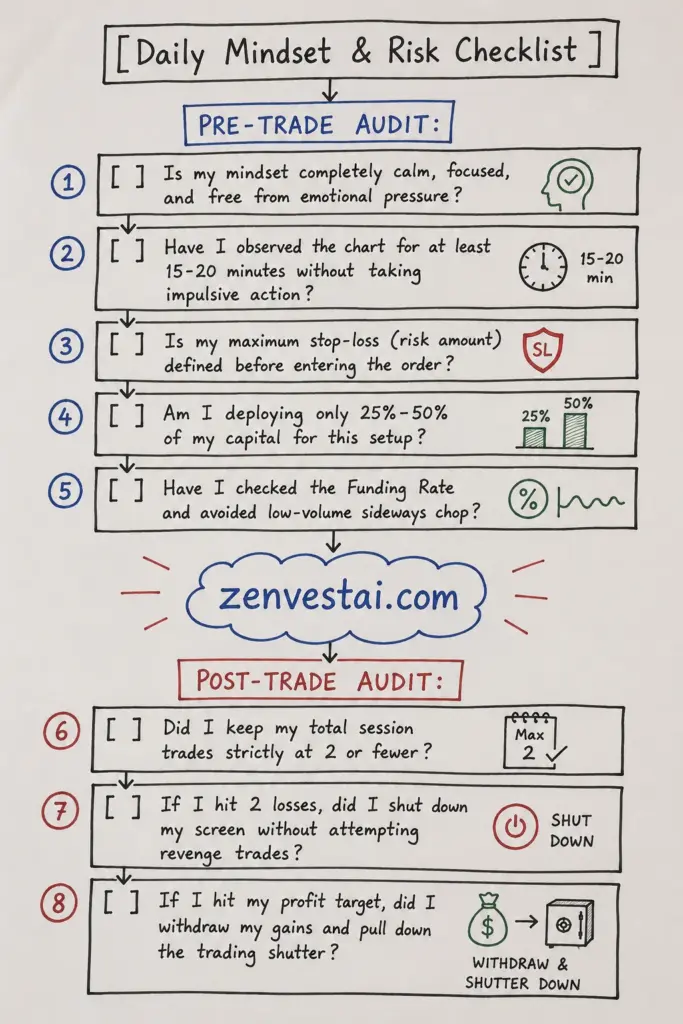
The Core ZenvestAI Truth:100% Capital Deployed = 100% Emotional Panic. 25%–50% Strategic Deployment + Strict Stop-Loss = Calm, Consistent, Institutional-Grade Longevity.
Glossary of Crypto Futures Terms
Initial Margin: The minimum collateral required to open a new leveraged trade.
Maintenance Margin: The critical collateral balance needed to keep an existing position open before liquidation occurs.
Leverage: A borrowing multiplier that increases buying power relative to deposited collateral.
Long Position: A trade that generates profit when the underlying asset increases in price.
Short Position: A trade that generates profit when the underlying asset declines in price.
Perpetual Contract (Perp): A derivative contract with no expiration date, balanced by funding rates.
Funding Rate: Periodic payments exchanged between long and short contract holders to anchor futures prices to spot index values.
Mark Price: An aggregated, manipulation-resistant reference price used for calculating margin and liquidation triggers.
Index Price: A volume-weighted spot price aggregated across top global exchanges.
Liquidation Price: The exact mark price level where a trader’s margin is exhausted and the exchange forcibly closes the position.
Stop-Loss (SL): An automated protective order that exits a losing trade at a predetermined price.
Take-Profit (TP): An automated order designed to close a winning position at a target profit level.
Slippage: The variance between your expected order price and the actual execution price.
Maker Fee: A reduced trading fee applied when you add limit orders to the order book.
Taker Fee: A standard trading fee charged when your market order immediately consumes available order book liquidity.
🎯 The Bottom Line:
Crypto futures trading provides immense flexibility, giving traders the ability to profit in both bull and bear markets while maximizing capital efficiency.
However, futures are sophisticated financial tools that demand strict discipline, mathematical risk management, and emotional control.
Never enter a trade based on potential profit alone; always calculate your maximum allowable downside first.
By utilizing low leverage, setting hard stop-losses, and following the ZenvestAI capital preservation framework, you can navigate the dynamic world of crypto derivatives with confidence and control.
Join the Conversation!
What has been your biggest challenge or experience with crypto futures trading so far?
Have you tried using isolated margin or automated stop-loss strategies in your trading journey?
Drop your thoughts, questions, and experiences in the comments section below! Let’s learn, grow, and build sustainable trading habits together as a community.
💡 Author’s Real-World Take:“I share these risk rules not from a textbook, but from personal scars. In my early years in the digital asset markets, I experienced firsthand what happens when you let leverage run without a defined exit plan.
Losing real capital to forced liquidation is an expensive way to learn discipline. Treat every trade with respect, size your positions for the worst-case scenario, and always protect your capital first.”
⚠️ Important Risk Disclaimer
Educational content only. This article does not constitute financial, investment, legal, or tax advice. Cryptocurrency derivatives and perpetual futures are high-risk financial instruments. The use of leverage can amplify both gains and losses, and you may lose some or all of your deposited capital. Never trade with funds you cannot afford to lose. Always verify the regulatory status and legal compliance of cryptocurrency derivatives within your local jurisdiction before engaging in live trading. ZenvestAI promotes disciplined risk management and does not endorse irresponsible leverage or speculative gambling.

Pingback: The Ultimate Guide to Spatial Arbitrage in Crypto Trading