Key Takeaways:
Spatial arbitrageinvolves buying an asset at a lower price on one exchange and selling it higher on another.
- The
net profitafter deducting all trading, network, and transfer fees is the only metric that matters.
Speed and automationare essential, as manual trading is often too slow to capture temporary price gaps.
Execution risk, slippage, and liquidityare major factors that can quickly turn a profitable opportunity into a loss.
Unlock Guaranteed-Looking Profits: The Ultimate Guide to Spatial Arbitrage in Crypto Trading
Have you ever stared at your screen, watching Bitcoin prices flash differently across various exchanges, and wondered if you could make money from that gap? Initially, when I first came across the term spatial arbitrage, it sounded incredibly intimidating. However, the underlying concept is actually quite simple. In today’s fast-paced digital market (bazaar), understanding how to capture these price differences can transform your trading strategy. 🚀
ZenvestAi Explains
Spatial arbitrage is a specialized trading strategy where an investor simultaneously buys an asset on one exchange at a lower price and sells the exact same asset on another exchange at a higher price.
This rapid transaction captures the price difference, known as the spread, to generate a profit. While the concept is straightforward, successful execution requires carefully calculating all hidden costs—including trading fees, network charges, and slippage—and executing the trade before market efficiency closes the temporary price gap.
Expand Your Crypto Knowledge: Essential Further Reading
If you want to take your cryptocurrency trading and investing to the next level, mastering the fundamentals of risk management, platform security, and advanced trading mechanics is crucial. Explore our comprehensive guides below:
Master Trading & Risk Management
-
What Is Crypto Futures Trading? A Complete Beginner’s Guide
Learn the mechanics of futures trading and how to navigate leverage and market volatility safely. -
The Ultimate Risk-to-Reward Ratio Guide: Master Crypto Risk and Protect Your Capital
Discover how to calculate your risk mathematically to ensure long-term profitability and protect your trading capital. -
What Is Take Profit (TP)? The Ultimate Step-by-Step Guide to Locking in Crypto Trading Profits with Discipline
Stop letting winning trades turn into losing ones by mastering the exact strategies to secure your gains. -
Ultimate Guide: What Is Crypto Portfolio Margin Financing?
Explore advanced capital efficiency techniques that allow you to maximize your purchasing power across your entire portfolio.
Exchange Security & Blockchain Fundamentals
-
How to Safely Set Up and Secure an Account on Binance
A step-by-step walkthrough to ensure your exchange account is fortified against hackers and fully optimized for trading. -
Why Does Staking Exist? The Ultimate Guide to Cryptoeconomic Security
Dive into the technology behind Proof-of-Stake networks and understand how locking your assets helps secure the blockchain while earning you rewards.
What This Post Covers
- The Core Problem: Market Inefficiencies
- The Solution: How Spatial Arbitrage Works
- Real-World vs. Crypto Arbitrage
- The Essential Calculation for Net Profit
- Main Risks and Execution Challenges
- Advanced Strategies (Triangular & DEX)
- Step-by-Step Practical Framework
- Glossary
The Problem: Navigating Fragmented Markets
Market prices are rarely perfectly aligned across all platforms. Because of this, traders often face confusion when they see Bitcoin trading at $100,000 on Binance and $100,500 on WazirX.
Exchanges operate independently with different user bases. Furthermore, they experience different levels of liquidity, trading volume, and sudden buying or selling pressure. For instance, a massive influx of local buyers might temporarily pump the price on an Indian exchange, while global platforms remain stable.
These price gaps create a temporary window of inefficiency. Consequently, if you do not understand why these gaps exist, you might either miss a great opportunity or, worse, lose money trying to chase a gap that isn’t actually profitable after fees.
The Solution: Mastering Spatial Arbitrage
What Is Spatial Arbitrage?
Spatial arbitrage means buying the exact same asset at a lower price in one location and selling it at a higher price in another. Most importantly, this price difference happens simultaneously but in entirely different markets.
Let’s look at a clear example:
- Exchange A (Buy): $100,000
- Exchange B (Sell): $100,500
If you can buy Bitcoin on Exchange A and instantly sell it on Exchange B, there is a $500 gross price difference. That difference represents your core arbitrage opportunity.
Zenvestai Quick InsightA visible price difference does not automatically guarantee profit (munafa). Always remember that trading fees, withdrawal charges, network congestion, slippage, and sudden price movements can drastically reduce or entirely erase your expected earnings. Speed and precision are your best tools.
Look at a Simple Example
Let me explain this without complicated trading jargon. Suppose a trusted gold shop in Delhi is selling gold for ₹6,000 per gram, while a buyer in Mumbai is offering ₹6,100 for the same gold.
There is a ₹100 difference. Therefore, you could technically buy in Delhi and sell in Mumbai. However, you cannot simply say your profit is ₹100. First, you must deduct travel expenses, local taxes, shop commissions, and the value of your time.
The exact same logic applies directly to cryptocurrency markets.
Why Speed and Calculation Matter Above All
The Most Important Calculation: Net Spread
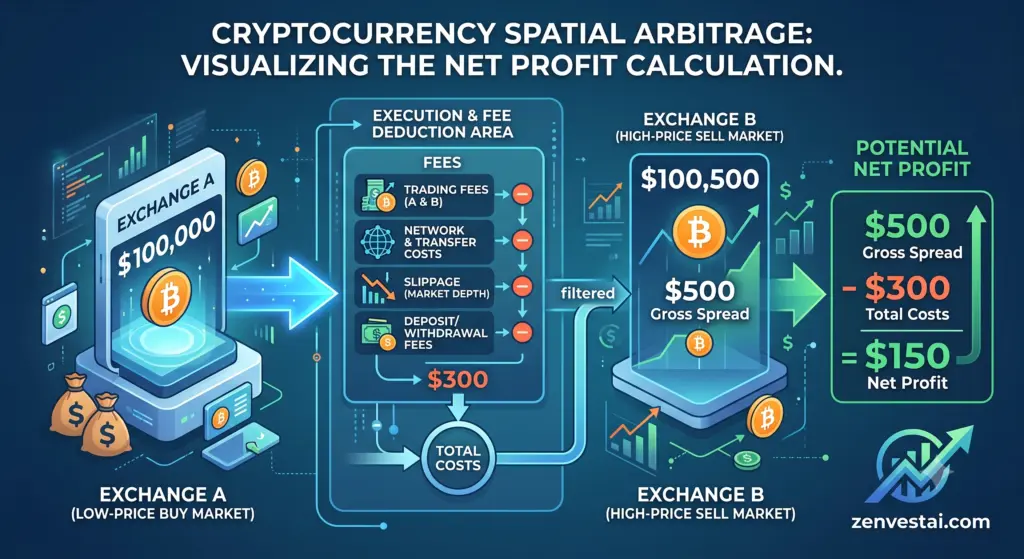
Beginners almost always make the mistake of focusing only on the gross spread. In reality, the net executable spread is the only number that dictates success. 💡
Imagine this scenario:
- Buy Price: $100,000
- Sell Price: $100,500
- Gross Spread: $500
Now, you must calculate your actual execution costs. These might include:
- Trading fees: $120
- Slippage (price movement during trade): $100
- Network and transfer costs: $50
- Other exchange costs: $30
Total Costs = $300. Thus, your Potential Net Profit is actually $500 – $300 = $150.
Further Reading: Expand Your Crypto Expertise
Whether you are just starting your crypto journey or looking to refine your long-term investment strategies, check out these essential guides from ZenvestAI:
Crypto Fundamentals & Technology
-
What Is Cryptocurrency? The Ultimate Beginner’s Guide
Build a solid foundation by understanding exactly what digital currencies are, how they work, and why they matter. -
How Distributed Ledgers Are Radically Rewriting the Rules of Modern Finance
Discover the underlying blockchain technology that is powering the crypto revolution and reshaping traditional global finance.
Wealth Building & Passive Income Strategies
-
The Complete Bitcoin Wealth Strategy
Learn actionable, long-term approaches to accumulating, managing, and protecting Bitcoin to build generational wealth. -
The Complete Ethereum Wealth Strategy
Navigate the complex Ethereum ecosystem and maximize your investment potential with the world’s leading smart contract platform. -
What Is Crypto Staking? The Complete Guide to Earning Rewards Safely
Find out how to put your idle crypto assets to work and generate consistent passive yield securely.
The Future of Trading
-
How AI Is Transforming Cryptocurrency Trading in 2026
Stay ahead of the market by exploring how artificial intelligence is automating strategies, predicting trends, and changing the landscape of crypto trading.
What Are the Main Risks in Spatial Arbitrage?
This strategy is absolutely not risk-free. Even though you avoid predicting market direction, you still face intense execution risks.
- Trading Fees: If the price difference is too small, platform fees will consume your entire profit.
- Withdrawal Fees: Moving crypto between exchanges incurs network fees, which spike during busy periods.
- Slippage: The displayed price may change before your full order executes due to low market depth.
- Transfer Time: Bitcoin can take 10-30 minutes to transfer. Meanwhile, the price gap might completely vanish.
- Liquidity Shortages: An exchange might show a high price, but only have a tiny amount of buyers willing to pay it.
Zenvestai Quick Insight
Liquidity matters far more than the displayed price. Always check the order book depth. If there are only $2,000 worth of buy orders at the peak price, a $100,000 sell order will crash through the levels, ruining your average selling price.
What Is Cross-Exchange Spatial Arbitrage?
This is the most traditional method. You simply compare the price of a single asset across two distinct exchanges (e.g., Coinbase vs. OKX) and execute the trade across borders.
What Is Triangular Arbitrage?
Triangular arbitrage happens within a single exchange. Instead of moving assets between platforms, you trade three different pairs. For example, you might trade USDT to BTC, then BTC to ETH, and finally ETH back to USDT. If the ratios are slightly mismatched, you end up with more USDT than you started with.
Automated Spatial Arbitrage and APIs
Manual trading is usually too slow for modern arbitrage. Consequently, serious traders rely on automated bots and exchange APIs.
How an automated system works:
- Collects prices instantly from multiple exchanges.
- Calculates the spread and all hidden costs in milliseconds.
- Checks liquidity to ensure the order will fill smoothly.
- Executes the trade simultaneously on both platforms.
A Practical Framework for Finding Opportunities
If you want to start analyzing these opportunities, follow this step-by-step checklist:
- Choose a Liquid Asset: Start with high-volume coins like BTC or ETH.
- Compare Markets: Monitor prices across at least 3-4 trusted exchanges.
- Calculate All Costs: Deduct trading, withdrawal, and gas fees immediately.
- Verify Liquidity: Check the order book to ensure your volume can be absorbed.
- Assess Transfer Speed: Confirm that neither exchange has paused withdrawals.
- Execute Rapidly: Use limit orders and fast networks (like Tron or Solana for stablecoins) if moving funds.
Explore More Crypto Insights
Ready to dive deeper? Check out these hand-picked guides to enhance your crypto knowledge:
Crypto Basics & Security
-
Basics of the Crypto Market
A perfect starting point to understand the fundamental mechanics, volatility, and dynamics of cryptocurrency markets. -
The Ultimate Guide to Crypto Wallets
Learn how to safely store, manage, and protect your digital assets from potential threats.
Trading & Real-World Usage
-
How to Start Crypto Futures Trading with Low Capital?
Discover actionable strategies to enter the futures market, manage leverage, and grow a small starting balance. -
Why the Binance Virtual Card is the Smartest Way to Spend Crypto in Asia (2026 Guide)
Bridge the gap between digital assets and everyday spending with this comprehensive guide to using crypto cards.
Market Outlook
-
The Future of Cryptocurrency in 2026
Stay ahead of the curve by exploring the intersection of AI, blockchain innovations, and the biggest trends shaping the market this year.
Glossary of Terms
- Arbitrage: Taking advantage of a price difference between two or more markets.
- Spread: The financial difference between the buying price and the selling price.
- Slippage: The difference between the expected price of a trade and the price at which it actually executes.
- Liquidity: How easily an asset can be bought or sold in the market without affecting its price.
- Market Making: Providing liquidity by placing both buy and sell orders to profit from the bid-ask spread.
- DEX (Decentralized Exchange): A peer-to-peer marketplace where transactions occur directly between crypto traders.
Is spatial arbitrage risk-free?
No, spatial arbitrage is not risk-free. While it reduces directional market risk, it introduces execution risks, including network transfer delays, slippage, unexpected exchange fees, and sudden price volatility. ⚠️
Zenvestai Quick Insight
Never treat arbitrage as guaranteed money. Always account for exchange downtime and smart contract risks, especially when operating on Decentralized Exchanges (DEXs) where network congestion can ruin trades.
How much money do you need for crypto arbitrage?
You need enough capital to ensure that your gross profit comfortably covers flat withdrawal fees. Small amounts (like $50) usually fail because network fees will consume 100% of the price difference. Professional traders often use thousands of dollars to make the margins worthwhile.
What is pre-funded arbitrage?
Pre-funded arbitrage is a strategy where traders hold balances on multiple exchanges simultaneously (e.g., USDT on Exchange A and BTC on Exchange B). This completely eliminates transfer delays, allowing for instant execution when a price gap appears.
Can I do spatial arbitrage with stablecoins?
Yes, stablecoins like USDT and USDC frequently trade at slight premiums or discounts against local fiat currencies across different regional exchanges. However, you must carefully calculate currency conversion rates and banking fees.
Continue Your Crypto Learning Journey
Broaden your understanding of the evolving digital economy and blockchain technology with these recommended reads from ZenvestAI:
Blockchain Fundamentals
-
A Beginners Guide to Cryptocurrency and Blockchain Technology
Start here to build a strong foundation on how decentralized networks operate and why digital currencies have value.
The Tokenization Revolution
-
Understanding Tokenization and Wholesale Digital Assets in 2026
Dive into how institutional money and wholesale digital assets are fundamentally reshaping traditional financial markets this year. -
How Tokenization is Empowering Small Businesses in 2026
Learn how tokenizing real-world assets is democratizing access to capital and unlocking new growth avenues for small enterprises.
Market & Regulatory Landscape
-
The Future of Crypto Regulations
Stay informed and prepared by exploring the latest shifts in global cryptocurrency laws and what they mean for investors and businesses alike.
The Bottom Line
Spatial arbitrage is a powerful tool for capturing market inefficiencies. Ultimately, the basic idea is incredibly simple: buy the same asset where it is cheaper and sell it where it is more expensive.
However, the real work lies in the execution. You must rigorously verify trading fees, liquidity depth, network transfer times, and slippage. It is not just about finding two different prices; it is about uncovering a net executable spread that leaves a healthy profit after all risks are managed. By mastering these calculations and leveraging automation, you can turn fleeting market gaps into consistent trading advantages. 📉
What is the biggest challenge you’ve faced when trying to move crypto between exchanges? Let me know your experience in the comments below!