Can you copy a masterpiece with a quick screenshot, or does the original still matter? In the digital world, millions of identical copies can exist in a single click, yet a non-fungible token creates verifiable scarcity, clear provenance, and distinct identity on a public ledger.
This guide delivers an authoritative, beginner-to-advanced breakdown of what is an NFT, clarifying the exact mechanics, technical token standards, economic realities, legal boundaries, and regulatory landscapes shaping digital assets today.
What Is an NFT in 30 Seconds
An NFT, short for non-fungible token, is a unique digital record created and verified on a blockchain using smart contracts. Unlike standard digital currencies where every unit is identical, each NFT contains unique identifier data that distinguishes it from any other token. It functions as an unalterable certificate of authenticity and ownership record for a specific digital or tokenized physical asset.
Key Takeaways
- Fungibility defines interchangeability: Traditional currencies and standard cryptocurrencies are fungible (interchangeable), whereas NFTs are non-fungible (one-of-a-kind or part of a strictly numbered series).
- Token records differ from media files: An NFT is a blockchain record containing a token ID and contract address; the associated artwork or metadata is typically stored off-chain on decentralized storage networks like IPFS or Arweave.
- Token standards govern functionality: Ethereum standards like ERC-721 handle individual unique tokens, while ERC-1155 enables multi-token management across both fungible and non-fungible assets.
- Legal rights require explicit agreements: Holding an NFT does not automatically convey underlying intellectual property, copyright, or commercial rights unless explicitly coded into the smart contract or accompanying legal contract.
- Market values are driven by utility and demand: NFTs fluctuate wildly based on market liquidity, community interest, and functional utility, carrying real risks of illiquidity and volatility.
⚡ At a Glance: NFT Fundamentals
Core Overview
| Question | Core Takeaway | Practical Analogy |
|---|---|---|
| What does NFT stand for? | Non-Fungible Token | A deed of ownership, concert ticket, or custom license plate |
| Are NFTs cryptocurrencies? | No. Shares blockchain rails, but lacks interchangeability | $100 bill (fungible currency) vs. Signed lease (unique contract) |
| Where are NFTs stored? |
Hybrid Architecture:
| Car title held at the registry vs. physical car parked outside |
| Primary Ethereum Standards |
| Serialized collector card vs. video game inventory loadout |
Table of Contents
- What Is an NFT?
- What Does NFT Stand For?
- How Does an NFT Work?
- What Makes an NFT Different From a Cryptocurrency?
- What Can an NFT Represent?
- What Are NFTs Used For?
- What Is Minting an NFT?
- What Are NFT Standards?
- Where Is an NFT Stored? The Token vs. Storage Reality
- Are NFTs the Same as Digital Art?
- Are NFTs Worth Money?
- What Are the Risks of NFTs?
- Comparing Cryptocurrency, NFTs, and Digital Assets
- A Simple Real-World Example
- Global Regulatory Frameworks and Institutional Impact
- Frequently Asked Questions About NFTs
- ZenvestAI View
- The Bottom Line
- Related Intelligence
- Author and Editorial Information
- Regulatory and Educational Disclosure
What Is an NFT?
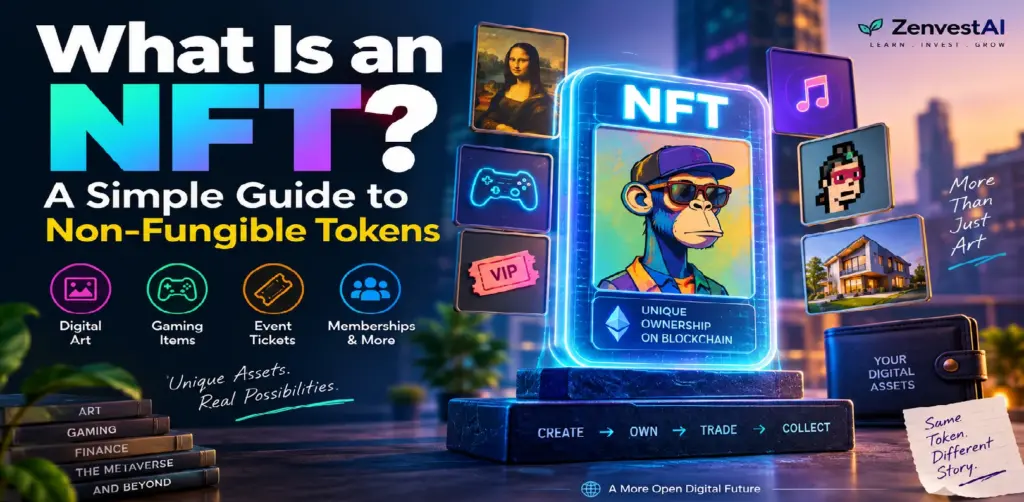
An NFT, or non-fungible token, is a unique digital record created and managed on a blockchain. It can represent ownership, access rights, or provenance associated with a digital or physical item, such as digital art, collectibles, event tickets, gaming assets, or verified credentials.
To understand NFT meaning, the concept of fungibility is the foundational starting point:
- Fungible means completely interchangeable and indistinguishable from another unit of the same type.
- Non-fungible means unique, distinct, and not interchangeable on a like-for-like basis.
Consider a practical example using everyday financial assets:
- One $100 bill equals any other $100 bill in purchasing power and function; you can swap them freely without any change in value.
- Token #101 of an NFT smart contract does not equal Token #102 of the same contract; each token has a distinct token ID, historical ownership trail, and specific metadata attributes.
This distinction is fundamental to decentralized systems and aligns directly with the architectural definitions outlined by the National Institute of Standards and Technology (NIST) and Ethereum’s technical documentation. While fungible tokens represent fungible stores of value or utility, non-fungible tokens represent unique entities and distinct properties.
Now that we understand what makes an item non-fungible, how does the acronym itself break down into practical technical concepts?
What Does NFT Stand For?
NFT stands for Non-Fungible Token.
Breaking down the three terms provides immediate clarity:
- Non-fungible: An asset that is unique, individually identifiable, and impossible to replace with an identical counterpart.
- Token: A digitally secure entry on a decentralized ledger managed by an automated smart contract.
- NFT: A blockchain-based token that uniquely points to and identifies a specific digital or physical asset.
Transition Bridge: Having clarified the terminology, what exact technical journey occurs when an NFT is brought into existence, held, and transferred?
How Does an NFT Work?
The operation of an NFT relies on smart contracts—self-executing code deployed to a blockchain network such as Ethereum, Solana, or Polygon. The entire lifecycle follows a five-step architecture: Create, Mint, Record, Own, and Transfer.
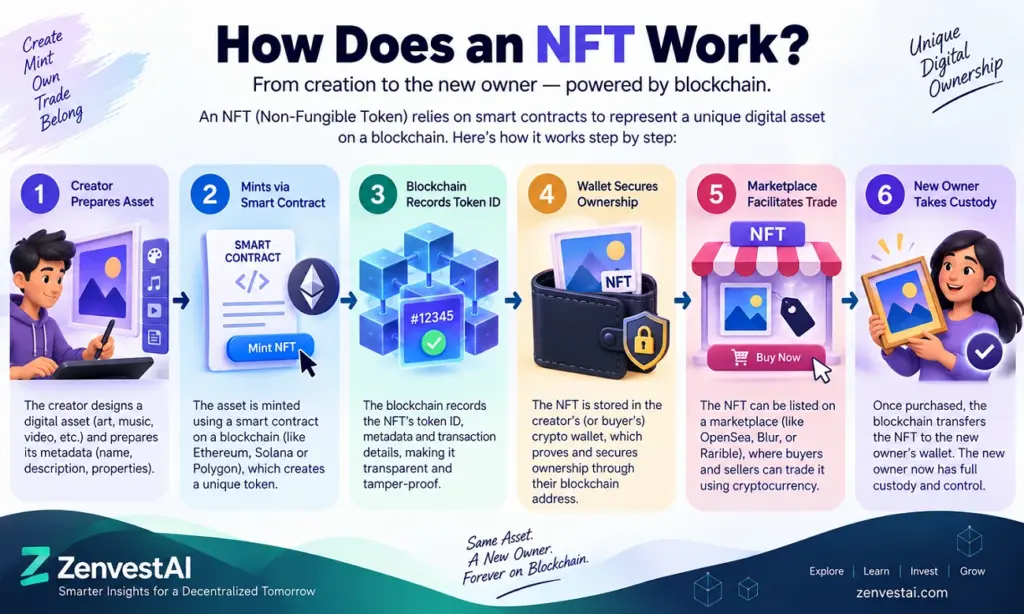
Step 1: Create
A creator prepares an original digital item—such as an image file, audio track, 3D model, or concert ticket database—and formats its corresponding descriptive metadata.
Step 2: Mint
The creator initiates a transaction to execute an issuance function inside a blockchain smart contract, formally initiating the token.
Step 3: Blockchain Records It
The decentralized network validates the transaction, assigning a permanent Token ID paired with the smart contract address, logging the creator’s wallet address as the initial owner.
Step 4: Ownership Changes
When the token is sold, gifted, or traded, the smart contract updates its internal mapping table, replacing the prior wallet address with the buyer’s public address.
Step 5: It Can Be Transferred Again
The recipient wallet now holds verifiable cryptographic title to the token, enabling them to hold it, use it for platform access, or list it on a secondary marketplace.
Ethereum’s foundational ERC-721 standard implements standardized functions such as ownerOf(tokenId) and transferFrom(from, to, tokenId). These functions enable any external platform, wallet, or decentralized application to independently query who owns a given token and facilitate secure transfers without an intermediary.
Because both NFTs and cryptocurrencies operate on blockchains, what specific differences separate the two asset classes?
What Makes an NFT Different From a Cryptocurrency?
The primary difference between an NFT vs cryptocurrency lies in token fungibility and divisibility. While cryptocurrencies operate as divisible media of exchange, NFTs act as distinct, indivisible digital certificates.
| Feature | Cryptocurrency | NFT (Non-Fungible Token) |
| Nature | Fungible | Non-Fungible |
| Interchangeability | Completely interchangeable | Unique and distinct |
| Divisibility | Divisible (e.g., 0.0001 BTC or 18 decimals) | Typically non-divisible (whole integer token IDs) |
| Primary Purpose | Medium of exchange, unit of account | Proof of ownership, authenticity, access credential |
| Underlying Standard | ERC-20 (Ethereum), SPL (Solana) | ERC-721, ERC-1155 (Ethereum), Metaplex (Solana) |
| Unit Differentiation | Every unit shares the identical market price | Every unit carries individual market pricing |
Bitcoin and Ethereum’s native Ether are designed so that every individual coin operates identically to any other coin of the same denomination. In contrast, an NFT contains individual parameters that distinguish it, meaning two tokens created under the exact same smart contract can command completely different values and utilities.
If an NFT is fundamentally an identity token, what varieties of real-world and digital media can it represent?
What Can an NFT Represent?
An NFT can represent almost any digital or physical asset where individual identity and provenance matter. Rather than being confined to visual files, non-fungible tokens serve as digital containers for diverse forms of data and rights:
- Digital Artwork: Still images, generative algorithmic designs, animations, and photography collections.
- In-Game Assets: Character skins, virtual land parcels, customizable gear, and rare equipment items.
- Music and Audio: Master recordings, exclusive album editions, and royalty distribution rights.
- Event Ticketing: Admission passes with anti-counterfeit protections and automated secondary market price caps.
- Memberships and Communities: Access keys for decentralized autonomous organizations (DAOs), private investment research clubs, or physical club entries.
- Identity and Credentials: Academic diplomas, professional certifications, and non-transferable soulbound identity tokens.
- Blockchain Domain Names: Web3 wallet handles and decentralized website addresses (such as
.ethor.sol). - Tokenized Real-World Assets (RWAs): Fractional or whole real estate deed records, luxury watches, fine wine allocations, and commodities.
Holding an NFT does not automatically convey underlying legal copyright or intellectual property rights. Unless the creator explicitly assigns copyright through a legal agreement or embedded license, the buyer generally acquires ownership of the specific token record, not the intellectual property itself.
How are businesses, creators, and institutions taking these theoretical representations and applying them to practical use cases today?
What Are NFTs Used For?
Understanding what are NFTs used for requires examining utility over speculative hype. Across multiple consumer and enterprise sectors, organizations deploy NFTs to streamline verification, eliminate middlemen, and protect authenticity.
Digital Art and Creative Provenance
Artists historically faced rampant piracy and an inability to establish original provenance for purely digital works. NFTs provide a tamper-resistant ledger trail connecting the creator’s verified public wallet address directly to the artwork, verifying genuine editions and supporting programmatic secondary royalties.
Gaming and Virtual Economies
Traditional gaming platforms trap digital purchases inside closed ecosystems where players have no custody over their items. Blockchain-based gaming items allow players to store in-game assets in self-custody wallets and trade them across external secondary markets.
Ticketing and Anti-Fraud Systems
Secondary ticketing fraud and predatory scalping plague the entertainment industry. Smart-contract ticketing enables event organizers to set price ceilings, restrict unauthorized transfers, and collect verifiable percentages of secondary market resales.
Memberships and Token-Gated Utility
Modern web applications use wallet signatures as a password-free authentication layer. Holding a specific NFT grants automatic access to private Discord channels, closed research portals, physical conference entrances, and premium decentralized software tools.
Digital Collectibles and Historical Archives
Organizations such as major sports leagues and museums use NFTs to mint officially licensed historical highlights, trading cards, and digital replicas of archived physical artifacts.
To interact with any of these practical use cases, an NFT must first be brought into existence through minting. What does that process entail?
What Is Minting an NFT?
Minting an NFT is the cryptographic process of publishing an original token onto a blockchain ledger so it becomes verifiable, tradable, and immutable.
During the minting process, several sequential steps occur:
- Metadata Assembly: The creator compiles a structured JSON file containing the asset’s name, description, attribute properties, and permanent Uniform Resource Identifier (URI) link.
- Contract Call: A web3 wallet signs a transaction that calls the minting function on a smart contract deployed to the network.
- Transaction Validation: Blockchain network validators include the transaction within a newly validated block.
- Token Generation: The smart contract generates a unique Token ID, registers the recipient’s wallet address as the owner, and emits a public event announcing the token’s creation.
Minting requires paying a network transaction fee, commonly referred to as “gas,” which compensates blockchain validators for the computation and storage used.
How do decentralized applications, wallets, and marketplaces communicate smoothly with these freshly minted tokens? They rely on universal token standards.
What Are NFT Standards?
Token standards establish common technical interfaces, ensuring that every marketplace, crypto wallet, and decentralized application can read, display, and transfer tokens seamlessly.
ERC-721: The Individual Token Standard
Introduced in 2018 on the Ethereum blockchain, ERC-721 is the foundational standard for non-fungible tokens. Every ERC-721 token has an independent token ID and requires individual tracking in smart contract storage. It is ideal for one-of-a-kind art, property deeds, and distinct digital collectibles.
ERC-1155: The Multi-Token Standard
Developed to solve efficiency bottlenecks in web3 gaming, ERC-1155 allows a single deployed smart contract to govern an infinite variety of fungible, semi-fungible, and non-fungible tokens. Instead of deploying separate contracts for gold coins (fungible) and enchanted swords (non-fungible), an ERC-1155 contract manages both simultaneously and enables gas-efficient batch transfers.
| Standard | Primary Use Case | Asset Type | Transfer Model |
| ERC-20 | Payments, Governance | Fungible | Single balance debit/credit |
| ERC-721 | Fine Art, Real Estate, Tickets | Non-Fungible | Individual token transfer |
| ERC-1155 | Video Games, Logistics | Hybrid Multi-Token | Batch and multi-asset transfer |
When a smart contract registers an ERC-721 or ERC-1155 token, does the high-resolution artwork or video file actually live inside the blockchain?
Where Is an NFT Stored? The Token vs. Storage Reality
A widespread misconception is that the artwork or media file of an NFT is stored directly inside the blockchain. In the vast majority of implementations, the blockchain stores only the ownership ledger and a text pointer, while the underlying media lives off-chain.
▼
tokenURI()Storing megabytes of high-resolution visual data directly on a decentralized smart contract platform like Ethereum is cost-prohibitive due to network computation and state storage fees. Consequently, developers rely on a two-part storage architecture:
- On-Chain Token Record: The blockchain records the contract address, Token ID, transaction history, owner wallet, and a
tokenURIlink. - Off-Chain Media and Metadata: The
tokenURIpoints to a structured JSON file hosted on decentralized storage networks such as the InterPlanetary File System (IPFS) or Arweave, or in some legacy projects, centralized Amazon Web Services (AWS) servers.
Centralized servers pose a systemic risk known as “link rot.” If the hosting company goes out of business or closes its servers, the NFT’s media link can break, leaving the owner holding a valid blockchain token that points to a blank URL. For this reason, institutional-grade NFT projects utilize immutable, permanent storage networks like Arweave or pinned IPFS nodes.
Given that the underlying media is technically separate from the on-chain token, does holding an NFT equate to holding digital art?
Are NFTs the Same as Digital Art?
No, NFTs are not the same as digital art.
An NFT is an underlying technological mechanism—a cryptographic record of verification and ownership. Digital art is merely one category of content that can be referenced by that record.
Conflating NFTs with digital art is like confusing a house deed with the physical house. The deed proves who owns the property, where it is registered, and when it was purchased, but you cannot live inside the deed. Similarly, digital artwork exists independently of the blockchain token that tracks its ownership rights.
Transition Bridge: Because some digital tokens have traded for millions of dollars while others become worthless, what actually determines whether an NFT has financial value?
Are NFTs Worth Money?
An NFT possesses no inherent guarantee of financial value. An NFT is simply a software container, and its market price is determined entirely by secondary market supply and demand dynamics.
Key factors that influence market valuation include:
- Utility and Access: Tangible benefits granted to the token holder, such as software licenses, revenue shares, real-world event admissions, or physical goods redemption.
- Scarcity and Edition Size: A strict, unalterable cap on issuance (such as a 1-of-1 artwork vs. an open edition of 50,000 passes).
- Provenance and Historical Significance: Verifiable creation by an influential artist, foundational historical protocol relevance, or notable previous ownership.
- Community Engagement and Network Effects: Active ecosystems of users, developers, and collectors who assign shared cultural value to the collection.
- Market Liquidity: The presence of willing buyers on public order books. Without active bids, an appraised value is purely theoretical.
Treating NFTs automatically as financial investments carries severe risks. Like emerging collectibles, the vast majority of non-fungible tokens issued during speculative market phases eventually experience steep declines in trading volume and resale prices.
What specific dangers and structural vulnerabilities should market participants understand before acquiring or deploying NFTs?
What Are the Risks of NFTs?
1. Market Illiquidity and Extreme Volatility
Unlike major cryptocurrencies with deep global order books where positions can be exited in seconds, NFTs are inherently non-fungible and illiquid. To sell an NFT, a specific buyer must agree to purchase that exact token at your asking price. During market contractions, floor prices often collapse, leaving sellers unable to liquidate their holdings at any price.
2. Smart Contract Vulnerabilities
NFTs rely entirely on automated code. If an issuing smart contract contains logic bugs or security loopholes, malicious actors can exploit the contract to drain funds, bypass minting rules, or freeze transfers.
Real-World Failure: In 2022, the Akutars NFT project suffered an unrecoverable smart contract vulnerability due to an error in their withdrawal logic, permanently locking over $34 million worth of Ethereum in an inaccessible contract address where no one could retrieve it.
3. Phishing, Malicious Signatures, and Scams
Because web3 transactions are final and irreversible, malicious actors deploy deceptive websites designed to prompt wallet holders to sign malicious approvals (such as setApprovalForAll). Signing an unvetted approval grants the scammer full authorization to drain every NFT from the victim’s wallet without requiring access to their private keys.
4. Intellectual Property and Copyright Confusion
Minting an asset on a blockchain does not prove that the minter holds legal copyright to the underlying file. Unauthorized actors can copy digital images created by legitimate illustrators and mint them without permission, creating counterfeit collections that platforms subsequently delist.
5. Custody and Private Key Loss
Decentralized self-custody offers complete sovereign control, but it eliminates any customer recovery mechanism. If a user loses their 12-to-24-word secret recovery phrase or falls victim to hardware damage without backups, access to their tokens is permanently lost.
To position NFTs clearly within the broader financial technology ecosystem, how do they compare against standard cryptocurrencies and generic digital assets?
| Category | Definition | Key Attribute | Real-World Analog |
|---|---|---|---|
| 📁 Digital Asset | Broadest umbrella term; includes any item stored digitally with ownership rights. |
Broad Category | An MP3 file, PDF ebook, website domain, or digital photo. |
| 🪙 Cryptocurrency | Blockchain-based digital currency designed as an interchangeable medium of exchange. | Fungible & Divisible | A $20 bill, gold bullion, or circulating fiat currency. |
| 🎟️ NFT | Blockchain-based cryptographic token representing a distinct, non-fungible item. | Unique & Indivisible | A real estate deed, passport, or numbered airline ticket. |
To navigate Web3 accurately, one must understand how digital assets, cryptocurrencies, and non-fungible tokens fit together in a clear hierarchy.
All cryptocurrencies and NFTs are digital assets, but not all digital assets are cryptocurrencies or NFTs.
To make these technical definitions immediately intuitive, let us look at a concrete physical comparison.
A Simple Example
Imagine walking into a large stadium for an international sporting event or music concert.
If you visit a concession stand inside the venue to buy food, you hand the vendor a $20 bill. The vendor does not examine the serial number on your bill; they accept it because any genuine $20 bill is identical in function and value to any other $20 bill. This represents fungibility—the exact principle underlying Bitcoin and Ethereum.
Now, look at the admission ticket in your hand. Your ticket displays a specific gate, section, row, and seat number: Section 104, Row B, Seat 12.
Even though another fan in line also holds an authentic admission ticket to the exact same concert, their ticket is for Section 302, Row M, Seat 4. You cannot trade tickets casually and expect to sit in the same location. One seat is closer to the stage, commands a different price, and provides an entirely distinct experience.
This represents a non-fungible token. At the protocol level, an NFT does for digital items what unique row and seat assignments do for stadium tickets: it guarantees that every asset possesses an unrepeatable, verifiable identity.
As these unique tokens expand into multi-billion-dollar global markets, how are international regulators and institutional finance approaching them?
Global Regulatory Frameworks and Institutional Impact
European Union: Markets in Crypto-Assets (MiCA)
The European Union’s Markets in Crypto-Assets (MiCA) regulation establishes clear legal guidelines regarding non-fungible assets. Under MiCA, truly unique and non-fungible digital assets—such as standalone digital art and collectibles—are generally excluded from the stringent reserve and prospectus requirements applied to standard crypto-assets.
However, European regulators have explicitly noted that fractionalized NFTs or large collections issued in large series with fungible characteristics can be reclassified as financial instruments, subjecting issuers to full compliance regimes.
United States: SEC and the Howey Assessment
In the United States, the Securities and Exchange Commission (SEC) evaluates digital assets through the legal framework of the Howey Test. The primary regulatory concern is whether an NFT is marketed and sold as an investment contract, where buyers are led to expect profits derived predominantly from the managerial or entrepreneurial efforts of the project promoters.
When creators promise staking returns, passive yields, or active secondary price support, regulators view those assets as unregistered securities, regardless of whether the token is wrapped in an ERC-721 standard.
Institutional Tokenization and Real-World Assets (RWAs)
Major financial institutions, including BlackRock, JPMorgan, and Franklin Templeton, are exploring non-fungible token infrastructure beyond retail collectibles. Institutional use focuses heavily on tokenizing real-world assets (RWAs)—such as commercial real estate loans, carbon credits, and sovereign treasury debt—where unique legal documentation, credit ratings, and compliance checks must be attached to an indivisible, auditable token.
Let us address the most common everyday questions users ask when exploring non-fungible tokens.
Frequently Asked Questions About NFTs
What is an NFT in simple words?
An NFT is a unique digital certificate stored on a blockchain that proves you own a specific digital or physical asset. Unlike normal digital files that can be copied infinitely, an NFT provides unalterable proof of which copy is the authentic original.
What does NFT stand for?
NFT stands for Non-Fungible Token. Non-fungible means unique and non-interchangeable, while token refers to a secure digital entry on a blockchain.
How does an NFT work?
An NFT works through smart contracts on a blockchain network. The smart contract assigns a unique identification number to the asset and automatically records transfers, updating ownership records whenever the token moves between digital wallets.
Is an NFT a cryptocurrency?
No. While both run on blockchain rails, cryptocurrencies are fungible and interchangeable like ordinary cash, whereas NFTs are individually distinct and cannot be swapped on an equal 1:1 basis.
What can an NFT be used for?
NFTs are used for digital art, video game assets, music rights, event ticketing, exclusive membership passes, intellectual property tracking, and tokenized real-world property deeds.
What is NFT minting?
Minting is the process of generating a new token on a blockchain by executing a smart contract. This action logs the token’s metadata, assigns its unique Token ID, and writes its ownership record into the ledger.
Where is an NFT stored?
The token’s ownership record and identification code live directly on the blockchain ledger. The actual associated media (such as images, videos, or 3D files) is typically stored on decentralized storage networks such as IPFS or Arweave.
Can an NFT be copied?
A person can easily copy the digital image or file linked to an NFT by saving or screenshotting it. However, they cannot copy the underlying cryptographic token or the verified blockchain transaction that proves official ownership.
Do NFTs have real value?
An NFT has market value only if another individual is willing to purchase it based on its utility, historical importance, aesthetic appeal, or rarity. Many NFTs hold zero monetary value once secondary demand fades.
Are NFTs risky?
Yes, NFTs carry substantial risks including severe price volatility, market illiquidity, smart contract vulnerabilities, and pervasive phishing scams. Transactions on public blockchains are irreversible, meaning lost or stolen assets cannot be recovered by a central customer support desk.
What is the difference between an NFT and crypto?
Crypto (like Bitcoin or stablecoins) serves primarily as a divisible medium of financial exchange where every unit is identical. An NFT is an indivisible, unique digital asset designed to represent distinct identity, provenance, or access rights.
ZenvestAI View
At ZenvestAI, we view non-fungible tokens not as a speculative retail trend, but as a foundational architectural primitive for the internet’s ownership layer. The early market cycle was characterized by speculative froth and low-utility avatar collections, but the long-term utility of the technology resides in verifiable data infrastructure.
As global commerce migrates toward digital ecosystems, systems that prove authenticity, track supply chain provenance, and automate property rights without centralized gatekeepers will become essential enterprise infrastructure. The critical inflection point will occur when consumer-facing applications utilize NFTs quietly in the background—for concert tickets, software credentials, and financial title transfers—without requiring users to manage raw smart contract interactions.
The Bottom Line
An NFT is fundamentally a unique, tamper-proof blockchain record that establishes verifiable digital ownership and authenticity for an asset, distinguishing it completely from interchangeable cryptocurrencies.
Related Intelligence
- Deep Dive: Understanding Smart Contracts: An architectural analysis of how self-executing code powers decentralized finance and digital property rights.
- Guide to Token Standards: ERC-20, ERC-721, and ERC-1155: A technical comparison of smart contract token specifications across the Ethereum Virtual Machine ecosystem.
- Tokenized Real-World Assets (RWAs) Explained: How institutional capital markets are utilizing non-fungible infrastructure to digitize credit, bonds, and real estate.
- Web3 Custody and Wallet Security Best Practices: A guide to cold storage, multisig architecture, and protecting digital assets from malicious approvals.
Author and Editorial Information
Published by ZenvestAI Editorial Team
Review Lead: Digital Asset Research & Tokenomics Desk
Research Focus: Web3 Infrastructure, Protocol Standards, and Global Digital Asset Regulations
Fact-Checking Standard: Sourced directly from Ethereum Improvement Proposals (EIPs), NIST Special Publications, and regulatory documentation from the US SEC and European Securities and Markets Authority (ESMA).
Regulatory and Educational Disclosure
This article is prepared strictly for educational, informational, and research purposes and does not constitute financial, investment, legal, or tax advice. Non-fungible tokens (NFTs) and crypto-assets are subject to high market volatility, potential technical vulnerabilities, and regulatory developments across global jurisdictions, including frameworks established by the International Organization of Securities Commissions (IOSCO), the U.S. Securities and Exchange Commission (SEC), and the European Union’s Markets in Crypto-Assets (MiCA) regulation.
Past performance or historical sale prices of digital assets do not guarantee future performance or liquidity. Readers should conduct independent due diligence and consult qualified legal and financial professionals before interacting with decentralized protocols or acquiring digital assets. ZenvestAI does not endorse, sponsor, or recommend any specific NFT collection, platform, or smart contract protocol.