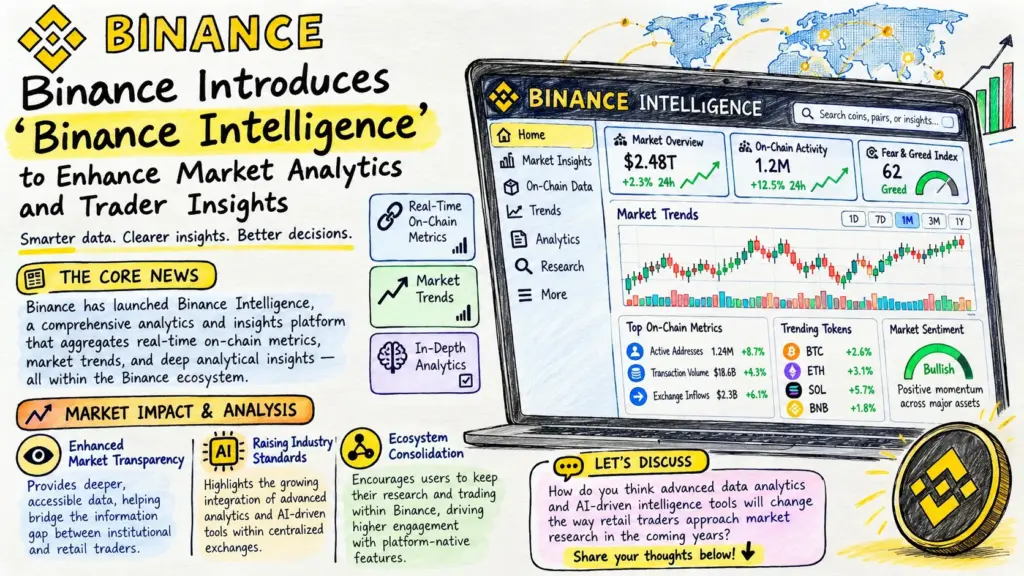
Binance has just made a move that could change how many people interact with crypto markets.
On October 5, 2026, Binance unveiled Binance Intelligence, a new AI product stack built directly into its financial ecosystem. The launch brings together three connected products: Binance AI, Binance AI Pro, and Binance Agent OS.
At first glance, this may look like another crypto exchange adding an AI chatbot.
It is much bigger than that.
The important change is not simply that Binance can now answer questions about Bitcoin or explain a market chart. The more important change is the movement from asking AI about the market to using AI to understand information, build a trading strategy, test that strategy, and potentially execute it within defined permissions.
That creates a new question for crypto traders:
What happens when the distance between a trading idea and a working trading system becomes much smaller?
This article explains what Binance Intelligence is, what Binance AI, Binance AI Pro, and Agent OS actually do, how AI-powered trading works inside this ecosystem, what safety controls Binance has described, what the launch could mean for beginners and advanced traders, and where the real risks remain.
As of October 7, 2026, Binance AI is being rolled out progressively, while Binance AI Pro is expected to receive its next major release in the coming weeks. Availability can vary by region.
What Is Binance Intelligence?
Binance Intelligence is Binance’s new AI product ecosystem for financial information, trading workflows, and AI-agent development.
Instead of treating AI as one separate chatbot, Binance is building several AI capabilities into different parts of its platform.
The three main products are:
| Product | Main user | What it does |
|---|---|---|
| Binance AI | Everyday users | Helps users understand markets and financial information |
| Binance AI Pro | Advanced traders | Turns natural-language ideas into trading strategies and automated workflows |
| Binance Agent OS | Developers | Lets AI applications and agents connect with supported Binance capabilities |
Binance introduced the suite during a livestream on October 5, 2026, with Co-CEO Richard Teng and VP of Product Jeff Li presenting the products. Binance described the overall goal as reducing the gap between access to financial markets and the knowledge needed to navigate them.
That distinction matters.
A normal AI chatbot mainly gives you information.
Binance Intelligence is being designed to connect information with financial actions.
That is why the launch deserves attention from crypto traders.
👉 Explore Binance Intelligence:
Binance Intelligence
Why Is Binance Launching AI Intelligence Now?
The timing is important because crypto trading has become an information-heavy activity.
A trader may watch Bitcoin price, funding rates, open interest, liquidation data, order books, market sentiment, macroeconomic events, on-chain activity, news, and several technical indicators at the same time.
The problem is no longer simply finding information.
The problem is processing the information fast enough and turning it into a useful decision.
This is where Binance sees an opportunity for AI.
Binance says its Intelligence initiative is intended to give users financial information and tools that adapt to their experience, interests, and use of the platform. The company says it has also built AI capabilities across its compliance and risk systems, with more than 100 models used across those areas.
There is another important reason.
AI has already changed how people search for information.
Instead of opening ten websites, reading five reports, checking charts, and then building a spreadsheet, a user can increasingly ask an AI system to organize the information first.
Crypto exchanges are now moving toward the next step:
AI inside the trading environment itself.
That means the exchange is no longer only the place where the trade happens.
It can also become the place where the user researches, builds, tests, and manages the trading workflow.
And that leads directly to the first product.
What Is Binance AI?
Binance AI is the user-facing intelligence layer designed for everyday Binance users.
It is intended to help users understand financial information without requiring them to become professional traders first.
Binance describes it as a personalized, 24/7 financial assistant that can adapt information to the user’s knowledge level, interests, and products used. The company says Binance AI is free for eligible users during the initial rollout.
The important word here is personalized.
A futures trader does not need exactly the same information as someone who only holds Bitcoin.
A user following U.S. stocks does not need exactly the same market dashboard as a user focused on DeFi.
Binance AI is designed to adapt the experience around those differences.
What Can Binance AI Show?
Binance has described several features and tools connected with its AI experience, including:
- Market Brief
- Smart Alerts
- PnL Recap
- Smart Tracker
- Macro Insight
- Hot Sector
- Trade Ideas
- Trader Picks
- Market and chart integrations
- Personalized financial information
- Smart tool guidance
The exact availability of features can vary by rollout and region. Binance has said its market information experience can cover crypto as well as selected traditional financial markets.
The bigger idea is simple:
Instead of giving every user the same dashboard, Binance wants AI to help decide which information is more relevant to that particular user.
That sounds like a small interface change.
It is not.
If the system works well, the exchange can gradually move from a tool-first experience to an intent-first experience.
Instead of asking:
“Where is the funding-rate chart?”
the user could eventually ask:
“Why is Bitcoin falling while funding remains positive?”
The interface then becomes less important than the question.
That is a major shift in financial software.
Binance AI Is Not the Same as an AI Trading Bot
This distinction is important for beginners.
Binance AI is primarily about information, market intelligence, personalization, and assistance.
It should not automatically be described as a system that takes your money and trades whenever it wants.
The more advanced automation story belongs to Binance AI Pro and the broader agent infrastructure.
That brings us to the most important part of Binance Intelligence.
What Is Binance AI Pro?
Binance AI Pro is designed to turn natural-language trading ideas into structured trading strategies and automated workflows.
This is where Binance Intelligence moves from AI as an information assistant toward AI as a trading workflow assistant.
Imagine a trader has an idea:
“Monitor Bitcoin and alert me when price and funding rate move in opposite directions.”
A traditional approach could require:
- Finding the right market data.
- Writing code.
- Connecting APIs.
- Creating conditions.
- Building an execution system.
- Testing the strategy.
- Managing the system after deployment.
AI Pro is designed to reduce that technical work.
Binance says users can describe a trading idea in natural language, receive a visualized and editable strategy workflow, test workflows through paper trading, and then approve them for execution within defined permissions, budgets, and risk limits.
The basic concept is:
Describe → Build → Review → Test → Approve → Execute
That sequence is more important than the word “AI.”
How Does Binance AI Pro Turn an Idea Into a Trading Strategy?
The easiest way to understand AI Pro is to follow one hypothetical example.
Suppose a trader says:
“Monitor BTC. If the funding rate becomes strongly positive while price momentum weakens, alert me and consider a short setup with a fixed risk limit.”
The AI system has to turn that sentence into measurable conditions.
For example, it may need to determine:
- Which BTC market?
- Which funding rate?
- What does “strongly positive” mean?
- Which timeframe?
- What does “weakens” mean?
- What is the entry condition?
- Where is the stop?
- How much capital can be used?
- What happens if the signal disappears?
- When should the strategy stop?
This is where natural language becomes trading logic.
The important point is that the AI does not magically create a profitable strategy.
It creates a structured interpretation of the user’s idea.
Those are two very different things.
A beautifully written strategy can still lose money.
That distinction should remain at the center of every discussion about AI trading.
The New Trading Workflow: From Prompt to Execution
The most interesting part of Binance Intelligence may be the shortening of the trading workflow.
A traditional automated strategy can look like this:
Idea → Research → Data → Coding → Testing → Deployment → Monitoring → Execution
AI-assisted trading aims to compress that process:
Idea → AI interpretation → Strategy → Test → Approval → Execution
This does not eliminate the underlying trading risks.
It reduces the technical distance between the idea and the system.
That is both the opportunity and the danger.
If the strategy is good, automation can save time.
If the strategy is bad, automation can make the bad idea easier to execute.
What Is Binance Agent OS?

Binance Agent OS is the developer infrastructure layer behind Binance’s broader AI-agent strategy.
Binance announced Agent OS in August 2026 as a developer platform designed to connect compatible AI applications and agents to supported Binance capabilities through user-controlled permissions.
It brings together several Binance technologies, including:
- Binance APIs
- Binance Wallet Agentic Hub
- Binance x402
- Binance Skill Hub
- Model Context Protocol, or MCP, support
The purpose is to make it easier for developers to build applications and AI agents that can work with Binance-supported financial and blockchain functions.
This is important because AI agents need more than intelligence.
An AI model can understand a sentence.
But to perform an action, it needs access to tools.
For example:
AI model → market data → analysis → trading API → order
Agent OS is intended to provide the infrastructure connecting those pieces.
👉 Open Binance Agent OS:
Binance Agent OS
Why Agent OS Could Matter More Than a Chatbot
A chatbot answers.
An AI agent can observe, decide, and act through permitted tools.
That difference is important.
Suppose an AI agent has access to market data but cannot trade.
It can analyze.
Now give it authorized trading access.
It can potentially analyze and execute.
Add wallet functions, payment functions, on-chain tools, and other approved capabilities.
The system becomes much more powerful.
This is why permissions become one of the most important subjects in AI-powered crypto trading.
Binance says Agent OS uses user-controlled permissions and includes controls such as isolated sub-accounts, restricted agent capabilities, and permission revocation. Binance has also described an emergency-stop mechanism for disconnecting agents.
The goal is not to give AI unlimited control.
The goal is to give AI limited authority inside a controlled environment.
That is a much safer design principle.
What Makes Binance Intelligence Different From a Normal Trading Bot?
A traditional trading bot normally follows rules written by a user or developer.
For example:
If RSI < 30 → buy.
If price crosses moving average → sell.
The bot does not necessarily understand the wider market context.
AI-powered systems introduce another layer.
They can potentially work with:
- Natural-language instructions
- Multiple data sources
- Market research
- User preferences
- Strategy logic
- Dynamic conditions
- AI-generated workflows
- Human approval
- Automated execution
The difference can therefore be summarized like this:
| Traditional trading bot | AI-assisted trading workflow |
|---|---|
| Usually rule-based | Can start from natural language |
| Coding often required | Less coding may be required |
| User defines the workflow | AI can help build the workflow |
| Data sources may be separate | Platform data can be integrated |
| Execution is automated | Execution can operate within permissions |
| Strategy logic is usually explicit | AI helps translate the user’s idea into logic |
But there is an important warning.
AI does not make a trading strategy automatically intelligent.
It makes strategy creation and interaction easier.
That is a major difference.
Can Binance Intelligence Actually Trade Crypto?
Parts of the Binance Intelligence ecosystem are designed to support automated trading, but Binance Intelligence is not one single autonomous trading system.
Binance AI is mainly focused on financial intelligence and user assistance.
Binance AI Pro is the part aimed at creating and deploying automated trading workflows.
Agent OS provides infrastructure that developers can use to connect AI applications and agents with supported Binance capabilities.
Binance says AI Pro workflows require user review and approval before activation and can operate only within the permissions, budgets, and risk limits set by the user. Funds used by the workflow are also kept within an authorized sub-account.
This is an important distinction because headlines such as “Binance AI can trade for you” can make the system sound more autonomous than it actually is.
The more accurate description is:
Binance is building AI-assisted trading workflows that can operate within user-defined controls.
Does AI Pro Mean You No Longer Need Coding?
For many basic strategy ideas, the answer may increasingly be no.
That is one of the most important changes created by natural-language trading.
A person does not necessarily need to know Python or API programming to describe a strategy.
But that does not mean technical knowledge has become useless.
In fact, the opposite may happen.
When coding becomes easier, strategy understanding becomes more important.
A trader still needs to understand:
- Market structure
- Volatility
- Position sizing
- Leverage
- Funding rates
- Liquidity
- Slippage
- Stop-loss logic
- Risk-reward
- Drawdown
- Correlation
- Market regime changes
AI can help build the machine.
It cannot remove the need to understand what the machine is doing.
What Happens Before an AI Trading Strategy Goes Live?
The testing stage is one of the most important parts of the new workflow.
Binance has described paper trading as part of AI Pro’s workflow so users can test a strategy before using it in live markets.
That creates a much safer sequence:
Idea
↓
AI-generated strategy
↓
Review
↓
Paper trading
↓
Performance evaluation
↓
Risk adjustment
↓
User approval
↓
Live deployment
The mistake would be to jump from the first step to the last.
A strategy that looks impressive in a conversation may fail immediately when exposed to real market conditions.
Why AI Trading Can Still Fail
This is where the theory meets the real world.
Suppose an AI creates a strategy that performs extremely well in a historical test.
That does not prove that it will work tomorrow.
Crypto markets change.
A strategy can fail because:
- Volatility changes.
- Liquidity disappears.
- Funding conditions change.
- Market participants change.
- A narrative suddenly reverses.
- Correlations break.
- A backtest contains unrealistic assumptions.
- Slippage is higher than expected.
- Fees reduce the actual return.
- Leverage increases losses.
- The AI misunderstands the user’s instruction.
The most dangerous sentence in AI trading is:
“The backtest looks good, so the strategy must work.”
It does not.
A backtest is evidence.
It is not a guarantee.
The Hidden Problem: Execution Becomes Easier
There is a deeper issue that deserves attention.
When it takes an experienced developer several hours to create a trading bot, the difficulty itself acts as a barrier.
Natural-language AI removes part of that barrier.
That is useful.
But it also means more people can create automated strategies.
This could produce two opposite outcomes.
More people may gain access to useful trading tools.
At the same time, more poorly designed strategies may enter the market.
This is one reason the quality of the strategy remains more important than the ease of creating it.
Automation removes friction.
It does not remove risk.
What Safety Controls Has Binance Described?
Binance has emphasized several controls around AI-assisted trading and agents.
These include:
Separate or dedicated sub-accounts: AI trading activity can be isolated from the user’s main account.
User-controlled permissions: AI agents do not simply receive unlimited access.
No agent withdrawals: Binance has described restrictions preventing agents from withdrawing funds.
Risk limits: AI workflows can operate within defined risk parameters.
Budget limits: Users can limit how much capital a workflow can use.
User approval: Binance says workflows require review and approval before activation.
Permission revocation: Users can revoke an agent’s permissions.
Emergency stop: Binance has described an emergency mechanism for disconnecting agents.
These controls matter because an AI agent with trading access is fundamentally different from a normal chatbot.
A chatbot can give you a bad answer.
An improperly controlled trading agent can potentially create a financial loss.
That is why AI security becomes part of trading security.
What Are the Biggest Risks of Binance AI Trading?
The first risk is model error.
AI can misunderstand data, instructions, context, or market conditions.
The second risk is strategy error.
An AI-generated strategy can be technically correct but economically weak.
The third risk is execution risk.
A strategy may behave differently in live markets because of slippage, fees, liquidity, latency, or sudden price movements.
The fourth risk is overconfidence.
A polished AI explanation can make a weak idea sound convincing.
The fifth risk is automation risk.
A manual mistake may affect one trade.
An automated mistake can potentially repeat many times.
The sixth risk is permission risk.
Users must understand what an AI agent can and cannot do before giving it access.
Binance itself warns that AI outputs can contain errors, bias, or outdated information and should not be treated as guaranteed advice or relied upon as the sole basis for decisions.
That warning should not be treated as legal text buried at the bottom of the screen.
It is one of the most important lessons for users.
Binance Intelligence Could Change the Meaning of a “Trading Skill”
For many years, trading skill was closely connected to the ability to find information and execute decisions manually.
Then algorithmic trading changed the process.
Now AI introduces another layer.
The valuable skill may increasingly become the ability to define a good trading problem.
Consider two users.
User A says:
“Buy Bitcoin when it looks bullish.”
User B says:
“Monitor BTC on the four-hour timeframe. Compare trend strength, funding conditions and volatility. Alert me only when all predefined conditions are met. Do not risk more than a fixed percentage of the authorized account.”
The second instruction is better because it defines a system.
This leads to an important future skill:
Prompt quality may become part of trading-system design.
Not because a clever prompt guarantees profit, but because clear instructions reduce ambiguity.
ZenvestAI Original Analysis: The Prompt-to-Execution Gap
ZenvestAI introduces a useful way to think about this change: the Prompt-to-Execution Gap.
The Prompt-to-Execution Gap is the distance between:
“I have a trading idea.”
and
“I have a tested system capable of acting on that idea.”
Historically, that gap could be large.
A trader might need:
- Market research
- Technical knowledge
- Data access
- Coding
- API connections
- Backtesting
- Deployment
- Monitoring
Binance Intelligence is attempting to reduce that distance.
This does not mean the gap disappears.
Instead, part of the technical work is moved from the human trader to the AI system.
That creates a new responsibility.
The trader must now spend more time validating the AI’s interpretation.
This is a ZenvestAI analytical framework, not a Binance-reported metric.
It may become one of the most useful ways to judge AI trading products in the coming years:
How much technical friction does AI remove, and how much decision risk does that create?
That is a better question than simply asking whether an AI platform is “smart.”
ZenvestAI Original Analysis: The Automation Quality Triangle
ZenvestAI also sees three variables that should be evaluated together:
Strategy quality + execution quality + risk control
A system can fail if any one of the three is weak.
For example:
Good strategy + poor execution = poor real-world result
Good execution + poor strategy = efficient loss
Good strategy + good execution + poor risk control = potentially large drawdown
This is particularly important in crypto because leverage, volatility and liquidity can change quickly.
Therefore, the real value of AI trading should not be measured only by how impressive its analysis looks.
It should be measured by how well the complete workflow behaves under real market conditions.
This is another ZenvestAI analytical framework, based on the product architecture and trading risks discussed above.
Could Binance Intelligence Make Crypto Trading Easier for Beginners?
Yes, but easier does not mean safer.
This distinction is critical.
For a beginner, Binance AI could make complicated market information easier to understand.
Instead of searching:
“What is funding rate?”
the user can ask:
“Why does funding rate matter for Bitcoin futures?”
That is useful.
But the next step can become dangerous if the beginner moves directly from understanding a concept to executing a leveraged trade.
A better progression is:
Learn → Observe → Question → Simulate → Review → Trade Carefully
AI should shorten the learning curve.
It should not eliminate the learning process.
Could Advanced Traders Benefit More?
Advanced traders may find the automation side more interesting.
A professional or experienced trader may already know how to create a strategy.
For that person, the advantage may not be “AI knows how to trade.”
The advantage may be time compression.
Binance has previously demonstrated workflows where AI-assisted tools can reduce the time needed to move through research and trading tasks. Binance has described examples of compressing multi-step workflows that previously required substantial manual effort.
This is an important distinction.
For experienced traders, AI may be less about replacing skill and more about reducing repetitive work.
What Does Binance Agent OS Mean for Developers?
For developers, the story becomes even larger.
If AI agents can connect to financial APIs, market data, wallets, payment systems, and blockchain functions through controlled permissions, developers can build applications that behave differently from traditional crypto applications.
Instead of:
User → Website → Button → API
we could increasingly see:
User → AI agent → Tools → Blockchain / exchange / wallet
That does not mean humans disappear.
It means the interface between humans and financial infrastructure may become conversational.
A user may no longer need to know exactly which application contains a particular function.
The user may simply state the objective.
The agent then finds the permitted tool.
This is one of the bigger ideas behind agentic crypto.
Why MCP Matters in This Story
Model Context Protocol (MCP) is becoming relevant because AI agents need standardized ways to connect models with external tools and data.
Binance Agent OS includes MCP support as part of its developer ecosystem.
For crypto developers, this matters because fragmented integrations can make agent development difficult.
If every application requires a different connection method, building an AI agent becomes slower and harder to maintain.
A more standardized tool layer can reduce that friction.
The bigger trend is therefore not simply Binance + AI.
It is:
AI models + financial tools + blockchain infrastructure + controlled permissions.
That combination deserves much more attention than the chatbot headline alone.
Binance Intelligence and the Future of Crypto Exchanges
The launch may also change how exchanges compete.
For years, major crypto platforms competed around:
- Liquidity
- Trading fees
- Number of assets
- Derivatives
- Security
- Trading products
- User interface
- Institutional services
AI introduces another competitive layer:
Who can provide the best intelligence and execution workflow?
If AI becomes the main interface through which users discover opportunities, analyze markets, and execute strategies, the exchange with the strongest AI ecosystem may gain an important advantage.
This is not guaranteed.
AI products still need to prove:
- Reliability
- Accuracy
- Speed
- Security
- User trust
- Strategy quality
- Execution quality
The launch is therefore the beginning of the test, not the conclusion.
What Should Crypto Traders Watch Next?
The next stage is more important than the announcement itself.
Here are the signals ZenvestAI believes are worth watching.
1. AI Pro Adoption
How many traders actually use AI-generated strategies?
The number of users matters, but repeat usage will matter more.
2. Paper Trading Results
If users generate thousands of strategies, what percentage survive testing?
That could tell us more than marketing claims.
3. Live Trading Behavior
The real test begins when AI strategies operate with real capital.
4. Agent OS Activity
Developer adoption could reveal whether AI agents become a serious part of crypto infrastructure.
Binance has reported more than 280,000 Agent OS calls per day in recent product communications, although this figure should be treated as a Binance-reported activity measure rather than proof of trading success.
5. Risk Controls
The quality of permission systems will become increasingly important as AI agents receive more capabilities.
6. User Behavior
The biggest question may be psychological:
Will traders actually review AI decisions, or will the approval button gradually become a formality?
That question has no answer yet.
But it could become one of the defining issues of AI-powered trading.
Is Binance Intelligence Available to Everyone?
Not immediately in every market.
Binance said Binance AI began rolling out first to eligible users in New Zealand, with a broader rollout planned. Binance AI Pro is expected to follow in the coming weeks. Availability depends on the user’s region and applicable product restrictions.
This is important for readers in India, Europe, the United States, and other markets.
A product announcement does not automatically mean that every feature is available in every country.
Crypto products can be affected by:
- Local regulations
- Product restrictions
- Eligibility requirements
- Account status
- Regional rollout schedules
Users should therefore check the current Binance product page and applicable terms before assuming that a feature is available in their jurisdiction.
Is Binance Intelligence Free?
The answer depends on the product and feature.
Binance AI has been announced as a free experience for eligible users.
For Binance AI Pro, Binance has described a free version using refreshed credits, with paid access planned for advanced capabilities. Current rollout and pricing details can change, so users should verify the live terms when the product becomes available in their region.
Some third-party Binance Square posts have reported a 19.99 USDC monthly Premium price for certain AI Pro functionality, but because pricing and availability can change, ZenvestAI recommends checking Binance’s current product terms before relying on that figure.
This is a good example of why official product documentation should take priority over social-media summaries.
What Should Beginners Do When Binance AI Becomes Available?
A beginner should not start with automated futures trading.
The better approach is to begin with information.
Use AI to ask questions such as:
- What is Bitcoin funding rate?
- Why did BTC move today?
- What is open interest?
- What is a liquidation?
- How does spot trading differ from futures?
- What does market liquidity mean?
- Why can a profitable backtest fail in live trading?
Then move to observation.
Then paper trading.
Only after understanding the strategy should real capital enter the process.
The key rule is simple:
Do not automate what you do not understand manually.
What Should Experienced Traders Do Differently?
Experienced traders can use AI more aggressively, but they should also be more systematic.
A useful workflow is:
Define the idea → Make the conditions measurable → Generate the workflow → Inspect every condition → Paper test → Stress test → Set risk limits → Deploy small → Monitor
The important step is inspect every condition.
Never assume that the AI interpreted your sentence exactly as you intended.
If you say:
“Buy when momentum is strong,”
the phrase “strong” must eventually become a measurable rule.
Trading systems cannot execute vague language.
They execute defined conditions.
Binance Intelligence Does Not Remove the Need for Risk Management
This point deserves repetition because it is easy to miss.
AI can improve information processing.
It can reduce coding requirements.
It can automate repetitive work.
It can connect tools.
It can monitor markets.
But it cannot remove:
Volatility.
Liquidity risk.
Leverage risk.
Execution risk.
Model risk.
Strategy risk.
Market risk.
A strategy that loses 10% manually can still lose 10% when AI executes it.
In some cases, automation can make the problem worse because the system can continue executing without the emotional hesitation that might have stopped a human trader.
That is why risk controls are not an optional feature of AI trading. They are part of the strategy itself.
The Bigger Picture: Binance Is Moving From Trading Platform to Intelligence Platform
This may be the most important takeaway from the launch.
Binance Intelligence suggests that Binance does not want AI to remain a separate assistant sitting beside the trading platform.
It wants AI to become part of the platform itself.
The architecture tells the story:
Binance AI helps users understand.
Binance AI Pro helps advanced users build and automate.
Agent OS helps developers create new AI applications.
Together, they create a path from:
Information → Strategy → Automation → Execution
That is much more significant than simply adding an AI chat window.
Frequently Asked Questions About Binance Intelligence
What is Binance Intelligence?
Binance Intelligence is Binance’s AI product ecosystem built around Binance AI, Binance AI Pro, and Binance Agent OS. It is designed to help users understand financial information, create trading strategies and enable developers to build AI applications connected to supported Binance capabilities.
When did Binance launch Binance Intelligence?
Binance unveiled Binance Intelligence on October 5, 2026, during a livestream featuring Co-CEO Richard Teng and VP of Product Jeff Li.
What are the three products in Binance Intelligence?
The three main products are Binance AI, Binance AI Pro, and Binance Agent OS.
What is Binance AI?
Binance AI is designed as a personalized financial assistant that provides market information, alerts, summaries, tracking tools and other AI-assisted features for users.
What is Binance AI Pro?
Binance AI Pro is designed for advanced users who want to turn natural-language ideas into structured trading strategies and automated workflows. Binance says users can test strategies before deploying them and must approve workflows before activation.
What is Binance Agent OS?
Binance Agent OS is a developer platform that connects compatible AI applications and agents with supported Binance capabilities through user-controlled permissions. It includes support for Binance APIs and MCP among other components.
Can Binance AI trade automatically?
Some Binance AI Pro workflows are designed to support automated trading after user approval and within defined permissions, budgets and risk limits. Binance AI itself should not be confused with a fully autonomous trading bot.
Does Binance AI Pro guarantee profitable trades?
No. AI-generated strategies can lose money. Neither AI automation nor backtesting guarantees future performance.
Can beginners use Binance Intelligence?
Yes, Binance is specifically positioning Binance AI for users at different experience levels. However, beginners should start with education, market information and simulation rather than immediately using leveraged automated trading.
Is Binance Intelligence available worldwide?
The rollout is progressive, and availability can vary by region. Binance initially announced Binance AI for eligible users in New Zealand before broader rollout. Users should check the current availability in their jurisdiction.
Is Binance Intelligence available in India?
Availability should be checked directly through Binance for the user’s account and current jurisdiction because financial products and features can have regional restrictions. A global product announcement does not automatically mean every feature is available in India.
Does Binance Intelligence replace human traders?
Not necessarily.
The more realistic near-term outcome is AI-assisted trading, where humans define objectives, review strategies, set limits and supervise execution.
ZenvestAI View
Binance Intelligence is important because Binance is moving AI closer to the actual financial workflow.
The headline is not simply that Binance launched an AI assistant.
The deeper development is the connection between financial information, strategy creation, AI agents and execution.
For beginners, this could make crypto markets easier to understand.
For experienced traders, it could reduce repetitive work.
For developers, Agent OS could make it easier to build applications that connect AI with crypto infrastructure.
But there is a second side to the story.
When the barrier to creating a trading strategy falls, the barrier to creating a bad automated strategy also falls.
That is why ZenvestAI believes the next stage of AI trading should be judged on three things:
How intelligent is the system?
How reliable is its execution?
How strong are its controls?
The market does not reward an AI because its explanation sounds intelligent.
The market rewards systems that survive real conditions.
That is the test Binance Intelligence now has to face.
The Bottom Line on Binance Launches Binance Intelligence — The Next Era of AI-Powered Trading
Binance Intelligence marks a shift from AI that simply explains crypto markets to AI that can increasingly participate in the trading workflow.
Binance AI focuses on understanding.
Binance AI Pro focuses on strategy creation and automation.
Agent OS focuses on giving developers the infrastructure to build AI agents.
The opportunity is clear: less technical friction, faster market analysis, and easier access to automated workflows.
The risk is equally clear: making execution easier does not make a strategy safer or more profitable.
The one thing every trader should remember is this:
AI can reduce the distance between an idea and a trade, but it cannot remove the distance between a good idea and a profitable strategy.
That difference will matter more than the technology itself.
Related Intelligence
If you are reading this article then you must have to read this:
- AI-Powered Crypto Trading
- Crypto Trading Bots
- AI Agents in Web3
- Model Context Protocol (MCP)
- Algorithmic Trading
- Crypto Market Data
- Funding Rates
- Open Interest
- On-Chain Analysis
- Risk Management in Crypto Trading
- Agentic Finance
- AI and DeFi
Sources and Primary Resources
For this article, ZenvestAI used primary Binance announcements and Binance-published material as the main factual sources.
Binance — Binance Intelligence launch announcement: Binance Launches Binance Intelligence to Close the Financial Knowledge Gap
Binance — Intelligence Suite announcement: Binance Unveils Intelligence Suite With AI Tools for Traders and Developers
Binance — Binance Intelligence livestream recap: Binance Intelligence Makes Finance Smarter for Everyone
Binance — Agent OS announcement: Introducing Binance Agent OS
Binance — AI Pro security and product information: Binance AI Pro: Major Update
Binance — AI Pro workflow examples: Three Ways to Streamline Real Trading Workflows With Binance AI Pro
Binance — AI and future product direction: Binance Goes “All In” on AI as Yi He Outlines Vision for the Future of Finance
Disclosure
This article is provided for educational and informational purposes only and does not constitute investment, financial, trading, legal or tax advice.
Crypto assets and automated trading involve substantial risk, including the possible loss of capital. AI-generated information, strategies and outputs can contain errors or may not perform as expected in live markets. Readers should independently verify information, understand the products they use, test strategies carefully, and consider their own risk tolerance and applicable local laws and regulations before making financial decisions.
Product availability, features, pricing and regional access can change. Readers should consult the applicable official Binance terms, product documentation and regulatory requirements before using Binance Intelligence or any AI-powered trading feature.
