Strapline: How India moved past trading speculation to capture 15.2% of the world’s decentralized developer pool. And why protocol engineering, Rust, and AI agents are redefining six-figure tech salaries.
In 2026, the high-value Web3 engineer in India represents a fundamental shift from speculative crypto trading to mission-critical infrastructure development. India now supplies 15.2% of all global Web3 developers, making it the fastest-growing decentralized engineering hub worldwide.
With $396 million in Series B/B+ venture capital flowing back into Indian Web3 infrastructure, top engineers proficient in Rust, Zero-Knowledge (ZK) circuits, and AI-agent smart contracts are securing domestic compensation packages between ₹30 LPA and ₹1.5 Crore+, while remote international contracts regularly offer $80,000 to $150,000.
ZenvestAI Quick Insight: The 2021–22 cycle rewarded anyone who could deploy a basic smart contract on an EVM chain. The 2026 cycle rewards systems architects who can build secure zero-knowledge circuits, optimize low-latency Rust runtimes, and build financial rails for autonomous AI agents.
Key Takeaways
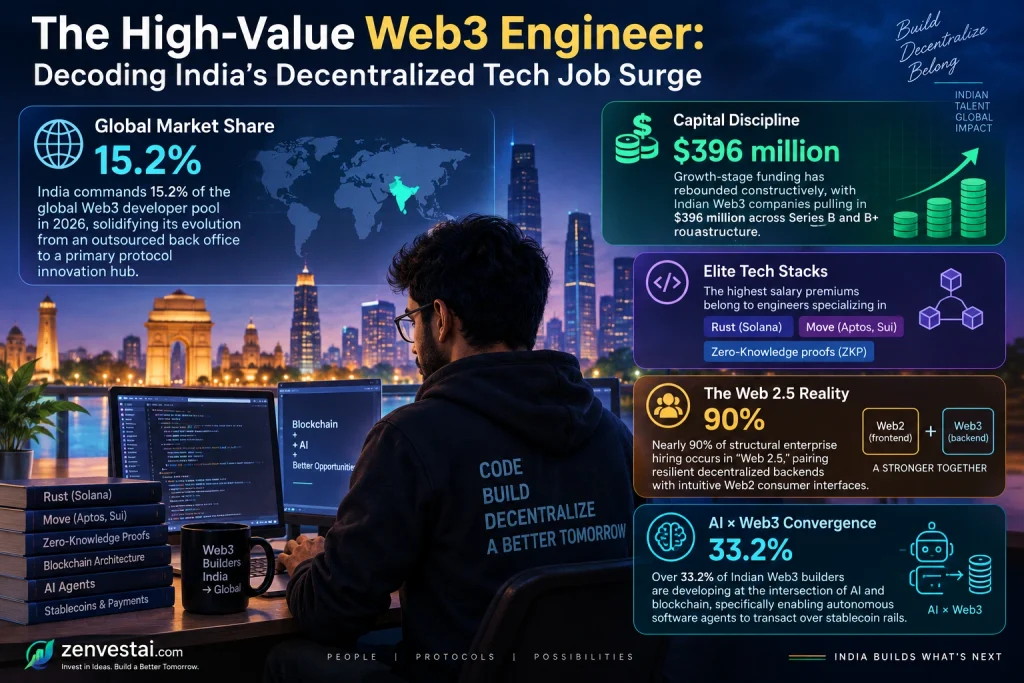
- Global Market Share: India commands 15.2% of the global Web3 developer pool in 2026, solidifying its evolution from an outsourced back office to a primary protocol innovation hub.
- Capital Discipline: Growth-stage funding has rebounded constructively, with Indian Web3 companies pulling in $396 million across Series B and B+ rounds targeted at real-world infrastructure.
- Elite Tech Stacks: The highest salary premiums belong to engineers specializing in Rust (Solana), Move (Aptos, Sui), and Zero-Knowledge proofs (ZKP).
- The Web 2.5 Reality: Nearly 90% of structural enterprise hiring occurs in “Web 2.5,” pairing resilient decentralized backends with intuitive Web2 consumer interfaces.
- AI × Web3 Convergence: Over 33.2% of Indian Web3 builders are developing at the intersection of AI and blockchain, specifically enabling autonomous software agents to transact over stablecoin rails.
- Cash-First Compensation: Due to past market turbulence, senior Indian engineers now negotiate for cash-heavy base salaries paired with milestone-vested incentives rather than speculative token allocations.
The High-Value Web3 Engineer: Decoding India’s Decentralized Tech Job Surge
At a Glance: India's Decentralized Engineering Market in 2026
| Dimension | Market Reality |
|---|---|
| What It Is | The maturation of India’s decentralized developer pool into production infrastructure, protocol security, and zero-knowledge cryptographic systems. |
| Why It Matters | Shifts India from a consumer trading market restricted by high local taxation into an indispensable global exporter of blockchain core architecture. |
| Primary Talent Hubs | Bengaluru (₹45 LPA median), Hyderabad (₹41 LPA median), and Pune (₹38 LPA median), alongside expanding clusters in Mumbai and Delhi NCR. |
| Most Scarce Roles | Zero-Knowledge (ZK) Circuit Engineers, Rust Protocol Developers, and Smart Contract Security Auditors. |
| Hiring Mix | Approximately 90% in Web 2.5 infrastructure, enterprise consortia, and cross-border protocol engineering. |
| Regulatory Stance | A strict, conservative tax framework on retail trading (30% capital gains plus 1% TDS), contrasting with an open, neutral stance toward technology development and developer employment. |
Table of Contents
- Why Is India Shifting from Crypto Speculation to Code Sovereignty?
- What Does a "High-Value" Web3 Engineer Actually Build?
- What Are the Real Salary Bands for Indian Engineers in 2026?
- Where Do Decentralized Tech Jobs Actually Exist Today?
- How Does the AI × Web3 Wave Drive "Agentic Commerce"?
- What Are the Risks, Structural Traps, and Career Headwinds?
- How Can Developers and Employers Win in the 2026 Market?
- Frequently Asked Questions
- ZenvestAI View
- The Bottom Line
- Related Intelligence
- Editorial Disclosure
Why Is India Shifting from Crypto Speculation to Code Sovereignty?
India’s journey through decentralized technology has moved through three distinct eras over the last six years.
During the 2021–2022 hype cycle, inflated valuations and frenzied venture activity led to extreme compensation offers. Engineers with basic Solidity knowledge were commanding packages of ₹3 to ₹5 Crore from speculative projects. When the market contracted sharply during the 2022–2023 crypto winter—triggered by global exchange collapses and macro liquidity freezes—that speculative hiring bubble burst. Startups retrenched, token-based packages lost their paper value, and domestic trading volumes dropped under the weight of India’s 30% capital gains tax and 1% Tax Deducted at Source (TDS).
Yet the contraction cleared the field of short-term noise. Between 2024 and 2026, the sector rebounded through disciplined infrastructure building. India’s share of the global Web3 developer pool steadily climbed to 15.2%, positioning the nation as the fastest-growing builder ecosystem in decentralized technology.
Hype Cycle
Speculative hiring & unvetted token grants
Market Winter
FTX crash, layoffs & 30% local trading tax
Pragmatic Rebound
15.2% global talent & $396M Series B/B+ VC
This recovery has institutional backing. Indian Web3 companies secured $396 million in Series B and B+ funding rounds, directed almost entirely toward layer-1 and layer-2 scaling, developer tooling, decentralized physical infrastructure networks (DePIN), and enterprise settlement systems.
India has evolved from being the global technology industry’s back-office into the primary core-engineering engine for decentralized protocols.
What Does a “High-Value” Web3 Engineer Actually Build?
The modern market makes a sharp distinction between general frontend developers and true high-value protocol engineers.
Today’s premium engineering roles require deep systems thinking, low-level memory management, applied mathematics, and security-first development. Approximately 90% of structural hiring occurs within Web 2.5 environments—firms building traditional, compliant user experiences on top of self-sovereign blockchain rails.
Rust and Alternative Virtual Machines
The Ethereum Virtual Machine (EVM) remains widely used, but the rapid expansion of high-throughput networks like Solana has created an acute talent shortage for Rust engineers.
Writing smart contracts on Solana requires managing custom parallel execution runtimes and fine-tuning serialization mechanics using frameworks like Anchor. Engineers who can design low-latency, memory-safe programs command an immediate compensation premium over standard web developers.
Zero-Knowledge Circuits and Cryptographic Scaling
Zero-Knowledge (ZK) engineering represents the most technically demanding and highest-compensated specialty in decentralized tech.
Elite Indian engineers are building zkEVM circuits, validium systems, and succinct proof verifiers for layer-2 rollups. These architectures require translating mathematical constraints into arithmetic circuits using languages like Circom, Halo2, or Cairo, proving transaction validity off-chain while anchoring final settlement onto layer-1 chains.
Object-Centric Languages: Move and Parallel Execution
Ecosystems such as Aptos and Sui have introduced the Move programming language, which treats digital assets as explicit resources that cannot be copied or accidentally discarded.
Engineers fluent in Move are designing asset-safe financial protocols that prevent common smart contract bugs like reentrancy vulnerabilities by default. This makes Move developers highly sought after by institutional protocol foundations.
High-Value Engineering Demand Matrix (India 2026)
| Engineering Domain | Primary Ecosystem Focus | Skill Scarcity Level | Average Salary Range (Domestic) |
|---|---|---|---|
| ZK & Cryptographic Engineer | Layer-2 Rollups, Privacy Networks, zkEVMs | Critical | ₹45,00,000 – ₹80,00,000+ |
| Rust Infrastructure Engineer | Solana, DePIN, High-Throughput L1s | High | ₹35,00,000 – ₹60,00,000 |
| Smart Contract Security Auditor | EVM Systems, Formal Verification, Bug Bounties | High | ₹25,00,000 – ₹50,00,000 |
| Full-Stack dApp Developer | React, TypeScript, Solidity, Viem/Wagmi | Moderate | ₹15,00,000 – ₹30,00,000 |
What Are the Real Salary Bands for Indian Engineers in 2026?
Compensation for decentralized software engineering has normalized into structured, predictable bands. The market now offers compensation packages that are 20% to 40% higher than comparable Web2 software roles.
Domestic Experience Tiers and Compensation
- Fresher & Associate (0–1 year): Junior developers and technical interns earn between ₹4 and ₹8 LPA, primarily assisting with integration testing and frontend wallet connectivity.
- Junior Engineer (1–2 years): Developers building production dApps and writing standard Solidity smart contracts command ₹8 to ₹14 LPA.
- Mid-Level Protocol Engineer (2–4 years): Engineers writing core business logic on EVM or Solana runtimes earn between ₹14 and ₹28 LPA.
- Senior Architect & Lead (4–7 years): Leads responsible for protocol security, smart contract upgrades, and complex decentralized finance mechanics earn ₹28 to ₹50 LPA.
- Principal Architect & Staff Engineer (7+ years): Core protocol contributors and heads of engineering receive ₹50 to ₹80 LPA+, with elite talent touching ₹1.5 Crore+ in algorithmic trading and quantitative development environments.
Geographic Distribution Across Indian Tech Hubs
Salaries remain closely tied to regional developer ecosystems. Bengaluru continues to lead the country, supported by dense venture networks and protocol developer houses.
- Bengaluru: Median package of ₹45 LPA, scaling up to ₹72 LPA for lead protocol architects.
- Hyderabad: Median package of ₹41 LPA, with peak domestic roles at ₹66 LPA.
- Delhi NCR: Median package of ₹38 LPA, with senior roles reaching ₹60 LPA.
- Pune: Median package of ₹38 LPA, sustained by systems engineering and enterprise labs.
- Chennai: Median package of ₹36 LPA, scaling up to ₹57 LPA.
- Mumbai: Median package of ₹36 LPA, heavily focused on compliant digital asset exchanges, institutional custody, and fintech rails.
The Shift to Cash-Heavy Base Compensation
One of the most defining shifts of 2026 is how compensation is structured. During the prior cycle, early-stage projects offered small cash salaries paired with massive allocations of unvested, speculative tokens.
Following multiple market corrections, experienced Indian engineers now negotiate for 60% to 75% of their total pay in direct fiat or stablecoin base salaries. Equity and token grants are treated as long-term performance incentives, structured with multi-year linear vesting and clear liquidity provisions rather than sudden token cliff unlocks.
Where Do Decentralized Tech Jobs Actually Exist Today?
Rather than thousands of transient meme-coin projects, long-term employment is concentrated across four stable organizational pillars.
1. Global Layer-1 and Layer-2 Foundations
Major international ecosystems maintain dedicated developer relations and protocol engineering outposts in India. Organizations like Polygon Labs, Solana India, Aptos India, and data availability networks like Avail hire local engineers to build core node clients, consensus mechanisms, and developer tooling.
2. Domestic and Global Digital Asset Exchanges
Exchanges operating in the region—including CoinDCX, CoinSwitch, ZebPay, and institutional custody teams—require specialized backend engineers. These roles focus on ultra-low-latency order matching, automated clearing pipelines, wallet key management (MPC/multi-sig), and rigorous regulatory reporting integrations.
3. IT Services and Enterprise Consortia
India’s IT giants have integrated decentralized ledgers into their enterprise digital transformation suites. TCS (BaNCS), Infosys (Finacle), and Wipro employ blockchain architects to design permissioned networks for trade finance, global supply chain tracking, and cross-border settlement. Enterprise consultants in these firms make between ₹18 and ₹40 LPA at mid-levels.
4. Public Banking Infrastructure and CBDCs
State institutions, including teams working alongside the Reserve Bank of India (RBI) on the Digital Rupee (e₹), as well as consortiums backed by the State Bank of India (SBI) and ICICI, recruit cryptography engineers. Their work focuses on privacy-preserving ledgers, offline settlement protocols, and sovereign payment infrastructure.
How Does the AI × Web3 Wave Drive “Agentic Commerce”?
The convergence of artificial intelligence and decentralized finance has emerged as the most significant technological catalyst in 2026.
Data shows that builder interest in India is highly concentrated in two domains: DeFi (36.6%) and AI × Web3 (33.2%). This intersection has introduced a new engineering paradigm known as Agentic Commerce.
Traditional web commerce relies on credit cards, banking APIs, and human identity verification. Autonomous software agents—such as specialized Large Language Model (LLM) agents executing tasks across the web—cannot open traditional bank accounts. However, an autonomous agent can generate a public-private keypair, hold custody of a cryptographic wallet, and execute trustless micro-transactions over high-speed networks like Solana or Polygon.
High-value engineers bridge the technical gap between natural language reasoning and on-chain program execution:
- Decentralized Inference Verification: Building zero-knowledge proofs (zkML) to verify that an AI model executed its computation correctly without altering results.
- On-Chain Micro-Payments: Creating high-throughput smart contracts that allow autonomous AI bots to pay other services fractionally using stablecoins for compute, APIs, and raw data sets.
- Decentralized Tool-Calling Frameworks: Designing deterministic smart contract interfaces that AI agents can query safely without risking unexpected reentrancy or state lockups.
What Are the Risks, Structural Traps, and Career Headwinds?
While the market offers compelling financial rewards, developers must navigate distinct industry risks.
Market Volatility and Hiring Cycles
Hiring in decentralized technology remains linked to broader digital asset market cycles. While infrastructure teams are better funded than during the 2022 downturn, a protracted market decline can lead to headcount freezes, particularly in early-stage startups that have not achieved product-market fit.
Regulatory and Tax Complexities
India maintains a strict regulatory separation between trading digital assets and software engineering employment. While engineering work, software exports, and receiving salaries for IT services are legally recognized and supported, the domestic trading landscape remains constrained by a 30% capital gains tax with no loss offsetting, alongside a 1% TDS on every transaction, enforced under evolving India crypto regulation.
Engineers receiving token incentives must carefully navigate complex local direct tax classifications upon grant vesting.
Indian Regulatory Distinction (2026)
- 30% flat tax on gains (no loss offsets)
- 1% TDS deducted per transaction
- Restrictive domestic banking gateways
- 100% legal software export & service revenue
- Institutional adoption via CBDC (e₹) & enterprise
- Vibrant ecosystem (15.2% global talent share)
Junior Oversupply vs. Senior Scarcity
The market suffers from an educational disconnect. Bootcamps and tutorials have produced thousands of junior developers who know how to copy-paste basic ERC-20 smart contracts.
However, protocols face an extreme shortage of the 1,500 to 2,500 senior production engineers nationwide who understand gas optimization, formal verification, low-level systems programming, and cryptographic primitives.
How Can Developers and Employers Win in the 2026 Market?
Navigating this competitive environment requires targeted strategies from both software engineers and tech leaders.
The Blueprint for Engineers
- Prioritize Systems Languages Over Frameworks: Move beyond basic JavaScript libraries. Learn Rust, Go, or Move, and understand low-level concepts like memory management, concurrency, and serialization.
- Adopt a Security-First Development Mindset: Study historical protocol exploits. Learn to write unit, integration, and fuzz tests using modern testing frameworks like Foundry for Solidity and Anchor for Solana.
- Build a Verifiable Public Codebase: Degrees and traditional resumes carry less weight in Web3 than verified on-chain deployments, merged pull requests on core protocol repositories, and public bug bounty submissions on platforms like Immunefi.
- Master Multi-Domain Architecture: Position yourself at high-demand intersections: combine smart contract engineering with AI tool orchestration, or backend distributed systems with applied zero-knowledge circuits.
The Playbook for Employers
- Anchor Compensation in Cash Stability: Offer transparent, fiat-denominated salaries. Reserve token components for milestone-driven performance upside with structured multi-year vesting schedules.
- Recruit via High-Signal Technical Communities: Avoid standard corporate job portals. Source talent through developer hackathons such as ETHIndia, open-source GitHub repositories, and specialized technical guilds.
- Provide High-Impact Technical Ownership: Senior engineers leave organizations where their work is bogged down in bureaucratic maintenance. Grant them architectural freedom to solve hard scaling, security, and cryptographic problems.
Frequently Asked Questions
Is Web3 development legal in India?
Yes. Developing blockchain software, building smart contracts, and working as an engineer for domestic or international Web3 companies is completely legal in India. India’s strict crypto laws apply to retail trading, asset exchanges, and taxation on capital gains, not to software engineering employment or technology consulting, as highlighted in analysis on who regulates crypto in India.
Why is Rust preferred over Solidity for high-paying roles?
Solidity runs within the Ethereum Virtual Machine (EVM), which executes transactions sequentially. High-speed networks like Solana utilize Rust to execute transactions in parallel across multiple CPU cores. Writing high-throughput, memory-safe code in Rust requires deeper systems engineering knowledge, creating higher skill scarcity and commanding larger compensation packages.
What is “Agentic Commerce” in Web3?
Agentic Commerce refers to automated software agents powered by Artificial Intelligence conducting business transactions autonomously. Because AI agents cannot register traditional bank accounts, they use crypto wallets and smart contracts to make instant, fractional payments for API usage, computing power, and real-time data over low-cost blockchain networks.
Can junior developers transition directly into Web3?
Yes, but the barrier to entry has risen. Junior developers can no longer rely on superficial smart contract templates. Successful candidates must understand fundamental computer science principles, distributed systems, relational and non-relational databases, and cryptoeconomic security best practices before specializing in blockchain runtimes.
How are Indian Web3 engineers paid by foreign protocols?
Most global protocols hire Indian engineers as independent contractors or through global Employer of Record (EOR) platforms. Compensation is typically disbursed either directly in fiat currency via international bank wires or in dollar-pegged stablecoins (such as USDC) through compliant cross-border conversion channels adhering to Indian Foreign Exchange Management Act (FEMA) guidelines.
How many Indian Web3 developers are there?
There is no single official number for Indian Web3 developers because Web3 developers are part of the wider software and blockchain developer community. However, India has one of the world’s largest developer populations. GitHub reported 21.9 million developers in India in 2025, after adding more than 5 million developers during the year. This large technical talent pool gives India a strong base for Web3 development.
What do Indian Web3 developers do?
Indian Web3 developers build and maintain blockchain-based applications and infrastructure. Their work can include smart contracts, decentralized applications (dApps), crypto wallets, DeFi protocols, blockchain infrastructure, tokenization systems, Web3 gaming, and security tools. Many also contribute to open-source blockchain projects and global Web3 companies.
How many GitHub developers are there in India?
GitHub reported 21.9 million developers in India in 2025, making India the second-largest developer community on GitHub at that time. India also added more than 5.2 million developers during 2025, the largest increase from any country that year.
Important: GitHub’s figure refers to developers on GitHub, not specifically Web3 developers.
Why is India the world’s strongest Web3 talent hub?
India is considered one of the world’s major Web3 talent hubs because it combines a very large developer population, strong engineering education, a growing startup ecosystem, widespread English-language skills, and active participation in open-source technology. Its rapidly expanding developer community also gives blockchain and Web3 companies access to a large pool of technical talent. GitHub’s 2025 data shows that India added more than 5 million developers in one year alone.
Is India a major contributor to the global Web3 ecosystem?
Yes. India’s large developer base and growing participation in open-source projects make it an important contributor to the global technology ecosystem. However, developer numbers alone do not prove that India is the world’s largest Web3 ecosystem. Web3 strength also depends on blockchain research, protocol development, startups, capital, users, regulation, and open-source contributions.
ZenvestAI View
The decentralized technology sector in India has quietly achieved something remarkable: it detached itself from the casino.
When retail speculation took a backseat under strict local tax policy, the noise left the room. The builders stayed. Capturing 15.2% of global Web3 development proves that India’s competitive advantage was never cheap trading volume—it has always been high-grade software engineering talent.
For developers, the lesson of 2026 is clear. The era of getting wealthy by deploying a fork of a decentralized exchange is over. The engineers winning the next decade are systems programmers who treat smart contracts with the same mission-critical rigor as aerospace software or banking mainframes. If you master the math, the security, and the low-level runtimes, the market will treat you as an indispensable global asset.
The Bottom Line
India’s Web3 job surge is no longer a speculative trend—it is a sustainable, infrastructure-first reality where senior engineers proficient in Rust, Zero-Knowledge systems, and AI-driven smart contracts command market-leading compensation on the world stage.
Related Intelligence
- Understanding Zero-Knowledge Proofs: How zk-SNARKs and zk-STARKs Power Modern Scaling
- Solana Architecture Breakdown: Parallel Runtimes, Accounts, and Anchor Development
- AI Meets Decentralized Finance: How Autonomous Agents Interact with Smart Contracts
- India’s Virtual Digital Asset Regulatory Framework: Direct Taxes, TDS, and Compliance for Developers
Editorial Disclosure
Editorial Disclosure: This article is published strictly for educational and informational purposes as part of the ZenvestAI technology intelligence series, strictly adhering to our Editorial Policy. It does not constitute financial, investment, legal, or tax advice. Compensation figures and market statistics are derived from 2026 industry hiring reports, public protocol grants, and verified compensation surveys across the Indian technology sector.
