Have you ever entered a crypto trade with high hopes, only to watch a sudden market crash wipe out weeks of hard-earned gains?
If that feeling of frustration and anxiety sounds familiar, you are certainly not alone.
Most beginners enter the crypto market focusing entirely on how much profit they can make [munafa kamana], while completely ignoring how much capital they could lose [jokhim] on a single bad trade.
To begin with, profitable trading is not about predicting the future with 100% accuracy.
Instead, experienced crypto traders survive and grow their portfolios by answering one fundamental question before clicking buy or sell: “How much capital am I risking to achieve this potential profit?”
In this comprehensive guide, let us demystify the risk-to-reward ratio and show you how to trade with clarity, discipline, and emotional control.
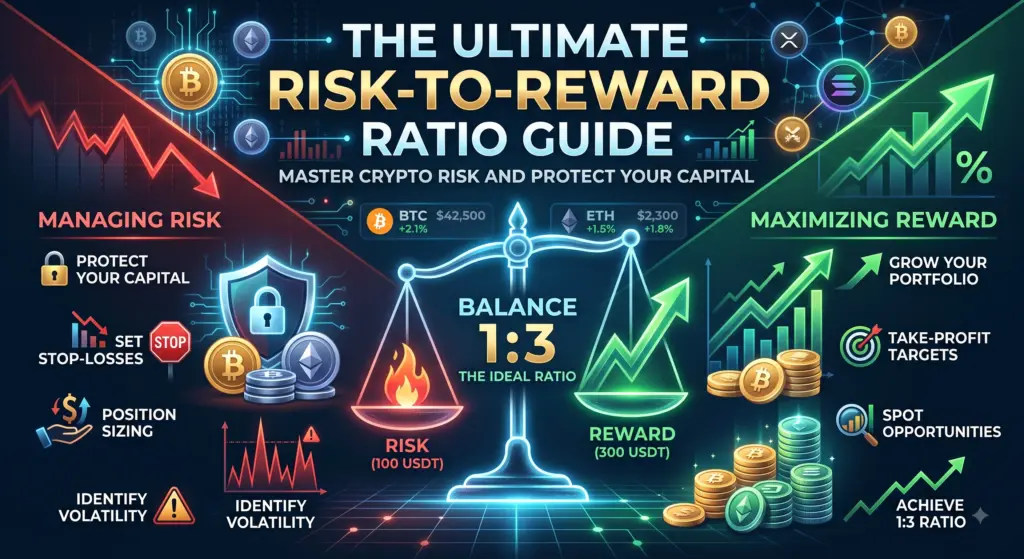
⚖️ The Ultimate Risk-to-Reward Ratio Guide: Master Crypto Risk and Protect Your Capital
📓 A Costly Lesson from My Personal Trading Journal
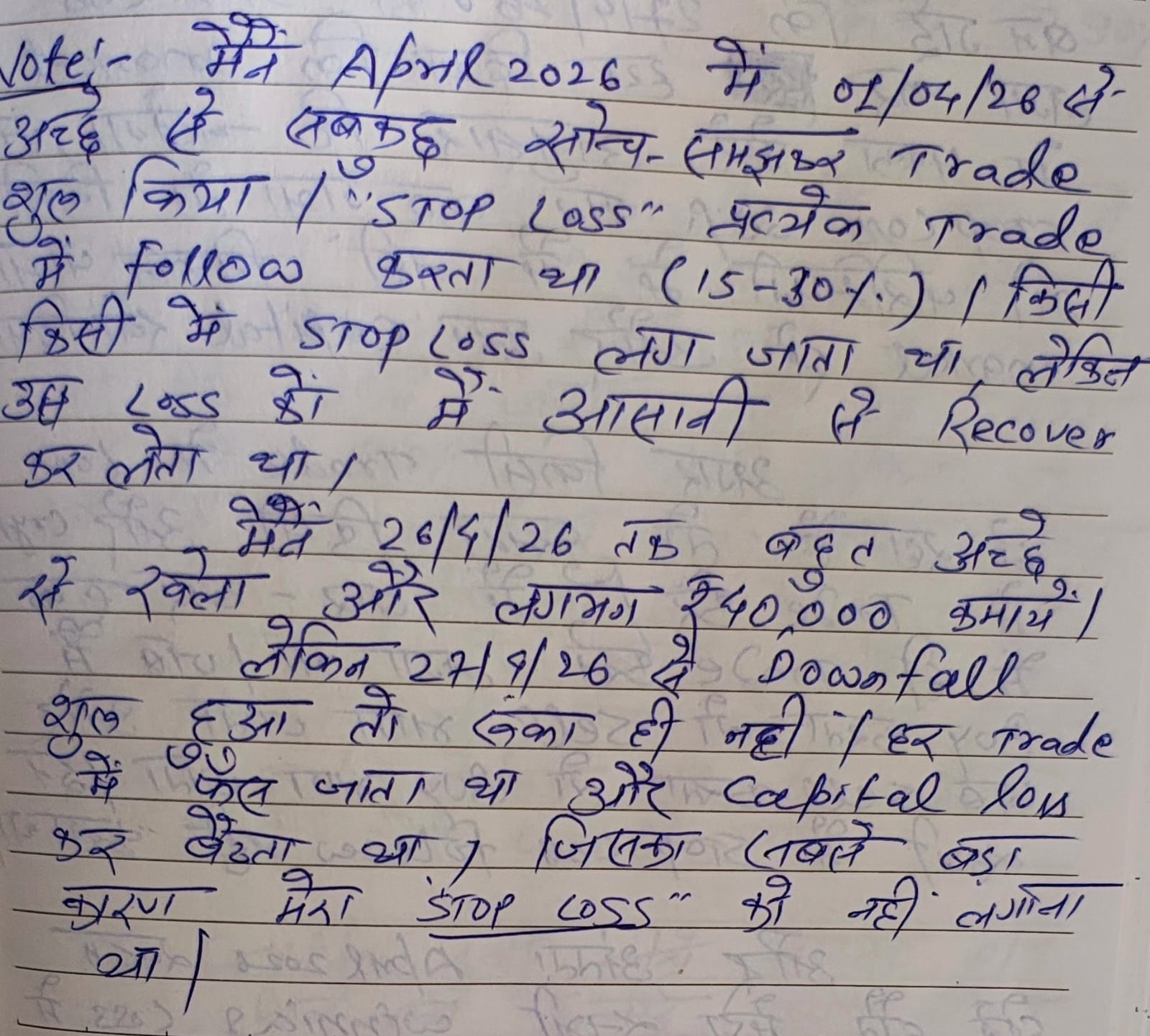
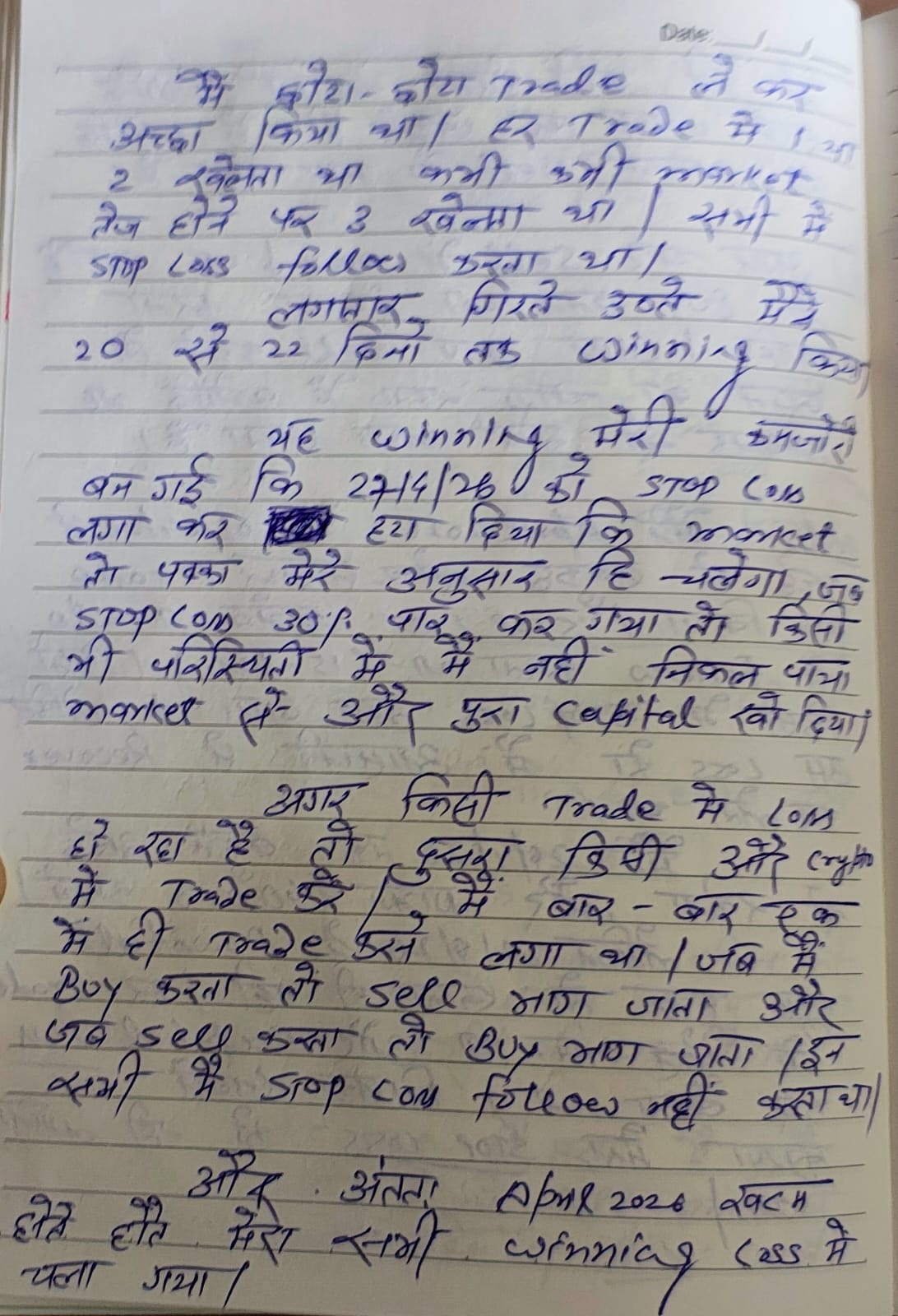
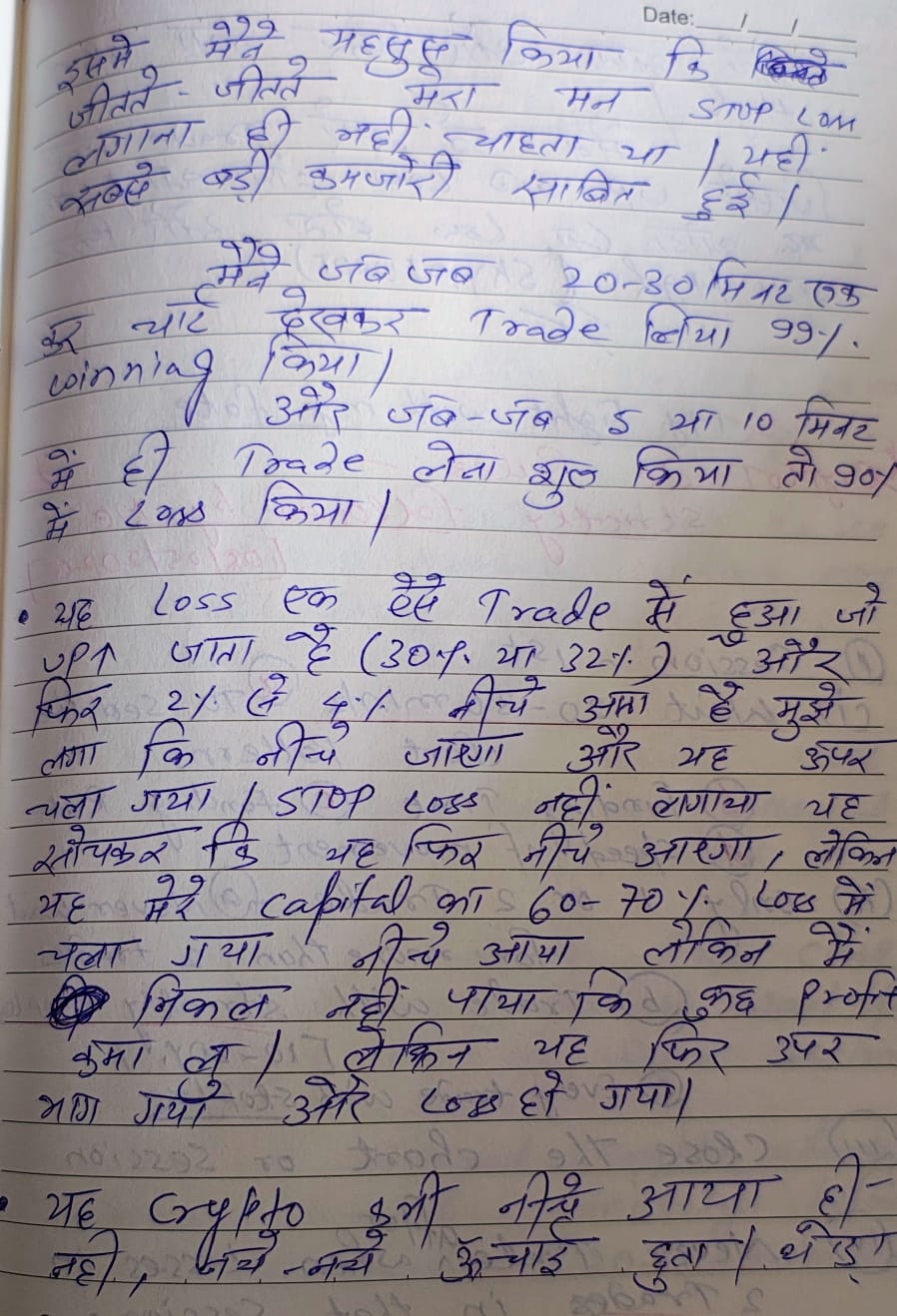
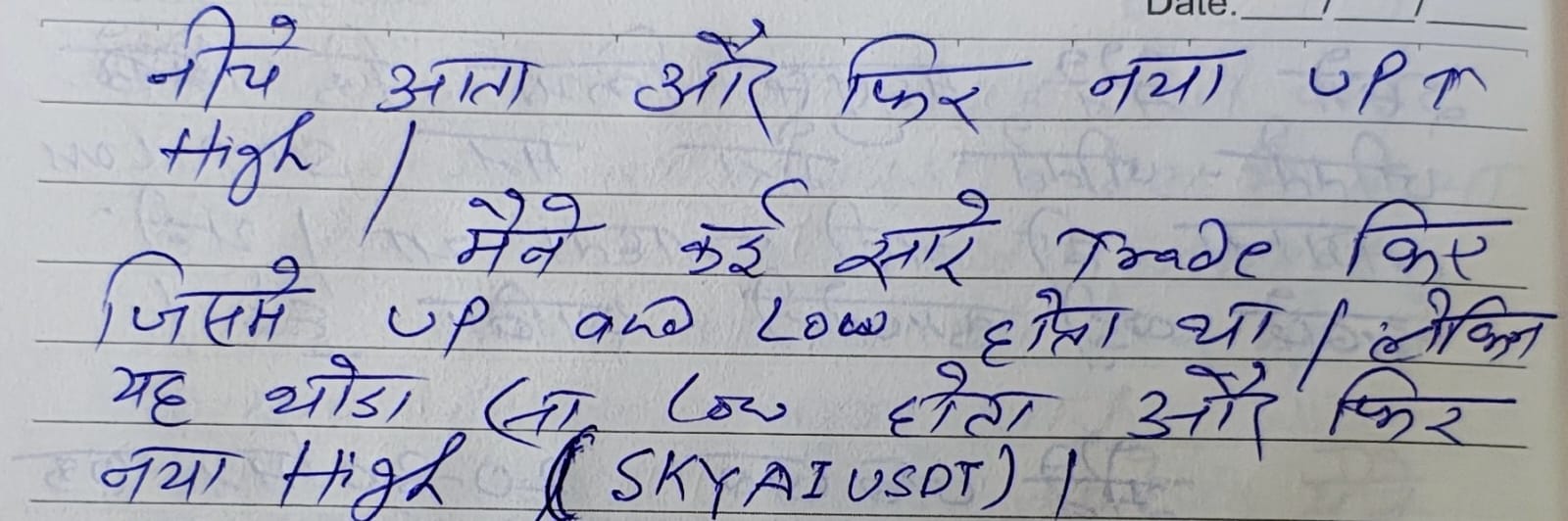
📓 From the Author’s Desk: Pages from my trading journal (April 2026) documenting the ₹40,000 disciplined profit and the subsequent drawdown from removing a stop loss.
Early in my trading journey, I learned the importance of risk management the hard way.
In April 2026, I traded with strict discipline for 22 consecutive days, keeping a strict 15%–30% stop loss on every position and carefully analyzing charts for 20–30 minutes before entering. That discipline helped me earn nearly ₹40,000 in steady profits.
But on April 27, overconfidence crept in. While shorting a fast-moving token (SKYAI/USDT), I manually removed my stop loss, convincing myself: “The market will definitely reverse in my favor.”
Instead of reversing, the token kept breaking out to new highs. A small manageable loss quickly spiraled into a 60%–70% capital drawdown, wiping out weeks of hard-earned gains in a matter of hours.
That painful experience taught me a permanent truth: The market does not care about your hope or ego; it only respects your risk-to-reward discipline.
Essential Guides for Crypto Investors
Whether you are a beginner looking to understand the basics or an advanced trader looking to maximize your returns, check out our comprehensive guides:
- Master Ethereum: Discover The Complete Ethereum Wealth Strategy to build a long-term portfolio.
- Earn Passive Income: Learn What Is Crypto Staking? The Complete Guide to Earning Rewards Safely and start putting your idle assets to work.
- Understand the Tech: Curious about where those rewards come from? Read Why Does Staking Exist? The Ultimate Guide to Cryptoeconomic Security.
- Trade Like a Pro: If you are ready for advanced market strategies, dive into What Is Crypto Futures Trading? A Complete Beginner’s Guide.
💡 ZenvestAI Explains
The
risk-to-reward ratio (R:R)measures the potential financial loss against the expected profit on any individual trade setup.Calculated as Potential Loss ÷ Potential Profit, it allows traders to evaluate whether a setup warrants capital deployment before entering a position.
In volatile crypto markets, utilizing favorable ratios—such as
1:2 or 1:3—enables traders to maintain positive account growth even with a win rate below 50%, provided position sizing, slippage, and exchange transaction fees are managed systematically.
📌 Key Takeaways
Risk precedes reward:Always calculate your exact invalidation level and potential monetary loss before calculating profit targets.
Asymmetric edge:A 1:2 R:R setup requires only a 33.3% break-even win rate (before fees), allowing you to absorb consecutive losses without depleting your capital.
Position sizing rules all:A favorable chart ratio is ineffective if your position size is excessively large relative to your total account balance.
Leverage does not alter R:R:Leverage only changes required margin; it amplifies liquidation speed without improving the mathematical quality of the trade setup.
Dynamic market alignment:Base stop-loss and take-profit targets on technical market structures, support/resistance, and volatility—not arbitrary figures.
📊 At a Glance:
| Metric / Parameter | 1:1 Setup | 1:2 Setup | 1:3 Setup | 1:5+ Setup |
| Potential Risk : Reward | ₹1,000 : ₹1,000 | ₹1,000 : ₹2,000 | ₹1,000 : ₹3,000 | ₹1,000 : ₹5,000 |
| Theoretical Break-Even Win Rate | 50.0% | 33.3% | 25.0% | 16.7% |
| Realistic Win Rate in Crypto | 55% – 65% | 40% – 50% | 30% – 40% | 15% – 25% |
| Target Feasibility | High | Balanced / Ideal | Moderate | Low (Requires Strong Trend) |
| Primary Risk Factor | Fee drag / Chop | Execution slippage | Premature reversals | Unrealistic target setting |
📑 What This Guide Covers
- The Real Problem vs. The Mathematical Solution
What Exactly Is the Risk-to-Reward Ratio?- How to Calculate Risk-to-Reward (With Formula)
- Comparing Common Ratios: 1:1, 1:2, and 1:3
- The Interplay Between Win Rate and Risk-to-Reward
Why High R:R Ratios Can Be Dangerous- Crypto Futures, Leverage, and Indian Market Nuances
- Step-by-Step Pre-Trade Calculation Framework
6 Costly Mistakes Traders Make (And How to Fix Them)- The ZenvestAI Trading Psychology & R-Multiples System
- Pre-Trade Execution Checklist
Glossary of Essential Terms- The Bottom Line
🔴 The Problem vs. 🟢 The Solution: Why Most Crypto Traders Fail
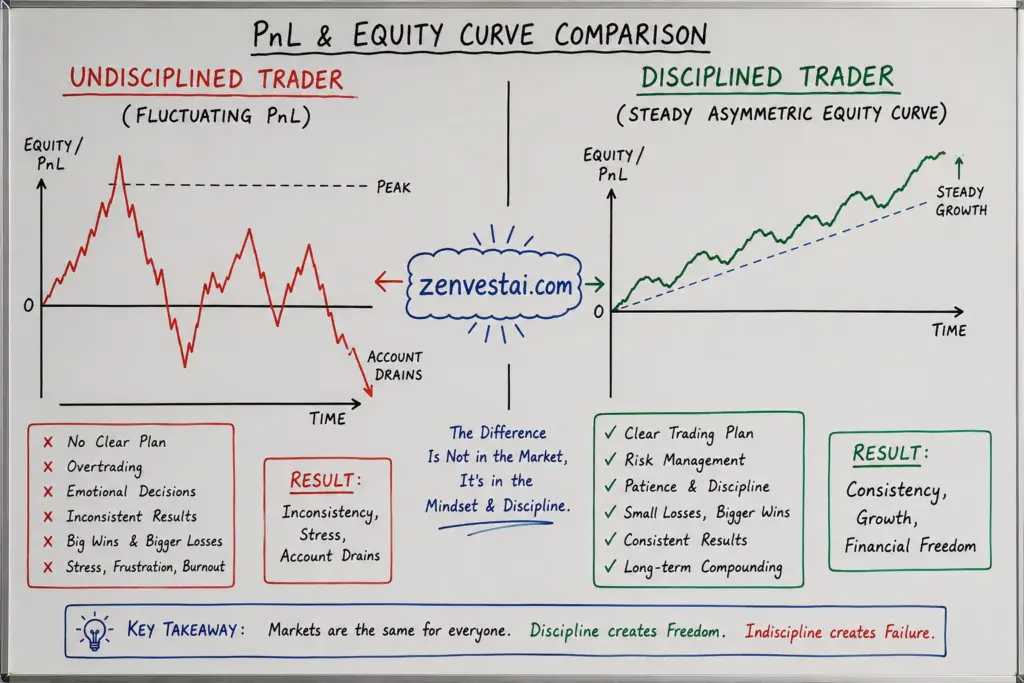
Emotional trading remains the single biggest destroyer of trading accounts. When you trade without a defined framework, the unpredictable volatility of cryptocurrencies leads directly to costly behavioral errors.
The Core Problems Traders Face
- Chasing Green Candles (FOMO): Entering positions near local tops without identifying where the trade idea becomes invalid.
- Holding Onto Losing Trades: Hoping a collapsing coin will recover, turning a small manageable loss into portfolio destruction [bada nuksan].
- Taking Tiny Profits Early: Cutting winning trades too quickly out of fear, preventing winning trades from offsetting regular losses.
The Systematic Solution
- Pre-Defined Invalidation Levels: Identifying your exact stop-loss price before entering the market.
- Controlled Downside Risk: Limiting maximum account loss to 1%–2% per setup.
- Asymmetric Profit Targets: Letting winning setups run to logical structural targets that offer multiples of the initial risk.
❓ What Is Risk-to-Reward Ratio in Crypto Trading?
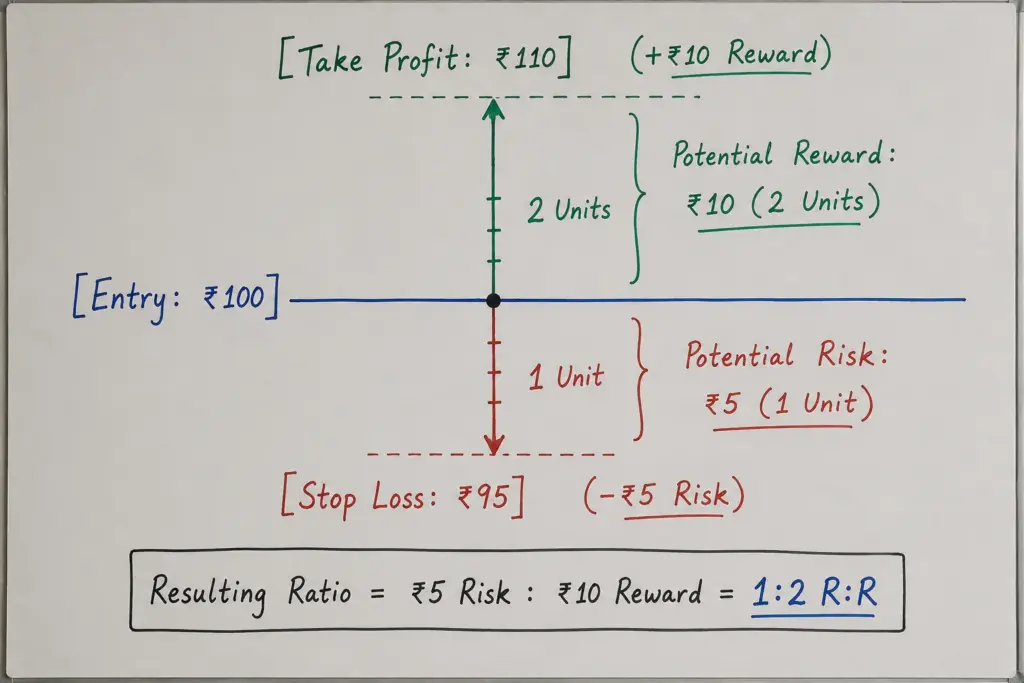
The risk-to-reward ratio compares how much capital you risk against the potential profit you expect on a trade. Specifically, it expresses the mathematical relationship between your entry point, your stop-loss level, and your take-profit target.
For instance, if you risk ₹100 to target a profit of ₹200, your risk-to-reward ratio is 1:2. Consequently, for every single rupee you place at risk, you seek to generate two rupees in return.
💡 Zenvestai Quick Insight
What is the basic concept of risk-to-reward ratio in crypto?
The risk-to-reward ratio defines your trade’s balance between potential loss and expected gain before entry. It ensures you only take setups where the financial payoff justifies the downside hazard, keeping your trading decisions structured, logical, and resilient against emotional bias.
Navigating the Future of Digital Finance in 2026
If you are just starting your journey into digital assets, building a solid foundation is crucial. The best place to start is by understanding the basics with our comprehensive breakdown: What Is Cryptocurrency? The Ultimate Beginner’s Guide. From there, you can explore the underlying technology driving this revolution and see exactly How Distributed Ledgers Are Radically Rewriting the Rules of Modern Finance.
Once you understand the technology, it is time to look at actionable investment and spending strategies. For those looking to build a long-term portfolio, The Complete Bitcoin Wealth Strategy offers a step-by-step approach to navigating market volatility. If you are an active trader looking for an edge, you will want to discover How AI Is Transforming Cryptocurrency Trading in 2026 to automate and optimize your strategies.
Finally, cryptocurrency isn’t just for holding—it’s for using. If you want to integrate your digital assets into everyday life, don’t miss our breakdown on Why the Binance Virtual Card is the Smartest Way to Spend Crypto in Asia (2026 Guide).
🧮 How to Calculate Risk-to-Reward Ratio (The Step-by-Step Formula)
Calculating your setup’s ratio requires basic arithmetic based on your trade parameters.
The Core Mathematical Formula
Risk-to-Reward Ratio = (Entry Price − Stop-Loss Price) ÷ (Take-Profit Price − Entry Price)
Practical Walkthrough
Suppose you identify a breakout on Ethereum (ETH):
- Entry Price: ₹2,50,000
- Stop Loss (Support Invalidation): ₹2,45,000
- Take Profit (Resistance Target): ₹2,60,000
- Potential Risk: ₹2,50,000 − ₹2,45,000 = ₹5,000 per ETH
- Potential Reward: ₹2,60,000 − ₹2,50,000 = ₹10,000 per ETH
- Risk-to-Reward Ratio: ₹5,000 : ₹10,000 = 1:2
Importantly, this calculation must always be performed before you place an order, not after the trade is live.
⚖️ Understanding Common Risk-to-Reward Ratios: 1:1, 1:2, and 1:3
Different market conditions require different risk-to-reward expectations. Let us examine the mechanics of the three most widely used ratios.
1. The 1:1 Ratio (Equal Risk & Reward)
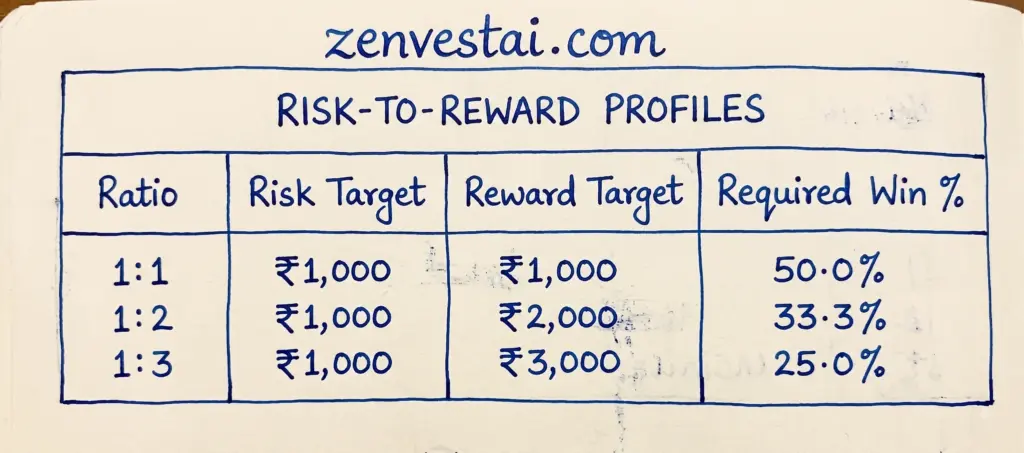
In a 1:1 setup, you risk ₹1,000 to make ₹1,000. While straightforward, you must maintain a win rate well above 50% to stay profitable once trading fees, slippage, and exchange funding rates are factored in.
2. The 1:2 Ratio (The Balanced Standard)
In a 1:2 setup, you risk ₹1,000 to potentially gain ₹2,000. This provides a robust structural cushion because a single successful trade compensates for two losing trades of identical risk.
3. The 1:3 Ratio (Asymmetric Growth)
In a 1:3 setup, you risk ₹1,000 to target ₹3,000. While this setup accelerates account growth on winning runs, price targets are further away and require stronger market momentum to fill.
💡 Zenvestai Quick Insight
Is a 1:2 risk-to-reward ratio better than 1:1 for beginners?
Yes, a 1:2 ratio is generally superior because it provides a mathematical safety buffer. It allows you to break even with only a 33.3% win rate, absorbing normal trading losses without demanding unsustainable prediction accuracy.
🎯 The Critical Connection: Win Rate vs. Risk-to-Reward Ratio
Your trading profitability is determined by the combination of your win rate and your risk-to-reward ratio. Neither metric functions in isolation.
The Break-Even Formula
To determine the exact win rate required to break even with any R:R profile, use this formula:
Break-Even Win Rate (%) = Risk ÷ (Risk + Reward) × 100
10-Trade Scenario Matrix (Assuming ₹1,000 Risk per Trade)
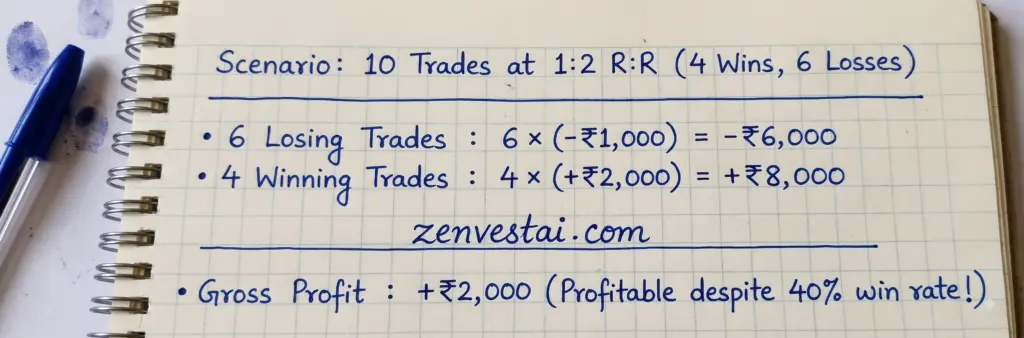
This mathematical relationship proves that you do not need to win every trade to build wealth in crypto trading.
⚠️ Why a High Risk-to-Reward Ratio Is Not Always Better
Many beginner traders fall into the trap of manufacturing artificial 1:10 or 1:20 setups on charts.
However, an attractive theoretical ratio is useless if the market probability of reaching that target is near zero.
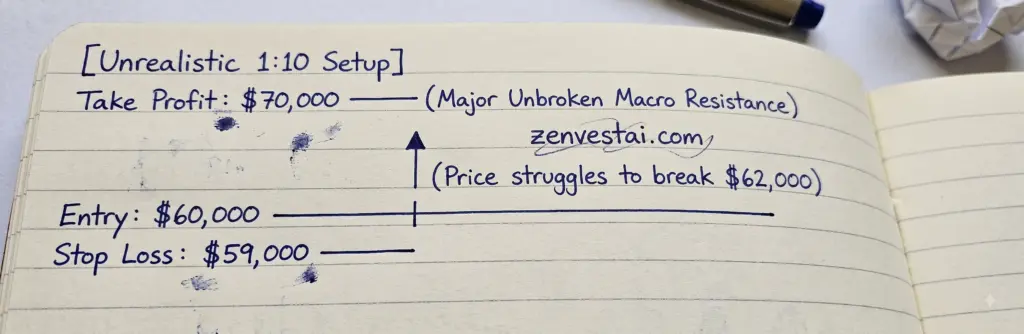
The Pitfalls of Forced High R:R Ratios:
1. Ignoring Technical Structure: Setting take-profit levels far beyond major resistance zones where sellers dominate.
2. Premature Stop-Outs: Setting unrealistically tight stop losses just to inflate the mathematical ratio, getting stopped out by standard market noise.
3. Plummeting Win Rate: When targets are too far away, your trade win rate can drop below 15%, causing psychological fatigue.
💡 Zenvestai Quick Insight
Does a higher risk-to-reward ratio guarantee better trading results?No, higher ratios do not guarantee profitability.
If price targets are placed beyond key resistance levels or stop losses are excessively tight, your trade failure rate spikes dramatically, leading to repeated losses despite favorable on-paper numbers.
⚡ Crypto Futures, Leverage, and Indian Market Realities
Trading crypto futures introduces leverage, which magnifies both gains and losses.
Crucially, leverage changes the capital efficiency of your trade, but it never alters the underlying price-based risk-to-reward ratio.
Position Sizing vs. Risk Percentage
Your risk-to-reward ratio dictates your chart parameters; your position size dictates your actual financial risk in rupees [rupaye ka nuksan].
Position Size (Units) = (Account Capital × Account Risk %) ÷ (Entry Price − Stop-Loss Price)
Example:
- Account Size: ₹1,00,000
- Max Risk per Trade (1%): ₹1,000
- Entry: ₹1,000 | Stop Loss: ₹950 (Risk = ₹50/unit)
- Correct Position Size: ₹1,000 ÷ ₹50 = 20 units
How I Manage Risk & Leverage on Live Crypto Futures Trades
Theory is helpful, but seeing how risk management actually plays out in a live order book is where the real learning happens.
To show you how this works in practice, let me share an actual snapshot from my recent USDⓈ-M Futures trade history on the TUT/USDT perpetual pair.
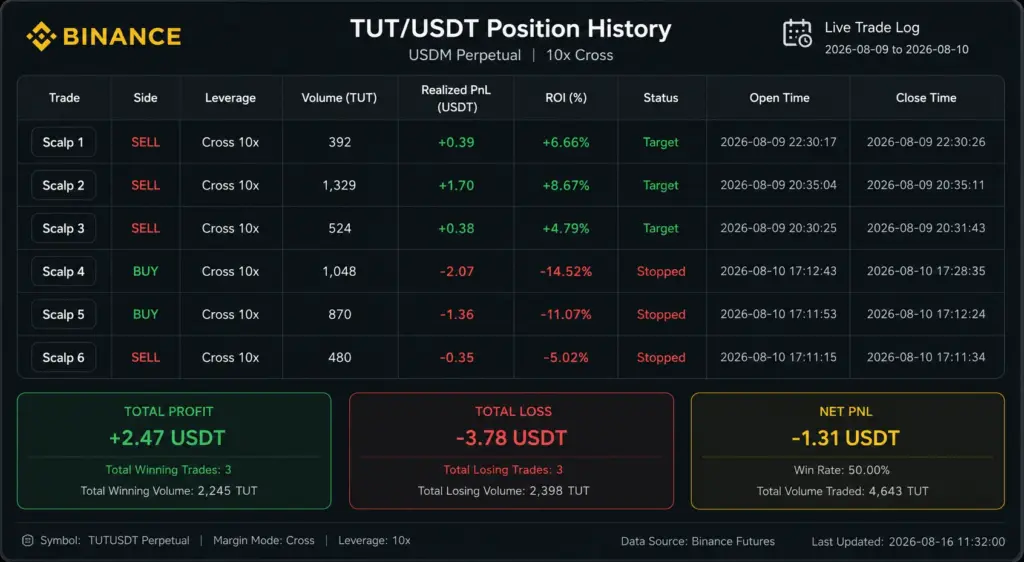
Practical Lessons from My Live Trades:
1. Real Trading Includes Losses — The Key is Keeping Them Small
Notice how not every trade in my log was in the green. On the long (Buy) attempts, the price broke below my invalidation level, and my planned stop losses were triggered at -0.35 USDT, -1.36 USDT, and -2.07 USDT.
Instead of moving my stop loss further down or hoping for a bounce [nuksan ka intezar karna], I exited immediately. Because these losses were strictly capped, my overall trading account remained safe.
2. Disciplined Leverage Usage (10x Cross)
When trading futures with 10x leverage, price movements happen rapidly. Notice that my trade durations were tight—some lasting under a minute (0m to 1m) and others up to 15 minutes.
Because I predetermined my exit points before entering, the 10x leverage worked as a tool for capital efficiency rather than a reckless gamble.
3. Asymmetric Profit Capture
When the short (Sell) momentum aligned with my technical setup, the winning trades generated solid returns (+8.67% ROI, +6.66% ROI, and +4.79% ROI).
The takeaway here is simple: you do not need a 100% win rate to be disciplined. When you cut losing trades quickly and let your winning setups hit logical targets, your portfolio stays protected across all market cycles.
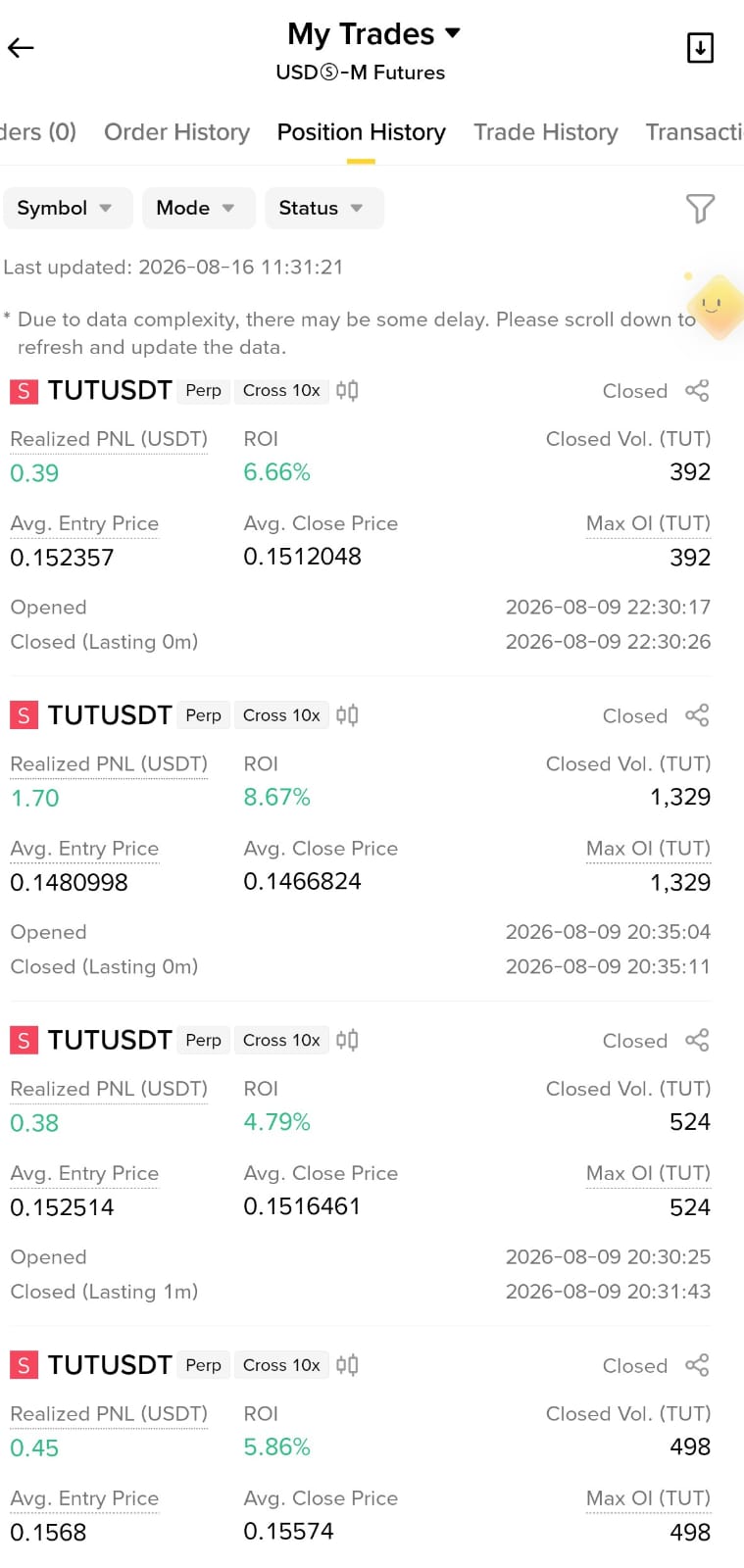
📊 Figure: Live order execution & strict stop-loss management on TUT/USDT (Binance Futures)
💡 Zenvestai Quick Insight
What is the main takeaway from live leveraged crypto trading?
Live futures trading requires strict emotional detachment.As shown in the trade history, taking small, predefined stop losses is a normal part of the process.
Protecting your capital by exiting invalidated setups promptly is what allows you to capitalize on the next winning trade.
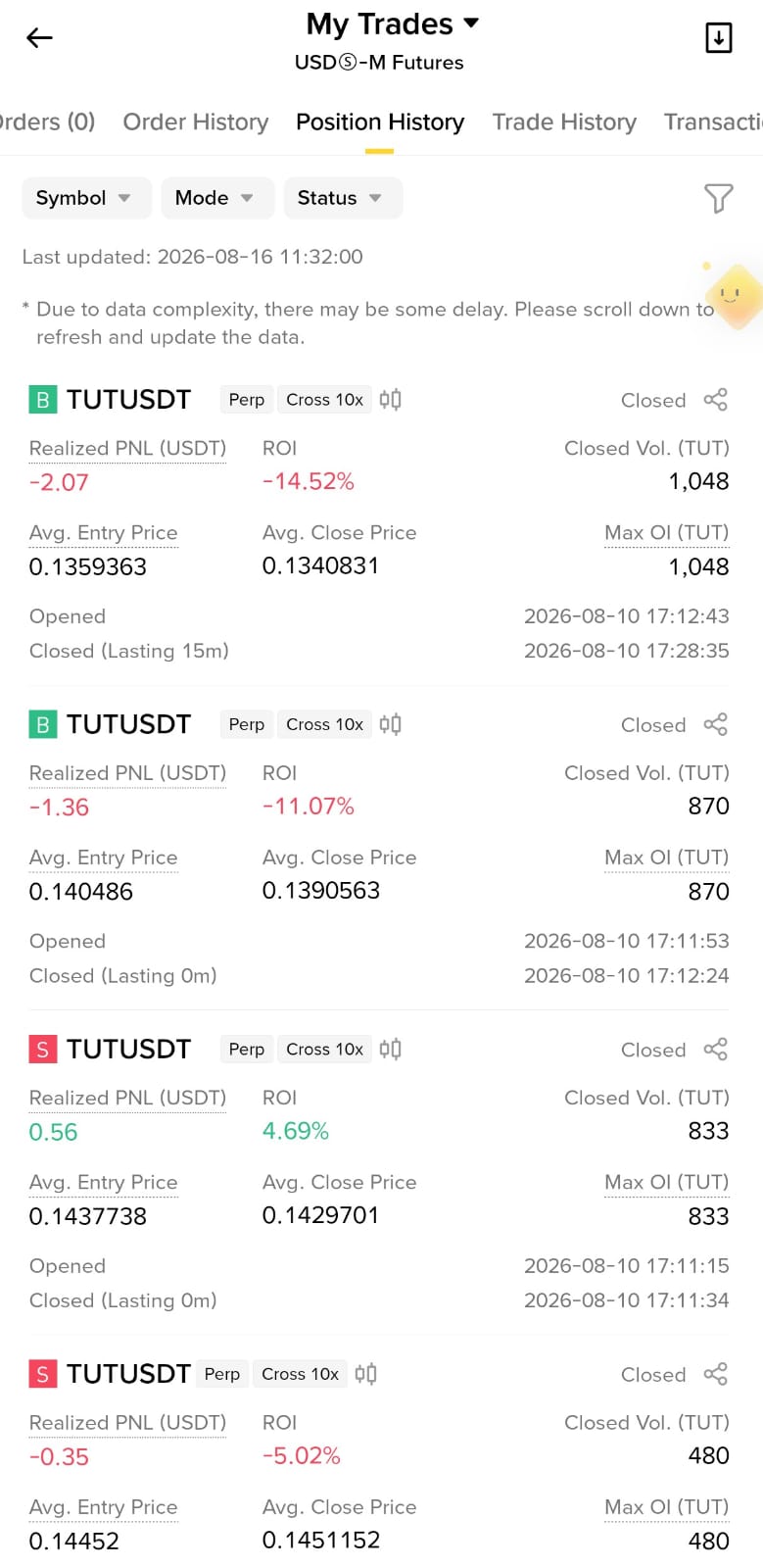
📊 Figure: Live order execution & strict stop-loss management on TUT/USDT (Binance Futures)
Real-World Indian Trading Friction
When planning crypto setups from India, always account for mandatory transaction overhead:
Exchange Fees & Slippage:Maker/taker fees and order book spread during volatile swings.
- Perpetual Funding Rates: Ongoing financing costs for keeping leveraged futures positions open.
1% TDS & Flat 30% Tax Regime:In India, Section 194S mandates 1% TDS on Virtual Digital Asset (VDA) transfers, and net crypto income is taxed at 30% (plus surcharge and cess) without cross-trade loss offsets. Factoring friction into your net profit targets is essential.
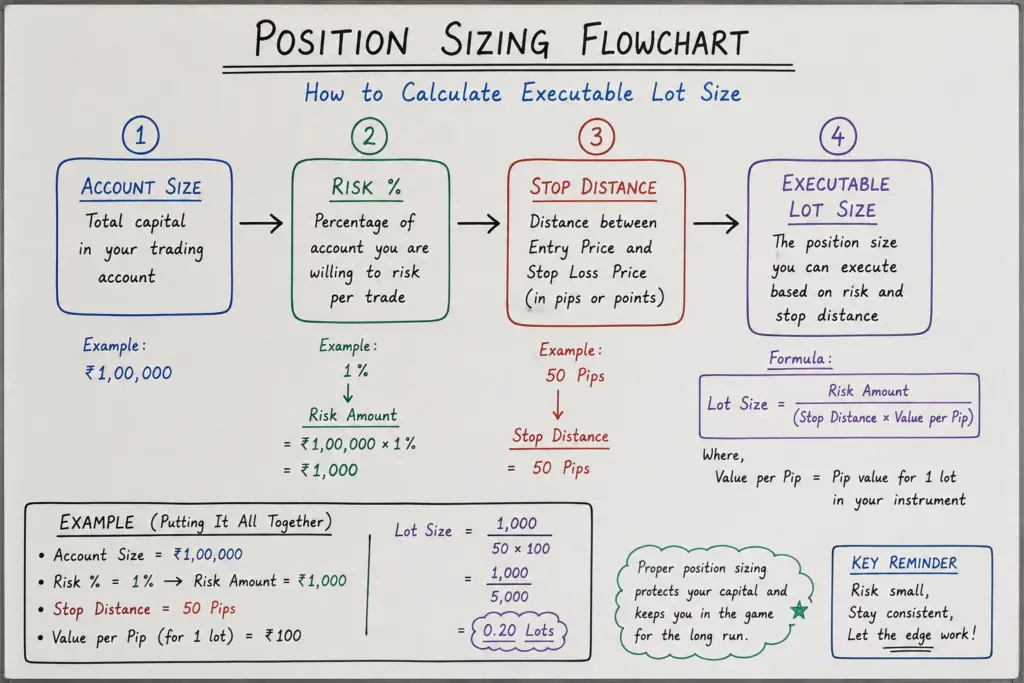
🛠️ The 5-Step Pre-Trade Framework
Follow this sequential workflow before entering any crypto position:

Step 1: Identify the Valid Setup: Locate a confluence level (e.g., support bounce, moving average cross, or order block).
Step 2: Establish the Stop-Loss Level: Place your stop loss just outside structural invalidation points (below swing lows for longs, above swing highs for shorts).
Step 3: Define the Profit Target: Identify the next key liquidity zone or major resistance level.
Step 4: Calculate the R:R & Position Size: Ensure the setup offers at least 1:1.5 to 1:2. Determine the exact quantity to purchase based on your 1% risk rule.
Step 5: Execute or Walk Away: If the setup offers less than your minimum required ratio, pass on the trade. Preserving capital is your primary victory.
🚫 6 Costly Risk-to-Reward Mistakes to Avoid
1. Moving the Stop Loss During a Trade: Widening your stop loss when the market goes against you turns a planned ₹1,000 loss into a catastrophic drawdown.
2. Moving Take-Profit Arbitrarily: Pushing targets farther away during a trade without technical justification invites sudden market reversals.
3. Ignoring Trading Friction: Failing to account for taker fees, perpetual funding, and slippage on low-liquidity altcoin pairs.
4. Applying Static Ratios to All Market Conditions: Demanding a 1:3 ratio in a sideways, range-bound market where price only moves 1%–2% before oscillating.
5. Using Leverage to Compensate for Poor Capital: Increasing leverage to take bigger bets rather than letting a systematic edge compound over time.
6. Revenge Trading After a Loss: Immediately opening an unplanned, oversized trade to recover recent losses [badla lene ki trading].
🧠 Trading Psychology: Thinking in R-Multiples
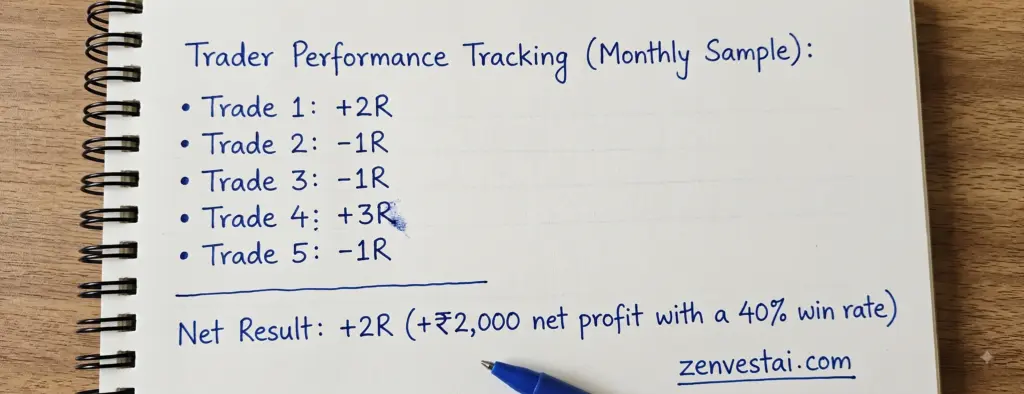
Professional crypto traders evaluate their performance in “R” rather than absolute rupee or dollar amounts.
Thinking in R-multiples removes emotional attachment to money and keeps your focus entirely on execution quality.
If your standard risk per trade is ₹1,000 (1R):
- Loss: −1R (−₹1,000)
- Target 1 Hit: +1R (+₹1,000)
- Target 2 Hit: +2R (+₹2,000)
- Target 3 Hit: +3R (+₹3,000)
💡 Zenvestai Quick Insight
Why do seasoned traders express trade performance in R-multiples?
R-multiples standardize performance tracking across different account sizes and volatile market conditions.
By measuring gains and losses as units of predefined risk rather than raw currency, traders reduce emotional stress and reinforce disciplined risk-management habits.
Essential Reading for 2026 Crypto Investors
- Master the Fundamentals: A beginners guide to cryptocurrency and blockchain technology
- Understand the Ecosystem: Basics of the Crypto Market
- Secure Your Assets: The Ultimate Guide to Crypto Wallets
- Spot Emerging Trends: The Future of Cryptocurrency in 2026
- Deep Dive into Tokenization: Understanding Tokenization and Wholesale Digital Assets in 2026
- Real-World Impact: How Tokenization is Empowering Small Businesses in 2026
- Stay Compliant: The Future of Crypto Regulations
- Actionable Trading Strategies: How to Start Crypto Futures Trading with Low Capital?
📋 Pre-Trade Execution Checklist
Before pressing the submit button on your exchange, verify every item on this checklist:
- [ ] Invalidation Point Identified: Have I placed my stop loss at a structural level where my trade thesis is definitively proven wrong?
- [ ] Target Grounded in Market Structure: Is my profit target realistic and placed before major resistance or liquidity clusters?
- [ ] Minimum Ratio Met: Does this setup offer at least a
1:1.5 to 1:2 R:R?
- [ ] Position Sized Accurately: Have I calculated my lot size so that hitting my stop loss risks only
1%–2%of my account?
- [ ] Friction Accounted For: Have I factored in maker/taker fees, funding rates, and slippage?
- [ ] Emotional State Checked: Am I executing an objective technical setup, or am I reacting to FOMO and social media hype?
📖 Glossary of Key Crypto Trading Terms
- Risk-to-Reward Ratio (R:R): The mathematical comparison of potential capital at risk versus anticipated profit on a single position.
- Stop Loss (SL): An automated order type placed with a broker or exchange to close a position once price breaches a specified invalidation level.
- Take Profit (TP): A pre-set limit order designed to close an open position and lock in profits once price reaches a target resistance/support zone.
- Position Sizing: The exact number of cryptocurrency coins, tokens, or contracts allocated to a trade based on predefined portfolio risk limits.
- R-Multiple: A framework that standardizes trade outcomes in multiples of the initial dollar or rupee amount risked on the trade.
- Invalidation Level: The specific market price where a technical chart pattern or trading thesis is invalidated by market price action.
- Liquidation Price: In leveraged margin or futures trading, the price threshold at which the exchange forcibly closes a trader’s position due to complete margin exhaustion.
🏁 The Bottom Line
The risk-to-reward ratio is the ultimate equalizer in cryptocurrency trading.
It transforms trading from an emotional guessing game into a structured, probability-driven discipline.
To succeed over the long term, commit to these non-negotiable rules:
1. Always define your invalidation level and potential monetary loss before you enter.
2. Structure trades with asymmetric upside (targeting at least 1:2 R:R where technically feasible).
3. Scale your position size to keep your maximum loss to 1%–2% of your total portfolio.
4. Accept that losses are simply the regular cost of doing business in financial markets.
Trading cryptocurrency is not about proving you are right on every single move.
It is about protecting your capital when you are wrong and maximizing your gains when you are right.
🚀 What’s Your Trading Strategy?
What is your preferred risk-to-reward ratio when trading crypto—do you prefer quick 1:1.5 scalps or patient 1:3+ trend-following setups?
Have you established a firm 1% risk rule for your portfolio?
Share your thoughts, experiences, and questions in the comments below!
Disclaimer: Cryptocurrency trading involves substantial risk of loss and is not suitable for every investor. The valuation of cryptocurrencies and futures contracts may fluctuate significantly. This guide is provided strictly for educational purposes and does not constitute financial, investment, or legal advice. Always conduct your own research and manage your risk prudently.
