📌 Key Takeaways:-
- DEX routing finds the most cost-effective path to swap crypto across multiple decentralized exchanges and liquidity pools.
- Direct swaps often cost more due to fragmented liquidity, high slippage, and price impact on single trading pairs.
- Multi-hop routing and trade splitting break your transaction into smaller pieces or route through intermediary tokens to get more output value.
- The highest displayed exchange rate is not always the best route because network gas fees, pool fees, and Maximum Extractable Value (MEV) slippage reduce net returns.
- Smart Order Routers (SORs) and DEX aggregators automate complex route calculations in milliseconds so you never have to compare pools manually.
What Is DEX Routing? The Ultimate to Best Crypto Swap Execution
What This Post Covers
- What Is DEX Routing in Simple Words?
- The Core Problem: Why Direct Swaps Lose You Money
- How DEX Routing Works: Multi-Hop vs. Trade Splitting
- DEX Routing Comparison Matrix
- The True Cost Formula: Why Quoted Rates Lie
- Step-by-Step: How a Route Executes On-Chain
- Cross-Chain DEX Routing and Bridge Realities
- ZenvestAI Insider Insight: Spatial Arbitrage & Net Yields
- Key Benefits of Smart Order Routing
- Major Risks: MEV, Gas Spikes, and Smart Contract Bugs
- DeFi DEX Routing Glossary
- Frequently Asked Questions (FAQs)
- The Bottom Line
Have you ever hit “Swap” on a decentralized exchange, only to realize you received far fewer tokens than you expected? That painful feeling of losing hard-earned money to hidden slippage, sudden gas spikes, or shallow liquidity pools is something almost every crypto trader experiences. In today’s fast-moving DeFi world, swapping tokens is no longer just about picking a single exchange and hoping for the best.
Understanding what is DEX routing is the single most effective way to protect your capital and maximize every trade you make across decentralized finance. Let’s start with the foundational definition.
Mastering Crypto Trading: From Setup to Advanced Strategies
Diving into the world of cryptocurrency trading can feel overwhelming, but having the right resources makes all the difference. Whether you are setting up your first exchange account or looking to master complex arbitrage, we have compiled a step-by-step reading list to help you protect your capital and maximize your gains.
1. Secure Your Foundation
Before you make a single trade, you need a reliable and secure platform. Start your journey by learning How to Safely Set Up and Secure an Account on Binance. Protecting your assets from day one is the most crucial step in your crypto journey.
2. Learn the Trading Mechanics
Ready to move beyond basic spot buying? Understanding futures and leverage is essential for modern traders. Check out our comprehensive piece on What Is Crypto Futures Trading? A Complete Beginner’s Guide. If you want to optimize your capital efficiency and leverage your current holdings, you should also explore our Ultimate Guide: What Is Crypto Portfolio Margin Financing?
3. Master Risk Management
The secret to long-term trading success isn’t just making winning trades—it’s managing your downside. Master your capital allocation with The Ultimate Risk-to-Reward Ratio Guide: Master Crypto Risk and Protect Your Capital. Just as importantly, don’t let winning trades turn into losing ones; discover What Is Take Profit (TP)? The Ultimate Step-by-Step Guide to Locking in Crypto Trading Profits with Discipline.
4. Explore Advanced Market Opportunities
Once you have a handle on the basics and risk management, you can start looking for unique market inefficiencies. Learn how to capitalize on price differences across different exchanges in The Ultimate Guide to Spatial Arbitrage in Crypto Trading.
🤖 ZenvestAi Explains
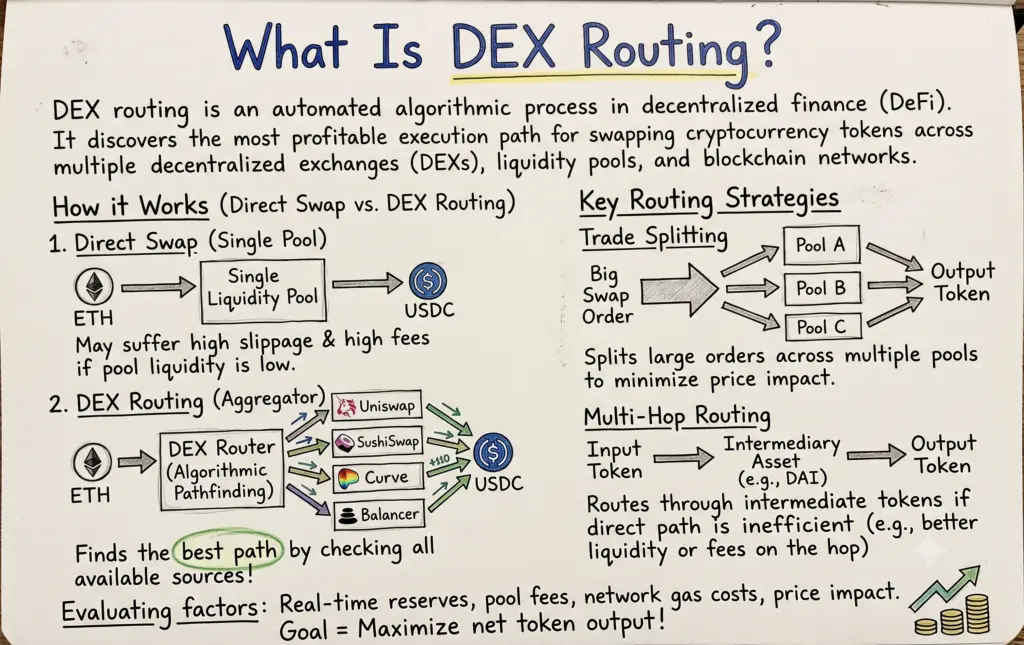
DEX routing is an automated algorithmic process in decentralized finance (DeFi). It discovers the most profitable execution path for swapping cryptocurrency tokens across multiple decentralized exchanges, liquidity pools, and blockchain networks.
Instead of executing an entire swap through a single liquidity pool, a DEX router evaluates real-time token reserves, pool fees, network gas costs, and price impact.
It then dynamically splits trades or routes transactions through intermediary assets (multi-hop routing) to deliver the highest net output.
What Is a DEX and Why Does Liquidity Fragment?
A decentralized exchange (DEX) is a peer-to-contract trading venue powered by blockchain smart contracts rather than a centralized order book. Popular DEX platforms such as Uniswap, Curve Finance, PancakeSwap, SushiSwap, and Raydium allow you to trade directly from your self-custody Web3 wallet.
Instead of trading against a centralized market maker, you trade against liquidity pools containing paired assets (for example, ETH/USDC or SOL/USDT). However, because anyone can deploy a new DEX or create a new pool, liquidity is scattered across thousands of separate contracts.
[Traditional Centralized Exchange]
User Order ----> Central Order Book (Single Liquidity Depth)

[Fragmented Decentralized Finance]
User Trade ----> Pool A (Uniswap v3)
            ----> Pool B (Curve)      ===> Liquidity Scattered Everywhere!
            ----> Pool C (SushiSwap)
Zenvestai Quick Insight:
Liquidity fragmentation happens when available trading capital is spread thinly across competing protocols, different fee tiers, and separate blockchains.
A standalone DEX only sees its internal reserves, whereas a dedicated router scans the entire decentralized ecosystem simultaneously.
The Core Problem: Why Direct Swaps Lose You Money {#the-core-problem}
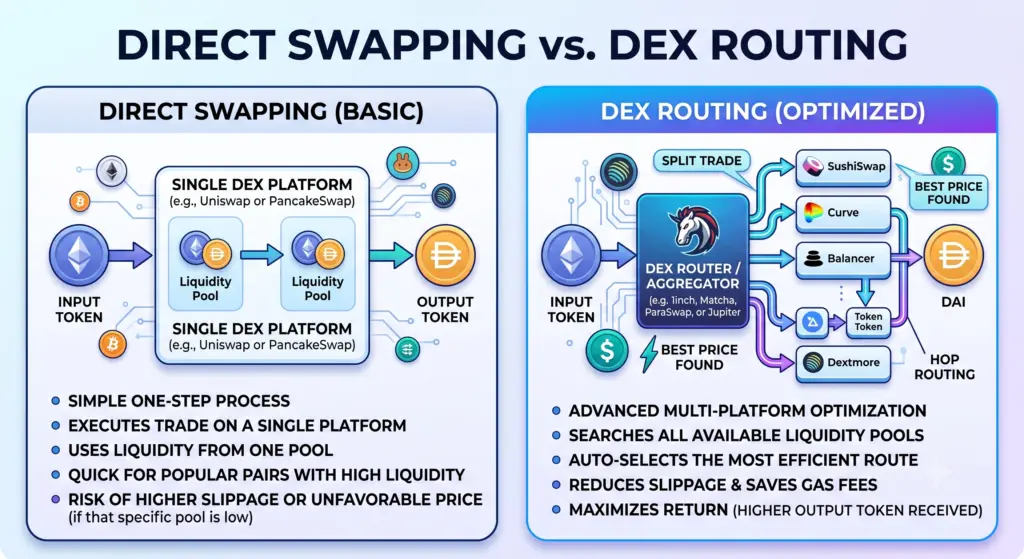
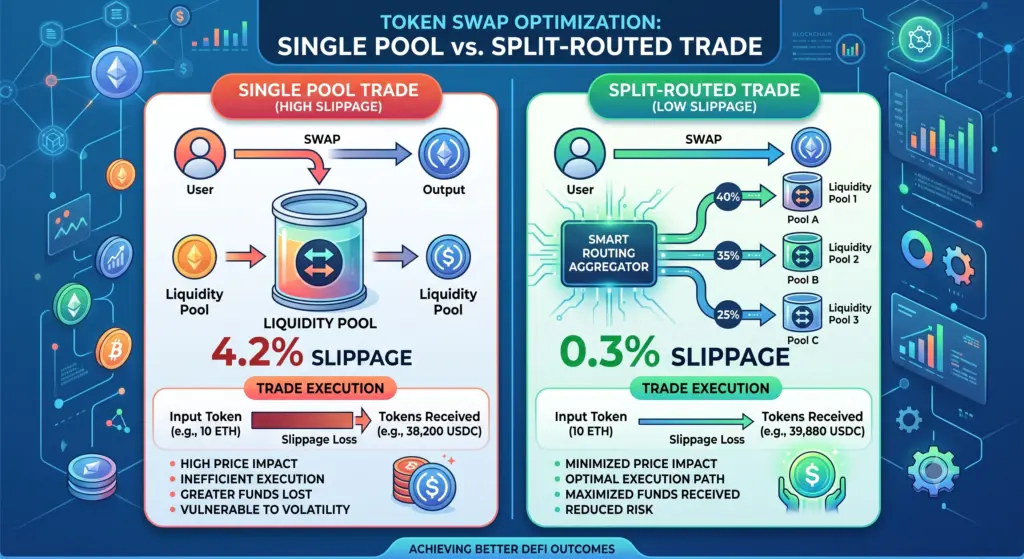
Direct swapping through the first available pool often results in severe price impact and unnecessary slippage. When you execute a swap inside a shallow liquidity pool, your transaction shifts the pool’s internal asset balance, forcing the execution price upward against you (bhav badal jana / price deviation).
Direct Swapping vs. DEX Routing
- Simple DEX Swapping: You select Token A and Token B on a single DEX. The protocol executes 100% of your trade through one single pool, regardless of shallow liquidity or high slippage.
- Smart DEX Routing: An algorithm inspects dozens of liquidity sources, models slippage across various pool depths, calculates gas overhead, and constructs an optimal multi-path route.
How DEX Routing Works: Multi-Hop vs. Trade Splitting {#how-dex-routing-works}
DEX routers achieve superior trade execution primarily through two foundational mechanisms: multi-hop routing and trade splitting.
1. What Is Multi-Hop Routing?
Multi-hop routing routes your swap through one or more intermediate tokens when no direct trading pair exists or when direct liquidity is too thin.
- Direct Path:
Token A → Token C(Limited liquidity, resulting in high price impact). - Multi-Hop Path:
Token A → Token B → Token C(Deep liquidity in both intermediate pools, delivering more final tokens).
For instance, swapping a niche altcoin directly for ETH might suffer from high slippage, whereas swapping Altcoin → USDC → ETH utilizes two deep, liquid pools to yield a substantially higher net return.
2. What Is Trade Splitting?
Trade splitting divides a single large order into multiple smaller sub-orders that execute simultaneously across different liquidity pools.
For example, if you swap 100,000 USDC for ETH:
- 45% routes through Uniswap v3 (0.05% fee tier).
- 35% routes through Curve Finance.
- 20% routes through Balancer.
The core objective of trade splitting is to keep each pool’s price impact at the absolute lowest possible level.
Zenvestai Quick Insight:
Multi-hop routing solves token pair availability and depth constraints, while trade splitting mitigates volume-driven price impact. Top routers dynamically combine both techniques in a single atomic transaction.
The Complete Crypto Investor’s Roadmap: From Basics to Wealth Generation
Navigating the cryptocurrency landscape requires a solid understanding of the underlying technology, major assets, and modern trading tools. We have put together this essential reading guide to help you build your knowledge from the ground up and craft a winning crypto strategy.
1. Understand the Foundation
If you are new to the digital asset space, the best place to start is by grasping the core concepts. Read our comprehensive What Is Cryptocurrency? The Ultimate Beginner’s Guide. Once you understand the assets themselves, dive into the underlying technology to see How Distributed Ledgers Are Radically Rewriting the Rules of Modern Finance.
2. Formulate Your Core Wealth Strategy
The two biggest pillars of the crypto market are Bitcoin and Ethereum, but investing in them requires distinct approaches. Learn how to maximize your portfolio with The Complete Bitcoin Wealth Strategy. Then, discover how to navigate the world of smart contracts and decentralized finance by applying The Complete Ethereum Wealth Strategy.
3. Unlock Passive Income and Network Security
Simply holding crypto isn’t the only way to generate wealth—you can also put your digital assets to work. Find out how to generate yield in What Is Crypto Staking? The Complete Guide to Earning Rewards Safely. To truly understand where those rewards come from, delve into the mechanics of consensus in Why Does Staking Exist? The Ultimate Guide to Cryptoeconomic Security.
4. Stay Ahead of the Curve
As the market evolves, so do the tools used to trade it. Give yourself a competitive edge by exploring the future of automated investing and data-driven decision-making in How AI Is Transforming Cryptocurrency Trading in 2026.
DEX Routing Comparison Matrix {#comparison-matrix}
| Trading Method | Execution Path | Liquidity Sources | Slippage Control | Gas Cost Level | Best Suited For |
| Simple Direct Swap | Single direct pool (A → B) | 1 Pool | Low / Vulnerable | Lowest | Very small trades (< $100) |
| Multi-Hop Swap | Sequential intermediate pairs (A → X → B) | 2–3 Pools | Moderate to High | Medium | Niche pairs or illiquid direct pairs |
| Split-Route Swap | Parallel split execution across venues | Multiple Pools / DEXs | Highest | Higher | Mid-to-large trades ($5,000+) |
| Cross-Chain Routing | Source Chain → Bridge → Target Chain | Cross-chain liquidity + Bridges | Variable | Highest | Moving assets across distinct networks |
The True Cost Formula: Why Quoted Rates Lie {#true-cost-formula}
A common beginner mistake is choosing a swap route purely based on the headline token quote displayed on your screen. Because every intermediate contract call consumes computational energy on the blockchain, complex routes carry higher network gas fees.
Net Output Value = Gross Output − DEX Swap Fees − Gas Network Fees − Slippage − MEV Losses
Route A (Single Direct Pool):
Gross Output: 3.10 ETH
Gas Cost:     -$8.00
Net Return:   3.097 ETH

Route B (3-Hop Split Route):
Gross Output: 3.13 ETH
Gas Cost:     -$45.00
Net Return:   3.115 ETH (True Winner for large size, but a losing trade for small size!)
Zenvestai Quick Insight:
A trade that gains you $5 worth of extra tokens but burns $25 extra in smart contract gas leaves you with a net loss. Professional DEX routers calculate gas-adjusted net returns before suggesting an execution path.
Step-by-Step: How a Route Executes On-Chain {#step-by-step-execution}
Modern Smart Order Routers (SOR) execute complex calculations within milliseconds through a structured pipeline:
- Trade Intent Input: You define the input asset, desired output asset, and trade amount in your interface.
- Liquidity Graph Scanning: The router builds a topological graph of all accessible liquidity pools and pricing curves across supported DEXs.
- Gas & Slippage Modeling: The algorithm models simulated price impact for different fractional order sizes while factoring in current base gas fees.
- Optimal Path Selection: The router selects the route that maximizes the final net balance after all network and protocol fees.
- Wallet Approval & Signature: You grant the smart contract token spending permissions and sign the atomic transaction.
- Atomic Smart Contract Execution: The router contract interacts with all designated pools in a single blockchain block. If any step violates your preset minimum slippage tolerance, the entire transaction reverts, protecting your principal funds.
Cross-Chain DEX Routing and Bridge Realities {#cross-chain-routing}
As the crypto ecosystem expands across Layer 1s and Layer 2 rollups—including Ethereum, Arbitrum, Base, Polygon, Solana, and BNB Chain—cross-chain routing has become essential. Cross-chain aggregators combine on-chain DEX routing with decentralized bridge protocols to enable seamless asset swaps between disparate blockchains.
However, cross-chain swaps introduce distinct operational variables:
- Bridge Latency: Cross-chain messaging takes minutes rather than seconds.
- Bridge Protocol Risk: Liquidity pool bridges represent attractive targets for smart contract exploits.
- Destination Gas Requirements: Ensuring your destination wallet receives native gas tokens to perform follow-up transactions.
ZenvestAI Insider Insight: Spatial Arbitrage & Net Yield Realities {#zenvestai-insight}
At ZenvestAI, our quantitative analysis of decentralized markets demonstrates that spatial price discrepancies between liquidity pools are rarely “free money.” True trading profitability requires auditing the full transaction friction stack.
💡 ZenvestAI Key Rule:
Headline price differences are meaningless without factoring in atomic execution costs. If DEX A quotes ETH at $3,500 and DEX B quotes $3,525 (a 0.71% spread), that spread evaporates instantly if combined slippage, pool fees (0.30% each side), and Layer 1 transaction gas exceed $25 per ETH. Sustainable execution requires low-latency settlement, automated private RPC relays to block frontrunning, and precise mathematical modeling of net profit boundaries.
Key Benefits of Smart Order Routing {#key-benefits}
- Maximum Capital Efficiency: You receive the highest possible quantity of destination tokens for your trade.
- Minimized Price Distortion: Trade splitting preserves pool reserves and prevents aggressive price spikes.
- Time Savings: Eliminates the need to manually browse across Uniswap, Curve, or PancakeSwap to compare prices.
- Deep Market Access: Multi-hop algorithms connect rare and exotic token pairs through standard base tokens like WETH, USDC, and USDT.
- Customizable Protection: Built-in safeguards allow you to customize maximum slippage tolerances and deadline expirations.
Major Risks: MEV, Gas Spikes, and Smart Contract Bugs {#risks-and-vulnerabilities}
While DEX routing provides significant advantages, interacting with multi-contract systems involves specific structural risks:
- Smart Contract Exposure: Splitting orders across four protocols means trusting the underlying code security of four separate smart contract suites.
- MEV Sandwich Attacks: Public mempool transactions can be targeted by automated bots that buy ahead of your trade and sell immediately after, forcing you into maximum slippage.
- Failed Transactions and Lost Gas: If market prices fluctuate past your slippage limit before block inclusion, the swap fails, yet the network still consumes your gas fee.
- Bridge Exploits in Cross-Chain Paths: Intermediary bridges used in multi-chain hops add additional counterparty and technical risk.
DeFi DEX Routing Glossary {#glossary}
- AMM (Automated Market Maker): A decentralized exchange protocol that uses mathematical formulas (e.g., $x \times y = k$) to price assets without human market makers.
- DEX Aggregator: A unified trading interface (like 1inch, ParaSwap, or Jupiter) that indexes multiple DEXs to source the best swap rate.
- Multi-Hop: A swap route that passes through one or more intermediate tokens before delivering the desired asset.
- Price Impact: The percentage change in an asset’s market price directly caused by the size of your transaction relative to pool liquidity.
- Slippage: The difference between the expected quote when you submit a trade and the actual execution price when the block confirms.
- Smart Order Routing (SOR): An algorithmic system that dynamically distributes trade volume across multiple routes to achieve optimal pricing.
The Bottom Line
To summarize, DEX routing transforms crypto trading from a manual, inefficient guessing game into a streamlined, mathematically optimized experience. Rather than blindly swapping tokens inside the first liquidity pool you encounter, smart order routing analyzes reserves, models price impact, and factors in network overhead to deliver the highest net output value.
Whether you are swapping $50 on a Layer 2 network or executing large six-figure transactions, leveraging smart routing tools ensures you keep more of your hard-earned capital where it belongs: in your wallet.
Join the Conversation! 💬
What DEX routing platform or aggregator do you rely on most for your on-chain swaps—and have you ever saved a trade from heavy slippage using multi-hop routing? Drop your thoughts, questions, or trading experiences in the comments below!
What is the difference between a DEX aggregator and DEX routing?
A DEX router is the underlying mathematical algorithm that calculates the optimal swap path across liquidity pools. A DEX aggregator is the consumer-facing platform or user interface that integrates multiple routers and decentralized exchanges to offer a single trading portal.
Does DEX routing increase gas fees?
Yes, multi-hop routes and split trades interact with multiple smart contracts, which consumes more gas than a single direct swap. However, a quality router only selects a multi-contract path if the extra tokens gained outweigh the increased gas cost.
Can DEX routing prevent front-running and MEV?
Standard DEX routing does not inherently prevent MEV sandwich attacks on public blockchains. To avoid MEV extraction, traders must use private transaction endpoints (such as Flashbots Protect or MEV-blocker RPCs) alongside advanced routers with MEV-aware architecture.
What is DEX routing in crypto?
DEX routing is the process of finding the most efficient path to swap tokens across multiple decentralized exchanges, pools, and intermediaries to minimize fees and slippage while maximizing token return.
How to use DEX routing for my daily trades?
You can access automated DEX routing by using established DEX aggregators like 1inch, Matcha, ParaSwap, or Jupiter (on Solana). When you input your trade, the platform automatically routes your transaction through the most efficient path.
Can I lose money while using a DEX router?
While DEX routers aim to get you the best price, you can still experience losses from volatile market slippage, sudden gas fee spikes, or smart contract exploits in underlying pools. Always set a conservative slippage tolerance (e.g., 0.5%) to safeguard your assets.
