A DAO (Decentralized Autonomous Organization) is a blockchain-based organization where members collectively make decisions using governance mechanisms such as proposals and voting. Its operational rules and treasury are managed by smart contracts, allowing approved decisions to be recorded transparently and, in many systems, executed automatically on-chain without relying on traditional corporate hierarchies.
Imagine working for an organization where there is no CEO in a corner office, no board of directors negotiating behind closed doors, and no corporate bank account controlled by a single chief financial officer. Instead, imagine a digital community where every member has a transparent voice, every dollar spent is verifiable by anyone with an internet connection, and the organization’s foundational bylaws are written not in legal jargon, but in self-executing software code.
That is the premise of a Decentralized Autonomous Organization. Over the last decade, DAOs have grown from experimental code snippets on Ethereum into a global coordination layer.
Across more than 10,000 active organizations, communities now govern upwards of $23 billion in collective digital assets—powering decentralized financial protocols, open-source software, cultural archives, and venture collectives.
Yet, behind the buzzwords lies a complex web of technical mechanisms, game theory, and human psychology. To understand how these entities actually coordinate people and capital at scale, let us start by breaking down the acronym itself.
Table of Contents
- What Is a DAO?
- How Does a DAO Work?
- How Does DAO Voting Work?
- What Is a DAO Treasury?
- What Are DAOs Used For?
- DAO vs. Traditional Organization
- What Are the Advantages of DAOs?
- What Are the Risks of DAOs?
- Examples of DAOs in Action
- Are DAOs Really Decentralized?
- What Is the Difference Between a DAO and a Cryptocurrency?
- Frequently Asked Questions About DAOs
- Exclusive Analytical Frameworks
- The Bottom Line
- Conclusion
- Verified Research References
What Is a DAO?
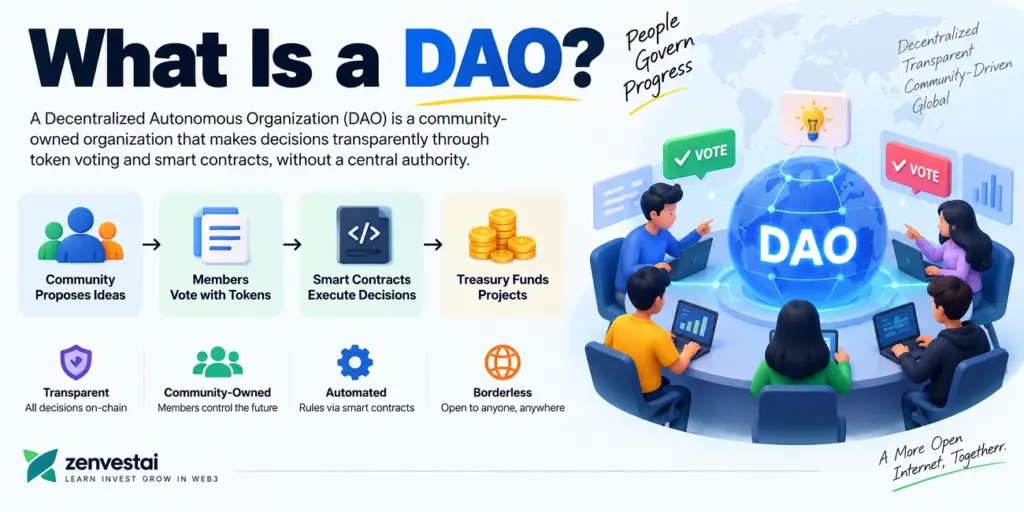
Think of a DAO as a community with a shared digital treasury and a rulebook written in code.
In a traditional company, governance moves strictly top-down:
CEO / Executives → Board of Directors → Management → Operational Execution
Information flows upward through memos and closed-door meetings, while authority flows downward. If the leadership decides to spend $500,000 on a marketing campaign, the broader workforce or public shareholders rarely participate in that specific decision in real time.
In a DAO, the organizational pyramid is flattened:
Community Members → Proposal → Token Vote → Smart Contract Execution → Public Blockchain Record
If a member wants the organization to fund a new software tool, they draft a public proposal. The community deliberates in open forums, token holders cast their votes on-chain or via cryptographic signatures, and if the proposal passes quorum, the smart contract releases the funds directly to the developer’s address.
The Nuance: On-Chain Automation vs. Multi-Sig Reality
Beginners often assume every DAO is 100% automated by self-executing algorithms. In reality, modern DAOs operate across a spectrum:
- Fully Automated (On-Chain Governance): The vote itself triggers a smart contract transaction. For instance, if a proposal to update a lending interest rate passes on Compound or Uniswap, the protocol updates automatically when the timelock expires.
- Hybrid / Multi-Signature Governance: Many DAOs use off-chain signaling (such as gasless voting on Snapshot) followed by execution carried out by a designated group of trusted community trustees holding a multi-signature wallet (such as Safe).
Acknowledging this technical distinction is crucial: a DAO is not an infallible machine; it is a programmable social contract. Now that the mental model is clear, let us trace how a DAO functions step-by-step from an initial idea to on-chain execution.
How Does a DAO Work?
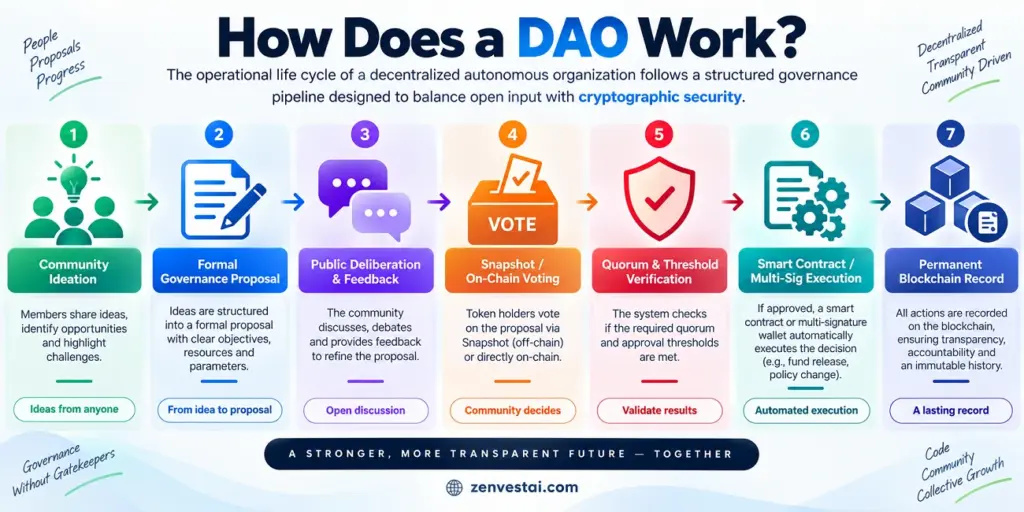
The operational life cycle of a decentralized autonomous organization follows a structured governance pipeline designed to balance open input with cryptographic security:
1. Proposal
Any eligible member (often requiring a minimum threshold of governance tokens to deter spam) writes and submits a formal proposal. This document specifies the proposed action—such as allocating treasury funds, changing a protocol parameter, or entering an external partnership—along with the exact blockchain transaction details.
2. Discussion
Before voting begins, the proposal undergoes public review on governance forums (such as Discourse) and community channels. Members scrutinize the financial costs, technical safety, and strategic alignment, offering critiques and requesting amendments.
3. Voting
The proposal moves to an active voting window. Eligible participants cast their votes using cryptographic signatures tied to their blockchain wallets. Governance rules define the duration of the voting window and how individual voting weight is calculated.
4. Approval and Quorum
For a vote to be legally binding within the DAO, it must clear two hurdles:
- Quorum: A minimum percentage of total circulating voting power must participate, ensuring a small cabal cannot pass stealth resolutions.
- Approval Threshold: A predefined majority (often 50% + 1, or a supermajority like 66%) must vote “For.”
5. Smart Contract Execution
Once approved, the proposed changes are implemented. In on-chain systems, the transaction sits in a “timelock” contract (a cooling-off safety period) before executing automatically. In hybrid systems, designated multi-sig signers execute the transaction precisely as authorized by the community vote.
6. Blockchain Record
Every stage—the proposal hash, individual votes, and the final treasury transaction—is inscribed permanently onto the underlying blockchain ledger. Anyone with a block explorer can independently verify who voted, how much weight they carried, and where every fraction of a cent went.
To make this machinery run reliably, every DAO relies on four foundational pillars. Let us examine each component in detail.
Every functioning DAO relies on four technical and structural components working in harmony:
1. Smart Contracts
Smart contracts are tamper-proof programs deployed on blockchains like Ethereum. They define the DAO’s fundamental operating rules: how proposals are initiated, what quorum is needed, and under what conditions funds leave the treasury. Because smart contracts execute deterministically, no rogue administrator can unilaterally alter the rules mid-vote.
2. Governance Framework
Governance represents the social and legal architecture of the organization. It establishes proposal guidelines, code review requirements, emergency intervention protocols, and dispute resolution channels.
3. Governance Tokens or Membership Rights
Membership in a DAO provides voting rights, typically determined in one of three ways:
- Token-Based: Fungible ERC-20 tokens represent proportional voting weight (common in DeFi protocols).
- Share-Based: Non-transferable shares granted upon entry or capital deposit (common in investment clubs and venture collectives like MolochDAOs).
- Reputation-Based: Non-transferable badges or soulbound tokens earned through contributions and active participation.
4. Treasury
The treasury is the economic engine of the DAO. It consists of a smart-contract-controlled wallet containing native tokens, stablecoins, or external crypto assets. Crucially, the private keys to this treasury do not belong to an individual; capital can only be unlocked via consensus-driven governance.
Because governance tokens and voting determine how these parts operate, voting design represents the most fiercely debated topic in Web3. Let us dive into how DAO voting actually works.
How Does DAO Voting Work?
DAO voting is the process through which a decentralized community converts individual preferences into binding organizational action.
In traditional democracies, voting typically adheres to the principle of “one person, one vote.” In public blockchain environments, however, identities are pseudonymous wallet addresses. If a DAO attempted a simple “one wallet, one vote” system, an attacker could trivially generate 10,000 empty wallet addresses and hijack every decision (a Sybil attack).
To prevent this, DAOs utilize alternative voting architectures:
- Token-Weighted Voting (1 Token = 1 Vote): The most common model. Your voting power is directly proportional to the quantity of governance tokens you hold. While Sybil-resistant, it can concentrate power among wealthy holders (“whales”).
- Vote Delegation: Small token holders can delegate their voting weight to trusted domain experts or active community leaders without relinquishing custody of their tokens. Protocols like ENS and Arbitrum rely heavily on active delegate ecosystems.
- Quadratic Voting: The cost of casting additional votes scales quadratically rather than linearly 1 Vote = 1 Token → 2 Votes = 4 Tokens → 10 Votes = 100 Tokens. This mathematical design elevates the voice of broad community majorities over a handful of ultra-wealthy individuals.
- Optimistic Governance: Proposals are assumed to be approved by default unless a member of the community formally vetoes or challenges them within a specified timeframe, accelerating routine operational spending.
Important Distinction: Does Owning a DAO Token Mean You Own the DAO?
Not necessarily.
A governance token gives you specific protocol rights—such as submitting proposals, voting on treasury distributions, or adjusting fee parameters—within the rules of that software ecosystem. It does not automatically grant equity, legal ownership of intellectual property, or dividend rights in a traditional legal sense. Conflating token holdings with corporate equity is one of the most common legal and financial misconceptions in Web3.
With voting power established, where do these votes direct their influence? In most cases, right into the DAO’s treasury.
What Is a DAO Treasury?
A DAO treasury is a cryptographically secured pool of digital capital governed entirely by the organization’s community consensus.
Treasury Vault → Governance Proposal → Community Vote → On-Chain Approval → Automated Fund Release
Unlike a corporate bank account that requires corporate signatures and intermediary bank clearance, a DAO treasury lives natively on a public ledger. Anyone in the world can inspect its holdings in real time—viewing token balances, past expenditures, and incoming revenues.
DAO treasuries are commonly deployed for:
- Core Protocol Development: Compensating software engineers, cryptographers, and auditors to maintain and upgrade smart contracts.
- Ecosystem Grants: Funding third-party teams building auxiliary tools, analytics dashboards, and developer integrations.
- Liquidity Management: Providing liquidity on decentralized exchanges to ensure protocol tokens can be smoothly traded with low slippage.
- Investments and Asset Diversification: Swapping native governance tokens into stablecoins, real-world tokenized treasury bills, or productive staking assets to ensure runway during market downturns.
- Operational Expenses: Paying for legal structures, community moderation, security bounties, and hosting infrastructure.
Having covered how DAOs manage money and votes, let us examine how different industries apply these tools in practice.
What Are DAOs Used For?
DAOs are not limited to experimental tech circles; they serve as coordination infrastructure across multiple sectors:
| DAO Category | What the DAO Coordinates | Prominent Real-World Examples |
| DeFi Protocol Governance | Smart contract parameters, risk thresholds, and fee structures | Uniswap, Aave, MakerDAO / Sky |
| Treasury & Ecosystem Grants | Capital deployment to open-source developers and researchers | Gitcoin, Uniswap Grants, Arbitrum Foundation |
| Infrastructure & Identity | Domain naming registries, decentralized data, and RPC layers | ENS (Ethereum Name Service) |
| Investment & Venture Collectives | Pooled capital for early-stage Web3 investments and real-world assets | MetaCartel Ventures, The LAO |
| Cultural & Creative Collectives | Media intellectual property, public art, and digital asset acquisitions | Nouns DAO, PleasrDAO |
| Civic & Single-Mission Causes | Targeted crowdfunding for historic auctions or public goods | ConstitutionDAO, UkraineDAO |
Whether optimizing a multi-billion-dollar lending market or purchasing a cultural artifact, the underlying mechanism remains consistent: transparent, code-enforced collaboration. But how does this compare to traditional companies?
DAO vs. Traditional Organization
To understand why decentralized organizations attract such intense interest, it helps to compare them side-by-side with conventional corporations:
| Feature | Traditional Organization (Inc. / LLC) | Decentralized Autonomous Organization (DAO) |
| Leadership Structure | Hierarchical: CEO, Board of Directors, Managers | Flat & Distributed: Community, Delegates, Working Groups |
| Trust Model | Legal contracts, court systems, and regulatory oversight | Open-source software code and cryptographic consensus |
| Transparency | Closed-door boardrooms; quarterly or audited annual reports | Real-time, publicly auditable on-chain ledger |
| Decision-Making | Top-down executive mandate | Proposal submission followed by tokenized or reputation voting |
| Execution | Manual human fulfillment prone to bureaucratic bottlenecks | Programmatic execution via smart contracts and multi-sig vaults |
| Geographic Reach | Bound to national jurisdictions and local banking laws | Borderless; open globally to anyone with an internet connection |
| Adaptability | Strategic changes can be made swiftly by executive leadership | Structural changes require community consensus, which can be deliberate and slow |
Note:It is an oversimplification to claim that all DAOs have zero leadership. In practice, mature DAOs rely on elected sub-committees, specialized working groups, and core developer teams to handle day-to-day operations. The critical difference is that their mandates and compensation are granted—and can be revoked—by a transparent community vote.
This balance between autonomy and collective input brings distinct benefits. Let us look at what makes this model so powerful.
What Are the Advantages of DAOs?
When designed thoughtfully, DAOs offer structural advantages over legacy institutions:
- Radical Financial Transparency: Every proposal, vote, and penny spent is visible on a public blockchain. There is no corporate embezzlement hidden by opaque bookkeeping; balance sheets are verifiable in real time.
- Permissionless Global Coordination: A developer in Seoul, an analyst in London, and a designer in Nairobi can co-manage an organization without incorporating a subsidiary, signing paper contracts, or navigating cross-border banking friction.
- Direct Stakeholder Alignment: Users, developers, and liquidity providers are often the governing token holders. When the protocol succeeds, its community shares in that governance power directly, eliminating the classic agency conflict between corporate executives and external users.
- Immutable, Tamper-Proof Rules: Once a smart contract is finalized, no rogue officer can alter voting outcomes, confiscate treasury funds, or cancel approved initiatives without broad consensus.
- Composability and Modularity: DAOs can easily integrate open-source governance tools—such as Snapshot for gasless voting, Tally for on-chain execution, and Safe for secure asset custody—dramatically lowering the operational cost of starting a new organization.
However, transparency and open code do not make DAOs immune to failure. Next, let us confront the serious vulnerabilities and trade-offs that every participant must evaluate.
What Are the Risks of DAOs?
A DAO does not eliminate organizational risk; it relocates trust from human institutions and legal courts into software code, economic incentives, and distributed governance processes. When these mechanisms are poorly designed, the consequences can be severe.
| Risk Vector | Description |
|---|---|
| 1. Governance Whales | Disproportionate voting control |
| 2. Low Voter Participation | Voter apathy enabling minority takeovers |
| 3. Smart Contract Bugs | Exploitable vulnerabilities in code |
| 4. Governance Attacks | Flash-loan exploits borrowing voting wt |
| 5. Coordination Latency | Slow emergency responses vs centralized |
| 6. Legal & Tax Ambiguity | Unincorporated general partnership risks |
1. Governance Concentration (“Whale” Dominance)
In token-weighted governance systems, individuals or institutional funds holding large token reserves can easily outvote thousands of smaller community members, creating an oligarchy under the guise of decentralization.
2. Low Voter Participation (Voter Apathy)
The vast majority of token holders rarely vote. When turnouts hover between 2% and 5%, passing critical security patches or treasury approvals becomes difficult—or worse, leaves the DAO vulnerable to coordinated takeovers by minor coalitions.
3. Smart Contract Vulnerabilities
Because the code is the organization, a bug in a smart contract is not just a software glitch; it is an open vault door. The most famous example occurred in 2016 with “The DAO”, where a recursive calling vulnerability allowed an attacker to siphon 3.6 million ETH (worth roughly $50 million at the time), leading to the historic blockchain split between Ethereum and Ethereum Classic.
4. Economic and Governance Attacks (Flash Loans)
Attackers can borrow millions of dollars in governance tokens using decentralized lending protocols (a “flash loan”), use that temporary capital to pass a malicious proposal that empties the treasury, execute the transaction, and repay the loan all within a single blockchain block.
5. Coordination Latency
While centralized CEOs can make emergency decisions in minutes during a crisis, a DAO often requires days of forum debate, timelocks, and voting windows. When an active exploit strikes, this structural slowness can prove costly.
6. Legal and Regulatory Uncertainty
If a DAO fails to register as a recognized legal entity (such as a Wyoming DAO LLC or a Swiss association), courts may categorize it as a General Partnership. Under general partnership law, every individual token holder could potentially face joint and several personal liability for the organization’s debts and legal obligations.
To see how real-world communities navigate these trade-offs, let us examine some of the most influential DAOs in production today.
Examples of DAOs in Action
Understanding DAOs is easiest when you examine projects actively running at scale:
- Uniswap Governance: The decentralized exchange operates a multi-billion-dollar treasury and protocol. UNI token holders vote on deploying contracts to new layer-2 networks, funding ecosystem development, and adjusting protocol fee switches.
- MakerDAO / Sky Ecosystem: One of the earliest and most complex decentralized credit facilities. Token holders govern the collateral types, risk parameters, and stability fees backing decentralized stablecoins.
- ENS DAO (Ethereum Name Service): Governs the decentralized web’s premier domain registry. ENS uses a vibrant delegation model where holders assign their voting power to active delegates who debate community grants and protocol pricing.
- Arbitrum DAO: Manages ecosystem incentives, protocol upgrades, and treasury allocations for the Arbitrum One and Nova layer-2 rollups, operating with structured security councils and multi-tier governance timelocks.
- Nouns DAO: Generates and auctions one generative art NFT every 24 hours. 100% of auction proceeds flow directly into an autonomous treasury governed exclusively by Noun NFT holders, funding creative public-goods projects across the globe.
Observing these projects naturally leads to a fundamental question: are these organizations genuinely decentralized, or is decentralization merely a marketing slogan?
Are DAOs Really Decentralized?
The short answer: rarely completely, and never uniformly.
Decentralization is not a binary toggle; it is a multi-dimensional spectrum. A DAO can be profoundly decentralized in one dimension while remaining heavily centralized in another.
To evaluate real decentralization, analysts assess five distinct layers:
- Ownership Dispersion: Are governance tokens held by thousands of independent community members, or are they concentrated among venture capital funds and founding teams?
- Voting Engagement: Is voting driven by active grassroots debate, or do two or three institutional delegates decide every outcome?
- Code Immutability: Can the smart contracts be upgraded at will by an administrative multi-sig key, or do updates require strict on-chain timelocks and community validation?
- Treasury Control: Does the community directly hold the cryptographic keys to all funds, or are assets parked in centralized off-chain bank accounts controlled by a corporate entity?
- Operational Execution: Are day-to-day engineering, marketing, and legal tasks distributed among competing working groups, or is the project wholly dependent on a single centralized development company?
Recognizing these nuances ensures you assess projects with clear-eyed objectivity. Before we review common questions, let us clarify one frequent source of confusion.
What Is the Difference Between a DAO and a Cryptocurrency?
While DAOs and cryptocurrencies are closely related in Web3, they refer to fundamentally different concepts:
- A Cryptocurrency is a digital monetary asset or unit of account secured by cryptographic techniques (e.g., Bitcoin, Ether, USDC). Its primary purpose is to serve as a medium of exchange, store of value, or gas token for network transactions.
- A DAO is an organizational and governance structure. It is the framework through which human beings collaborate, pool funds, and steer a collective enterprise.
The Relationship: A DAO frequently issues or uses a cryptocurrency (specifically a governance token) as the voting instrument to coordinate its decisions, but holding a cryptocurrency does not automatically mean you are participating in a DAO.
Frequently Asked Questions About DAOs
What does DAO stand for?
DAO stands for Decentralized Autonomous Organization.
What is a DAO in crypto?
In crypto and Web3, a DAO is a blockchain-based organization that replaces centralized executive management with smart contracts, community proposals, and token-weighted voting to manage protocols and capital.
How does a DAO make decisions?
Members make decisions through a structured governance cycle: an idea is drafted as a formal proposal, debated openly on community forums, voted on by eligible token or share holders, and executed via code or multi-sig signers once approved.
What is a DAO token?
A DAO token (or governance token) is a digital asset that confers voting and governance rights within a specific decentralized organization, determining the holder’s proportional influence over proposals and treasury allocations.
Who controls a DAO?
A DAO is controlled collectively by its members and token holders according to its governance smart contracts. In practice, control is shared among token holders, delegated representatives, and elected working groups.
Where does a DAO keep its money?
A DAO stores its funds in an on-chain treasury—typically a multi-signature smart contract vault (such as Safe) or an autonomous timelock contract—accessible only through verifiable governance approval.
Can a DAO be hacked?
Yes. DAOs can be compromised through smart contract code vulnerabilities, social engineering of multi-sig signers, or economic governance attacks such as flash-loan-funded voting manipulations.
Is a DAO a company?
Not automatically. A DAO is a governance and technological framework. Without formal legal wrappers (such as a DAO LLC, foundation, or association), many legal jurisdictions view unincorporated DAOs as general partnerships.
Are all DAOs fully decentralized?
No. Most DAOs operate on a progressive decentralization pathway, beginning with centralized founding teams and gradually transitioning governance power and treasury ownership to the broader community over time.
Exclusive Analytical Frameworks
The following frameworks provide actionable diagnostic tools for evaluating decentralized organizations:
1. The Five-Vector Decentralization Audit (FVDA)
To measure true structural independence, protocols should be scored across five core vectors from 1 (Centralized) to 10 (Autonomous):
- Ownership Dispersion: Gini coefficient of circulating governance tokens.
- Voting Concentration: Percentage of passing votes controlled by the top 10 delegate addresses.
- Code Immutability: Presence of irrevocable contracts versus admin-controlled proxy contracts.
- Treasury Custody: Ratio of capital locked in purely algorithmic on-chain vaults versus off-chain bank accounts or low-threshold multi-sigs.
- Operational Redundancy: The ability of protocol development to continue if the original founding legal entity dissolved tomorrow.
2. The Capital Velocity vs. Governance Latency (CV/GL) Ratio
Healthy DAOs maintain a balanced CV/GL Ratio:
CV/GL Ratio = Monthly Treasury Outflows (USD) ÷ Average Proposal Turnaround Time (Days)
- Hyper-Bureaucratic DAOs ($< 0.2$): Capital is frozen by excessive voting delays, causing developer talent to migrate elsewhere.
- Vulnerable / Impulsive DAOs ($> 5.0$): Treasury outflows move faster than security checks and community scrutiny can evaluate, signaling heightened risk of governance capture or treasury drain.
- Optimal Resilience ($0.5 – 2.0$): High-speed execution for routine grants combined with rigorous timelocked scrutiny for major treasury disbursements.
The Bottom Line
A DAO is fundamentally a programmable coordination tool. It strips away traditional corporate hierarchies—CEOs, boards of directors, and closed-door meetings—and replaces them with transparent smart contracts, on-chain treasuries, and token- or share-based voting.
However, a DAO does not make an organization magically effortless, democratic, or risk-free. It simply changes the rules of engagement: trust moves from human institutions and legal enforcement to open-source software code, cryptographic consensus, and economic incentives.
Conclusion
Decentralized Autonomous Organizations represent one of the most significant experiments in human organizational design since the advent of the modern joint-stock corporation. By enabling trustless, borderless capital allocation and decision-making, DAOs have made it possible for global communities to fund public goods, manage complex decentralized finance protocols, and coordinate shared missions at scale.
At the same time, the ecosystem continues to mature. Real-world challenges—such as low voter turnout, governance concentration among large token holders, smart contract security vulnerabilities, and uncertain legal frameworks—demonstrate that code alone cannot resolve all human coordination issues.
As tracked by resources like DeepDAO and detailed in the Ethereum Foundation DAO Documentation, the most resilient organizations are moving toward hybrid governance models. By pairing on-chain automated execution with specialized working groups, delegation systems, and legal wrappers, modern DAOs are striking a practical balance between decentralized participation and operational efficiency.
Verified Research References
For primary documentation, real-time analytics, and formal research on decentralized organizations, explore these verified resources:
- Ethereum Foundation — What Is a DAO?: Official developer and conceptual documentation outlining DAO architectures, membership models, and smart-contract execution standards.
- DeepDAO Analytics Engine: The industry’s primary ecosystem analytics platform tracking aggregate treasury balances, voter participation, proposal counts, and governance token distributions across thousands of organizations.
- DeepDAO Discovery & Directory: Comprehensive real-time indexing of on-chain organizations, active proposals, and token holder dynamics.