Imagine putting your money into a project, watching it grow into a multi-billion-dollar platform, and then realizing you have zero say in how the code changes tomorrow. In traditional business, buying stock usually gives you a seat at the annual shareholder meeting and a legal claim on corporate assets. In crypto, millions of newcomers make the painful mistake of assuming that buying a protocol token works the exact same way. It does not.
Governance tokens are cryptocurrencies that grant holders the right to vote on changes to a blockchain protocol, decentralized application (dApp), or Decentralized Autonomous Organization (DAO). Depending on the rules written into the protocol’s smart contracts, token holders can vote to change fee percentages, allocate millions of dollars from a community treasury, adjust risk parameters, or fund technical upgrades.
Holding a governance token gives you specific voting rights within a software system, not legal equity, shares of a corporation, or guaranteed dividend rights. Understanding this crucial boundary is the difference between making informed crypto decisions and falling victim to false assumptions.
This guide delivers a comprehensive, step-by-step breakdown of how token-based democracy functions in practice. You will explore the lifecycle of a governance vote, contrast governance tokens with utility tokens and traditional stock, examine real-world voting models, evaluate major vulnerabilities like whale dominance, and learn an audit checklist to inspect any token before participating.
Now that the core definition is clear, let us look at the foundational concepts at a glance before walking through the mechanics.
ZenvestAI Explains: At a Glance
The following snapshot highlights the essential facts, figures, and structural realities of governance tokens across the digital asset industry.
- Primary Function: Enabling decentralized community voting over code updates, protocol parameters, and treasury management.
- Core Mechanisms: Token-weighted voting, delegation, timelocks, and smart contract execution.
- Standard Unit: 1 token often equals 1 vote, though locked-token and quadratic variations exist.
- Legal Distinction: Software governance power is separate from corporate equity or equity-backed dividend claims.
- Primary Valuation Base: Quoted in USD across major global spot and liquidity markets.
- Key Risk Vectors: Low voter turnout, whale domination, flash loan voting exploits, and centralized emergency multisignature overrides.
With this foundational snapshot in mind, let us examine the core takeaways you should retain throughout this analysis.
Key Takeaways
Voting rights drive protocol direction: Holding a governance token allows you to influence rules, software updates, fee switches, and treasury distributions.
Governance is not legal ownership: You do not own the company, physical assets, intellectual property, or legal revenue streams of the founding development entity.
Decentralization is a spectrum, not a binary switch: A project may distribute a governance token yet still leave critical admin keys in the hands of core team members.
Token concentration dictates real power: If a small number of venture funds or founders hold the majority of tokens, community votes are often symbolic rather than decisive.
Execution methods matter: On-chain votes execute automatically through code, whereas off-chain votes rely on trusted humans to implement the results.
What exactly creates this new class of digital assets, and where did the concept originate? The following section examines the structure and purpose of governance tokens.
Table of Contents
- ZenvestAI Explains: At a Glance
- Key Takeaways
- Governance Tokens: What They Are, How They Work, and Why They Shape Crypto
- What Are Governance Tokens?
- How Do Governance Tokens Work?
- A Simple Real-World Example: Adjusting a Lending Rate
- Main Components of a Governance System
- What Can Governance Tokens Be Used For?
- Governance Tokens vs. Utility Tokens
- Governance Tokens vs. Ownership and Traditional Stock
- Types of Governance Token Voting
- Current Landscape: Key Trends Shaping Governance
- Advantages of Governance Tokens
- Risks and Limitations of Governance Tokens
- How to Evaluate a Governance Token: The Audit Checklist
- Do Governance Tokens Make a Protocol Decentralized?
- Common Mistakes to Avoid
- Comprehensive Governance Glossary
- Frequently Asked Questions (FAQ)
- ZenvestAI View
- Related Intelligence
- Author & Editorial Information
- Resources & Reference Data
- Regulatory & Educational Disclosure
Governance Tokens: What They Are, How They Work, and Why They Shape Crypto
What Are Governance Tokens?
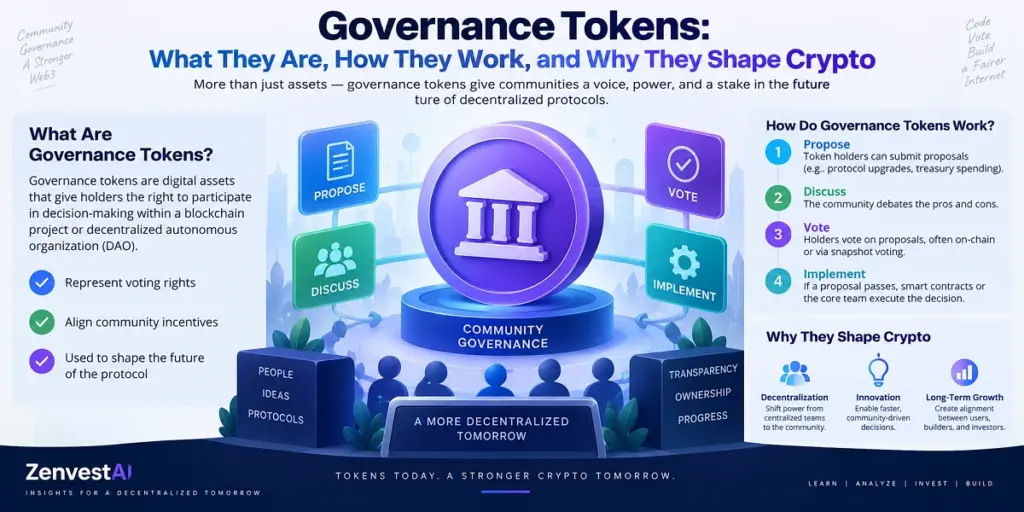
Governance tokens are digital assets native to a blockchain that convey voting power over the technical and financial decisions of a decentralized protocol. When a team launches a protocol—such as a decentralized exchange or lending market—they face a choice: keep decision-making centralized within their company, or distribute authority across the global user base. Governance tokens serve as the instrument to distribute that authority.
In traditional organizations, a board of directors meets in private to adjust pricing, launch products, and decide corporate strategy. Decentralized protocols replace the private boardroom with open-source smart contracts and public discussion boards. According to the foundational architecture outlined in Ethereum Governance Documentation, public blockchains provide the infrastructure where consensus and community-led management can replace centralized management hierarchies.
The basic relationship flow of a governance token is straightforward:
Governance Token → Voting Weight → Governance Proposal → Community Consensus → Protocol Action
Governance tokens exist at the intersection of three major sectors in the digital asset landscape:
1. Decentralized Autonomous Organizations (DAOs)
A DAO is an internet-native organization governed by smart contract rules rather than corporate executives. Governance tokens serve as the membership and voting credential within the DAO. Holders submit proposals, deliberate publicly on forums, and cast votes to direct the organization’s resources.
2. Decentralized Finance (DeFi) Protocols
DeFi protocols rely on governance tokens to adjust financial parameters that must adapt to dynamic market conditions. For example, token holders determine which crypto assets can be borrowed, what collateral ratios borrowers must maintain, and how protocol fees are routed or preserved.
3. Layer-1 and Layer-2 Blockchain Networks
Beyond single applications, Layer-2 scaling networks distribute governance tokens to coordinate network upgrades, allocate developer grant funds, and govern sequencer operations.
Once you possess a governance token, how does your vote actually transform into a living, functioning change on the blockchain? Let us walk through the governance lifecycle step by step.
How Do Governance Tokens Work?
The governance process follows an orderly, multi-stage lifecycle designed to balance community debate with technical safety. While specific thresholds vary between ecosystems, established networks follow a standard six-step workflow.
Step 1: Token Distribution
Protocols distribute governance tokens to users, investors, founders, and community contributors through airdrops, liquidity mining incentives, or public distributions. Your initial token balance establishes your baseline voting power or your capacity to delegate that power to someone else.
Step 2: Proposal Submission (Request for Comment)
A community member or core contributor drafts a proposal detailing an intended change. This may involve altering interest rate curves, deploying the protocol to a new network, or spending treasury funds. To prevent spam, most protocols enforce a minimum token threshold before a user can submit a formal proposal. For instance, the Uniswap Governance Process requires participants to progress through community discussion phases and temperature checks before launching a binding vote.
Step 3: Off-Chain Deliberation
Before any blockchain transaction occurs, the community debates the proposal on public forums like Discourse or Discord. This stage allows developers, risk analysts, and token holders to critique code audits, model financial consequences, and refine the proposal language based on feedback.
Step 4: Casting the Vote
Once finalized, the proposal moves to a formal vote. Token holders cast their ballots either on-chain or off-chain:
- On-chain voting: Votes are submitted as blockchain transactions directly to a governance contract. Each vote consumes network transaction fees, but the result is immutably recorded on the ledger.
- Off-chain snapshot voting: Token holders sign free cryptographic messages through tools like Snapshot to record their preferences without paying gas fees.
Step 5: Meeting Quorum and Approval Thresholds
A proposal must satisfy two distinct mathematical hurdles to succeed:
- Quorum: A mandatory minimum percentage of the circulating token supply must participate in the vote. If a vote receives 99% approval but fails to meet the quorum threshold, the proposal is rejected.
- Approval Threshold: A required supermajority or simple majority (e.g., greater than 50% or 66%) of participating votes must vote “For” rather than “Against” or “Abstain.”
Step 6: Timelock and Smart Contract Execution
If a proposal passes, it enters a mandatory waiting period known as a timelock. The timelock typically delays execution by 24 to 72 hours. This delay gives dissenting users time to exit the protocol or withdraw their funds if they disagree with the impending software change. Once the timelock expires, the smart contract automatically executes the pre-approved code changes on the blockchain.
How does this abstract process feel in practice for an individual user? Let us look at a concrete real-world scenario.
A Simple Real-World Example: Adjusting a Lending Rate
Consider a decentralized lending protocol called “ShieldLend,” where users deposit collateral in USD stablecoins to borrow other digital assets. The protocol’s interest rate model relies on community governance.
- The Issue: Market conditions change, and the cost of borrowing capital across other platforms drops from 6% to 4%. Borrowers begin leaving ShieldLend because its rates are too high.
- The Proposal: An active community member drafts “Proposal 42,” suggesting that ShieldLend lower its base interest rate parameter from 6% to 4.25% to stay competitive.
- The Forum Debate: Over seven days, liquidity providers, risk analysts, and users debate the proposal on the governance forum. Analysts run simulations showing that 4.25% maintains a safe buffer while recovering loan volume.
- The Vote: The proposal moves to an on-chain vote lasting five days. Alice, who holds 1,000 ShieldLend governance tokens, connects her Web3 wallet and votes “For.” Bob, a large token holder with 50,000 tokens, delegates his voting power to an independent DeFi research group that also votes “For.”
- The Outcome: The vote concludes with 82% in favor, exceeding the protocol’s 4% total supply quorum requirement.
- Execution: The proposal enters a 48-hour timelock. When the timer concludes, the governance contract calls the lending contract, updating the interest rate variable to 4.25% automatically.
Main Components of a Governance System
Every token-based governance framework relies on five interacting components to maintain order and predictability.
- The Governance Token Contract: The underlying standard (such as an ERC-20 contract) that tracks balances, records delegation history, and provides snapshots of token holdings at specific blockchain blocks.
- The Governor Module: The smart contract that manages proposal states, tracks voting periods, calculates quorum, and aggregates incoming ballots. Pioneer architectures such as the Governor Bravo contract detailed in the Compound Protocol Governance Docs serve as the industry standard for on-chain voting engines.
- The Community Treasury: A smart-contract-controlled vault holding digital assets, protocol reserves, or unallocated governance tokens. The treasury can only release funds when a governance proposal passes.
- The Timelock Controller: A safety module that sits between the Governor contract and the operational protocol contracts. It enforces a programmed delay between when a vote passes and when the code changes take effect.
- The Community Forum: The off-chain public town square where ideas are researched, debated, and scrutinized before being converted into code.
What Can Governance Tokens Be Used For?
Governance powers are strictly bounded by what the protocol’s code permits the community to modify. The following table highlights the standard operational responsibilities handled by governance token holders across Web3.
| Governance Scope | What Token Holders Decide | Practical Real-World Example |
| Protocol Upgrades | Approving updates to core smart contracts and logic | Migrating routing contracts to newer, more gas-efficient versions |
| Fee Parameters | Adjusting trading, borrow, or protocol revenue fees | Toggling a 0.05% protocol service fee on high-volume trading pairs |
| Treasury Allocations | Spending community-controlled capital | Funding a $500,000 security bug bounty or paying an external auditing team |
| Risk Parameters | Modifying collateral limits, loan-to-value (LTV) ratios, and liquidation fees | Lowering collateral requirements for high-liquidity assets or raising liquidation buffers |
| Asset Listings | Approving new assets for lending collateral or pool pairs | Voting to accept tokenized government treasuries as eligible collateral |
| Governance Architecture | Changing voting periods, quorum thresholds, or proposal requirements | Reducing the proposal submission threshold to encourage broader community participation |
Governance Tokens vs. Utility Tokens
While both types exist as tradeable cryptographic assets, their primary architectural purposes differ significantly.
| Feature | Governance Token | Utility Token |
| Primary Purpose | Voting and policy influence over a software system | Accessing, paying for, or utilizing a specific platform service |
| Decision-Making Rights | Central to the token’s identity and function | Typically nonexistent or secondary |
| Protocol Influence | Direct voting power over treasury and code changes | Restricted to user-level application interaction |
| Value Proposition | Systemic coordination, policy oversight, and treasury stewardship | Consumption, transaction fee discounts, or network access |
| Practical Example | Voting on a lending collateral ratio | Burning tokens to pay for distributed cloud storage |
Governance Tokens vs. Ownership and Traditional Stock
Holding a governance token does not make you a shareholder in a corporation. This distinction is one of the most critical legal and conceptual boundaries in the entire cryptocurrency industry.
In a traditional company, buying common stock grants you equity. Equity conveys legal ownership of the company’s underlying assets, intellectual property, physical inventory, and potential bankruptcy recovery claims. Shareholder rights are protected by established corporate law and regulatory enforcement agencies.
In contrast, a governance token conveys rights over a software program, not a legal entity.
- No Corporate Equity: Owning governance tokens does not grant you equity in the development firm that wrote the protocol’s original software.
- No Automatic Legal Claim on Profits: Unless explicitly structured and compliant with jurisdictional laws, governance tokens do not legally entitle the holder to corporate dividend payouts.
- No Fiduciary Duty: Protocol participants and fellow token holders owe no legal fiduciary duty to maximize your investment return.
- No Boardroom Jurisdiction: Your vote cannot direct the real-world employment decisions, corporate office leases, or banking relationships of the founding engineering team.
When analyzing governance tokens, remember this core rule: Governance rights equal software parameter influence, not corporate equity.
Types of Governance Token Voting
Protocols have evolved past basic majority voting to solve problems like low voter participation, voter fatigue, and disproportionate influence. Several distinct voting models exist today.
1. Token-Weighted Voting (1 Token = 1 Vote)
This is the simplest and most widespread model. If your wallet holds 100 tokens, you cast 100 votes; if another participant holds 10,000 tokens, they cast 10,000 votes. While easy to understand and execute, this model inherently favors wealthy token holders (“whales”), often creating an informal plutocracy.
2. Delegated Voting
Recognizing that most token holders lack the technical expertise or time to evaluate every smart contract proposal, delegated voting allows holders to assign their voting weight to an expert representative. The original holder retains full ownership and custody of their tokens and can revoke or redirect the delegation at any time.
3. Vote-Escrow Models (ve-Tokens)
Pioneered by platforms seeking to align long-term platform health with governance, the vote-escrow (ve) model requires participants to lock their tokens in a non-transferable contract for a predetermined timeframe (ranging from weeks to several years).
- A user who locks 1,000 tokens for four years receives maximum voting weight.
- A user who locks 1,000 tokens for six months receives significantly lower voting weight.This design prevents short-term speculators from buying tokens, voting for risky parameter changes that benefit their personal trades, and dumping the tokens immediately afterward.
4. Quadratic Voting
Quadratic voting is designed to prioritize community breadth over sheer capital depth. Instead of your voting power scaling linearly with your balance, the power of your vote scales with the square root of your tokens:
- 1 token = 1 vote
- 100 tokens = 10 votes
- 10,000 tokens = 100 votesUnder quadratic voting, 100 small community members holding 1 token each exert 100 votes collectively, whereas a single whale holding 100 tokens exerts only 10 votes. This model requires robust Sybil-resistance systems (such as cryptographic identity verification) to prevent individuals from splitting their tokens across hundreds of newly created wallet addresses.
5. On-Chain vs. Off-Chain Governance
Another major distinction lies in where the governance data lives:
- On-Chain Governance: Every proposal submission, vote, and execution order occurs directly on the blockchain via smart contracts. It provides maximum censorship resistance and trustless automation, but requires participants to spend network transaction fees.
- Off-Chain Governance: Discussions take place on forums, and voting is conducted off-chain through cryptographic signatures via platforms like Snapshot. This eliminates gas fees and increases voter turnout, but requires trusted multi-signature signers to manually translate the community vote into on-chain code changes.
Current Landscape: Key Trends Shaping Governance
The governance token market has shifted away from purely speculative experimentation toward sustainable operations and regulatory compliance. Several major developments define the modern environment:
1. Competition from Real-World Assets (RWAs) and Tokenized Equities
Pure governance tokens no longer operate in a vacuum. The rapid tokenization of traditional financial assets—including short-term U.S. Treasuries, corporate bonds, and tokenized equity contracts—has introduced yield-bearing alternatives. Investors increasingly scrutinize tokens that provide only voting rights while generating zero direct economic return.
2. The Drive Toward Real Economic Utility and Fee-Switching
The historical era of holding tokens solely to vote on minor forum topics is fading. Protocols are actively evaluating “fee-switches”—mechanisms where protocol trading fees or cash flows are directed into token buybacks, treasury burns, or rewards for active governance stakers. This transition moves governance tokens closer to traditional business cash-flow sustainability models while introducing heightened legal considerations.
3. Layer-2 Network Governance Maturity
Ecosystems like Arbitrum, Optimism, and Polygon coordinate massive infrastructure grants, security councils, and data availability upgrades through tokenized governance. Layer-2 governance token holders manage billions in community reserves, influencing the technical scaling baseline of the broader Web3 infrastructure.
4. Global Regulatory Scrutiny
Regulatory frameworks across international jurisdictions—including the U.S. Securities and Exchange Commission (SEC) guidelines, the European Union’s Markets in Crypto-Assets (MiCA) regulation, and policy standards from the International Organization of Securities Commissions (IOSCO)—are closely analyzing token models. Regulators examine whether token distributions, founding team allocations, and economic fee-sharing mechanisms cross the legal boundary into regulated securities. Consequently, protocols are restructuring their governance frameworks to safeguard genuine decentralization and minimize regulatory exposure.
🚀 Must-Read Market & Regulation Insights
Advantages of Governance Tokens
When designed effectively, governance tokens offer substantial benefits over traditional corporate and organizational management.
- Decentralized Decision-Making: Strategic authority is distributed across a worldwide network of participants rather than remaining trapped inside a closed executive suite.
- Transparent and Verifiable Records: Every proposal, ballot, token weight, and execution command is recorded openly on the public blockchain, eliminating back-room manipulation.
- Global Alignment of Incentives: Users, liquidity providers, and developers can align their collective economic interests around the long-term security and utility of the software.
- Trustless, Programmable Execution: With on-chain timelocked contracts, successful proposals execute automatically without relying on intermediaries, banks, or corporate officers to follow through.
Risks and Limitations of Governance Tokens
Token-based governance is not an automatic cure for organizational flaws. In many cases, it introduces complex new challenges that can undermine protocol security.
1. Whale Dominance and Plutocracy
Because the default model awards one vote per token, individuals and venture capital funds with deep financial reserves can easily overpower thousands of retail community members. A vote supported by 98% of individual users can be overturned in seconds by a single wealthy wallet holding millions of tokens.
2. Voter Apathy and Low Turnout
The vast majority of token holders are short-term speculators rather than active protocol researchers. Voter turnout across major protocols frequently drops below 5% of circulating supply. When voter participation is exceptionally low, small coordinated interest groups can push through controversial proposals without widespread community consent.
3. Governance Attacks and Flash Loan Exploits
Decentralized lending markets enable users to borrow massive sums of capital for the duration of a single blockchain block without providing upfront collateral, an instrument known as a flash loan. In a flash loan governance attack, an attacker borrows millions of dollars in governance tokens, votes to pass a malicious proposal (such as draining the community treasury), executes the transaction, and returns the borrowed tokens—all within seconds. Protocols defend against this by taking balance snapshots before votes begin and enforcing mandatory timelocks.
4. Governance Capture and Malicious Collusion
Well-funded rival protocols or aggressive funds can accumulate governance tokens on open secondary markets to vote down platform upgrades, divert treasury funds to their own products, or adjust risk parameters to sabotage a competitor’s market health.
5. Centralization via Admin Multisignatures
Many protocols that promote themselves as community-governed retain emergency administrative keys. These keys are typically controlled by a small group of founders using a multi-signature wallet. If an administrative council holds the technical power to veto votes, pause smart contracts, or bypass timelocks, the governance token functions as an advisory polling mechanism rather than a true governing instrument.
How to Evaluate a Governance Token: The Audit Checklist
Before participating in any token-governed ecosystem, run the platform through this operational due diligence checklist.
- [ ] Proposal Threshold: What percentage of total token supply is required to introduce a proposal? Is the barrier reasonable, or is it so high that only venture funds can create proposals?
- [ ] Voter Turnout History: What percentage of circulating tokens actively votes on routine proposals? Is the quorum routinely met by real community members or by one or two founder wallets?
- [ ] Token Distribution Balance: What percentage of the token supply is controlled by early venture capital firms, founding team members, and the foundation versus the public community?
- [ ] Delegation Framework: Does the system permit delegation? Who are the top ten delegates by voting power, and how do they communicate their voting rationale?
- [ ] Voting Engine Architecture: Are votes recorded on-chain, or are they collected off-chain via snapshot tools? If off-chain, who holds the cryptographic keys responsible for executing the final transactions?
- [ ] Timelock Duration: Does the protocol enforce an unalterable timelock between vote passage and execution? Is the duration (e.g., 48 hours) long enough for users to withdraw their deposits if a dangerous change is approved?
- [ ] Emergency Admin Controls: Does a core team multi-signature wallet have the unilateral power to pause the protocol, override proposals, or bypass the timelock?
Do Governance Tokens Make a Protocol Decentralized?
Distributing a governance token does not automatically make a protocol decentralized. Decentralization is an ongoing architectural spectrum across multiple functional layers, not a binary status achieved by minting a token.
To assess whether genuine decentralization exists, examine the five stages of protocol control:
- Token Distribution Layer: If 70% of the token supply remains locked inside team, advisor, and private investor allocations, the underlying power structure remains centralized regardless of public marketing.
- Ideation and Proposal Layer: If only internal core developers have the access or resources to submit valid governance proposals, the community is simply reacting to an elite agenda.
- Voting Participation Layer: If community voter turnout is negligible, protocol decisions reflect the wills of a handful of institutional delegates rather than a broad, distributed user base.
- Execution Layer: If the outcome of a community vote depends on a small multi-signature team choosing to manually sign and broadcast the updates, the system relies entirely on human trust.
- Code Upgrade Authority: If the software allows a developer key to instantly change smart contract addresses without a timelock, the protocol remains fundamentally centralized.
Common Mistakes to Avoid
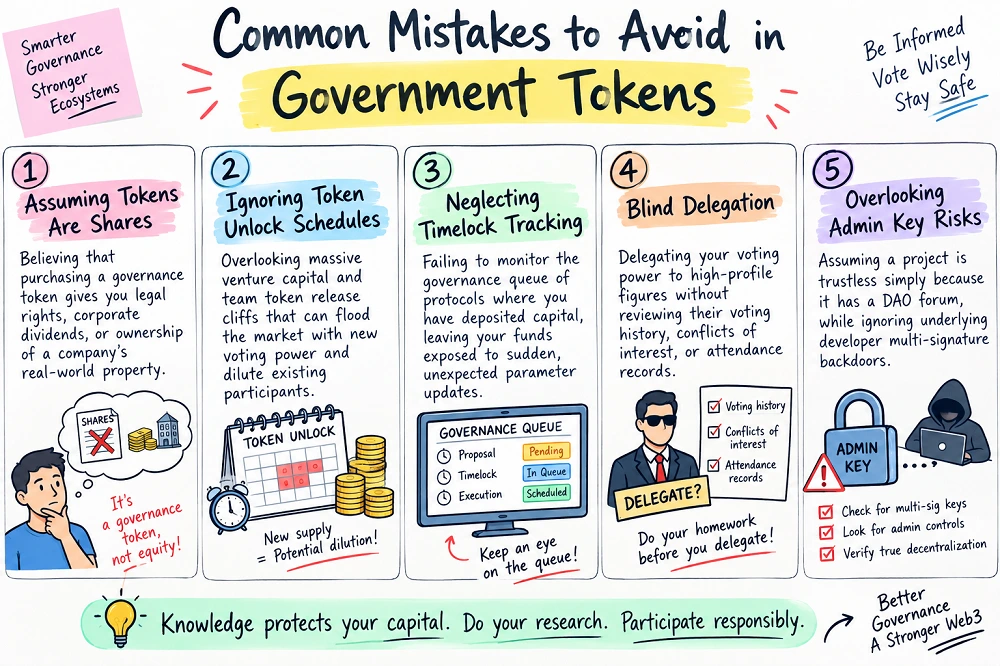
- Assuming Tokens Are Shares: Believing that purchasing a governance token gives you legal rights, corporate dividends, or ownership of a company’s real-world property.
- Ignoring Token Unlock Schedules: Overlooking massive venture capital and team token release cliffs that can flood the market with new voting power and dilute existing participants.
- Neglecting Timelock Tracking: Failing to monitor the governance queue of protocols where you have deposited capital, leaving your funds exposed to sudden, unexpected parameter updates.
- Blind Delegation: Delegating your voting power to high-profile figures without reviewing their voting history, conflicts of interest, or attendance records.
- Overlooking Admin Key Risks: Assuming a project is trustless simply because it has a DAO forum, while ignoring underlying developer multi-signature backdoors.
Comprehensive Governance Glossary
- Decentralized Autonomous Organization (DAO): An open-source, internet-native organization whose rules and treasury allocations are managed directly through smart contracts and token-based member votes.
- Quorum: The minimum amount or percentage of circulating token voting power that must participate in a vote for the outcome to be considered legally valid by the smart contract.
- Timelock: A programmable delay mechanism that prevents an approved governance proposal from executing immediately, granting dissenting participants an exit window.
- Delegation: The process of assigning your token voting weight to another wallet address without transferring custody or ownership of the underlying assets.
- Vote-Escrow (ve): A tokenomic model where users lock tokens for fixed durations to earn non-transferable voting weight, rewarding longer-term commitments with greater influence.
- Quadratic Voting: A mathematical voting system where the cost of each additional vote increases quadratically, amplifying the voices of broad majorities over isolated capital concentrations.
- Flash Loan Governance Attack: A malicious exploit where capital is borrowed without collateral to temporarily sway an on-chain vote, drain protocol reserves, and repay the loan in a single transaction block.
- Snapshot: An off-chain cryptographic polling platform used by decentralized communities to record gas-free, verifiable votes based on wallet balance states.
Frequently Asked Questions (FAQ)
What is a governance token in simple words?
A governance token is a digital crypto asset that acts like a voting card for a blockchain application. If you hold the token, you can vote on proposed updates, rule adjustments, and financial spending decisions for that specific platform.
Do governance tokens pay dividends or passive income?
In general, standard governance tokens do not pay legally guaranteed dividends. While some protocols direct a portion of protocol fees toward buyback programs or staking rewards, these mechanisms depend entirely on community votes and must navigate strict global financial regulations.
Can I lose my governance tokens if I vote on a proposal?
No. Voting on a governance proposal does not consume or destroy your tokens. Your tokens remain in your personal wallet or inside the voting contract, and your balance is fully preserved once the voting period closes. The only direct cost for on-chain voting is the network transaction fee (gas) required to record your ballot.
How is voting power calculated?
In traditional token-weighted governance, one token equals one vote. In more advanced structures, voting power may depend on how long you lock your tokens (vote-escrow models) or may use mathematical weighting (quadratic voting) to limit the dominance of wealthy holders.
Can a protocol change its rules without a governance vote?
If the protocol still retains centralized administrator keys or emergency multi-signature permissions, core developers can alter specific smart contract parameters directly. Fully decentralized protocols, however, require an approved on-chain governance proposal to execute any code change.
What is the difference between on-chain and off-chain voting?
On-chain voting requires voters to send a blockchain transaction, making the vote immutable and self-executing at the expense of paying transaction fees. Off-chain voting allows holders to sign cryptographic messages for free on platforms like Snapshot, but relies on a trusted committee to manually execute the approved results on-chain.
ZenvestAI View
At ZenvestAI, we view governance tokens not as speculative financial chips, but as an early experiment in global, decentralized coordination. Digital networks are steadily replacing legacy corporate structures across several financial niches, and open protocols require resilient, tamper-resistant methods to update code without re-centralizing control.
However, the industry must move past early illusions of effortless democracy. Today’s governance models frequently suffer from the same vulnerabilities that have affected political assemblies for centuries: voter disengagement, consolidation of power among wealthy elites, and political maneuvering. The future of decentralized governance will belong to platforms that implement structured vote-escrow alignments, verifiable delegation, automated code execution, and programmatic safeguards against capital concentration.
The Bottom Line on Governance Tokens: What They Are, How They Work, and Why They Shape Crypto
A governance token grants software voting rights over a protocol’s code and treasury, not equity ownership, corporate control, or guaranteed commercial dividends.
Related Intelligence
- Deep Dive: How Decentralized Autonomous Organizations (DAOs) Manage Billions in Treasuries
- Understanding ve-Tokenomics: Why Long-Term Staking Locks Are Replacing Simple Voting Models
- The Architecture of Smart Contract Timelocks: Defending Protocols Against Malicious Exploits
- DeFi Lending Risks: Collateral Limits, Liquidation Penalties, and Governance Guardrails
Author & Editorial Information
- Author: ZenvestAI Research Desk
- Editorial Desk: Digital Assets & Protocol Governance
- Reviewed: September 15, 2026
- Last updated: September 15, 2026
- Research focus: Digital assets, DeFi, protocol governance and blockchain infrastructure
Resources & Reference Data
- Ethereum Foundation: DAO Architecture and Governance Overview
- Ethereum Foundation: On-Chain vs. Off-Chain Governance Frameworks
- Uniswap Labs: Developer Documentation on the Governance Lifecycle
- Compound Finance: Governor Bravo System and Parameter Controls
- MakerDAO / Sky: Ecosystem Governance Rules and Stability Mechanisms
Regulatory & Educational Disclosure
This article is prepared exclusively for educational and informational purposes by ZenvestAI and does not constitute financial, investment, legal, tax, or regulatory advice. Digital assets, cryptocurrencies, and governance tokens carry significant volatility and systemic risks.
Under international regulatory standards—including guidelines from the U.S. Securities and Exchange Commission (SEC), the European Union’s Markets in Crypto-Assets (MiCA) framework, and recommendations from the International Organization of Securities Commissions (IOSCO)—governance tokens should not be conflated with registered securities, shares of commercial corporations, or guaranteed investment contracts. Always conduct independent research and consult licensed financial and legal professionals before allocating capital to any digital asset.