Key Takeaways:
- Automated Profit Locking: A Take Profit (TP) order automatically closes your crypto trade when the price hits your target, securing gains before the market reverses.
- Removes Emotional Biases: Setting your exit in advance eliminates fear, greed, and hesitation [Lalach vs Discipline] during volatile market swings.
- Essential for Futures: In leveraged crypto futures, predefined TP levels protect your margin and prevent sudden liquidations.
- Flexible Execution: You can choose between single full exits, partial profit-taking (scaling out), or trailing take-profit strategies.
- Balanced Risk Management: Pairing a Take Profit with a Stop Loss (SL) ensures a positive risk-to-reward ratio (RRR) on every trade.
A Quick Personal Note from the Author: The Lesson That Changed My Trading Forever
Let me share a hard lesson from my early days in the crypto markets that I will never forget.
Back in my early years of trading crypto, I entered a swing trade on an altcoin that took off almost immediately. Within three days, my position was sitting at an incredible +45% unrealized profit. The green numbers looked fantastic on my screen, and excitement took over. Instead of sticking to my original plan, greed whispered: “This project has massive momentum—it will easily hit 2x from here.”
Because I hadn’t placed an automated Take Profit (TP) order, I just kept watching the chart.
Later that evening, while I was away having dinner with my family, Bitcoin took a sudden sharp pullback. In less than twenty minutes, my +45% gain evaporated. When I finally opened my exchange app, the trade was sitting at breakeven. Shocked and desperate, I told myself, “It will bounce back.” It didn’t. Two hours later, I panicked and closed the trade at a -12% loss.
Key Trading Takeaway
“Unrealized profit on your screen is just a digital illusion until you lock it in [Jab tak munafa book na ho, wo aapka paisa nahi hai].”
Setting a preset Take Profit order does not limit your potential—it protects your hard work, your discipline, and your peace of mind.
ZenvestAI Quick Read:
| Feature | Details & Best Practice |
| Primary Purpose | Automatically lock in profits at a predetermined target price. |
| Order Types | Take-Profit Market (instant fill, slight slippage) vs. Take-Profit Limit (exact price, execution risk). |
| Ideal Risk-to-Reward | Minimum 1:2 or 1:3 ratio based on technical market structure. |
| Applicable Markets | Spot trading, Margin trading, and Leveraged Crypto Futures. |
| Top Exit Strategy | Partial Take Profit (e.g., 50% at TP1, 25% at TP2, 25% trailing). |
What Is Take Profit (TP)? The Ultimate Step-by-Step Guide to Locking in Crypto Trading Profits with Discipline 🎯
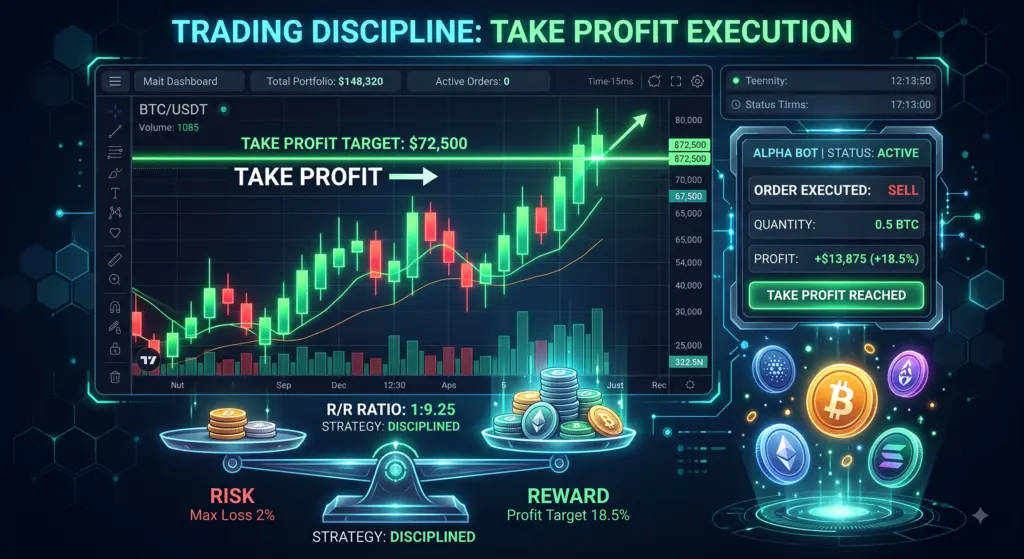
Why Most Traders Watch Their Green Trades Turn Red
Have you ever watched a crypto trade surge into massive profit, only to see those gains vanish minutes later because you waited too long to sell?
In today’s fast-paced crypto market, this painful experience [Haath aaya par muh na laga] happens to almost every trader at some point.
When prices skyrocket, excitement takes over, and your mind whispers, “Just a little higher.”
However, the crypto market is unforgiving, and sudden pullbacks can wipe out unrealized profits in the blink of an eye.
To achieve long-term success, you must master What Is Take Profit? A Complete Guide to Take-Profit Orders in Crypto Trading.
Successful trading is not merely about predicting which coin will pump next; rather, it is about executing a complete trade plan with strict discipline.
At ZenvestAI, we believe that a truly great trade is not just about making a profit—it is about knowing exactly when and how to take that profit.
📚 Essential Crypto Wealth & Trading Strategies
Ready to level up your crypto game? Bookmark these foundational guides:
🏛️ Core Wealth Building:💸 Passive Income & Network Security:📈 Active Trading & Capital Protection:🤖 ZenvestAI Explains
A Take Profit (TP) order is an automated trading instruction that closes an open cryptocurrency position once the market reaches a predetermined profit target.
Instead of constantly monitoring volatile price charts, you set your desired exit price in advance.
When the market hits that level, your exchange automatically executes the order to lock in your realized gains.
Utilizing take-profit orders removes emotional bias like greed or hesitation, protects your capital from sudden market reversals, and enforces disciplined risk-to-reward management across spot and futures trades.
What This Guide Covers
What Is a Take-Profit (TP) Order?- The Psychology of Exits: Why Take Profit Is Critical
- Take Profit vs. Stop Loss: Key Differences
How Risk-to-Reward Ratio (RRR) Drives Profit Targets- How to Calculate Take Profit (Formulas & Real Examples)
- Take-Profit Market vs. Take-Profit Limit Orders
- Advanced Strategies: Scaling Out & Trailing Take Profit
Managing Take Profit in Leveraged Crypto Futures- 6 Costly Take-Profit Mistakes to Avoid
- The ZenvestAI Pre-Trade Take-Profit Checklist
Crypto Glossary
What Is a Take-Profit (TP) Order in Crypto Trading?
A Take-Profit (TP) order is a preset exit order designed to close an open position automatically once a specific profit target is reached.
Initially, when you enter a trade, you determine the exact price level where your trade idea will have succeeded.
Furthermore, by submitting a TP order to the exchange, you ensure that the platform will execute the sale or buyback on your behalf without requiring your manual intervention.
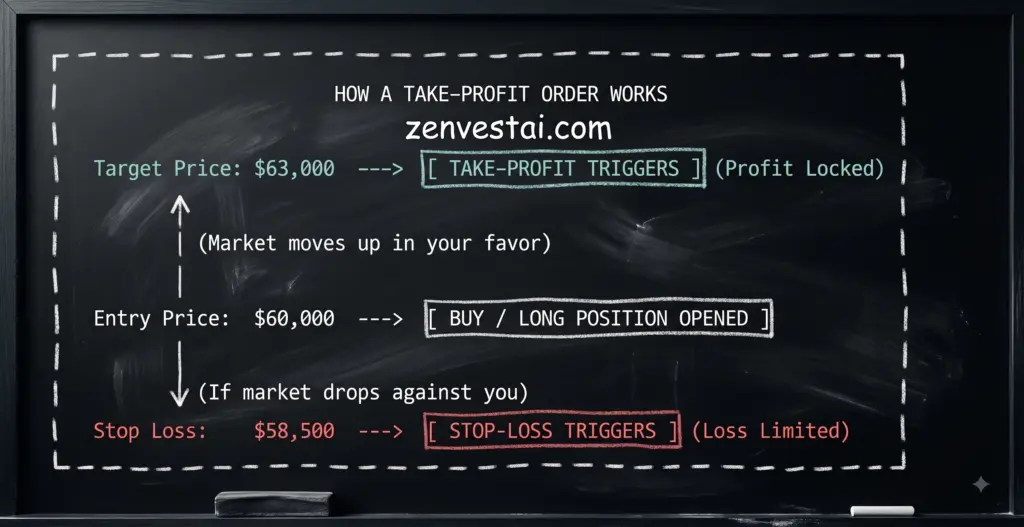
To illustrate, imagine you buy Bitcoin (BTC) at $60,000 and identify strong resistance at $63,000.
Consequently, you set a take-profit order at $63,000.
As soon as the market price reaches your target, your order triggers, closing your position and locking in your $3,000 gain per coin before any reversal occurs.
ZenvestAI Quick Insight: 💡
A Take Profit (TP) order guarantees that you exit a winning trade at your pre-planned target rather than waiting for an elusive market peak.
In volatile crypto markets, price spikes can disappear within seconds.
Setting an automated TP removes hesitation and locks in your hard-earned gains before sudden market reversals happen.
Why Is a Take-Profit Order Crucial for Every Trader?
Most unprofitable traders fail not because of poor entries, but because of undisciplined exits.
While beginner traders spend hours analyzing chart patterns to find the perfect entry, professional traders focus equally on where they will exit if they are right or wrong.
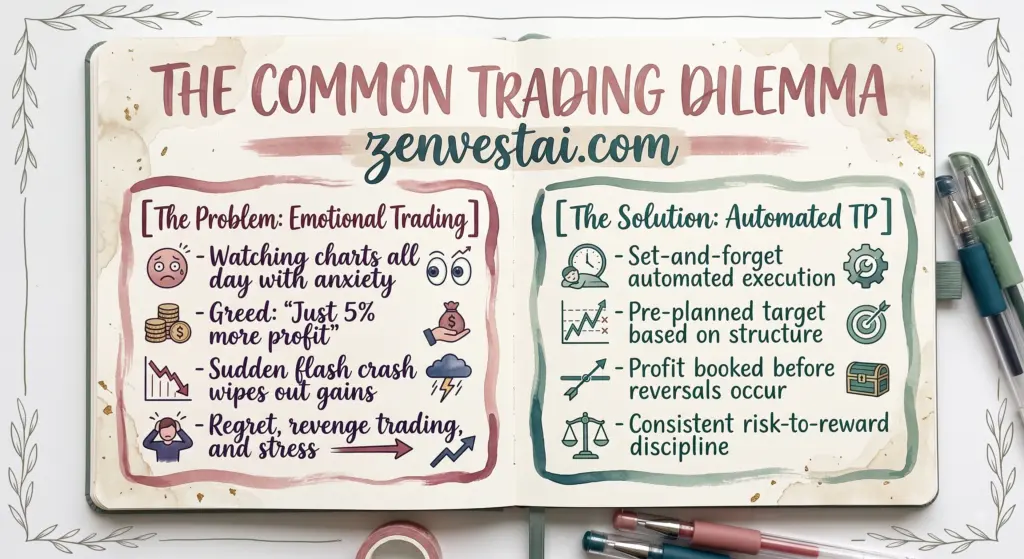
1. Locks in Planned Gains Automatically
Cryptocurrency prices fluctuate rapidly across 24/7 global markets.
A coin might surge while you are sleeping or away from your desk, only to pull back before you wake up.
Therefore, a predefined TP ensures you never miss your target due to timing.
2. Eliminates Emotional Biases and Greed
Emotional attachment to a winning position often leads to regret.
When a trade looks profitable, greed tempts you to hold longer [Munafa Book Karna chhod kar aur lalach karna].
An automated TP enforces rational decision-making over impulse.
3. Establishes a Structured Trading Plan
Every sustainable trading strategy relies on clear rules.
When you define your Entry, Stop Loss, and Take Profit before risking money, you create an objective framework that can be tested and measured over time.
🌐 Your 2026 Crypto Survival & Growth Kit
Navigating the next evolution of digital finance? Bookmark these essential guides:
📖 The Fundamentals:🤖 Future Trends & Tech:💸 Actionable Trading & Spending:Take Profit vs. Stop Loss: What Is the Difference? ⚖️
Take Profit and Stop Loss represent two complementary sides of a complete risk-management system.
While both are conditional orders placed to close an active position, they address opposite market outcomes.
| Feature | Take Profit (TP) | Stop Loss (SL) |
| Core Purpose | Realize and lock in planned profits | Limit and contain potential capital loss |
| Trigger Condition | Market hits your target price | Market moves against your trade thesis |
| Psychological Goal | Overcomes greed and over-holding | Overcomes denial and hope |
| Trade Outcome | Closes a winning position | Closes an invalidated losing position |
| Planning Role | Defines your Reward | Defines your Risk |
A disciplined trade always pairs a Take Profit with a Stop Loss before clicking Buy or Sell.
How Does Risk-to-Reward Ratio (RRR) Drive Your Profit Targets?
Your take-profit level should never be chosen randomly; it must provide an attractive risk-to-reward ratio.
For instance, if you risk $100 on a trade, you should aim to make at least $200 (a 1:2 RRR) or $300 (a 1:3 RRR).

In this setup, even if you win only 40% of your trades, a consistent 1:2 RRR will keep your overall portfolio profitable over time because your average win is twice as large as your average loss.
ZenvestAI Quick Insight: 💡
Always align your Take Profit with key technical resistance levels or support zones rather than an arbitrary dollar figure.
A realistic
1:2 risk-to-reward ratioensures that your profitable trades comfortably outweigh your losing trades over time, keeping your trading account consistently growing even with a moderate win rate.
How to Calculate Take Profit: Formulas and Real Examples 📊
Calculating your exact profit target involves simple math based on whether you are going long or short.
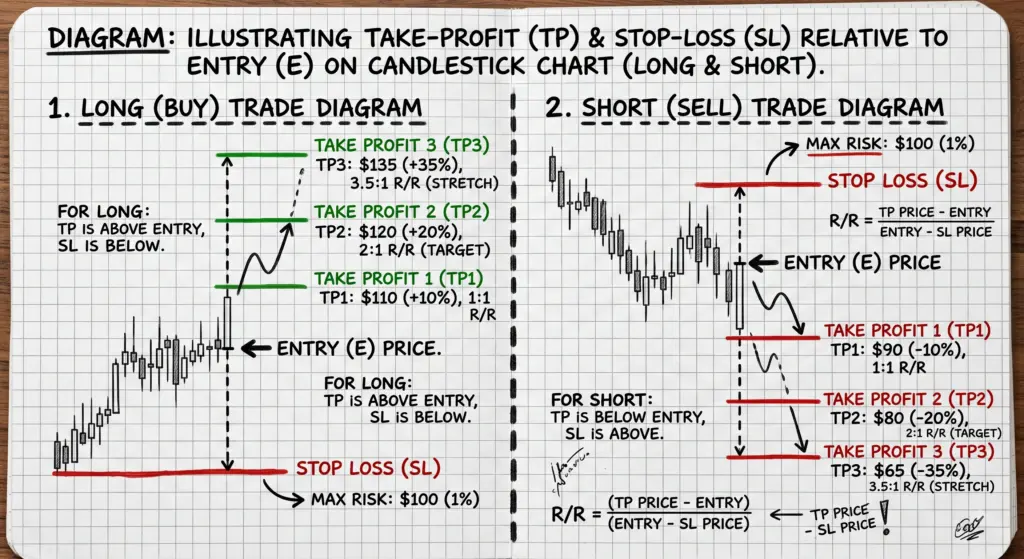
1. Take Profit in Long Trading (Buying Low, Selling High)
In a long trade, you profit when the asset price climbs.
Potential Gross Profit = (Exit Price − Entry Price) × Position Size
- Entry Price: $100,000 (BTC)
- Take-Profit Target: $104,000
- Position Size: 0.05 BTC
- Gross Profit: ($104,000 − $100,000) × 0.05 = $200
2. Take Profit in Short Trading (Selling High, Buying Low)
In a short trade, you profit when the asset price falls.
Potential Gross Profit = (Entry Price − Exit Price) × Position Size
- Entry Price: $100,000 (BTC)
- Take-Profit Target: $96,000
- Position Size: 0.05 BTC
- Gross Profit: ($100,000 − $96,000) × 0.05 = $200
3. Take Profit Percentage Formula
Long TP % = [(TP Price − Entry Price) ÷ Entry Price] × 100
Short TP % = [(Entry Price − TP Price) ÷ Entry Price] × 100
Take-Profit Market vs. Take-Profit Limit: Which Order Type Should You Use?
Crypto trading platforms generally provide two distinct mechanisms for executing take-profit orders.
Choosing the right one depends on whether you value price precision or guaranteed order execution.
Dimension | Take-Profit Market Order | Take-Profit Limit Order |
| Execution Speed | Immediate once trigger price is touched | May take time or remain unfilled |
| Price Guarantee | No (subject to market slippage) | Guaranteed at limit price or better |
| Fill Certainty | 100% Guaranteed fill | Not guaranteed if price moves too fast |
| Best Used For | Fast-moving breakout trades & high volatility | Range-bound markets & large positions |
ZenvestAI Quick Insight: 💡Choose a Take-Profit Market order when guaranteed execution is your priority during high volatility, accepting slight slippage.
Conversely, select a Take-Profit Limit order when you require an exact execution price, understanding that extreme fast-moving candles could potentially bypass your limit order without filling it.
Advanced Profit-Taking Strategies: Scaling Out & Trailing TP
You do not have to close your entire position at a single price target.
Experienced traders frequently use dynamic profit-taking methods to capture large trends while reducing downside risk.
Partial Take Profit (Scaling Out)
Partial profit-taking involves dividing your total position into multiple target levels.
Instead of selling 100% at your first target, you can structure your exits as follows:
- TP1 (+3%): Close 50% of your position to lock in initial gains and move your Stop Loss to breakeven.
- TP2 (+6%): Close 25% of your position as momentum continues.
- TP3 (+10%): Let the remaining 25% run to capture an extended breakout.
Trailing Take Profit
A trailing take-profit order dynamically follows the market price as long as it moves in your favor.
If the price reverses by a specified percentage (e.g., 2%), the order triggers and closes your trade. This allows you to ride explosive bull runs without guessing the absolute top.
Managing Take Profit in Leveraged Crypto Futures Trading
In crypto futures trading, leverage magnifies both your gains and your liquidation risks.
Because high leverage multiplies position exposure, even a small 2% pullback can cause substantial damage [Zor ka jhatka] to your collateral margin.
- Position Size Matters Most: High leverage reduces your margin cushion, making tight, well-calculated TP orders essential.
- Account for Funding & Exchange Fees: Futures contracts accrue funding fees and trading taker fees, which slightly reduce your net realized return.
- Never Trade Futures Without an Exit Plan: Entering a leveraged trade without both a preset TP and SL is gambling, not trading.
Diving into the digital asset space requires a strong foundation before exploring its more complex layers. If you are entirely new to this ecosystem, start your journey with A beginner’s guide to cryptocurrency and blockchain technology and familiarize yourself with the Basics of the Crypto Market. Before acquiring any digital assets, make sure your funds will be secure by reading The Ultimate Guide to Crypto Wallets.
Once you grasp the basics, you can explore the structural changes transforming global finance this year. A major trend is how physical and digital assets are merging; discover the mechanics behind this in Understanding Tokenization and Wholesale Digital Assets in 2026, and see its direct economic impact in How Tokenization is Empowering Small Businesses in 2026.
Finally, as institutional capital scales up these tokenized markets, the rules of the game are shifting rapidly. Stay ahead of upcoming compliance and legal shifts by reading about The Future of Crypto Regulations.
6 Costly Take-Profit Mistakes and How to Avoid Them
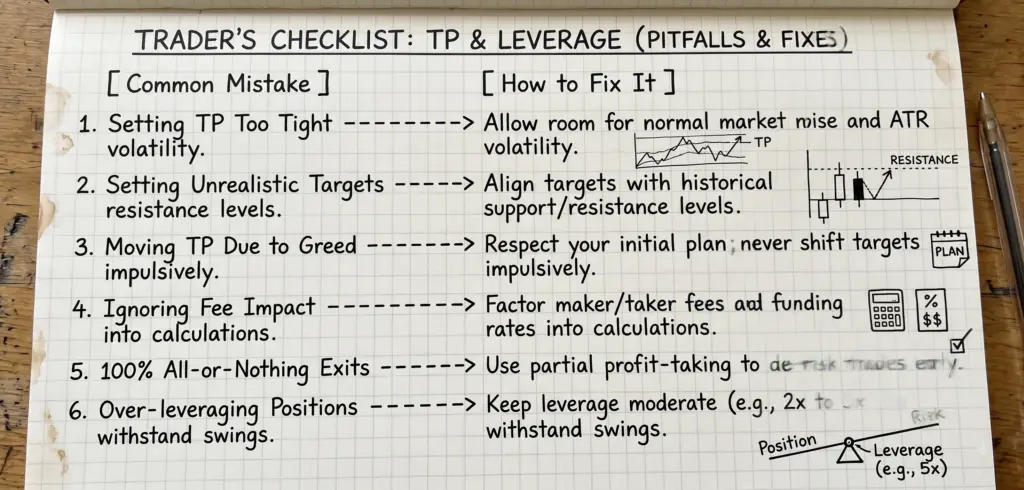
The ZenvestAI Pre-Trade Take-Profit Checklist
Before opening any trade, review this practical 10-point checklist:
- [ ] Have I identified a clear technical entry point?
- [ ] Is my Stop Loss placed at a logical invalidation level?
- [ ] Is my Take Profit placed below key resistance (for longs) or above key support (for shorts)?
- [ ] Is my Risk-to-Reward Ratio at least 1:2?
- [ ] Have I decided between a Market TP and a Limit TP?
- [ ] Am I using partial scaling targets (TP1, TP2, TP3)?
- [ ] Does my position size protect my overall portfolio capital?
- [ ] Have I factored in trading fees and funding costs?
- [ ] Am I committed to letting the trade hit the TP without interfering emotionally?
- [ ] Is my overall risk per trade capped at 1–2% of total account equity?
Crypto Trading Terms: Glossary
1. Take Profit (TP): A pre-set order that closes a trade automatically once a targeted profit price is reached.
2. Stop Loss (SL): A risk-management order placed to close a losing trade and prevent further capital drawdown.
3. Risk-to-Reward Ratio (RRR): The proportion of capital risked compared to the potential profit targeted on a trade.
4. Slippage: The difference between the expected price of an order and the actual price at which it executes.
5. Partial Take Profit: The practice of closing portions of a position across multiple ascending price targets.
6. Trailing Stop/TP: An exit order that automatically adjusts upward (for longs) as the market price climbs.
The Bottom Line: Trade with a Plan, Exit with Discipline 🚀
At the end of the day, entering a trade is easy, but exiting with your profit intact requires true mastery.
In the fast-moving world of cryptocurrency, successful traders do not rely on luck or hope; they rely on structured systems, consistent risk-to-reward ratios, and automated execution.
By defining your Take Profit before you open a trade, you protect your hard-earned capital, eliminate emotional stress, and build long-term trading consistency.
Remember: Plan your trade, manage your risk, respect the market, and always take profit according to your plan.
Join the Conversation!
What is your personal rule for taking profits in crypto? Do you prefer setting a single fixed target, scaling out with partial TPs, or using a trailing stop? Drop your thoughts and questions in the comments below!
ZenvestAI Risk Disclaimer
Educational Disclaimer: The content provided by ZenvestAI is strictly for educational and informational purposes and does not constitute financial, investment, or trading advice. Cryptocurrency and leveraged futures trading involve significant financial risk and may lead to substantial or complete loss of invested capital. Always conduct thorough independent research and consult a licensed financial advisor before making trading decisions.
