At a Glance: Key Upgrade Facts
| Metric / Parameter | Upgrade Details |
| Upgrade Name | Glamsterdam (Gloas + Amsterdam) |
| Early Public Testnet | Platåberget (Announced August 17, 2026) |
| Expected Mainnet Window | Q4 2026 (Following multi-stage testnet validation) |
| Primary Goal | Enshrined PBS (ePBS), Block-level Access Lists (BALs), & EIP-8037 State Gas Repricing |
| Gas Capacity Target | Post-Glamsterdam gas-limit floor target of 200 million |
| Subsequent Public Testnets | Sepolia and Hoodi |
| Who Must Act Immediately? | Wallet developers, indexers, RPC providers, and DeFi protocol builders |
Ethereum Opens Early Platåberget Testnet for Huge Glamsterdam Upgrade: The Complete Breakthrough Guide 🏙️
Key Takeaways:-
- Early testing minimizes ecosystem risk: The Platåberget testnet provides a dedicated sandbox to discover protocol bugs months before any mainnet deployment.
- Native block building arrives: Enshrined Proposer-Builder Separation (ePBS) integrates block building directly into Ethereum’s consensus layer, removing reliance on third-party relays.
- Predictable state access: Block-level Access Lists (BALs) allow nodes to map transaction dependencies in advance, speeding up sync times and enabling parallel execution.
- Smarter gas pricing via EIP-8037: Ethereum is introducing a multi-dimensional gas model that accurately prices long-term state creation versus simple computational execution.
- Infrastructure builders must update outdated assumptions immediately: Hard-coded gas limits in wallets, indexers, and decentralized apps will break if not adapted before the Q4 2026 mainnet launch.
Introduction: A Major Road Redesign for Web3’s Busiest City
Imagine Ethereum as a bustling metropolis where millions of people travel every single day. Businesses operate around the clock, decentralized finance (DeFi) platforms move billions in value, and thousands of smart contracts share the exact same road network.
Nowadays, if a major city decides to redesign its foundational highway infrastructure, it cannot simply shut down every street without warning. Instead, city engineers build an experimental testing ground to test traffic flows, identify bottlenecks, fix structural flaws, and ensure driver safety before touching the main roads.
To begin with, that is precisely what the Ethereum Foundation is doing with the Ethereum Glamsterdam Upgrade. On August 17, 2026, Ethereum officially launched Platåberget, an early public testnet designed to trial sweeping protocol improvements before they roll out to production.
⚡ ZenvestAi Explains
The Ethereum Glamsterdam Upgrade is a major Layer 1 protocol transition scheduled for Q4 2026, officially entering public testing on the Platåberget testnet in August 2026.
Glamsterdam introduces Enshrined Proposer-Builder Separation (ePBS), Block-level Access Lists (BALs), and EIP-8037 state gas accounting.
These architectural changes separate block agreement from execution, improve node sync speeds through upfront dependency mapping, and establish a 200 million gas-limit floor, making Ethereum substantially more efficient and scalable without compromising decentralization.
What This Post Covers
- The Core Problem: Why Ethereum Needed a Protocol-Level Overhaul
- Meet Platåberget: Ethereum’s Proving Ground for Protocol Changes
- The Big Three Technical Innovations: ePBS, BALs, and EIP-8037 State Gas Repricing
- Current Ethereum vs. Post-Glamsterdam: Side-by-Side Comparison Matrix
- Real-World Impact Analysis: What Changes for ETH Holders, Wallets, and DeFi Protocols
- Timeline & Next Milestones: From Platåberget to Sepolia, Hoodi, and Hegotá (2027)
- Glossary of Essential Terms: Technical Concepts Made Simple
- ZenvestAI Perspective: Strategic Outlook on Ethereum’s Evolution
- The Bottom Line: What to Do Next
1. The Core Problem: Why Ethereum Needs the Glamsterdam Upgrade
Ethereum’s rapid growth has created critical architectural challenges in state management and block production. While Layer 2 rollups handle significant transaction volume, Ethereum Layer 1 remains the ultimate settlement anchor that must store state data, verify proofs, and produce blocks securely.
In today’s world, block construction relies heavily on external off-chain infrastructure (such as MEV-Boost relays), creating centralization risks and coordination overhead.
Furthermore, every time smart contracts write new data to Ethereum’s global storage, that state persists across all full nodes permanently, yet historical gas rules have not adequately priced this long-term disk burden.
Because of this imbalance, node hardware requirements have faced upward pressure, and transaction execution has suffered from unpredictable gas spikes during high network congestion.
Consequently, the Ethereum Glamsterdam upgrade solves these foundational bottlenecks directly inside the core protocol [aasan bhasha mein: protocol ke andar hi direct sudhar].
- The Complete Ethereum Wealth Strategy
- What Is Crypto Staking? The Complete Guide to Earning Rewards Safely
- Why Does Staking Exist? The Ultimate Guide to Cryptoeconomic Security
- What Is Crypto Futures Trading? A Complete Beginner’s Guide
- The Ultimate Risk-to-Reward Ratio Guide: Master Crypto Risk and Protect Your Capital
2. Meet Platåberget: Ethereum’s Controlled Testing Ground 🔬
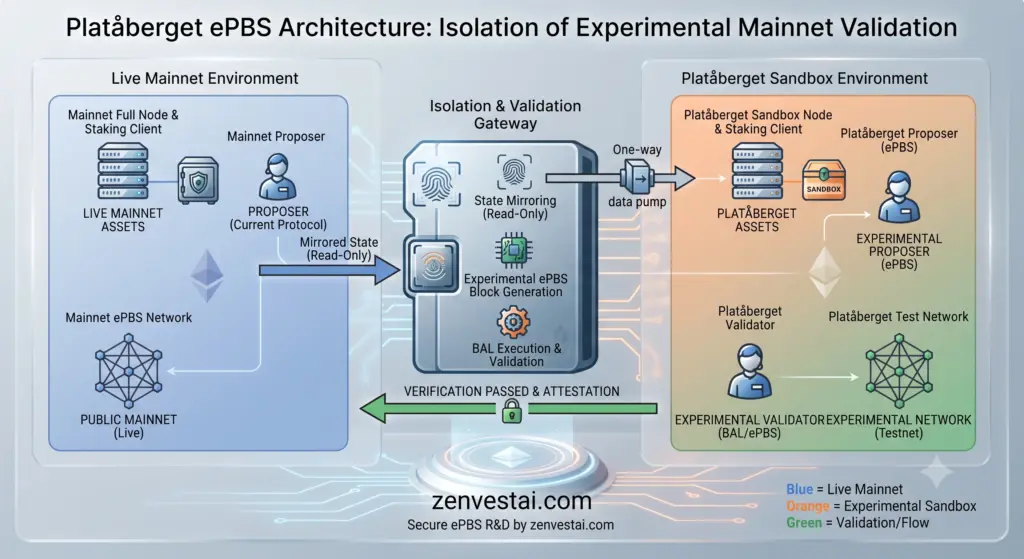
Platåberget is Ethereum’s dedicated public early testnet for experimental protocol validation. It operates completely separate from Ethereum mainnet, providing developers with a safe sandbox where they can deliberately push edge cases and identify breaking changes.
Indeed, the Ethereum Foundation launched Platåberget on August 17, 2026, to give validator operators, client development teams, and wallet architects several months of hands-on verification.
Moving changes directly to long-lived networks without early sandboxing would expose billions of dollars in DeFi liquidity to unnecessary operational risk.
Therefore, Platåberget serves as an essential warning system: if your decentralized application or node tooling relies on legacy gas assumptions, now is the time to test and adapt.
3. What Technical Innovations Does Glamsterdam Introduce? ⚙️
Glamsterdam brings structural changes to block production, transaction access patterns, and resource accounting. Let’s break down the three primary architectural pillars step-by-step.
                      GLAMSTERDAM PROTOCOL PILLARS

1. Enshrined PBS (ePBS)           - Native protocol-level block building
2. Block-Level Access Lists (BALs)- Upfront dependency mapping for fast sync
3. EIP-8037 State Gas Repricing   - Multi-dimensional state creation accounting
4. 200M Gas Limit Floor Target    - Substantially expanded L1 processing capacity
Pillar 1: Enshrined Proposer-Builder Separation (ePBS)
Enshrined Proposer-Builder Separation natively integrates the division between block proposers and block builders into the Ethereum consensus layer. Previously, validators relied on external third-party middleware to auction and build optimized blocks.
In addition, ePBS separates block agreement from transaction processing. Validators can now safely outsource complex block assembly to specialized builders without having to trust external software relays.
Significantly, this structural separation allows Ethereum Layer 1 to scale throughput safely by enabling validators to process larger batches of transaction data without running high-end server clusters.
Pillar 2: Block-Level Access Lists (BALs)
Block-level Access Lists require blocks to declare all memory storage slots and contract accounts they will access before execution begins. Without access lists, nodes must repeatedly search through vast database structures while executing transactions sequentially.
Think of BALs like a pre-sorted picking list in a mega warehouse. Instead of warehouse workers wandering aimlessly through aisles for each item, they receive an optimized itinerary upfront.
As a result, BALs unlock three major performance advantages:
- Parallel Disk Reads: Nodes retrieve required state storage in parallel before executing smart contracts.
- Accelerated Node Synchronization: New validators sync transaction history significantly faster.
- Lower Gas for State-Heavy dApps: Smart contracts that read and write predictable data structures receive optimized gas calculations.
Pillar 3: EIP-8037 & State Gas Repricing
EIP-8037 introduces a dedicated state-gas dimension to Ethereum’s economic model. Under legacy rules, calculating a mathematical formula and creating permanent storage on thousands of global computers were lumped into a single gas metric.
However, creating new contract state places a permanent storage burden on full nodes. EIP-8037 ensures that operations creating brand-new accounts or storage slots pay a fair rate that reflects actual hardware storage costs.
What’s more, Ethereum developers confirmed in May 2026 that Glamsterdam establishes a post-upgrade gas-limit floor target of 200 million, dramatically expanding baseline capacity.
How Does EIP-8037 Affect Daily Gas Fees?
💡 Zenvestai Quick Insight
EIP-8037 separates computational gas from state-creation gas. Regular token transfers between established accounts remain low-cost, while creating new contracts or deploying brand-new accounts incurs a more precise state fee. This prevents state bloat and keeps execution costs predictable across high-volume DeFi applications.
4. Current Ethereum vs. Post-Glamsterdam Comparison Matrix
To help you visualize how these technical updates change everyday network operations, here is a structured comparison:
| Protocol Dimension | Current Ethereum Architecture (Pre-Glamsterdam) | Post-Glamsterdam Network Architecture |
| Block Assembly | Handled via off-chain third-party relays (e.g., MEV-Boost) | Enshrined directly into the core consensus layer (ePBS) |
| State Access | Unpredictable, sequential disk lookups during execution | Pre-declared Block-level Access Lists (BALs) enabling parallel reads |
| Gas Accounting | Single-dimensional gas covering compute, bandwidth, and storage | Multi-dimensional gas model with dedicated state-gas under EIP-8037 |
| Gas Limit Target | Standard variable gas ceiling | Post-upgrade gas-limit floor target of 200 Million |
| Node Sync Speed | Bound by sequential state access bottlenecks | Significantly accelerated through pre-mapped block dependencies |
| Legacy Tooling | Relies on fixed gas estimation formulas | Requires dynamic multi-dimensional gas simulation algorithms |
5. Real-World Impact: How Glamsterdam Affects You
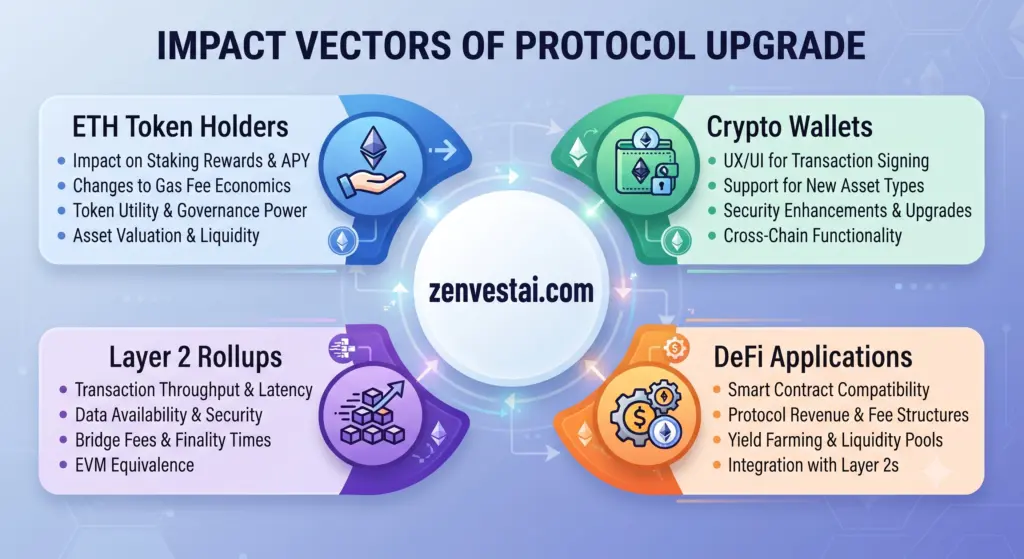
For Everyday ETH Holders and Stakers
If you simply hold ETH in cold storage or participate in standard liquid staking pools, you do not need to make manual wallet adjustments. Glamsterdam does not alter your account balances or require token migrations.
Nevertheless, you will benefit over time from improved network reliability and higher base-layer throughput.
For Crypto Wallet Developers
Wallet engineering teams face the most urgent technical transition. Many existing web3 wallets utilize hard-coded maximum gas ceilings or assume static gas calculation models.
In fact, the Ethereum Foundation issued a direct advisory for wallet maintainers to upgrade:
- Dynamic Gas Estimators: Support multi-dimensional gas models that account for state creation differences.
- Account Creation Logic: Update transaction simulation when sending funds to uninitialized addresses.
- RPC Compatibility: Verify that node provider endpoints return updated Glamsterdam fee payloads without errors.
For Decentralized Finance (DeFi) Protocols
Automated Market Makers (AMMs), lending protocols, and derivatives platforms will experience more predictable transaction execution. However, Glamsterdam does not mean fees instantly drop to zero overnight.
Rather, it builds the infrastructural efficiency required for sustainable, high-capacity decentralized financial markets.
For Layer 2 Rollups (Arbitrum, Optimism, Base)
Layer 2 networks rely heavily on Ethereum Layer 1 for settlement security and state verification.
Because Glamsterdam optimizes block execution and increases overall gas limits, rollups gain a more robust base layer to post batches and finalize transactions efficiently.
Will Glamsterdam Make Ethereum Layer 1 Extremely Cheap?
💡 Zenvestai Quick Insight
Glamsterdam is designed to improve structural efficiency, state access, and block capacity rather than act as an instant fee-slashing tool. While the 200M gas floor expands capacity, user transaction fees still depend on real-time market demand, network congestion, and Layer 2 rollup adoption.
6. Upgrade Timeline & The Broader Ethereum Roadmap
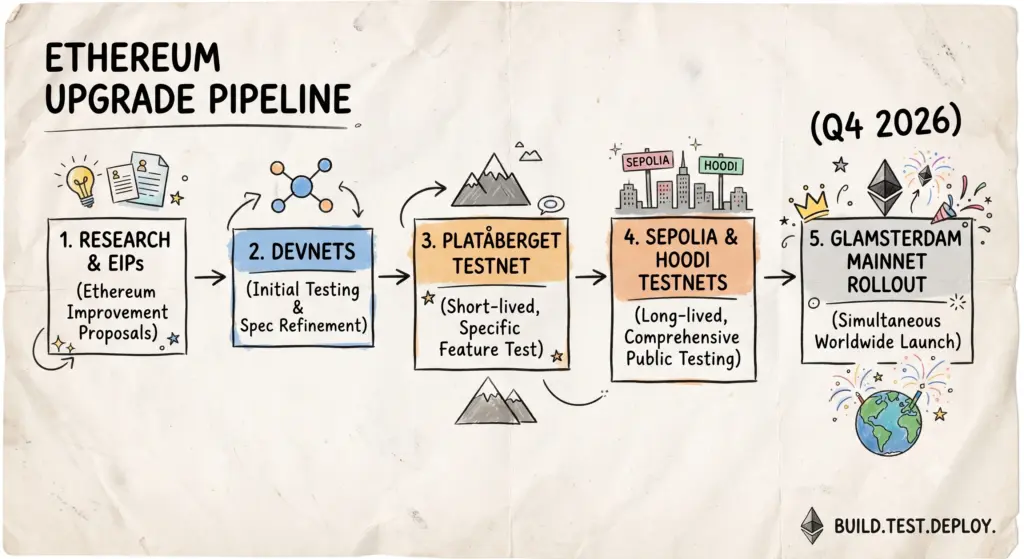
The journey toward a major hard fork follows a disciplined, multi-stage engineering cycle. Rather than rushing experimental changes to mainnet, developers adhere to strict verification milestones.
                         GLAMSTERDAM TO MAINNET ROADMAP

 [Q1-Q2 2026]     Research, EIP Finalization, and Devnet Architecture

 [August 2026]    Platåberget Public Early Testnet Launch

  [Q3-Q4 2026]     Migration to Long-Running Testnets (Sepolia & Hoodi)

  [Q4 2026]        Glamsterdam Hard Fork Deployment on Ethereum Mainnet

  [2027+]          Hegotá Upgrade & Advanced Protocol Milestones (Statelessness, zkEVM)
Why Was Glamsterdam Scheduled for Q4 2026?
Earlier development roadmaps originally targeted mid-2026 for the upgrade. However, because ePBS and EIP-8037 touch fundamental consensus and execution mechanisms, core developers opted for an extended testing window.
In mission-critical financial software, methodical security testing is far more valuable than hasty delivery.
Looking Ahead to Hegotá (2027)
Glamsterdam is an essential bridge toward Ethereum’s next major upgrade milestone, Hegotá, planned for 2027. Future protocol stages will introduce:
- Single Slot Finality (SSF): Finalizing blocks within seconds rather than 15-minute epochs.
- Statelessness: Enabling lightweight nodes to verify transactions without storing terabytes of historical state.
- Native zkEVM Verification: Utilizing zero-knowledge proofs so validators verify block validity without re-executing transactions.
- Post-Quantum Cryptography: Future-proofing Ethereum against advanced quantum computing decryption.
To master the art of trading, you must first learn how to exit positions effectively. Read our Ultimate Step-by-Step Guide to Take Profit (TP) to learn how to lock in gains with discipline.
Before you begin trading, security is paramount. Ensure your assets are protected by following our guide on how to safely set up and secure an account on Binance.
For advanced traders looking to optimize their leverage, we cover the mechanics of capital efficiency in our Ultimate Guide to Crypto Portfolio Margin Financing.
Interested in capturing price differences across exchanges? Explore the strategies behind it in our Ultimate Guide to Spatial Arbitrage in Crypto Trading.
If you are frequently swapping tokens, you need to understand how to get the best prices. Learn about the technology powering your trades in our guide: What Is DEX Routing? The Ultimate Guide to Best Crypto Swap Execution.
What is the Platåberget testnet in simple words?
Platåberget is a sandbox testnet where developers can safely test the Glamsterdam upgrade before it launches on Ethereum mainnet.
It allows engineers to uncover software bugs, test new gas calculation models, and ensure client software compatibility without risking real user funds.
💡 Zenvestai Quick Insight
Platåberget acts as Ethereum’s public research lab for Glamsterdam. It provides a real-world multi-client environment where infrastructure providers, wallet builders, and validator operators can stress-test new features like ePBS and BALs under heavy traffic conditions before mainnet release.
How to prepare your web3 application for the Glamsterdam upgrade?
To prepare your application, audit all gas estimation logic, test contract interactions on Platåberget, and update RPC client dependencies.
Developers must eliminate legacy hard-coded gas limits and verify that contract deployments handle state-gas accounting correctly.
💡 Zenvestai Quick Insight
Start by deploying your smart contracts to the Platåberget testnet. Next, inspect your frontend gas estimators and backend indexers against multi-dimensional gas responses.
Finally, ensure your dApp gracefully handles new account creation costs introduced under EIP-8037 state accounting.
Can Ethereum validators run on lower hardware after Glamsterdam?
Yes, Block-level Access Lists and ePBS reduce computational friction for validators over time. By outsourcing block assembly to dedicated builders natively and pre-fetching disk data through access lists, regular validators can validate blocks with greater efficiency.
💡 Zenvestai Quick Insight
While the post-upgrade gas target rises to 200 million, BALs enable parallel disk reads and faster block verification. This counterbalances state growth and prevents validator hardware requirements from escalating uncontrollably, preserving Ethereum’s core decentralization.
7. Glossary of Key Terms
- ePBS (Enshrined Proposer-Builder Separation): A native consensus mechanism separating the entity that selects and orders transactions from the validator that proposes the final block.
- BALs (Block-level Access Lists): A mandatory list included in each block detailing all state accounts and storage keys that will be read or modified during execution.
- EIP-8037: An Ethereum Improvement Proposal creating a distinct state-gas accounting system to accurately price persistent data creation.
- Platåberget: The early public testnet launched in August 2026 to validate the Glamsterdam hard fork.
- State Bloat: The continuous accumulation of historical and active data stored on Ethereum nodes, increasing hardware requirements over time.
- Gas-Limit Floor: The minimum baseline computational capacity allocated for block execution across the network.
8. ZenvestAI Strategic Perspective & Expert Analysis 💡
At ZenvestAI, we view Glamsterdam as a defining structural milestone in Ethereum’s transformation into a mature global settlement layer. Too often, mainstream crypto commentators look at upgrades purely through short-term price speculation.
In contrast, sustainable long-term value comes from architectural resilience [seedhi baat: majboot infrastructure hi lambi race ka ghoda hai]. The decision to extend testing through Platåberget, Sepolia, and Hoodi demonstrates institutional maturity.
Above all, by solving block production centralization with ePBS and tackling state access bottlenecks through BALs, Ethereum is reinforcing its economic moat. Our recommended analytical framework remains constant: Learn the fundamentals, monitor testnet execution, verify stability, and make data-driven decisions.
Frequently Asked Questions
9. The Bottom Line: Summary of the Glamsterdam Milestone
In summary, the launch of the Platåberget testnet marks a pivotal transition for the Ethereum Glamsterdam Upgrade.
By integrating native ePBS, introducing Block-level Access Lists, and overhauling state pricing with EIP-8037, Ethereum is systematically dismantling historical scaling bottlenecks.
While everyday ETH holders can rest easy, infrastructure engineers and wallet creators must use this early window to update legacy systems before the scheduled Q4 2026 mainnet deployment.
Call to Action 🚀
Every major evolution in blockchain history has required patience, rigorous engineering, and collective effort. You are not just a spectator in the web3 revolution; you are witnessing the construction of an open, decentralized financial future that will empower generations to come.
Whether you are building next-generation DeFi protocols, running a home validator, or exploring crypto technology for the first time, your participation shapes this ecosystem.
Have you tested your smart contracts or wallet integrations on the Platåberget testnet yet? What feature of Glamsterdam are you most excited about? Share your thoughts, questions, and experiences in the comments below!
Authoritative Reference Source
- Ethereum Foundation Official Release: Announcing the Platåberget Testnet for Glamsterdam Protocol Validation (August 17, 2026).