Banking Without the Banker: What Is DeFi Lending?
Imagine walking into a bank, asking for a loan, and having the funds in your wallet two minutes later without signing a single paper form, showing a salary slip, or waiting for loan officer approval.
That is not science fiction. That is the reality of decentralized finance lending, commonly known as DeFi lending.
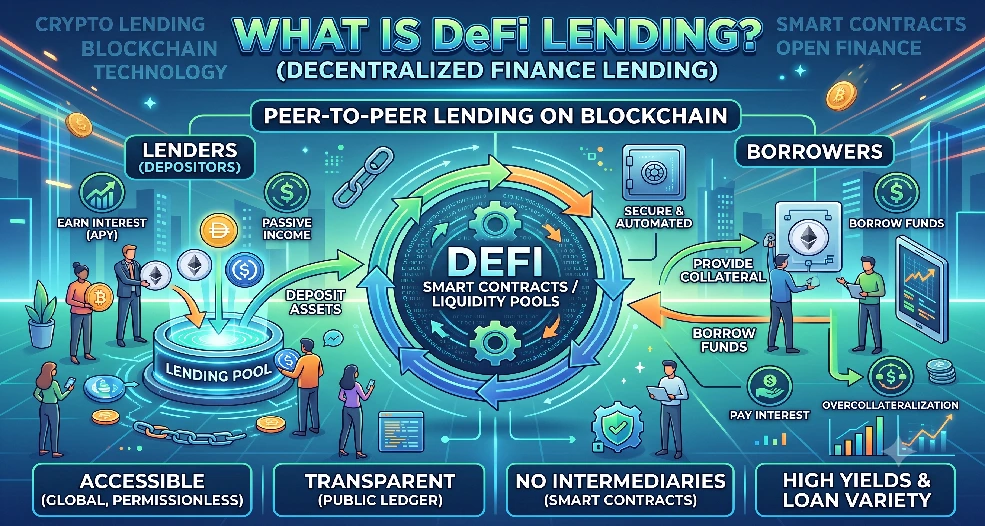
At its core, DeFi lending is an open financial system where you can lend your cryptocurrency to earn regular yield, or borrow digital assets by putting up other crypto assets as security.
Nobody sits in a corner office reviewing your credit score. Instead, automated computer programs called smart contracts handle every deposit, loan, and interest payment directly on a public blockchain.
DeFi Lending in Simple Words
Think of a traditional community savings pool or a vending machine. When you insert the correct coins into a vending machine, a mechanical spiral turns and drops your snack. You do not negotiate with the machine. You do not prove your employment history. The transaction happens because the rules are coded directly into the hardware.
DeFi lending works the same way:
- If you deposit digital assets into the pool, the code pays you interest.
- If you deposit sufficient security (collateral), the code releases a loan to you immediately.
How It Differs from Traditional Bank Lending
Traditional bank lending relies entirely on trust, paperwork, and intermediaries. A bank takes deposits from savers, pays them a small interest rate, lends that money to borrowers at a higher rate, and keeps the difference to cover salaries, offices, and profits.
DeFi changes this dynamic:
- Access: Banks require identity verification, bank accounts, and geographic presence. DeFi requires only an internet connection and a digital wallet. A farmer in Kenya, a student in Muzaffarpur, and a software designer in London all use the exact same interface under the exact same rules.
- Transparency: Bank balance sheets are private and audited periodically. DeFi lending pools live on public blockchains where every reserve, loan, and interest rate is visible 24 hours a day, 7 days a week, as tracked by open analytics portals like DefiLlama.
- Custody: A bank holds your money and can freeze accounts. In DeFi, rules are executed by computer code, giving you control over your private keys via a non-custodial wallet balance.

How Does DeFi Lending Work Step by Step?
While the underlying technology is sophisticated, the practical journey consists of seven clear steps.
Step 1: The Lender Supplies Crypto
A user who owns cryptocurrency (such as Ethereum, Bitcoin, or stablecoins pegged to the US Dollar) decides to earn passive income instead of leaving the assets idle in a wallet. The lender connects their wallet to a DeFi platform like Aave and clicks supply.
Step 2: Assets Enter a Shared Lending Pool
The deposited funds do not go directly to one specific borrower. Instead, they flow into a large collective digital pool alongside funds deposited by thousands of other lenders worldwide.
Step 3: The Borrower Deposits Collateral
Anyone wanting to take money out of this pool must first deposit their own cryptocurrency as security. Because DeFi does not use identity cards or credit scores, loans are backed by assets. If you want to borrow, you must lock up more value than you plan to take out.
Step 4: The Borrower Takes a Loan
Once the security deposit is locked safely in the smart contract, the borrower selects the asset they wish to borrow. The smart contract transfers the requested coins directly to the borrower’s private wallet in seconds.
Step 5: Interest Accrues Every Block
There are no monthly paper invoices. Interest accumulates continuously—often calculated block by block on the blockchain (roughly every few seconds). Lenders see their supplied balance grow, while borrowers see their debt balance rise slightly with each passing minute.
Step 6: The Borrower Repays
Borrowers enjoy flexible timelines. Unlike a standard bank loan with fixed monthly installments due on the first of each month, a DeFi loan can often be repaid whenever the borrower chooses, provided the value of their locked collateral remains healthy. Once the borrower returns the borrowed assets plus accrued interest, their collateral is unlocked.
Step 7: Automatic Liquidation if Collateral Drops
If market prices tumble and the borrower’s security deposit loses too much value, the protocol steps in automatically. The code sells a portion of the collateral to repay the debt. This mechanism protects the pool and ensures lenders never lose their underlying capital.
What Are the Main Parts of DeFi Lending?
To understand any machine, it helps to look at its working gears. DeFi lending relies on nine foundational pieces:
- Smart Contracts: Self-executing digital contracts written in code that run exactly as programmed without human intervention, foundational to decentralized finance platforms documented on Ethereum.org.
- Lending Pools: Smart-contract vaults holding pooled tokens that lenders supply and borrowers draw from, operating similarly to liquidity pools.
- Lenders (Suppliers): Everyday individuals and organizations who deposit crypto into the pool to earn interest yields, functioning as an alternative to native crypto staking.
- Borrowers: Users who draw tokens from the pool after depositing collateral.
- Collateral: The safety deposit locked by the borrower to guarantee repayment.
- Loan-to-Value (LTV): The ratio determining how much money you can borrow relative to the collateral you deposit.
- Interest Rates: The price of money, calculated dynamically based on how much of the pool is currently being borrowed.
- Price Oracles: External data messengers that feed real-time market prices from global exchanges into smart contracts, subject to unique oracle risks that protocols mitigate using decentralized networks like Chainlink.
- Liquidation System: The automatic safety valve that sells off collateral if its market value falls dangerously close to the outstanding loan amount.
What Is a DeFi Lending Pool?
In peer-to-peer systems, finding an exact match can take days: lender A has to find borrower B who wants the exact same amount for the exact same duration.
DeFi lending solves this problem through peer-to-pool architecture, moving away from legacy order books in favor of pooled market structure designs pioneered by protocols like Compound Finance.
A lending pool is a collective smart-contract reservoir. When you deposit assets, you are not waiting for someone to accept your loan terms. Your funds immediately join a vast ocean of capital.
Likewise, when someone borrows, they draw from that ocean instantly. This design provides deep liquidity, allows loans to be issued at any hour of the day or night, and lets lenders withdraw their funds whenever they wish, provided sufficient reserve liquidity remains in the pool.
How Do DeFi Lending Interest Rates Work?
Traditional central banks set benchmark interest rates through committee meetings. In DeFi, interest rates are decided purely by mathematical formulas reacting to supply and demand.
Supply, Demand, and Utilization
The most critical metric inside a lending protocol is the utilization rate—the percentage of the pool currently borrowed.
Utilization Rate = (Total Borrowed Assets / Total Supplied Assets) × 100
- When utilization is low (for example, only 20% of the pool is borrowed), the pool has excess cash. To encourage people to borrow, the algorithm drops borrowing rates. Because few people are paying interest, the yield paid to suppliers is also low.
- When utilization is high (for example, 90% of the pool is borrowed), the system needs more cash to maintain safe liquidity for withdrawals. The algorithm sharply increases the borrowing interest rate. This discourages new borrowing, encourages existing borrowers to repay their loans, and attracts new lenders seeking high returns.
Lending APY vs. Borrowing APR/APY
- Lending APY (Annual Percentage Yield): The yearly return a depositor earns, including the power of compounding interest.
- Borrowing APR/APY (Annual Percentage Rate/Yield): The total annual cost a borrower pays on their loan.
What Is Collateral in DeFi Lending?
When you apply for a home loan, the house itself serves as collateral. If you fail to repay, the bank forecloses on the property.
In DeFi, there are no bailiffs or courtrooms, so protocols require overcollateralization to preserve cryptoeconomic security.
Why Overcollateralization Is Necessary
Overcollateralization means you must deposit collateral worth significantly more than the amount you borrow.
For instance, you might need to deposit $1,500 worth of Bitcoin to borrow $1,000 worth of stablecoins.
Why would anyone lock up more money than they get in return?
- Holding Long-Term Assets: You believe your Bitcoin will rise in value over the coming years and you do not want to sell it, triggering taxes and losing your upside.
- Accessing Cash Flow: You need stable cash to cover real-world expenses or seize another market opportunity without parting with your core crypto savings.
What Is Loan-to-Value (LTV) in DeFi Lending?
The Loan-to-Value (LTV) ratio defines the maximum borrowing power granted against a specific asset. Different cryptocurrencies have different risk profiles, so their maximum LTV varies.
LTV = (Loan Amount / Collateral Value) × 100
- Stable, highly liquid assets like Ethereum might have an LTV of 75% to 80%.
- More volatile tokens may carry a lower LTV of 50% or less to protect the protocol against sharp market swings.
A Practical LTV Calculation
If Ethereum has an allowed maximum LTV of 75%, and you deposit $10,000 worth of Ethereum:
Maximum Borrowing Capacity = $10,000 × 0.75 = $7,500
If you borrow the full $7,500, your loan is sitting right at the maximum threshold. Even a tiny dip in the price of Ethereum would make your position unsafe. Experienced users manage their risk watch carefully and rarely borrow to the maximum limit, preferring to keep their LTV comfortably below the ceiling.
What Is Liquidation in DeFi Lending?
Because crypto prices move quickly, protocols implement an automated safety protocol known as liquidation, designed to protect overall DeFi security.
The Liquidation Threshold
Every asset has a predefined liquidation threshold (for example, 80% or 85%). If the market value of your collateral falls—or if accumulated interest causes your debt to grow—such that your debt reaches this threshold, your position is marked as hazardous.
The Liquidation Process
When a position crosses into unsafe territory, the smart contract allows independent market participants (called liquidators) to step in:
- The liquidator pays off a portion of your outstanding debt.
- In exchange, the protocol awards the liquidator an equivalent slice of your locked collateral, plus an extra liquidation penalty fee (often 5% to 10%).
- The remaining collateral stays in your account, but you have lost the liquidated portion and paid a penalty.
How Borrowers Reduce Liquidation Risk
- Maintain Low Initial Borrowing: Borrow only 30% to 50% of your allowed collateral value.
- Monitor Market Prices: Set mobile price alerts for your collateral asset.
- Top Up Collateral: Deposit additional collateral if the market begins a prolonged downturn.
- Repay Early: Pay back part of the borrowed balance whenever market volatility increases.
A Real-World Example: Borrowing with ₹5 Lakh Collateral
Let us make these numbers completely concrete with a clear real-world scenario.
Suppose you own Ethereum worth ₹5,00,000. You believe Ethereum will appreciate over the next two years, so you refuse to sell it. However, you need ₹2,00,000 in cash for home renovations.
Here is how you handle it through DeFi lending:
1. Deposit: You supply ₹5,00,000 of Ethereum to a protocol like Aave.
2. Safe LTV: The protocol allows up to 80% (₹4,00,000), but you borrow only ₹2,00,000 (a 40% initial LTV).
3. Loan Issuance: You receive ₹2,00,000 in a stablecoin (such as USDT or USDC).
4. Off-ramp: You convert the ₹2,00,000 of stablecoins into fiat currency in your bank account and complete your renovation.
5. Outcome A (Ethereum Rises):
   If Ethereum rises to ₹7,00,000, your financial cushion increases. Your LTV drops to under 30%, making your loan safer.
6. Outcome B (Ethereum Drops):
   If Ethereum drops to ₹3,50,000, your ₹2,00,000 debt now represents roughly 57% of your collateral.
   Because you gave yourself a large margin, you are still safely below the 80% liquidation threshold. You have ample time to deposit extra funds or repay some debt.
7. Final Settlement:
   Once your work bonus arrives, you purchase ₹2,00,000 in stablecoins plus the small accrued interest, pay back the smart contract, and withdraw your entire original Ethereum holding intact.
What Can You Do With DeFi Lending?
DeFi lending opens two main financial pathways:
1. Earning as a Lender
- Generate Yield on Idle Assets: Instead of keeping stablecoins or tokens sitting quiet in a cold wallet, you put them to work earning yield.
- Compound Earnings Daily: Interest is added directly back into your balance, creating a compounding effect without lock-in periods.
- Withdraw Anytime: In most pool-based systems, you can take out your supplied funds whenever you choose.
2. Utilizing Capital as a Borrower
- Unlock Liquidity Without Selling: Tap into purchasing power without triggering a capital gains tax event from selling your crypto, a critical consideration under evolving India crypto regulation frameworks.
- Shorting or Hedging: Traders borrow an asset they anticipate will fall in price, sell it immediately, and hope to buy it back cheaper later to pocket the difference, mirroring techniques used in margin trading.
- Leverage Working Capital: Miners and crypto businesses borrow operational funds to pay electrical bills or salaries without selling their core digital holdings.
What Are the Main Types of DeFi Lending?
Different platforms use distinct models to suit different needs:
Pool-Based Lending
The dominant model in DeFi (popularized by protocols like Aave and Compound). Lenders and borrowers interact with a collective smart-contract vault rather than matching individually with other people. Rates float continuously based on utilization.
Peer-to-Peer (P2P) Lending
Lenders and borrowers agree on custom loan terms directly with one another. This model is common for non-standard assets, such as using rare Non-Fungible Tokens (NFTs) or tokenized real-world assets as collateral where pooled liquidity is difficult to price.
Flash Loans
A unique tool exclusive to blockchain environments. Flash loans are uncollateralized loans where borrowing, utilizing, and repaying the capital all happen within a single blockchain transaction block (lasting only seconds).
If the borrower fails to return the exact loan amount plus interest by the end of the transaction script, the entire transaction reverts as if it never happened. This tool is primarily used by developers and traders executing crypto arbitrage to balance price discrepancies across decentralized exchanges.
DeFi Lending vs. Traditional Lending
| Feature | Traditional Bank Lending | DeFi Lending |
|---|---|---|
| Middleman | Bank branches, credit managers, loan officers | Autonomous smart contract code |
| Eligibility | Credit score, income proof, tax returns, nationality | Crypto collateral only |
| Speed | Days to weeks | Seconds to minutes |
| Operating Hours | Banking hours (Monday–Friday) | 24 hours a day, 365 days a year |
| Privacy & KYC | Full identity submission (KYC/AML rules) | Non-custodial crypto wallet connection |
| Repayment Schedule | Rigid monthly installments | Flexible; repay anytime before liquidation |
| Collateral Type | Real estate, vehicles, gold, personal guarantee | Digital crypto tokens |
| Transparency | Internal banking ledgers | Public, verifiable on-chain data via block explorers like Etherscan |
What Are the Key Benefits of DeFi Lending?
- Financial Inclusivity: Anyone with an internet connection can participate, removing geographical and socioeconomic gatekeeping.
- No Paperwork Friction: Loans are processed instantaneously without application fees, notary visits, or administrative red tape.
- Total Transparency: You do not have to wonder what the lending platform is doing behind closed doors; every balance, transaction, and health factor can be inspected directly on public block explorers.
- Self-Custodial Control: You interact with contracts directly from your decentralized crypto wallet, retaining ownership of your assets without handing them to a centralized company.
- Global Liquidity: Borrowers and lenders across different continents access the exact same rates and shared liquidity pools.
What Are the Risks of DeFi Lending?
While DeFi provides financial freedom, it also eliminates traditional safety nets. Understanding the risks is essential before committing capital.
Smart Contract Vulnerabilities
Code is written by humans, and code can contain bugs. If a smart contract has a flaw or programming loophole, attackers can exploit it to drain funds, reinforcing why regular DeFi security audits are mandatory across top protocols.
Liquidation Cascades
During intense market crashes, the prices of collateral assets can drop precipitously. If prices drop faster than liquidators can process transactions, borrowers face steep liquidation penalties, and pools can accumulate bad debt.
Oracle Failure
Smart contracts cannot look at real-world exchange prices directly; they rely on price feeds called oracles. If an oracle feed gets manipulated or experiences technical delays during extreme congestion, the protocol might liquidate safe loans by mistake, making DeFi oracle risk one of the most critical vulnerabilities in automated lending.
Liquidity Crunches
If a massive percentage of lenders attempt to withdraw their funds at the same time during a panic, the pool may temporarily run low on free reserves until borrowers repay their debts.
Interest Rate Volatility
Variable interest rates can swing dramatically. If borrowing demand suddenly surges, a comfortable 5% borrowing rate can spike to 30% or higher overnight, rapidly inflating debt costs.
Stablecoin De-Pegging
Borrowers frequently borrow or supply stablecoins. If a stablecoin loses its 1:1 peg with the fiat currency it tracks, the underlying value of your loan or deposit can be distorted.
Governance Risks
Many protocols are governed by holders of voting tokens. If malicious actors acquire a dominant share of voting power, they could theoretically vote to change protocol parameters, alter interest curves, or redirect fee revenues to their advantage.
Broader Market Risk
Cryptocurrency remains an inherently volatile asset class. Even if the smart contract performs as intended, severe price fluctuations in your underlying assets can alter your financial position quickly, which is why monitoring active market trends and keeping a close risk watch is essential.
Is DeFi Lending Safe?
DeFi lending is not completely risk-free, but neither is it a lawless gamble if approached responsibly.
Established blue-chip protocols have operated for years, handling tens of billions of dollars across multiple market cycles. These protocols undergo frequent code audits by top security firms and host multi-million-dollar bug bounties on developer platforms like Immunefi.
However, safety in DeFi is relative:
- There is no government-backed deposit insurance (such as FDIC in the United States or DICGC in India) to bail you out if a protocol fails.
- The system is unforgiving of user error: sending funds to an incorrect address or falling for crypto scams and phishing websites cannot be reversed by customer support.
For conservative users, sticking to established protocols with deep liquidity and long security track records significantly reduces risk.
DeFi Lending Guide for Beginners: How to Get Started Safely
Before You Supply Assets (Lenders)
- Choose Proven Protocols: Stick to well-known protocols with multi-year operating histories, such as Aave, Compound, or Maker/Sky.
- Inspect the Pool’s Reserves: Ensure the pool you are joining has abundant liquidity and is not dominated by a single whale depositor.
- Start with Small Test Transactions: Never deposit your entire savings at once. Send a nominal sum first, verify that your dashboard updates correctly, and test a withdrawal.
- Use Hardware Wallets: For substantial sums, always prioritize strict wallet security by securing your private keys with a hardware device rather than leaving them in a browser extension wallet.
Before You Take a Loan (Borrowers)
- Never Borrow at Maximum LTV: If the protocol allows an 80% LTV, keep your actual borrowing below 40% to 50% to maintain a favorable risk-to-reward ratio.
- Borrow Stable Assets: Borrowing stablecoins makes your repayment burden predictable, whereas borrowing volatile tokens can make debt harder to calculate if the borrowed token spikes in value.
- Keep Extra Collateral Ready: Always have emergency funds set aside in an external wallet so you can top up your collateral balance if the market experiences a flash crash.
- Have an Exit Strategy: Know in advance under what market conditions you will repay your debt, take profits, or close your position.
Key Comparisons: Clarifying Common Confusions
DeFi Lending vs. DeFi Borrowing
While both happen inside the same application, their economic roles are mirrors of each other:
- Lending is an income-seeking strategy: you supply assets to receive a steady stream of interest payments with minimal day-to-day management.
- Borrowing is a capital-utilization strategy: you lock up collateral to extract liquidity, carrying an obligation to manage debt levels and guard against liquidation.
DeFi Lending vs. Staking
Beginners often mix up lending and staking because both generate yields:
- DeFi Lending: You provide tokens to other market participants via a liquidity pool. Your yield comes directly from the interest borrowers pay.
- Staking: You lock proof-of-stake cryptocurrencies (like Ethereum or Solana) directly into the consensus mechanism to validate blocks and reinforce cryptoeconomic security. Your yield comes from newly minted network rewards and transaction fees, completely independent of borrowing demand.
Prominent DeFi Lending Protocols
Several established platforms define the modern DeFi lending landscape:
- Aave: The largest multi-chain lending protocol in crypto. Known for its deep liquidity, flash loans, broad collateral support, and sophisticated risk-management parameters.
- Compound: One of the earliest pioneers of algorithmic lending pools. Renowned for its focus on security, simplicity, and clean interest-rate modeling.
- Maker / Sky: The engine behind the decentralized stablecoin DAI (now USDS), as documented on Sky.money. Users lock collateral into decentralized vaults to mint fresh stablecoins directly against their assets.
- Morpho: A newer-generation protocol that enhances capital efficiency by combining peer-to-peer matching with the deep security of underlying liquidity pools, detailed at Morpho.org.
Frequently Asked Questions (FAQ)
Can I lose my money in DeFi lending?
Yes. While you do not face the credit risk of an individual borrower defaulting (thanks to overcollateralization), you face technical risks like smart contract vulnerabilities, market risks such as severe collateral liquidation, and protocol security exploits.
Do I need to complete KYC verification to use DeFi lending?
No. Genuine decentralized protocols operate on public blockchain infrastructure. You interact via a self-custodial cryptographic wallet without submitting passport scans, identity proofs, or personal documents.
How often is DeFi interest paid?
Interest in DeFi compounds continuously. It is calculated block by block (often every few seconds), meaning your dashboard balance updates in real time rather than once a month.
What happens if I never repay my DeFi loan?
Because your loan is overcollateralized, the protocol will never send debt collectors to your home. If you never repay, the protocol simply keeps your locked collateral. If the market value of that collateral ever drops near your debt threshold, the smart contract liquidates it to keep the pool whole.
Can I withdraw my deposited collateral at any time?
Yes, provided you have repaid any outstanding debt that relies on that collateral. If you have no active loans against your deposit, your funds can be withdrawn at your convenience.
The Final Word on DeFi Lending
DeFi lending strips away the slow, opaque, and exclusive layers of legacy banking, replacing them with code that works identically for every participant on the planet.
It provides savers with automated passive yield and gives asset holders a way to unlock cash without selling their long-term holdings.
Yet this financial autonomy demands personal responsibility. In DeFi, you are your own branch manager and your own risk officer. By understanding how blockchain technology works, keeping your loan ratios modest, and respecting the realities of market volatility, you can confidently navigate one of the most transformative innovations in the history of finance.
