Anthropic’s IPO is becoming an important test of how much investors are willing to pay for the future of artificial intelligence. The company behind Claude AI initially circulated IPO figures suggesting it could raise as much as $69.3 billion, with an expected share price of $70–$80. It subsequently told bankers that the pricing information was inaccurate and that an updated filing would follow.
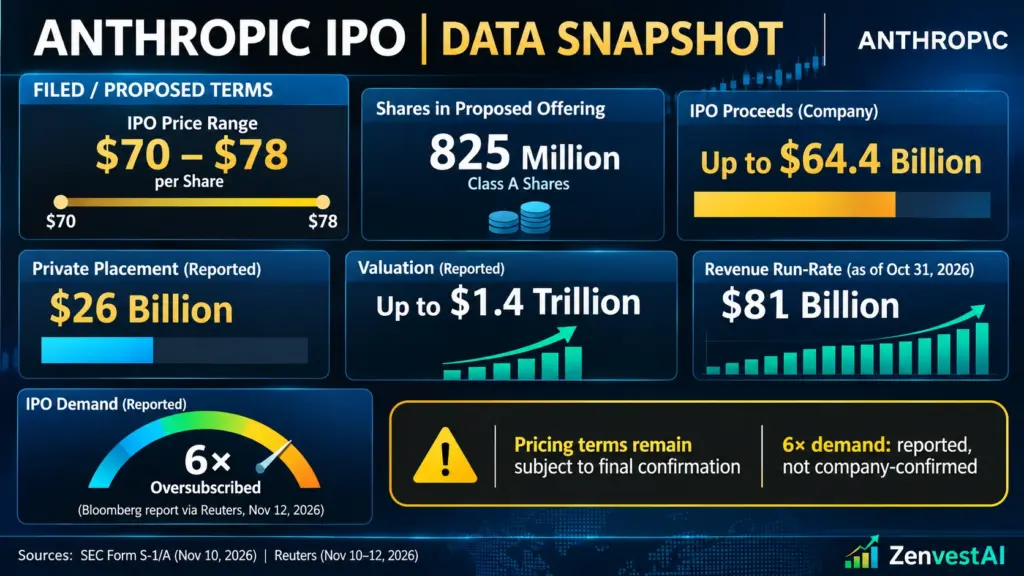
The revised regulatory filing provides a clearer picture. Anthropic is now proposing to sell 825 million Class A shares at an indicative price of $70–$78, with a proposed Nasdaq listing under the ticker ANT. The company is also arranging a separate $26 billion private placement involving major technology companies.
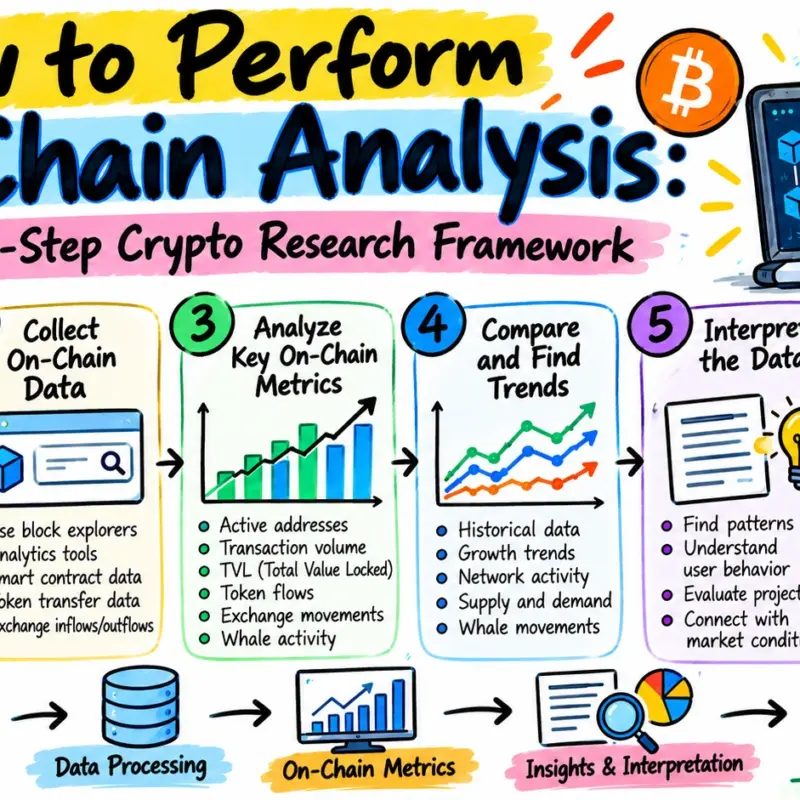
But there is a bigger question behind these numbers: Can the AI industry turn enormous investment in computing power into sustainable business revenue, and what happens to financial markets if investors begin questioning the returns?
This question matters beyond the stock market. Artificial intelligence and cryptocurrency increasingly depend on some of the same infrastructure: data centres, advanced chips, electricity, cloud computing and large-scale capital investment. Changes in investor confidence can influence how markets value both established technology companies and emerging digital asset projects.
This ZenvestAI research explains what happened to Anthropic’s IPO, what the latest filing actually says, how its valuation should be understood, and where the developments connect with the global crypto market.
Anthropic IPO: Pricing Confusion, Valuation Concerns and What It Means for the AI and Crypto Markets

What this article covers
- Why Anthropic withdrew its earlier IPO pricing information.
- What the revised November 2026 filing says.
- How much Anthropic is attempting to raise.
- Why the company’s valuation is attracting attention.
- What its revenue, losses and computing commitments reveal.
- Why the IPO matters to AI infrastructure and cryptocurrency.
- Whether AI-related crypto tokens could benefit.
- What investors should monitor before drawing conclusions.
1. What happened to Anthropic’s IPO, and why did the original figures change?
Anthropic’s IPO story became complicated when two different sets of offering figures reached the market within a short period.
On November 9, 2026, Reuters reported that Anthropic had circulated IPO details to bankers showing a proposed sale of approximately 866.7 million Class A shares at $70–$80 each. The plan suggested that the company and existing shareholders could raise up to $69.3 billion.
However, Anthropic subsequently sent another communication saying the pricing information was inaccurate and that it would update the filing. Reuters reported that it could not establish exactly which details were incorrect. Reuters+1
This distinction is important because an IPO involves several separate numbers:
- Share price: The amount investors pay for one share.
- Shares offered: The number of shares being sold to public investors.
- IPO proceeds: The money received from the shares sold by the company.
- Secondary proceeds: The money received by existing shareholders selling their shares.
- Market capitalisation: The market value of the company’s outstanding shares.
These figures are connected, but they do not mean the same thing.
For example, if a company sells 100 million shares at $50 each, the gross offering value is $5 billion. But if some of those shares belong to existing investors, the company does not receive the money from those sales.
That is why the revised Anthropic filing needs to be examined rather than relying on the first reported figures.
Read This:- Understanding Tokenization and Wholesale Digital Assets in 2026
2. What does Anthropic’s latest IPO filing actually say?
The November 10, 2026 amended registration statement filed with the US Securities and Exchange Commission (SEC) gives investors a more detailed view of the proposed offering.
Anthropic has proposed an initial public offering of 825 million Class A common shares, with an indicative price range of $70–$78 per share.
The offering has two parts.
| Offering details | Latest disclosed figures |
|---|---|
| Total Class A shares offered | 825 million |
| Shares sold by Anthropic | 801,351,354 |
| Shares sold by existing shareholders | 23,648,646 |
| Indicative IPO price | $70–$78 |
| Proposed exchange | Nasdaq |
| Proposed ticker | ANT |
| Additional underwriter option | 123.75 million shares |
| Separate private placement | $26 billion |
Source: Anthropic’s November 10, 2026 SEC filing. SEC+1
Why is the distinction between company shares and existing shares important?
Anthropic itself is offering approximately 801.35 million shares. Existing shareholders are offering another 23.65 million shares. The company will receive proceeds from its own share sale, but it will not receive money from the shares sold by existing shareholders.
At the midpoint of the proposed price range, $74 per share, the calculation looks like this:
Anthropic’s public share offering:- 801,351,354 × $74 = approximately $59.30 billion.
Existing shareholders’ share offering:- 23,648,646 × $74 = approximately $1.75 billion.
Total public offering:- 825 million × $74 = $61.05 billion.
These are gross amounts before applicable underwriting discounts and offering expenses.
The difference matters because a headline saying that Anthropic is raising more than $60 billion does not mean the entire amount will enter the company’s bank account.
What is the additional $26 billion private placement?
Alongside the IPO, Anthropic has disclosed a separate private placement of approximately $26 billion.
The SEC filing identifies seven participating technology companies:
- NVIDIA
- Advanced Micro Devices (AMD)
- Broadcom
- Micron Technology
- Microsoft
- TSMC Partners
These companies are expected to purchase Class N common shares at a price equal to the IPO price, subject to the conditions described in the filing. This is not the same as buying ordinary Class A shares through the Nasdaq IPO. It is a separate investment arrangement with a different share class. SEC
The important point: Anthropic’s fundraising plan combines a public share offering with a separate private placement. Keeping these two transactions separate gives investors a more accurate understanding of the capital entering the business.
3. Is Anthropic delaying its IPO, or is the valuation the real concern?
The original pricing correction created questions about whether Anthropic was reconsidering its IPO plans. However, the subsequent developments point to a continuing public offering process rather than a confirmed cancellation or postponement.
Anthropic announced its roadshow on November 10. Reuters reported on November 12 that the offering was approximately six times oversubscribed and that trading was expected to begin on Nasdaq on November 19. These dates and figures remain subject to the final offering process. Anthropic+1
An IPO roadshow is a period when company executives and investment bankers present the business to potential investors. They explain the company’s financial performance, business model, growth plans and risks.
The purpose is to build investor demand and help determine the final IPO price. A highly subscribed offering means investor demand exceeds the shares available at the stated terms. It does not guarantee that the stock will rise after listing.
What does the reported oversubscription mean?
Reuters reported that demand was approximately six times the number of shares available. This suggests that institutional investors are showing strong interest in Anthropic.
However, there is an important difference between demand during an IPO and demand after the shares begin trading. During the IPO, the company and underwriters allocate shares to selected investors. After listing, the stock trades in the open market, where buyers and sellers determine its market price.
A company can have an oversubscribed IPO and still experience a decline after listing if investors believe the final valuation is too high. This is why the first trading price should not be confused with the company’s long-term business value.
4. How much is Anthropic really worth? Understanding the valuation debate
The valuation question is more complicated than simply multiplying the IPO share price by the number of shares being offered. Market capitalisation is the value investors assign to a company’s outstanding shares. It is different from the amount of money a company raises during an IPO.
For Anthropic, the distinction becomes especially important because its capital structure includes multiple share classes, existing investors and a concurrent private placement.
Why are different valuation figures appearing?
Reuters reported on November 10 that Anthropic’s proposed offering could imply a valuation of approximately $1.02 trillion, based on its calculation using the outstanding shares in the regulatory filing. A separate Reuters report on November 12 described a valuation of up to $1.4 trillion.
These estimates should not be treated as interchangeable. The valuation depends on the share count used, the treatment of different share classes, conversion assumptions and the fully diluted capital structure. The final IPO price and the company’s actual post-listing market value may also differ.
For investors, this creates three separate questions:
- What valuation is implied by the IPO price?
- What valuation do investors expect after the stock begins trading?
- Can Anthropic generate enough future earnings and cash flow to justify that valuation?
The third question is the most important for long-term investors.
Why does a high valuation create additional pressure?
Imagine two companies:
- Company A is valued at $100 billion and generates $10 billion in annual revenue.
- Company B is valued at $1 trillion and generates $10 billion in annual revenue.
Both companies generate the same revenue, but investors are paying ten times more for Company B. This does not automatically make Company B a poor business. It means investors expect much stronger future growth.
If that growth does not happen, the valuation can fall even when the company continues to increase its revenue. This is one of the central risks surrounding large AI IPOs.
Related Article:- Governance Tokens: What They Are, How They Work, and Why They Shape Crypto
5. Anthropic’s revenue is growing, but what about its costs and profitability?
A strong IPO story needs more than customer growth. Investors also want to know whether a company can turn its revenue into sustainable profits. Anthropic’s financial disclosures offer an important example of this difference.
According to the November 2 Reuters report based on the amended SEC filing, Anthropic reported:
| Financial measure | Reported figure |
|---|---|
| Q3 2026 revenue | $16.96 billion |
| Quarterly revenue growth | 47% |
| Previous quarter’s revenue growth | 144% |
| Q3 operating loss | $567 million |
| Q3 net loss | $23.29 billion |
| Additional compute costs during Q3 | $5 billion |
| Large customers generating at least $100,000 in trailing 12-month revenue | More than 11,900 |
These figures are reported in the November 2 coverage and should be read in the context of the filing’s accounting definitions.
Revenue growth is not the same as profit growth
Anthropic’s revenue increased by 47% from the previous quarter. That is substantial growth, but it was slower than the 144% quarterly growth reported in the second quarter.
This is an important development.
When a company grows quickly, its revenue may increase faster than its operating costs. But when computing expenses, infrastructure spending and research costs rise, the company may find it harder to improve its margins.
For an AI company, this challenge is particularly important because every response generated by an AI model requires computing resources. A company may attract millions of users, but serving those users can become expensive.
Why is the reported net loss so large?
There is an important accounting distinction here. Anthropic reported an operating loss of $567 million for Q3, while its reported net loss was $23.29 billion.
These are not the same measure.
Operating income or loss measures the result of the company’s main business activities after operating expenses.
Net income or loss also includes non-operating items, such as certain financing and accounting effects.
Reuters explained that Anthropic’s net loss included non-operating items related to bonds convertible into its shares. Therefore, the $23.29 billion figure should not be interpreted as cash spent on ordinary operations during the quarter. Investing.com
This is a common mistake when reading financial reports. Investors should examine operating cash flow, capital spending, financing costs and the reasons behind accounting losses rather than relying on one headline number.
The customer growth story is worth watching
Anthropic reported more than 11,900 customers generating at least $100,000 in revenue over the preceding 12 months as of September 30, 2026.
That compares with more than 1,500 customers at the end of 2025.
This suggests that Claude is being adopted beyond individual users and is gaining a larger role in business operations.
Enterprise customers can be particularly valuable because they may use AI services across software development, customer support, research, data analysis and internal business processes.
However, customer numbers alone do not reveal how profitable those relationships are.
The next question is whether Anthropic can serve this growing customer base without allowing computing costs to rise at the same speed as revenue.
6. Why does Anthropic need so much computing power?
To understand Anthropic’s valuation, it is necessary to understand the infrastructure behind an AI model.
A large language model such as Claude does not operate like an ordinary website. It requires specialised computing systems to train the model, process user requests and improve its capabilities.
This infrastructure includes:
- GPUs: Process large amounts of mathematical calculations required by AI models.
- Data centres: Buildings containing servers, networking equipment and computing systems.
- Cloud computing: Allows businesses to access computing resources without owning all the physical infrastructure.
- Electricity: Powers the computing equipment and cooling systems.
- Networking: Connects thousands of computing units so they can work together.
A simple example makes this easier to understand.
Imagine a business that receives 100 customer requests per day. It may operate with a relatively small computing setup.
Now imagine that the same business receives 10 million requests per day from customers around the world. It needs considerably more computing capacity, electricity, storage and network resources.
The same principle applies to AI companies.
As the number of users and AI applications increases, the demand for computing power also increases.
Anthropic’s nearly $900 billion computing commitments
One of the most important disclosures in Anthropic’s IPO preparation concerns its future infrastructure commitments.
Reuters reported that Anthropic had approximately $895.4 billion in spending commitments related to AI infrastructure, with nearly half expected to be incurred before December 31, 2030.
The report also said that approximately $69.8 billion was due during the 12 months following September 30, 2026.
These commitments are not the same as money already spent or debt already borrowed.
They represent future contractual spending obligations connected to computing capacity and infrastructure.
That difference matters.
An infrastructure commitment may involve future payments for computing resources that become available over time. The actual financial burden depends on when capacity is delivered, when payments begin, how much of the contracted capacity is used and what revenue the company generates from it.
Anthropic also warned in its filing that some infrastructure providers depend on third-party financing and credit support. If that financing becomes unavailable or more expensive, contracted computing capacity could be delayed, repriced, reduced or not delivered.
This is a significant risk because AI growth depends not only on customer demand but also on whether the infrastructure can be delivered on time and at an affordable cost. Investing.com
Why should crypto investors care about this?
The cryptocurrency industry also depends on computing infrastructure, although not every blockchain uses the same type of hardware.
Bitcoin mining, AI model training, cloud computing and decentralised GPU networks have different technical requirements.
However, they share an important economic factor: access to reliable computing resources at a competitive cost.
For example:
- Bitcoin miners need specialised ASIC machines and affordable electricity.
- AI companies need powerful GPUs and data-centre capacity.
- Decentralised computing networks aim to connect people or businesses that have unused computing resources with customers who need them.
- Blockchain applications need reliable networks, storage and transaction processing.
When large AI companies compete for computing resources, the economics of data centres, chips, electricity and cloud infrastructure become increasingly important to technology and digital asset investors.
This does not mean that higher AI spending automatically increases cryptocurrency prices. The connection needs to be examined through actual demand, business usage and token economics.
7. How is Anthropic’s IPO connected to the cryptocurrency market?
Anthropic is not a cryptocurrency company. It is an artificial intelligence company, and its proposed IPO is a traditional equity offering.
Its shares are not cryptocurrencies, and the ANT ticker should not be confused with an existing crypto token that may use a similar symbol.
So why should a crypto research platform examine this IPO?
Because the AI and crypto industries are increasingly connected through infrastructure, investment, software and new business models.
There are four areas worth understanding.
7.1 AI infrastructure and decentralised computing
Centralised AI companies generally obtain computing power through their own infrastructure and partnerships with large cloud and technology providers.
Decentralised computing projects take a different approach.
They aim to connect independent GPU owners, data centres or computing providers through a network.
In theory, a business that needs computing resources could access capacity from multiple providers rather than relying entirely on a single centralised supplier.
Some blockchain-based networks use tokens to coordinate payments, rewards and network participation.
This is where projects such as Render and Akash Network enter the discussion.
Examples of projects in the decentralised computing sector; not endorsements or recommendations.
Render Network (RENDER)

Render connects GPU providers with users who need GPU-based rendering and computing services. Its original focus was distributed rendering, with its broader ecosystem also exploring AI-related workloads.
Akash Network (AKT)
Akash operates a decentralised cloud-computing marketplace where providers can offer computing resources to customers.
The important distinction is that these networks are not direct replacements for Anthropic’s infrastructure.
AI workloads require specific hardware, memory, networking, software support, reliability and service agreements. A decentralised network must demonstrate that it can meet those requirements consistently.
7.2 The growing importance of GPU marketplaces
A GPU is a specialised processor designed to handle many calculations simultaneously.
GPUs are widely used in AI model training, scientific computing, graphics processing and other demanding workloads.
The growing demand for AI computing has created interest in marketplaces that connect GPU owners with customers.
For crypto investors, this creates a practical research question:
Does a decentralised GPU network have real paying customers, or is its demand mainly driven by token speculation?
A project may advertise a large number of GPUs, but that does not automatically mean those GPUs are actively generating revenue.
Investors should examine:
- Number of active computing providers.
- Available GPU models and their performance.
- Actual customer demand.
- Completed computing jobs.
- Revenue generated from real usage.
- Token payments and settlement activity.
- Network costs and provider rewards.
- Whether token demand is connected to actual service usage.
A network with genuine customers and recurring demand has a stronger business foundation than a project that relies mainly on promotional claims.
7.3 AI agents and blockchain payments
AI agents are software systems that can perform tasks with limited human intervention.
For example, an AI agent may search for information, compare services, process data or interact with other software.
As these systems become more capable, they may need to pay for computing resources, APIs, data and other digital services.
Blockchain networks can potentially support automated payments between software systems.
A future AI agent might purchase computing capacity, pay for data access or settle small transactions using digital assets.
However, this is an emerging use case, not proof that all AI agents will use cryptocurrencies.
For the crypto market, the important question is whether these payments create meaningful network activity and a clear reason to hold or use a particular token.
7.4 Tokenisation and the difference between AI shares and crypto tokens
Another possible connection is the tokenisation of traditional financial assets.
Tokenisation means representing ownership or financial rights through digital tokens recorded on a blockchain.
In principle, a regulated platform could offer a blockchain-based representation of an equity security, subject to the relevant securities laws and issuer permissions.
However, there is a critical difference between:
- Owning Anthropic Class A shares through a permitted securities market.
- Holding a token that claims to represent Anthropic shares.
- Holding an unrelated cryptocurrency that happens to use the ticker ANT.
These are not automatically equivalent.
A tokenised share needs enforceable legal rights, a clear ownership structure, appropriate custody and compliance with securities regulations.
A token using Anthropic’s name or ticker does not establish ownership in Anthropic.
For investors, verifying the legal issuer and the rights attached to an asset is more important than its branding.
8. Which cryptocurrency sectors could benefit from the AI infrastructure boom?
The AI investment cycle may create opportunities across several crypto sectors, but the benefits will not be distributed equally.
A project can be associated with AI without having a useful product, paying customers or a token that captures economic value.
The following sectors deserve closer research.
8.1 Decentralised physical infrastructure networks (DePIN)
DePIN stands for Decentralised Physical Infrastructure Networks.
These networks use blockchain technology and token-based incentives to coordinate physical resources such as computing power, storage, wireless connectivity and energy infrastructure.
The basic idea is simple.
Instead of one company owning every resource, independent providers contribute equipment or services to a shared network. Customers use those services, and the network coordinates participation and payments.
Examples include:
- Render Network.
- Akash Network.
- io.net.
The Anthropic story makes this sector interesting because it highlights the scale of computing infrastructure required by AI businesses.
However, there is an important limitation: decentralised infrastructure must compete with established cloud providers on performance, reliability, price and customer support.
A cheaper GPU is not automatically useful if it cannot complete the required workload.
8.2 AI-related crypto networks
AI-related crypto projects are trying to build different parts of the AI economy.
Some focus on computing resources, while others focus on AI model development, data, agents or decentralised marketplaces.
Bittensor (TAO)
Bittensor uses blockchain-based incentives to coordinate specialised digital services and machine intelligence networks.
Artificial Superintelligence Alliance (FET)
The ecosystem focuses on decentralised AI services, agents and related infrastructure.
NEAR Protocol (NEAR)
NEAR is a general-purpose blockchain ecosystem that has also developed an AI-focused technology direction.
These projects have different products, technical designs and token economics. They should not be treated as one investment category.
8.3 Why real usage matters more than AI branding
A common mistake in crypto research is assuming that a project will become valuable simply because its sector is growing.
Consider two hypothetical decentralised GPU networks.
| Metric | Network A | Network B |
|---|---|---|
| Registered providers | 10,000 | 3,000 |
| Active paying customers | 20 | 500 |
| Monthly customer revenue | $50,000 | $1 million |
| Token demand | Mostly speculative | Linked partly to service usage |
Network A has more registered providers, but Network B has stronger customer activity in this example.
The numbers are illustrative, not actual project data.
This shows why active usage, paying customers, revenue and token value capture deserve more attention than promotional statistics.
A growing AI market does not guarantee a growing token price.
9. Could Anthropic’s IPO influence Bitcoin and the wider crypto market?
The relationship between an AI IPO and Bitcoin is indirect.
Anthropic does not need Bitcoin, Ethereum or any other cryptocurrency to complete its IPO. Its shares will trade through the traditional securities market.
However, large technology IPOs can influence investor confidence, capital allocation and broader market sentiment.
These factors can affect cryptocurrency markets.
9.1 Investor risk appetite
Financial markets generally move between periods of stronger and weaker risk appetite.
When investors feel confident, they may be more willing to invest in assets with higher uncertainty, including technology stocks and cryptocurrencies.
When confidence weakens, investors may prefer cash, government securities or other assets they consider more defensive.
An expensive AI IPO that performs poorly could contribute to concerns about technology valuations.
However, one IPO cannot independently determine Bitcoin’s direction.
9.2 Interest rates and liquidity
Interest rates influence the cost of borrowing and the attractiveness of different investments.
When interest rates are high, investors may demand stronger expected returns before investing in riskier assets.
When borrowing costs fall and financial conditions become easier, speculative investments may receive greater attention.
For Bitcoin and other digital assets, the broader liquidity environment, dollar conditions, institutional flows and market positioning can matter more than an individual technology IPO.
The Anthropic offering should therefore be examined alongside:
- Federal Reserve interest-rate decisions.
- US Treasury yields.
- US dollar strength.
- Global liquidity conditions.
- Bitcoin ETF inflows and outflows.
- Institutional positioning.
- Technology-sector valuations.
Read It:- Tokenomics Explained: What Is Tokenomics in Crypto and How Does It Work?
9.3 AI spending and semiconductor demand
AI companies require advanced semiconductors, memory, networking equipment and data-centre capacity.
Large infrastructure commitments can support demand for technology suppliers.
Companies such as NVIDIA and AMD operate in this wider supply chain.
Crypto mining companies and AI infrastructure operators may also compete for capital, electricity and suitable data-centre sites.
But the relationship is not always positive.
For example, higher electricity prices could increase costs for both data-centre operators and some Bitcoin miners.
The same infrastructure boom that creates demand can also increase operating expenses.
9.4 Could an AI market correction affect crypto valuations?
Yes, it is possible, but the impact would depend on how widespread the correction becomes.
Imagine that investors begin questioning whether AI companies can generate enough revenue to justify their infrastructure spending.
They may reduce exposure to expensive technology stocks, reassess companies providing AI infrastructure and become more cautious about speculative investments.
AI-related crypto tokens could experience additional selling pressure if their valuations depend heavily on the same growth expectations.
However, Bitcoin, stablecoins, DeFi protocols and AI-related tokens do not all have identical economic drivers.
A fall in AI stocks does not automatically mean that every cryptocurrency must decline.
The useful lesson is to identify the actual market connection rather than assuming that two assets will move together because both belong to the technology sector.
10. What risks should investors examine before investing in AI-related crypto tokens?
The Anthropic IPO provides an opportunity to separate the real AI business from the investment narrative surrounding it.
Before researching an AI crypto project, examine the following risks.
10.1 Token utility risk
A project may have a working AI product without needing its own cryptocurrency.
Ask:
- Why does this network require a token?
- Is the token used for payments?
- Does it secure the network?
- Is it required for access to services?
- Does increasing network usage create additional token demand?
If the project cannot clearly explain the role of its token, its long-term value proposition deserves further examination.
10.2 Revenue and token value capture
A protocol may generate revenue without that revenue benefiting token holders.
For example, a decentralised computing network could charge customers for GPU services, but its revenue may primarily go to infrastructure providers.
The token may only be used for rewards, staking or governance.
This creates a difference between protocol revenue and token value capture.
Investors should examine where customer payments go, how much the network retains, how providers are paid and whether token holders have any enforceable economic rights.
10.3 Token supply and dilution
Token supply is another important consideration.
A project may have strong customer demand, but large token unlocks can increase the amount of tokens entering circulation.
Study:
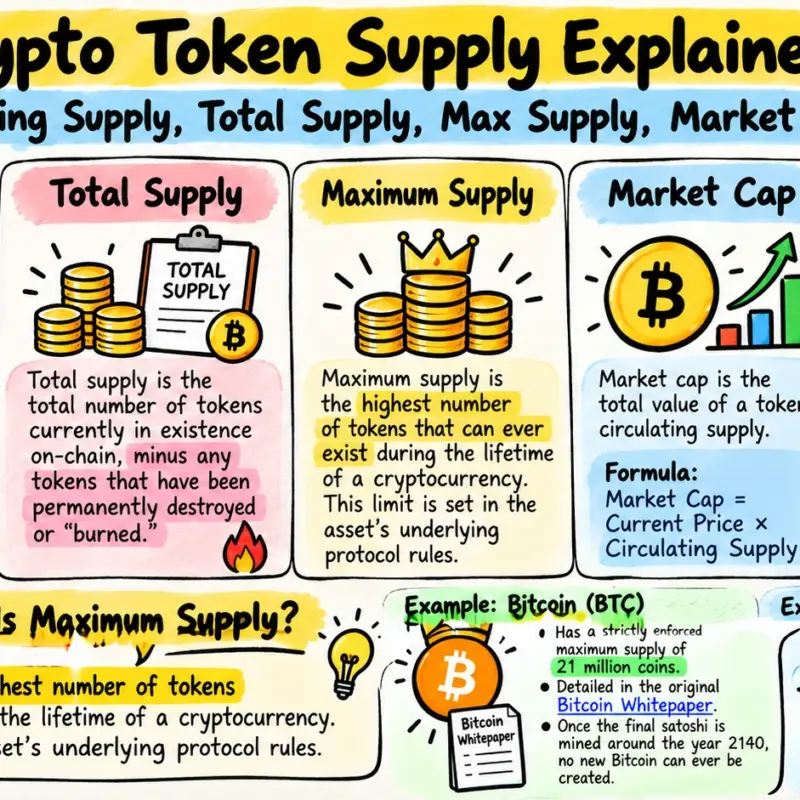
- Total token supply.
- Circulating supply.
- Maximum supply, if applicable.
- Vesting schedules.
- Team and investor allocations.
- Upcoming token unlocks.
- Emission and reward rates.
A rising market capitalisation does not always mean existing holders benefit equally if token supply is expanding quickly.
10.4 Smart contract and infrastructure risk
Decentralised computing networks depend on software, wallets, payment systems and sometimes smart contracts.
A security weakness can create financial losses even when the underlying business model is attractive.
Infrastructure risks also matter.
A GPU provider may stop supplying computing capacity, a network may experience downtime, or a customer may receive a service that does not meet its requirements.
A strong research process must examine both blockchain security and the actual computing service.
10.5 Competition from centralised cloud providers
Large cloud providers already have established infrastructure, business customers and technical support.
Decentralised networks must prove that they offer a meaningful advantage.
That advantage could involve lower costs, access to otherwise unused hardware, greater flexibility or specialised services.
But lower prices alone are not enough if reliability and performance are weaker.
10.6 Regulatory uncertainty
AI-related crypto projects may operate across several legal areas:
- Digital asset regulation.
- Securities laws.
- Data protection.
- Consumer protection.
- Cross-border payments.
- AI safety and accountability.
- Financial crime and anti-money-laundering requirements.
The regulatory position can differ substantially between the United States, European Union, India and other jurisdictions.
A project operating globally must consider the laws of the countries in which it provides services and offers tokens.
11. What should investors monitor after Anthropic’s IPO?
The IPO itself is only one event. The more useful information will emerge through the company’s final pricing, public trading and subsequent financial disclosures.
Here is a practical research framework.
| What to monitor | Why it matters |
|---|---|
| Final IPO price | Shows the price at which public investors buy shares |
| Final share allocation | Reveals how the offering was distributed |
| First-day trading | Shows early public-market demand |
| Market capitalisation | Helps assess the valuation after listing |
| Revenue growth | Measures demand for Claude and related services |
| Operating margins | Shows whether the business is becoming more efficient |
| Cash flow | Helps assess the company’s ability to fund operations |
| Compute commitments | Reveals future infrastructure spending pressure |
| Customer growth | Measures business adoption |
| Capital expenditure | Shows how much money is being invested in infrastructure |
What would be a positive signal?
A positive long-term picture would involve continued customer growth, improving operating performance, manageable infrastructure costs and stronger cash generation.
This would suggest that Anthropic is gradually turning AI demand into a sustainable business.
What would be a warning signal?
Investors should pay attention if computing costs increase faster than revenue, infrastructure commitments become difficult to finance or customer growth slows substantially.
A high IPO valuation leaves less room for disappointing financial results.
Why should crypto investors monitor the same information?
AI infrastructure spending can provide useful information about the economics of the wider computing industry.
If large businesses are willing to pay for specialised computing capacity, that can support the case for examining alternative computing networks.
But the next step must always be verification.
Are decentralised networks actually winning customers? Are their GPUs being used? Are they generating revenue? Does their token have a genuine economic role?
Those questions matter much more than simply following the latest AI narrative.
12. What does the Anthropic IPO reveal about the future of AI and crypto?
The Anthropic IPO highlights a wider change in the global technology economy.
AI is moving from experimental software towards services that businesses increasingly use in everyday operations.
At the same time, the cost of providing those services is becoming more visible.
The industry needs computing power, data centres, electricity, chips and financing. These resources require large amounts of capital and long-term planning.
Cryptocurrency networks are exploring whether some parts of this infrastructure can be organised through decentralised marketplaces.
There are genuine opportunities to investigate, but there are also important limitations.
Centralised AI and decentralised infrastructure may coexist
It is not necessary for decentralised computing networks to replace companies such as Anthropic.
A more realistic possibility is that different infrastructure models serve different customers.
Large AI companies may continue using centralised cloud providers for demanding workloads, while smaller businesses and developers use alternative computing marketplaces when the price, availability and performance make sense.
Some decentralised networks may specialise in rendering, inference, storage or other specific workloads.
This creates a more useful way to understand the relationship between AI and crypto.
Rather than asking whether blockchain will replace traditional AI companies, investors should ask which computing services can benefit from decentralised coordination and whether the associated tokens capture any real value.
The most important long-term question is economic value
AI adoption can grow rapidly without every AI company becoming profitable.
Likewise, decentralised computing usage can increase without every related cryptocurrency becoming more valuable.
The business model, operating costs, competition and token design determine whether growth creates sustainable economic value.
This is why ZenvestAI treats AI-related crypto narratives as research topics rather than automatic investment opportunities.
ZenvestAI Research Perspective: AI Infrastructure and Crypto
Anthropic’s IPO highlights an important question: how will the growing demand for AI computing translate into sustainable business revenue?
At ZenvestAI, we examine this relationship through three areas:
- AI Infrastructure Economics: Compare AI companies’ computing costs, infrastructure commitments and revenue growth to understand whether their business models are financially sustainable.
- AI Crypto Token Value: Evaluate projects such as Render (RENDER), Akash Network (AKT), Bittensor (TAO) and Artificial Superintelligence Alliance (FET). Our focus is on actual network usage, customer payments, token demand, supply changes and how much economic value reaches token holders.
- Centralised Cloud vs DePIN: Assess whether decentralised computing networks can compete with traditional cloud providers in pricing, reliability, computing capacity and customer adoption.
Our objective is to distinguish genuine economic demand from market speculation. An increase in AI adoption does not automatically mean that AI-related crypto tokens will gain value.
Frequently asked questions
1. What is Anthropic, and what does it do?
Anthropic is an artificial intelligence company founded in 2021. It develops Claude, a family of AI models used for writing, research, coding, data analysis and other tasks.
The company focuses on developing advanced AI systems with an emphasis on AI safety and responsible development.
2. What is Anthropic’s IPO ticker symbol?
Anthropic has applied to list its Class A common shares on the Nasdaq Global Select Market under the proposed ticker symbol ANT.
3. How much is Anthropic trying to raise?
Under the November 10, 2026 filing, Anthropic is offering 801,351,354 shares at an indicative price range of $70–$78.
At the midpoint of $74, this represents approximately $59.3 billion in gross proceeds for the company.
Existing shareholders are separately offering another 23,648,646 shares.
The company has also disclosed a separate $26 billion private placement.
4. Why did Anthropic retract its original IPO pricing information?
Anthropic initially circulated offering details suggesting approximately 866.7 million shares at $70–$80 each, potentially raising $69.3 billion.
It subsequently informed bankers that the pricing information was inaccurate and that it would update the filing.
Reuters could not independently establish which specific details were incorrect.
5. Is Anthropic’s IPO delayed?
The pricing correction did not establish that the IPO was postponed.
Anthropic announced its roadshow on November 10, 2026. Reuters subsequently reported that trading was expected to begin on November 19 under the ticker ANT.
The final timetable remains subject to the offering process and regulatory requirements.
6. Why is Anthropic’s valuation attracting attention?
Anthropic’s proposed valuation is attracting attention because investors are comparing its rapid revenue growth with the high costs of AI infrastructure.
Different valuation estimates have been reported, including approximately $1.02 trillion and up to $1.4 trillion.
These estimates use different valuation calculations and should not be treated as one confirmed figure.
7. Is Anthropic a cryptocurrency company?
No. Anthropic is an AI company.
Its proposed ANT shares are traditional securities, not cryptocurrencies.
8. Can Anthropic’s IPO affect Bitcoin?
It could influence broader technology-market sentiment and investor risk appetite, but its impact on Bitcoin would be indirect.
Bitcoin prices also depend on liquidity, interest rates, institutional demand, regulation, market positioning and other factors.
There is no established direct relationship between Anthropic’s IPO performance and Bitcoin’s price.
9. Which crypto projects are associated with decentralised computing?
Projects worth researching include:
- Render Network (RENDER).
- Akash Network (AKT).
- io.net (IO).
These projects have different operating models and should be evaluated independently.
10. Does AI growth automatically increase the value of AI crypto tokens?
No. AI adoption does not automatically create token demand.
A project needs actual users, useful services, competitive infrastructure and a clear connection between network activity and token economics.
11. What is the difference between AI infrastructure and decentralised AI?
AI infrastructure includes the hardware, software, data centres and computing resources required to operate AI services.
Decentralised AI attempts to coordinate certain AI services, computing resources or data through distributed networks.
Not every decentralised AI project owns computing infrastructure, and not every AI infrastructure company uses blockchain.
12. Can investors buy Anthropic shares using cryptocurrency?
The proposed IPO is a traditional securities offering. Any future crypto-based representation of Anthropic shares would require separate legal and regulatory arrangements.
A cryptocurrency exchange listing a token with the ANT name or ticker does not establish that it represents Anthropic equity.
13. What is the biggest risk investors should watch?
The relationship between AI revenue growth and infrastructure costs is one of the most important factors.
If the company cannot generate enough revenue and cash flow to support its computing commitments, its long-term financial performance could come under pressure.
ZenvestAI View: Anthropic’s IPO is bigger than an AI stock listing
Anthropic’s IPO deserves attention because it brings together three important questions about the future of technology markets.
First, how much are investors willing to pay for AI companies that are growing rapidly but require enormous infrastructure investment?
Second, can these companies convert growing demand for AI services into sustainable profits and cash flow?
Third, can decentralised computing and blockchain-based infrastructure create commercially useful alternatives in selected areas of the AI economy?
Our view is that the third question deserves particular attention from crypto researchers.
The growth of AI creates a reason to investigate GPU marketplaces, DePIN, decentralised cloud computing and AI agent infrastructure. But the opportunity must be measured through real customer demand, service revenue, network performance and token value capture.
A token should not receive a higher valuation simply because its project uses the words AI, GPU or decentralisation.
The strongest research opportunity is to identify where real economic demand meets a working blockchain-based business model.
That is where the AI and crypto industries have the most interesting long-term connection.
The Bottom Line On Anthropic IPO: Pricing Confusion, Valuation Concerns and What It Means for the AI and Crypto Markets
Anthropic’s IPO is a major test of investor confidence in the AI industry. Its revised offering proposes 825 million Class A shares at $70–$78, alongside a separate $26 billion private placement.
The original $69.3 billion pricing information was withdrawn, but the subsequent filing clarified the proposed offering.
For crypto investors, the important development is not the ANT ticker itself. It is the growing demand for computing infrastructure and the opportunity to examine whether decentralised networks can provide useful services within this expanding market.
AI growth may create opportunities for crypto infrastructure, but real usage, sustainable revenue and token economics will determine which projects deserve attention.
Sources and research references
The following primary and secondary sources support the factual information in this article. The SEC filing should take priority when checking offering terms.
1. Anthropic – Official IPO Roadshow Announcement (November 10, 2026)
Read the official announcement.
2. US Securities and Exchange Commission – Anthropic Form S-1/A, Amendment No. 2 (November 10, 2026)
Read the regulatory filing.
3. Reuters – Anthropic’s Nearly $70 Billion IPO Plan Briefly Circulated to Banks, Then Retracted (November 9, 2026)
Read the Reuters report.
4. Reuters – Anthropic’s IPO Is About Six Times Oversubscribed (November 12, 2026)
Read the Reuters report.
5. Reuters – Anthropic Revenue Growth Slows, Compute Financing Risks Mount Ahead of IPO (November 2, 2026)
Read the financial report.
6. US Securities and Exchange Commission – Company Filings
Search Anthropic’s regulatory disclosures.
Editorial information
Published by: ZenvestAI.Com
ZenvestAI is an independent digital asset research and educational platform covering cryptocurrency markets, blockchain technology, tokenomics, decentralised finance, digital infrastructure and emerging financial technologies.
Our objective is to explain complex developments in simple language while maintaining technical accuracy, global market context and independent editorial judgment.
Editorial approach: We distinguish verified information from market reports, company projections and our own analysis. We do not treat industry narratives as proof of investment value.
Important disclosure
This article is intended for educational and informational purposes only. It is not investment, financial, legal or tax advice, nor an offer or recommendation to buy or sell securities or digital assets.
Anthropic’s proposed IPO is a traditional securities offering and is separate from the cryptocurrency market. References to digital asset projects are for research and educational purposes only. Cryptocurrency investments involve substantial risks, including price volatility, liquidity risk, regulatory uncertainty, smart contract vulnerabilities and possible loss of capital.
ZenvestAI is independent of Anthropic and the cryptocurrency projects discussed. Readers should conduct their own research and consult appropriately qualified professionals before making financial decisions.