For years, India’s cryptocurrency conversation has largely revolved around Bitcoin prices, retail investors, crypto exchanges and government taxation. But a different conversation is now emerging. Financial institutions, fintech companies and global investors are increasingly exploring how blockchain and digital assets could reshape traditional financial services.
At the centre of this changing landscape is Gujarat International Finance Tec-City, popularly known as GIFT City. Designed to connect India’s financial industry with international markets, GIFT City is becoming an important part of the country’s ambition to build a globally competitive financial ecosystem.
The bigger question is whether India can use this platform to participate in the next generation of digital finance while maintaining strong regulatory standards. The answer could shape India’s position in the global financial industry over the coming decade.
What Makes GIFT City Important for India’s Financial Future?

GIFT City, located near Gandhinagar in Gujarat, is India’s first operational International Financial Services Centre (IFSC). Its purpose is to attract international financial institutions, banks, insurance companies, investment funds and technology businesses.
Unlike an ordinary business district, GIFT City has a dedicated financial regulatory structure. The International Financial Services Centres Authority (IFSCA), established under the IFSCA Act, 2019, acts as the unified regulator for financial activities within the IFSC.
This structure gives eligible financial institutions an environment designed for international business, with access to foreign-currency financial services and regulatory arrangements suited to cross-border operations.
The scale of its development is also worth watching. According to the IFSCA’s official website, the IFSC had more than 1,260 registrations and authorisations and a banking asset base exceeding $120 billion as of June 2026.
These figures show that GIFT City is developing beyond an ambitious infrastructure project. It is building an active financial ecosystem that could attract more international investment and financial technology businesses.
For India, the objective is straightforward: create a financial centre that can compete internationally and bring more global financial activity into the country’s own ecosystem.
Related Articles:- Is Crypto Legal in India in 2026? The Ultimate Guide to Taxes, FIU Rules, and VDA Laws
Why Are Financial Institutions Looking at Digital Assets?

The growing institutional interest in digital assets is not simply about buying Bitcoin or expecting cryptocurrency prices to rise.
Large financial institutions are examining the technology behind digital assets because it could improve the way financial products are created, managed, transferred and settled.
Traditional financial transactions often involve several intermediaries, separate databases, paperwork and reconciliation between institutions. These processes can take time and increase operational costs.
Blockchain technology offers another approach. It allows transaction records to be maintained on a shared digital network, making certain activities easier to track and verify.
Consider an international financial transaction. Banks and financial institutions may need to verify information, exchange records and reconcile payments through multiple systems. In suitable applications, blockchain-based infrastructure could simplify parts of this process.
This is one reason institutions are exploring digital finance.
Their interest includes:
- Digital representation of financial assets.
- Faster and more efficient settlement processes.
- Improved transaction records and transparency.
- New ways to manage investment funds and securities.
- Better integration between traditional financial systems and digital technology.
Related Articles:- How to Read Crypto Market Cap and Liquidity (Beginner Crypto Metrics Guide)
However, blockchain is not automatically better for every financial activity. Its usefulness depends on security, legal recognition, cost and whether it solves a genuine business problem.
Tokenisation: The Bigger Opportunity Beyond Cryptocurrency Trading
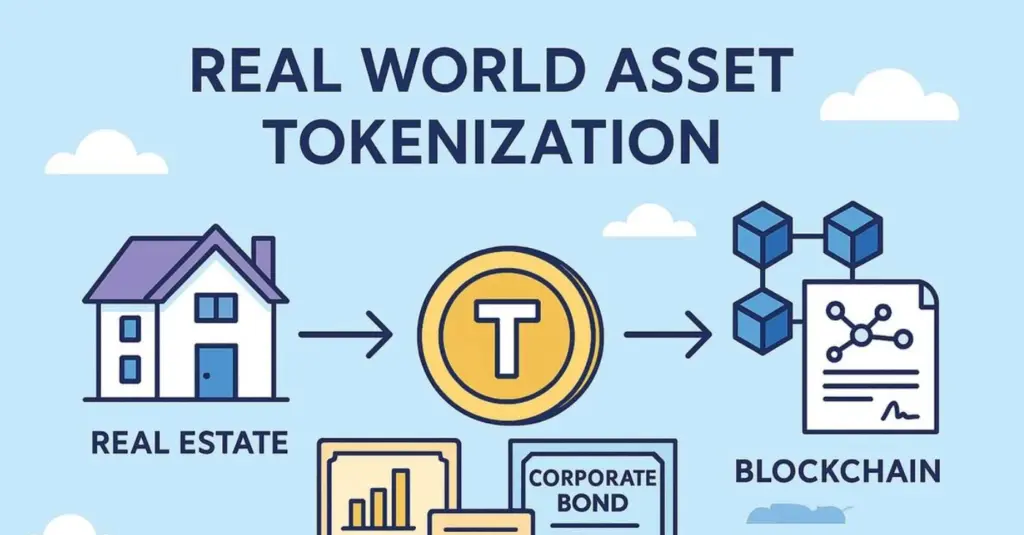
One of the most important developments in institutional digital finance is asset tokenisation.
In simple terms, tokenisation means representing rights in an asset through a digital token recorded on a blockchain or another digital ledger.
Imagine a commercial property valued at ₹100 crore. Traditionally, investment in such a property may involve large amounts of capital, legal documentation and complicated ownership arrangements.
Under a properly designed tokenisation structure, eligible ownership or beneficial interests in that property could be represented digitally. Investors might then be able to access certain investment opportunities through smaller units, subject to the applicable legal and regulatory framework.
The same concept could apply to other financial assets, including:
- Bonds and debt securities.
- Investment fund units.
- Real estate interests.
- Trade receivables.
- Certain commodity-related assets.
For institutional investors, the attraction is the possibility of more efficient record-keeping, easier administration and improved settlement processes.
IFSCA has recognised the potential of this area. On 26 February 2025, it published a consultation paper titled Regulatory Approach towards Tokenization of Real-World Assets. The paper explored how tokenised financial assets could be issued, held, traded and settled within an appropriate regulatory structure.
This is an important development, but a consultation paper is not the same as a final regulatory approval. It should also not be confused with permission to trade cryptocurrencies such as Bitcoin or Ethereum.
The distinction matters because tokenising a regulated financial asset and operating a cryptocurrency exchange are two very different activities.
India Is Entering a Global Competition for Digital Finance

India is not the only country trying to attract financial institutions and digital asset businesses. International financial centres are also investing in technology, regulation and infrastructure to attract global capital.
Singapore has developed a strong fintech ecosystem and has introduced regulatory requirements for digital payment token service providers.
Dubai has established a dedicated regulatory environment for virtual asset activities through the Virtual Assets Regulatory Authority (VARA), alongside separate arrangements within its financial free zones.
The European Union has introduced its Markets in Crypto-Assets (MiCA) framework, creating common rules for many crypto-asset service providers and issuers across the EU.
The United States has also seen growing institutional participation in digital asset investment products, particularly through regulated Bitcoin and Ethereum exchange-traded products.
These developments demonstrate an important change in global finance. Digital assets are no longer being discussed only as an alternative investment for technology enthusiasts. They are becoming part of broader conversations about financial infrastructure, investment products and market regulation.
For India, GIFT City offers an opportunity to participate in this competition. Its location, financial institutions, regulatory structure and connection with India’s technology workforce could make it an attractive destination for international financial businesses.
However, attracting institutional capital requires more than modern infrastructure. International investors also look for predictable regulations, strong legal protections, reliable banking arrangements and confidence in the financial system.
Related Articles:- What Is CPI? A Complete Guide to U.S. Inflation Data, Core CPI & CPI Surprises
India’s Crypto Regulatory Landscape: Opportunity Meets Caution

Despite growing interest in digital finance, India’s regulatory approach towards cryptocurrency remains cautious. This is an important part of the story because institutional investors cannot build long-term strategies on technology and market opportunities alone. They also need legal clarity, investor protection and reliable financial infrastructure.
India currently has a framework for taxing Virtual Digital Assets (VDAs) and monitoring certain crypto-related activities. Under the Prevention of Money Laundering Act (PMLA), crypto service providers involved in specified activities, including exchanges between virtual digital assets and fiat currencies, transfers and custody, are required to register with the Financial Intelligence Unit–India (FIU-IND) and follow applicable anti-money-laundering requirements.
However, FIU registration should not be confused with full regulatory approval of cryptocurrency as an investment product.
The distinction became particularly important in December 2024, when IFSCA officially clarified that it had no plans at that time to introduce a regulatory framework for cryptocurrency exchanges, cryptocurrencies or related virtual assets in GIFT IFSC.
Similarly, its 2025 consultation on real-world asset tokenisation focused on digitally representing traditional assets, rather than providing permission to trade Bitcoin, Ethereum or other cryptocurrencies.
This creates an interesting situation for India. The country is exploring opportunities in blockchain-based financial infrastructure while maintaining a cautious approach towards privately issued crypto assets.
For international institutions, regulatory clarity will be one of the biggest factors influencing their willingness to establish long-term operations in India.
Related Articles:- How Does a Blockchain Transaction Work From Start to Finish?
What Could GIFT City Mean for India’s Digital Finance Industry?

The potential impact of GIFT City extends beyond cryptocurrency markets. Its growing financial ecosystem could create opportunities across several areas of the digital economy.
1. More international financial businesses
A competitive IFSC could attract global financial institutions, investment managers, fintech companies and technology service providers. This could help India become a stronger participant in international financial markets.
2. New opportunities in blockchain technology
Financial institutions may require technology companies to develop secure digital transaction systems, asset-record platforms and blockchain-based financial applications.
3. Growth in financial technology employment
As the ecosystem develops, demand could increase for professionals working in financial compliance, cybersecurity, blockchain development, risk management and digital asset research.
4. Better financial infrastructure
The adoption of suitable digital systems could improve certain financial processes, particularly asset administration, transaction tracking and settlement.
5. Greater international participation
GIFT City’s ambition to connect global capital with India’s financial ecosystem could create new opportunities for international investors and financial service providers.
However, these are potential opportunities, not guaranteed outcomes. Their development will depend on regulatory decisions, institutional demand and the commercial usefulness of the technology.
Related Articles:- What Is Proof of Work? How Bitcoin Mining Actually Works
The Challenges India Must Address
Building a globally competitive digital finance ecosystem will not be easy.
First, regulatory clarity is essential. Financial institutions need to understand which digital asset activities are permitted, which licences are required and what legal protections apply to investors.
Second, cybersecurity remains a major concern. Digital platforms can face hacking, data breaches, fraud and operational failures. Strong security standards and effective risk management will be necessary.
Third, investor protection cannot be overlooked. The increasing availability of digital financial products does not automatically make them safe. Investors need transparent information about ownership rights, costs, liquidity and potential losses.
Finally, India must balance innovation with financial stability. Regulations that are too restrictive could discourage legitimate businesses, while weak oversight could expose investors and financial institutions to unnecessary risks.
The challenge is to create a framework that encourages responsible innovation without compromising the integrity of the financial system.
Related Articles:- What Is Blockchain Consensus and How Do Networks Agree on Transactions?
Conclusion: Is GIFT City India’s Gateway to the Future of Digital Finance?
GIFT City represents an important step in India’s ambition to become a globally competitive financial centre. Its growing banking, investment and fintech ecosystem provides a foundation for exploring new financial technologies.
The opportunity is bigger than cryptocurrency trading. Tokenisation, blockchain-based infrastructure and digitally managed financial assets could gradually change how institutions create, manage and transfer value.
However, India still needs clear regulatory pathways for different digital asset activities. GIFT City should therefore be viewed as an emerging platform for international financial innovation, not as an already established cryptocurrency trading hub.
The future of digital finance will depend on more than technology. It will depend on trust, transparency, regulation and institutional confidence.
India’s real opportunity is not simply to participate in the global crypto market. It is to help build the next generation of financial infrastructure while maintaining the standards that international institutions expect.
Sources supporting the article:
- Government of India – Smart Finance, Smart Future: GIFT City.
- IFSCA – Regulatory Approach Towards Tokenisation of Real-World Assets.
- IFSCA – Official clarification on crypto exchanges, December 2024.
- FIU-IND compliance requirements for virtual digital asset service providers, September 2026.