Public blockchains operate as open ledgers, yet most market participants never look beyond surface-level token prices. When you open a block explorer, you gain direct access to the raw, transparent record of every state change across the network.
You can inspect exact wallet balances, examine chronological transaction histories, track token transfers (ERC-20, BEP-20, or SPL), uncover hidden internal transactions, and audit direct smart-contract interactions.
Before analyzing transactions, you must understand a fundamental distinction that separates retail speculation from institutional research: a whale wallet is not automatically smart money.
A whale simply represents capital size. A treasury address, an early miner holding thousands of native tokens, or an institutional custodian holding static inventory is a whale by balance, but its actions may offer zero actionable trading insight.
In contrast, smart money is defined by repeated execution quality, disciplined timing, sophisticated interaction patterns, and measurable historical profitability.
A wallet holding $250,000 that consistently enters liquidity pools before major volume spikes is significantly smarter than an inactive whale wallet sitting on $50 million of legacy assets.
Understanding on-chain entities requires remembering the foundational rule of blockchain analysis: one wallet does not equal one person or entity.
A single trader, fund, or syndicate can operate dozens or hundreds of fresh addresses across multiple networks to fragment capital and conceal intent.
Conversely, a single address can represent a centralized exchange omnibus wallet, a decentralized lending protocol pool, a token bridge, a market-making algorithm, or a shared multi-signature treasury.
Successful on-chain tracking is therefore not about finding a single address; it is about connecting disparate addresses into a verified behavioral group known as a wallet cluster.
To track these movements effectively, you need an organized setup before opening your browser.
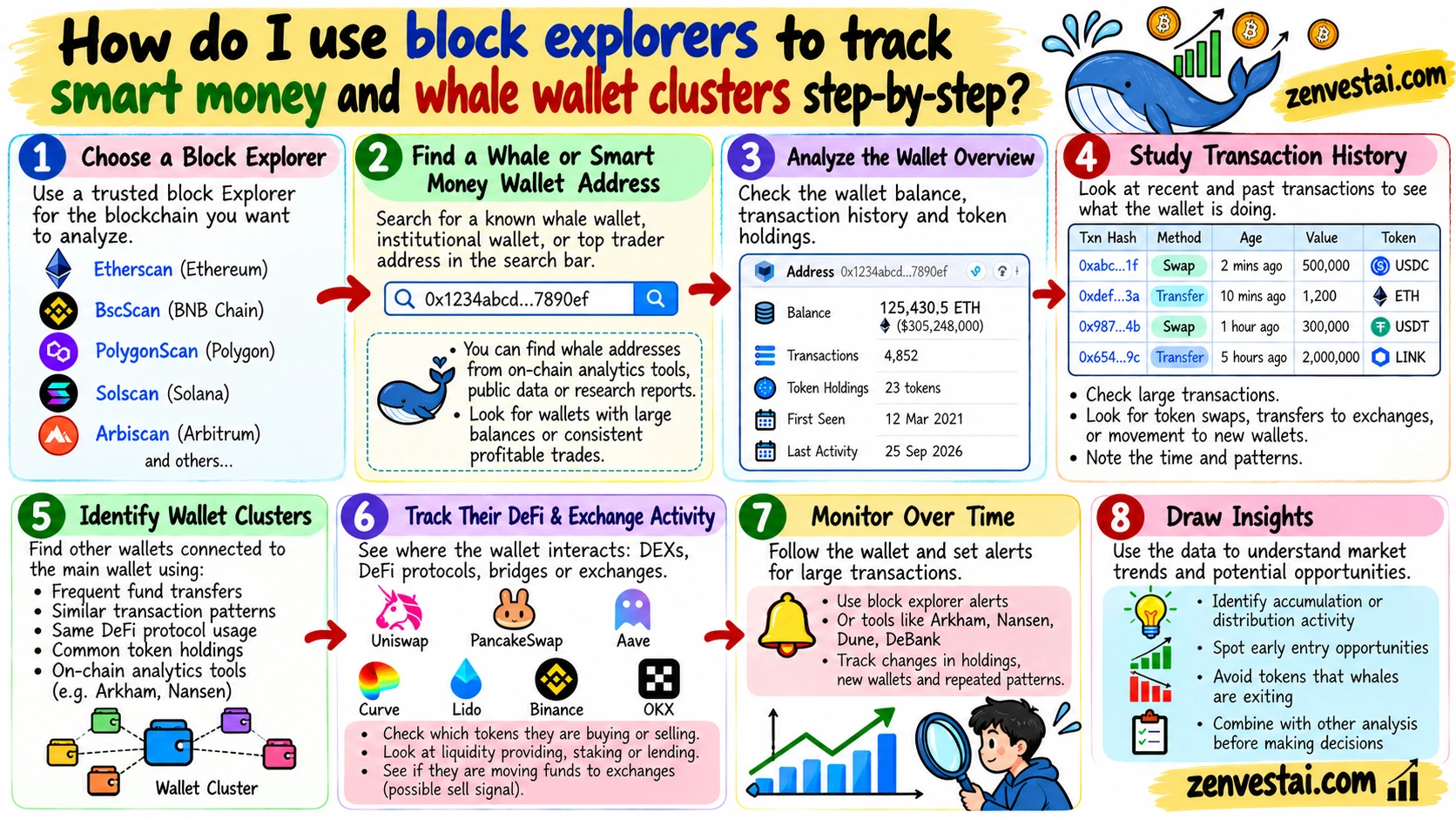
To track a whale wallet, start with its public address, open it in the relevant block explorer, review its token holdings and transaction history, identify major counterparties, trace its initial funding sources, and compare related addresses for common timing, behavioral, or transactional links to construct a verifiable cluster.
Table of Contents
- What Do You Need Before Tracking a Whale Wallet?
- How do I use block explorers to track smart money and whale wallet clusters step-by-step?
- Step 1 Choose the Correct Block Explorer
- Step 2 Find a Whale or Smart-Money Wallet
- Step 3 Open the Wallet Address and Read Its Profile
- Step 4 Identify What the Wallet Is Actually Doing
- Step 5 Trace the Wallet’s Funding Source
- Step 6 Find Related Wallets
- Step 7 Build a Wallet Cluster Map
- Step 8 Separate Real Whales From Exchange and Protocol Wallets
- Step 9 Verify the Wallet Cluster With Multiple Signals
- Step 10 Track Smart-Money Activity Over Time
- Block Explorer vs. On-Chain Analytics Platform
- A Complete Whale Wallet Tracking Workflow
- What Signals Should You Track?
- Common Mistakes When Tracking Whale Wallets
- Frequently Asked Questions
- The ZenvestAI View: The Evolution of On-Chain Analysis
- Related Intelligence and Verified Resources
- Editorial Information & Global Regulatory Compliance
What Do You Need Before Tracking a Whale Wallet?
Attempting to track on-chain movements without reference parameters leads directly to information overload. Keep this practical investigative checklist ready before starting any analysis:
- Target Blockchain: Identify the exact network where the activity takes place (e.g., Ethereum mainnet, Arbitrum One, BNB Chain, Solana).
- Target Wallet Address: The specific 42-character hexadecimal public address (or base58 string on Solana) under investigation.
- Token Contract Address: The verified contract address of the underlying asset being bought, sold, or transferred. Never rely on token ticker symbols alone, as duplicate tickers are common attack vectors.
- Dedicated Block Explorer: The native explorer configured for that specific network environment.
- Transaction Hash (TxHash): The unique transaction identifier if you are investigating a specific event or swap.
- Investigation Time Window: A defined chronological boundary (such as the last 7, 30, or 90 days) to prevent historical data bloat.
- Current Asset Distribution: Baseline breakdown of native network tokens versus secondary tokens held.
- Token-Transfer Ledger: Dedicated inspection of inbound and outbound asset logs.
- Counterparty Directory: The list of external contracts, routers, and peer addresses the wallet interacts with repeatedly.
- Primary Funding Origin: The foundational transaction that provided the wallet with its initial gas money and capital.
- DeFi Footprint: Active liquidity positions, staking locks, and money market collateral positions.
With these parameters identified, the first mechanical step is matching your target network to the right explorer infrastructure.
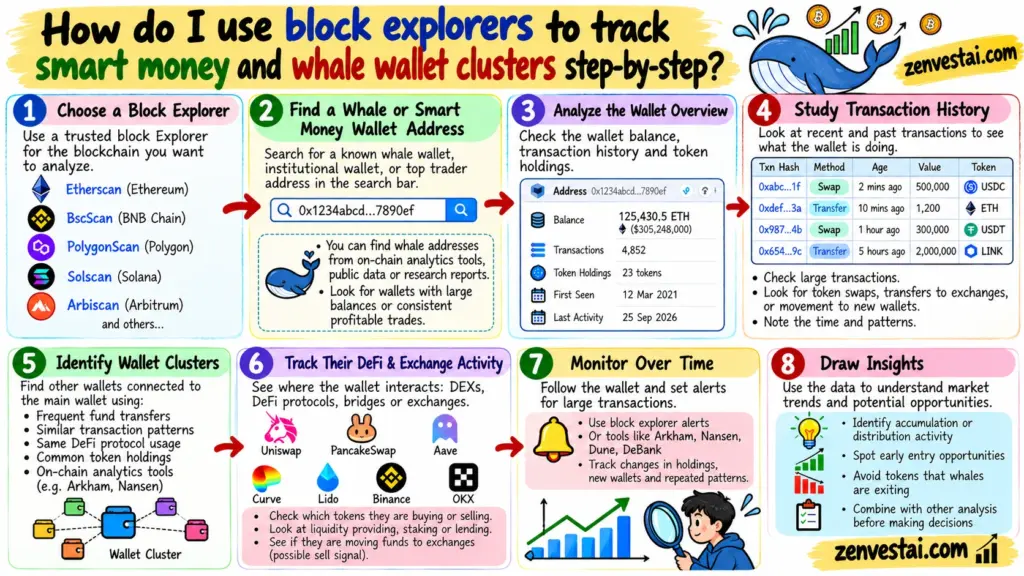
Block explorers to track smart money and whale wallet clusters step-by-step?
Step 1 Choose the Correct Block Explorer
Every blockchain maintains its own unique state database, which requires a specialized explorer to decode raw bytecode into readable transaction data. While unified search interfaces exist, using the explorer natively designed for the host chain delivers the highest data integrity, fastest index times, and cleanest contract verification.
| Blockchain | Primary Explorer | Core Analytical Focus |
| Ethereum | Etherscan | High-value settlement, deep liquidity routing, internal transactions |
| BNB Chain | BscScan | High-frequency retail flows, decentralized exchange (DEX) volume |
| Arbitrum One | Arbiscan | Layer-2 rollup sequencing, low-fee derivative protocol interactions |
| Polygon PoS | PolygonScan | High-throughput payments, gaming infrastructure, micro-transactions |
| Solana | Solscan / SolanaFM | Non-EVM slot processing, high-speed program invocations |
The major EVM-compatible block explorers operate on shared underlying infrastructure. This means mastering the layout, filters, and transaction tabs on Etherscan allows you to navigate BscScan, Arbiscan, and PolygonScan with identical workflows.
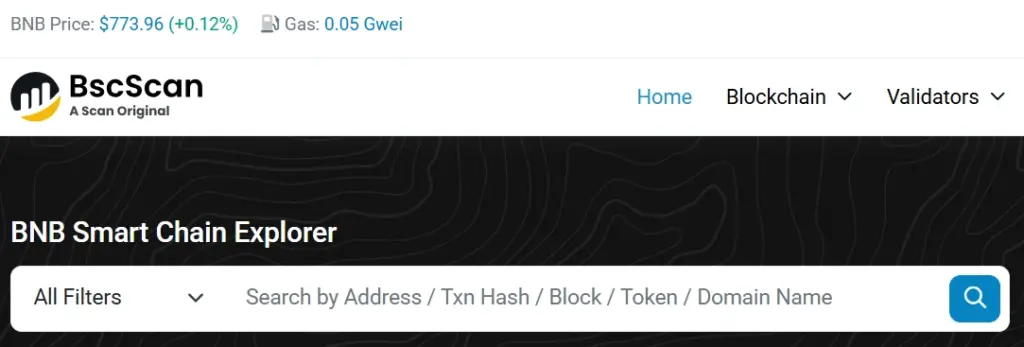
Once your explorer is selected, where do you find the addresses worth monitoring?
Step 2 Find a Whale or Smart-Money Wallet
Finding high-signal addresses requires filtering out passive holders and identifying capital that moves with distinct timing and intent. Use three systematic entry points rather than searching random transaction streams.
Method A: Start With Token Holders
The token holder directory provides an instant map of asset distribution.
- Navigate to the verified token contract page on your chosen explorer.
- Select the Holders tab located in the primary navigation menu.
- Review the top 100 addresses ranked by supply percentage.
- Exclude labeled protocol contracts (such as Uniswap V2/V3 liquidity pools, staking managers, and cross-chain bridge vaults).
- Identify unlabelled, self-custodied addresses showing recent balance accumulation or substantial shifts within the past 14 to 30 days.
Pay close attention to wallets that acquired their positions through multiple distributed DEX transactions rather than single lump sums. This pattern often points to intentional accumulation designed to minimize market impact.
Start With Token Holders
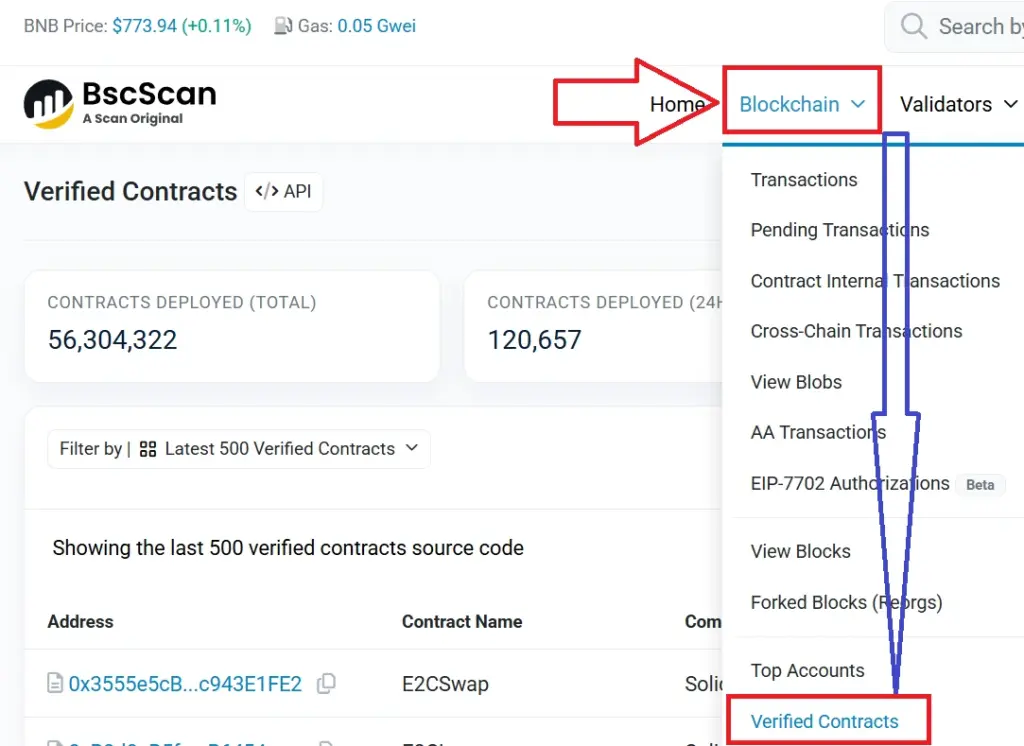
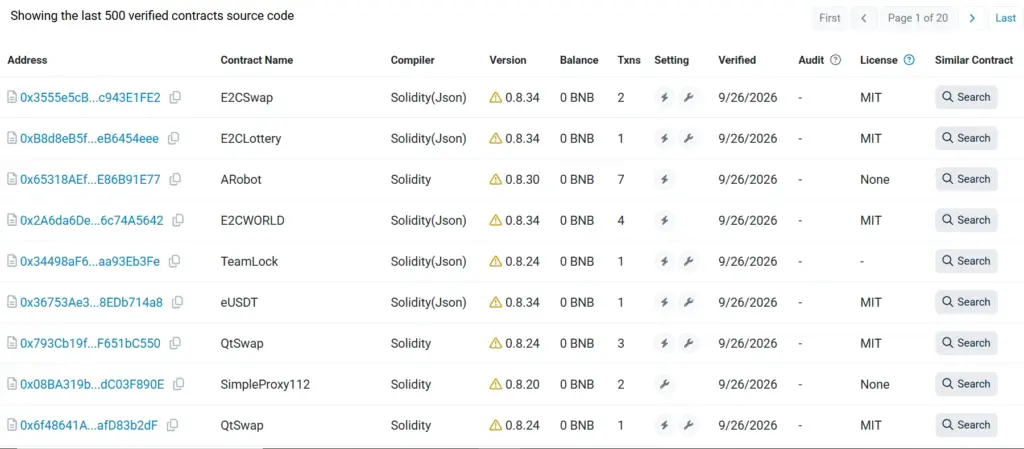
- Open BscScan and search for the token you want to analyze.
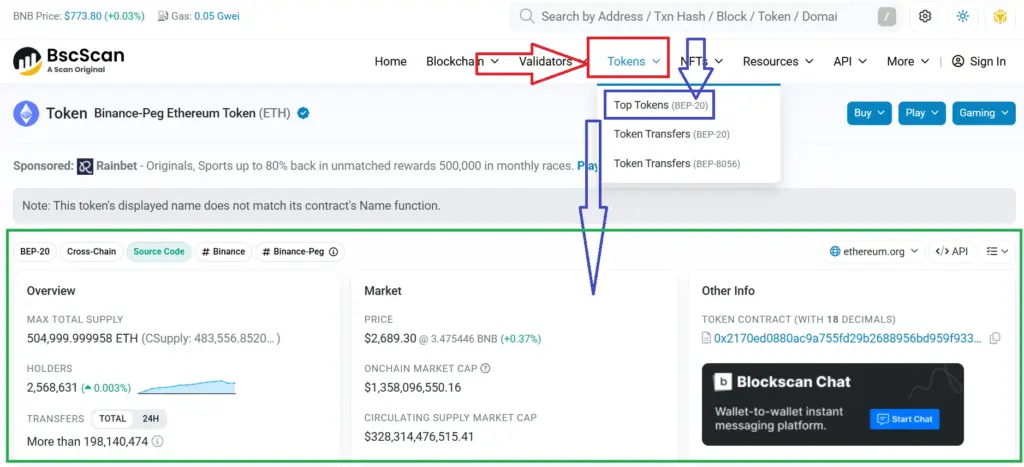
- Go to Tokens → Top Tokens (BEP-20) and open the correct token page.
- On the token page, check the Holders section to see how many wallets hold the token.
- Open the Holders list and start with the largest wallets.
- Exclude known exchange wallets, liquidity pools, staking contracts, bridges, burn addresses, and other protocol addresses.
- Focus on unlabelled wallets that have recently increased their holdings, especially through multiple transactions over the last 14–30 days.
- Compare the wallet’s transaction history and funding source before calling it a potential whale or smart-money wallet.
Image proof: The screenshot shows the path Tokens → Top Tokens (BEP-20) and the token page’s Holders section.
Method B: Start With a Known Transaction
When a sudden price swing occurs, reverse-engineer the move directly from the transaction log:
Transaction Hash → Sender/Receiver Address → Historical Ledger → Portfolio Profiling
Inspect the specific block where volume spiked. Locate the largest swaps executed right before the price adjusted. Open the initiator’s wallet address and examine its trading history over the preceding three months. Consistent entries prior to major public catalysts suggest a wallet worth tracking.
Method C: Follow Large DEX Transactions
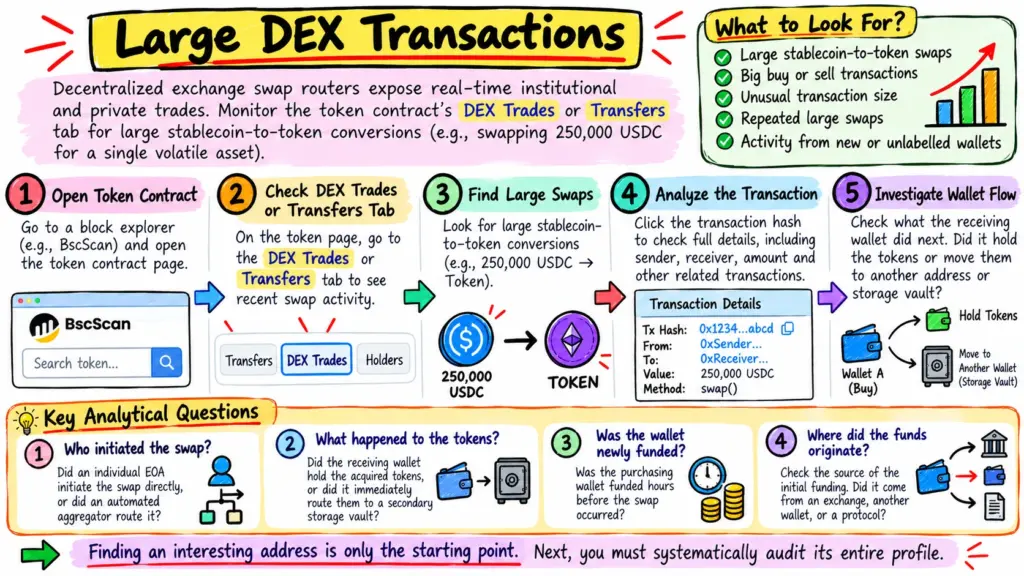
Decentralized exchange swap routers expose real-time institutional and private trades. Monitor the token contract’s DEX Trades or Transfers tab for large stablecoin-to-token conversions (e.g., swapping 250,000 USDC for a single volatile asset).
When you identify a large swap, ask yourself these analytical questions:
- Did an individual externally owned account (EOA) initiate the swap directly, or did an automated aggregator route it?
- Did the receiving wallet hold the acquired tokens, or did it immediately route them to a secondary storage vault?
- Was the purchasing wallet funded hours before the swap occurred?
- Where did that initial funding originate?
Finding an interesting address is only the starting point. Next, you must systematically audit its entire profile.
Step 3 Open the Wallet Address and Read Its Profile
Opening an address page on an explorer like Etherscan reveals the complete operational record of that account. Treat this page as a financial balance sheet and transaction log combined.
WALLET INVESTIGATION CHECKLIST
Native Balance: How much ETH/BNB/SOL is held for transaction fees?
Token Portfolio: Value distribution across liquid and illiquid coins
Age Profile: Timestamp of the first transaction ever recorded
Inbound Velocity: Frequency and average size of incoming deposits
Outbound Velocity: Frequency and destinations of outgoing capital
Internal Transactions: Execution outcomes from smart contracts
Contract Approvals: Active allowances granted to external routers
Multichain Footprint: Duplicate address activity on Layer-2 networks
When reviewing the wallet’s profile, examine the Internal Transactions tab closely. When a wallet interacts with an aggregator like 1inch or an automated lending market like Aave, the transfer of native ETH or underlying tokens occurs through contract execution rather than a direct peer-to-peer transfer. If you only look at standard transactions, you will miss the actual routing of the capital.
Once you have reviewed the basic balances and transaction history, begin mapping out the wallet’s true operational behavior.
Step 4 Identify What the Wallet Is Actually Doing
A raw transaction record can look confusing without proper context. Your objective is to convert individual transactions into a coherent timeline of actions.
Never settle for simple observations like “the wallet bought $500,000 of tokens.” Reconstruct the exact sequence of transactions to uncover the investor’s playbook:
Reconstructing this chain helps you identify whether the wallet owner is a systematic fund, a disciplined accumulator, or a retail participant trading on emotion.
The next phase bridges individual wallet analysis and full cluster mapping: finding where the wallet’s capital originated.
Step 5 Trace the Wallet’s Funding Source
Tracing capital backwards reveals the provenance of the wallet. Every non-custodial wallet requires an initial transaction to deposit native tokens for gas fees before it can execute any contract call or token transfer.
To locate the funding origin on Etherscan:
- Navigate to the wallet’s transaction history.
- Sort the transactions by age to view the earliest recorded event, or check the summary card for the First Txn entry.
- Identify the hash of the very first incoming transaction.
- Record the sending address.
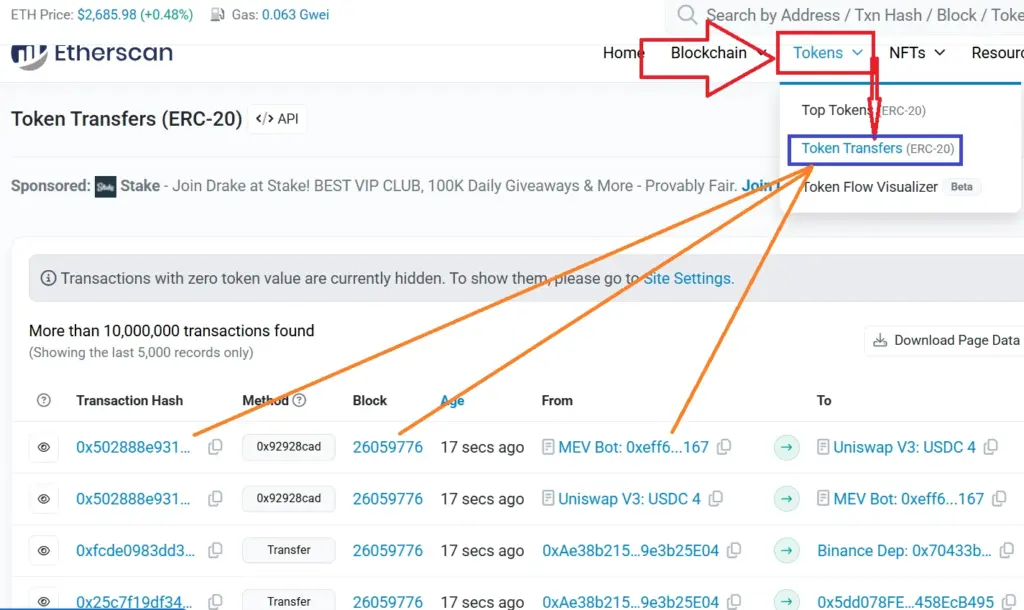
Capital usually originates from one of several distinct sources:
- Centralized Exchange (CEX) Hot Wallet: Indicates an on-ramp deposit, which breaks public on-chain links to earlier funding sources.
- Private Externally Owned Account (EOA): Points directly to an older parent wallet controlled by the same owner or an affiliated counterparty.
- Cross-Chain Bridge Contract: Demonstrates that capital was imported from another network, requiring cross-chain analysis.
- Decentralized Mixing or Privacy Pool: Shows an intentional effort to obscure the transaction trail.
- Protocol Treasury / Vesting Vault: Identifies the address as a team member, early investor, advisor, or foundation participant.
CRITICAL WARNING
A shared centralized exchange funding source DOES NOT prove common
ownership. Exchanges pool user funds into large “hot wallets” that
withdraw to thousands of independent customers every hour.
Exchange Hot Wallet ──┬──> Wallet A (User 1)
└──> Wallet B (User 2)
(These two addresses are completely unrelated in real life.)
If the funding source is a private, unlabelled wallet rather than an exchange hot wallet, you have uncovered your first link in a potential cluster.
Step 6 Find Related Wallets
Once you find a private funding source or unlabelled counterparty, you can begin hunting for companion wallets. Sophisticated market participants spread their operations across multiple accounts to minimize their footprint. You can identify these connected addresses using five primary on-chain links:
Connection 1: Common Unlabelled Funding Source
When an unlabelled private address funds multiple new wallets within a narrow timeframe, those recipient addresses are very likely operated by the same entity.
                Private Funding Wallet
                          │
          ┌───────────────┴───────────────┐
          ▼                               ▼
     Wallet A                       Wallet B
(Receives 2.5 ETH)              (Receives 2.5 ETH)
Connection 2: Direct Wallet-to-Wallet Transfers
Direct transfers of native gas tokens or newly acquired assets between unlabelled addresses provide strong evidence of common control.
Wallet A → Transfer 50,000 TOKEN → Wallet B → Transfer 50,000 TOKEN → Wallet C
Connection 3: Similar Transaction Timing and Block Synchronization
Watch for multiple addresses executing identical transactions within seconds or blocks of each other. If Wallet A, Wallet B, and Wallet C all swap into the same mid-cap token within a five-minute window, they are often executing trades via a single automated script or trading desk.
Connection 4: Repeated Counterparties and Liquidity Routes
If five separate wallets all send their exit proceeds to the exact same intermediate smart contract, over-the-counter (OTC) desk deposit address, or private liquidity vault, they share a clear operational link.
Connection 5: Matching Behavioral Footprints
Look for identical operational habits:
- Do the wallets use the exact same custom gas limits on their transactions?
- Do they trade exclusively through a single decentralized router?
- Do they systematically break purchases into identical tranche sizes (e.g., exactly 12.5 ETH per order)?
Connecting these links enables you to map out the entire operational cluster.
Step 7 Build a Wallet Cluster Map
A cluster map groups connected addresses into a single visual hypothesis. This structured view reveals how capital moves between funding sources, execution wallets, and long-term storage vaults.
The goal of on-chain clustering is not to discover someone’s real-world legal name. Instead, clustering helps you organize related on-chain activity into a clear hypothesis that you can test against future transactions. Once you recognize that three separate addresses function as one coordinated unit, their combined trades give you a much clearer signal of overall market intent.
However, before acting on any cluster hypothesis, you must ensure you have not accidentally swept infrastructure addresses into your tracking group.
Step 8 Separate Real Whales From Exchange and Protocol Wallets
A common beginner mistake is tracking an address with massive token balances, only to realize later that it is simply an automated smart contract or centralized exchange reserve.
Always identify the function of an address before analyzing its trade activity:
| Address Classification | Why It Looks Like a Whale | Identifying On-Chain Characteristics |
| Centralized Exchange Wallet | Massive token reserves, tens of thousands of transactions daily. | Constant inbound/outbound flows from thousands of unique counterparties; usually labeled by explorer tags. |
| Cross-Chain Bridge Vault | Holds huge balances of locked native assets. | Assets enter and lock while wrapped tokens mint on a secondary network; zero discretionary trading behavior. |
| Protocol Treasury | Holds large supplies of native governance tokens. | Movements require multi-signature execution or timelocked on-chain governance votes. |
| Automated Market Maker (AMM) Pool | Holds millions in paired tokens (e.g., ETH/USDC). | Code contract with a public router; balance shifts automatically according to a constant-product formula ($x \cdot y = k$). |
| Market Maker Operational Wallet | High-velocity trading volume, rapid two-way flows. | Maintains balanced exposure; buys and sells simultaneously to capture spreads rather than taking directional positions. |
| Token Burn Address | Massive dead balance (e.g., 0x000...dEaD). | Inbound transfers only; zero outbound transactions or contract approvals recorded. |
| Vesting / Escrow Contract | Holds large supplies of undistributed tokens. | Releases assets on strict programmatic block schedules directly to team or investor contracts. |
Block explorers maintain public directory tags (such as “Binance: Hot Wallet” or “Uniswap V3: Pool”). Check both the address name tag and the contract verification tab before adding any address to your personal watchlist.
Once institutional infrastructure is filtered out, evaluate the strength of the connections linking your cluster together.
Step 9 Verify the Wallet Cluster With Multiple Signals
On-chain analysis relies on probabilistic deductions rather than absolute proof. To prevent false positives, weigh your evidence across three confidence tiers:
Weak Evidence
- Purchasing the same token around the same time
- Funding accounts through the same centralized exchange hot wallet
- Using the same decentralized exchange router
Moderate Evidence
- Direct transfers of assets between unlabelled wallets
- Sharing a private, un-tagged funding source
- Synchronized order execution within identical transaction blocks
Strong Evidence
- Multiple addresses sweeping their final balances into a single private wallet
- Identical custom contract interactions and shared multi-sig administrative keys
- Repeated, multi-hop capital recycling across extended timeframes
Treat single transaction links as exploratory hints. Only upgrade your hypothesis to a verified cluster when an address group demonstrates both shared capital pathways and synchronized trading execution over several weeks.
Once verified, move the cluster from your research ledger to an active monitoring system.
Step 10 Track Smart-Money Activity Over Time
Analyzing historic transactions provides context, but catching transactions as they happen delivers actionable insight. Set up an active monitoring workflow across your confirmed clusters:
- Explorer Watchlists: Create a free account on the block explorer and add your target addresses to your personal Watch List. Configure alerts for all incoming and outgoing transaction events.
- Transaction Method Filtering: Pay special attention to specific contract calls like
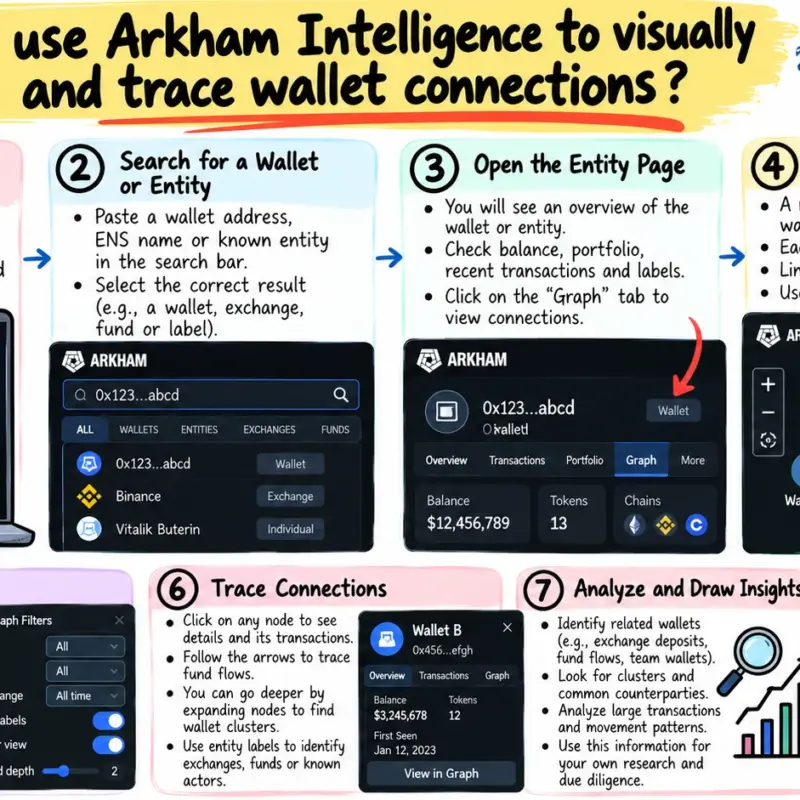
Swap,AddLiquidity, andTransfer. These method calls reveal strategic shifts long before general token balances reflect the change. - Specialized Analytics Platforms: Combine primary block explorer records with visualization tools like Arkham Intelligence or Nansen. These platforms help you map complex transaction networks visually and manage entity-level labels across multiple chains.
To choose the right monitoring approach, consider the complementary roles played by raw block explorers and specialized analytics platforms.
Block Explorer vs. On-Chain Analytics Platform
Understanding when to use a block explorer versus a specialized analytics platform will save you time and keep your research accurate.
| Feature / Capability | Native Block Explorer (e.g., Etherscan) | Specialized Analytics Platform (e.g., Arkham, Nansen) |
| Raw Transaction Audit | Complete, authoritative, down to the exact EVM bytecode | Filtered or aggregated; may omit failed transaction internals |
| Token Transfer History | Comprehensive event logs for all standard contract types | Aggregated balance views; occasional delay in indexing fresh tokens |
| Smart Contract Interaction | Direct access to read/write functions and Solidity source code | Limited to supported protocol interfaces and simplified views |
| Address Identification | Conservative, community-verified entity tags | Proprietary machine-learning and heuristic entity clustering |
| Visual Transaction Graphs | Basic line charts or text lists of transaction logs | Interactive node-link diagrams showing multi-hop fund routing |
| Cross-Chain Asset Mapping | Isolated to a single network per explorer instance | Unified dashboards tracking portfolios across EVM and non-EVM chains |
| Alert Infrastructure | Standard email notifications for basic address activity | Highly customizable alerts based on USD value, token type, and counterparties |
| Cost Profile | 100% free public utility | Tiered subscription models with gated institutional features |
Use block explorers as your definitive source of on-chain truth. Use analytics platforms to quickly form initial hypotheses, then verify those insights against raw explorer data.
Here is the complete investigative process distilled into a repeatable checklist.
A Complete Whale Wallet Tracking Workflow
Follow this ten-step sequence whenever you analyze a new market move:
What Signals Should You Track?
Not every transaction requires your attention. Focus your research on high-impact on-chain signals that point to decisive strategic moves:
| On-Chain Behavioral Signal | Potential Strategic Meaning | What to Verify Next |
| Sustained Accumulation | Steady spot position building over an extended period. | Check if the purchases are spread across multiple DEX pools to minimize price impact. |
| Direct Transfers to an Exchange | Preparation to sell assets or use them as margin collateral. | Check if the recipient address matches an exchange deposit address, and monitor order books for sell pressure. |
| Large Exchange Withdrawals | Moving assets into cold storage for long-term holding. | Confirm the destination is a secure self-custody wallet rather than a temporary holding account. |
| Sudden Stablecoin Inflows | Fresh capital arriving to fund future token purchases. | Trace the funding origin to see if the capital came from an OTC desk or another protocol exit. |
| Dormant Wallet Activation | An inactive whale moving capital after months or years of silence. | Review which assets are moving and whether spending permissions were recently granted to DEX routers. |
| Synchronized Cluster Buying | Multiple related wallets purchasing the same asset simultaneously. | Calculate the total volume purchased across the cluster to determine combined market exposure. |
| Cross-Chain Bridge Routing | Capital migrating toward opportunities on Layer-2 or alternative chains. | Monitor the corresponding bridge contract on the destination chain to locate the receiving wallet. |
Never interpret these signals in isolation. A whale moving tokens to an exchange might be preparing to sell, or they could simply be depositing collateral to borrow against their position without triggering a taxable event. Always look for supporting evidence across the wallet cluster.
Common Mistakes When Tracking Whale Wallets
Avoid these ten common pitfalls when analyzing on-chain activity:
Mistake 1: Assuming Every Large Balance Is Smart Money
Large account balances often belong to early project founders, passive long-term holders, or custodial institutions. These participants rarely trade actively, and their wallet balances reflect patience rather than tactical market timing.
Mistake 2: Treating an Isolated Transaction as a Pattern
A single large purchase is not proof of an informed investment strategy. Even well-capitalized traders make emotional decisions or execute unprofitable trades. Look for a track record of consistently profitable entries and exits over several market cycles.
Mistake 3: Assuming Shared Exchange Funding Proves Shared Ownership
As noted earlier, centralized exchange hot wallets withdraw capital to thousands of unrelated customers. Never cluster two addresses together solely because they received their initial gas funds from the same exchange.
Mistake 4: Misinterpreting Internal Smart-Contract Transactions
Direct token transfer logs only tell part of the story. If a trade executes through complex DeFi routing contracts or aggregators, the actual balance changes will appear under Internal Transactions or the token log, not the standard transaction ledger.
Mistake 5: Overlooking Token Approval Allowances
When a wallet interacts with a decentralized platform, it grants a token spending allowance to that smart contract. Auditing these approvals often reveals which new protocols a whale plans to use long before they deposit funds.
Mistake 6: Confusing Simple Transfers With Buys and Sells
Moving 10,000 tokens between two private wallets is not a trade; it is a routine custody transfer. Make sure you confirm an actual exchange of assets against a DEX liquidity pool or an OTC counterparty before logging a buy or sell event.
Mistake 7: Ignoring Wrapped and Synthetic Assets
Whales frequently move capital using synthetic derivatives (such as liquid staking tokens like stETH or wrapped tokens like WBTC) rather than native assets. If you only track native ETH, you will miss significant shifts in their overall portfolio.
Mistake 8: Limiting Your Investigation to a Single Blockchain
Sophisticated operators rarely stay on a single chain. If a wallet suddenly empties its balance into a bridge contract, follow the transaction to the destination chain. An apparent exit on Ethereum mainnet might simply be capital redeploying onto Arbitrum or Base.
Mistake 9: Misinterpreting Dust Transactions and Phishing Airdrops
Scammers regularly send unsolicited tokens (“dust”) to high-profile whale wallets to trick public observers into buying malicious projects. Always verify whether the wallet owner intentionally purchased the token or simply received it unprompted from a third party.
Mistake 10: Copy-Trading Without Accounting for Slippage and Liquidity
Attempting to instantly copy-trade whale transactions without verifying market depth often leads to poor execution. A trade size that moves the market slightly for a well-funded wallet can result in heavy slippage and unfavorable pricing for a retail trader.
Frequently Asked Questions
What is a block explorer used for in crypto?
A block explorer is a public search engine that indexes and displays raw blockchain data. It allows users to review transaction confirmations, audit token balances, verify smart-contract code, monitor gas fees, and track the movement of funds between public wallet addresses.
How do I find whale wallets?
You can find whale wallets by opening the Holders tab on verified token contracts via block explorers like Etherscan. You can also monitor real-time swap transactions on major decentralized exchanges or review the richest address distribution lists for native assets.
How do I track smart money on-chain?
To track smart money, locate wallets that show a consistent history of entering positions ahead of major volume expansion and exiting profitably. Trace their transaction sequences, audit their decentralized exchange interactions, and monitor their active addresses using explorer watchlists.
How can I tell if two wallets belong to the same entity?
While you cannot prove identity with absolute certainty using public records alone, you can infer common ownership when wallets share unique private funding sources, transfer capital directly to one another, execute synchronized trades within the same block, or share identical counterparty destinations.
Can block explorers identify wallet owners?
Block explorers display public addresses and transaction metadata, but they do not inherently expose the real-world legal identities of wallet owners. However, real-world attribution can occur if an address interacts with a know-your-customer (KYC) regulated service, uses a public domain name (like an ENS address), or publicly confirms ownership.
How do I track a whale wallet’s transactions?
Locate the wallet’s public address on the appropriate block explorer, then review its Transactions, Token Transfers (ERC-20/BEP-20), and Internal Transactions tabs. To monitor the address continuously, create an explorer account and add the address to your automated email notification watchlist.
What is wallet clustering in crypto?
Wallet clustering is an analytical method that groups multiple discrete blockchain addresses into a single operational profile based on shared transaction timing, identical funding pathways, direct token transfers, and common interaction patterns.
Are whale wallets always smart money?
No. Whale wallets are defined purely by their large token balances, which may simply represent early mining rewards, protocol treasury reserves, or static institutional custody. Smart money is defined by disciplined market timing, strategic capital rotation, and measurable trading performance.
Can I track whale wallets for free?
Yes. Major block explorers such as Etherscan, BscScan, and Arbiscan are completely free public tools. You can inspect transactions, audit token distributions, trace funding origins, and set up address tracking notifications without paying for premium software.
What is the difference between Etherscan and Arkham?
Etherscan is a primary block explorer that presents complete, unvarnished on-chain records and smart-contract code for the Ethereum network. Arkham is an analytics platform that aggregates cross-chain data, applies algorithmic entity clustering labels, and provides interactive visual transaction mapping.
The ZenvestAI View: The Evolution of On-Chain Analysis
At ZenvestAI, we see on-chain tracking entering a new era of sophistication. The days when a market participant could follow a single public address and generate consistent alpha are largely gone. As institutional capital and automated market makers have expanded their footprint, capital management practices have matured significantly.
Today’s market participants routinely use automated execution scripts, rotate ephemeral single-use addresses, and use decentralized cross-chain liquidity networks to break obvious transaction links. However, because blockchains are fundamentally deterministic, every capital movement leaves an indelible digital footprint.
The competitive edge in modern on-chain research no longer comes from having access to private data. The data is already open to everyone. Instead, success comes from applying disciplined forensic analysis: separating operational infrastructure from strategic capital, building rigorous cluster hypotheses, and verifying transactions methodically over time.
The Bottom Line on How do I use block explorers to track smart money and whale wallet clusters step-by-step?
Tracking smart money is not about finding the single largest wallet on a balance sheet. It is about reconstructing an investor’s complete operational timeline tracing their initial funding sources, identifying related companion addresses, filtering out passive infrastructure, and verifying behavioral patterns over extended market cycles.
Related Intelligence and Verified Resources
To continue your on-chain research, refer to these primary documentation resources and official analytics portals:
- Ethereum Foundation Documentation: Technical explanations of account structures, externally owned accounts (EOAs), and smart contracts.
- Etherscan Knowledge Base: Official user guides covering transaction verification, token tracking, and watch-list configuration.
- BscScan Directory: Verified contract registries and holder distributions across the BNB Chain ecosystem.
- Arbiscan Portal: Rollup-specific transaction sequencing and Layer-2 execution documentation.
- Solscan Analytics Hub: SPL token accounting standards and Solana account state frameworks.
- Arkham Intelligence Platform: Entity-level database registries and interactive network flow graphs.
- Dune Analytics Public Dashboards: Community-curated SQL queries analyzing smart-money accumulation across major decentralized protocols.
Editorial Information & Global Regulatory Compliance
Published By: ZenvestAI Research Team
Global Regulatory Disclosure:
This guide is published strictly for educational, informational, and technical research purposes in accordance with global financial publication standards, including frameworks established by the International Organization of Securities Commissions (IOSCO), the U.S. Securities and Exchange Commission (SEC), and the European Union’s Markets in Crypto-Assets (MiCA) regulation.
Nothing contained within this article constitutes financial advice, investment recommendations, securities endorsements, or legal solicitation. Public blockchain data is neutral and informational. Tracking wallet clusters involves probabilistic deductions that can result in analytical errors. Market participants must perform independent research, evaluate their own risk tolerance, and consult licensed legal and financial professionals before committing capital to digital assets.