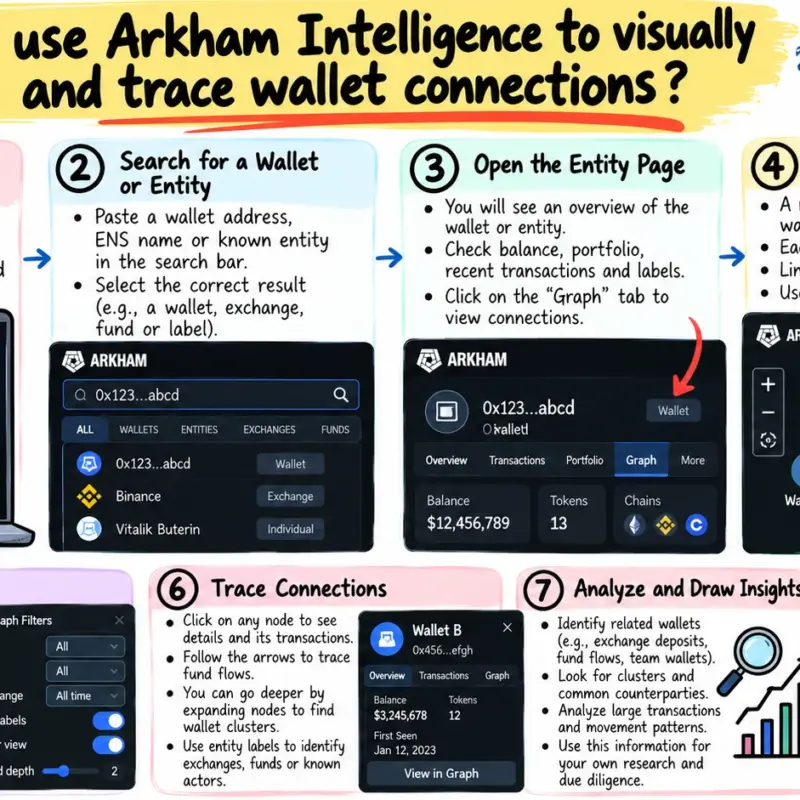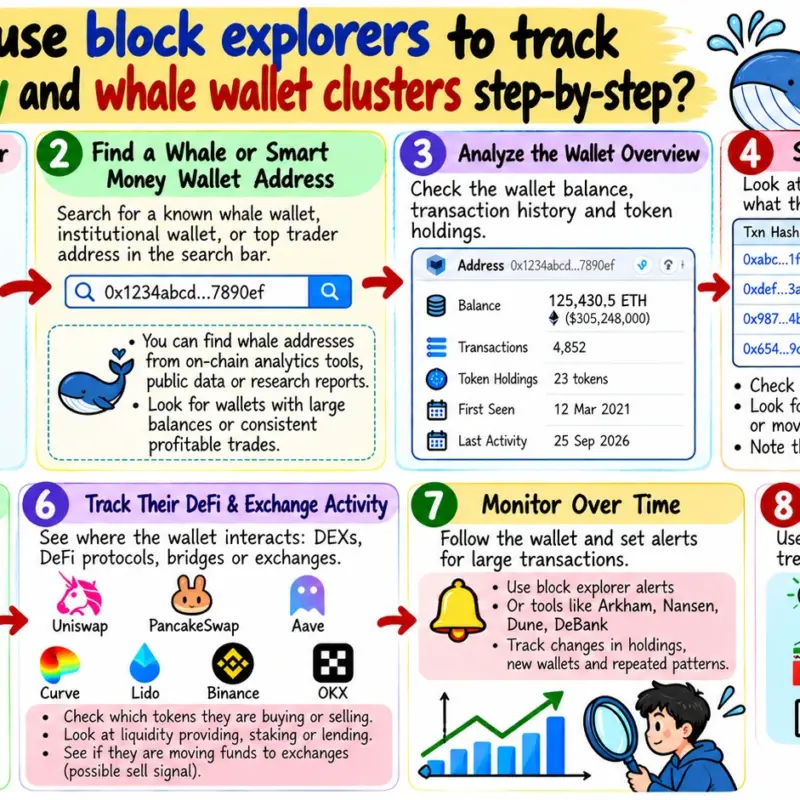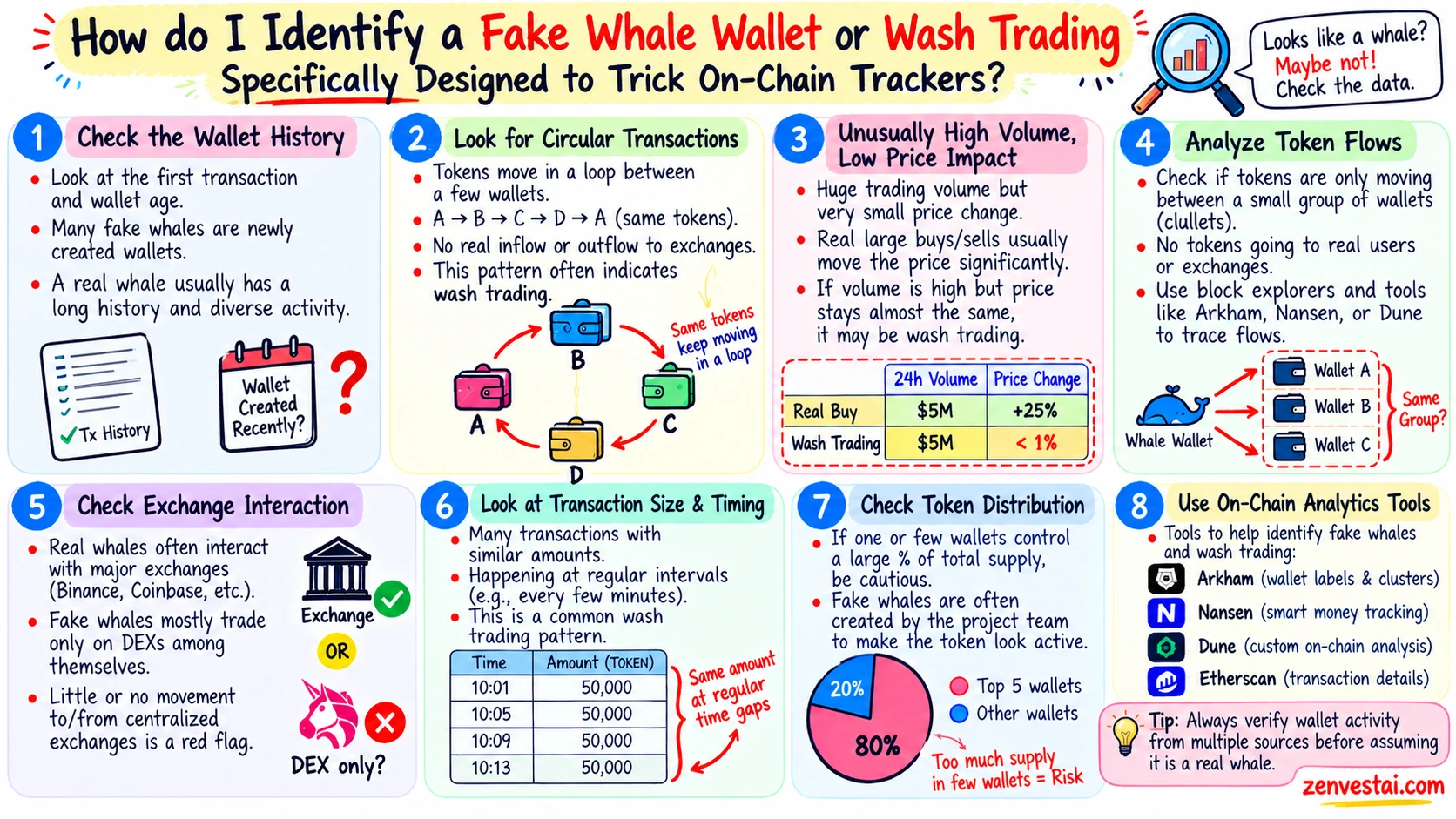
Your favorite token tracking alert just pinged your phone with a sudden alert: forty new wallets just bought $350,000 worth of a micro-cap token in three minutes, and a known smart-money whale entered the pool.
Your immediate instinct as an investor is to buy before the crowd notices, fearing you will miss the next massive rally.
Manipulators know you are watching that exact data feed. Professional market syndicates have moved far beyond amateur single-wallet buying and selling.
Today, deceptive actors deploy algorithmic bots, multi-wallet disperse contracts, and synthetic liquidity cycles explicitly engineered to trick on-chain trackers like DexScreener, DEXTools, Arkham, and Nansen into broadcasting fake accumulation alerts.
According to forensic research by Chainalysis, suspected wash trading across decentralized exchange (DEX) pools generates billions of dollars in artificial volume annually.
In October 2024, the U.S. SEC charged several crypto market makers, including Gotbit, ZM Quant, and CLS Global, alleging that they used algorithms and self-trading to create artificial trading volume.
The alleged activity involved wash trading across crypto trading platforms, making tokens appear more actively traded than they actually were.
In simple terms, the goal was to create fake market activity that could mislead investors and market-data trackers. When retail investors rush into these traps, the syndicates pull liquidity or dump developer reserves, leaving latecomers holding worthless tokens.
Identifying these advanced deceptive tactics requires shifting focus from isolated wallet actions to systemic behavioral forensics.
Table of Contents
- How do I identify a fake whale wallet or wash trading specifically designed to trick on-chain trackers
- How to Unmask a Fake Whale in Under 60 Seconds
- What You Need in Your Forensic Toolkit
- Before You Start: Understanding How Automated Trackers Get Tricked
- Step 1 Trace the Gas Funding (Shared Control)
- Step 2 Map Circular Transfers (The Loop)
- Step 3 Compare Volume Against Price Impact
- Step 4 Check for Unnatural Trade Sizes (The Roundness Trick)
- Step 5 Identify “Address Poisoning” (Zero-Value Spoofing)
- Deceptive Whale Archetypes & Tactics You Must Recognize
- Behavioral Footprints of Advanced Wash Trading
- Security and Safety: Protecting Your Capital from Traps
- Costs: The Operational Overhead of Forensic Analysis
- Common Mistakes Analysts Make When Tracking Wallets
- Troubleshooting: What to Do When Data Is Obfuscated
- Alternative Methods for Verifying On-Chain Demand
- Frequently Asked Questions
- The ZenvestAI View
- Related Intelligence
- Author & Editorial Information
- Regulatory Disclosures
- Resources & Verified Data Sources
How do I identify a fake whale wallet or wash trading specifically designed to trick on-chain trackers
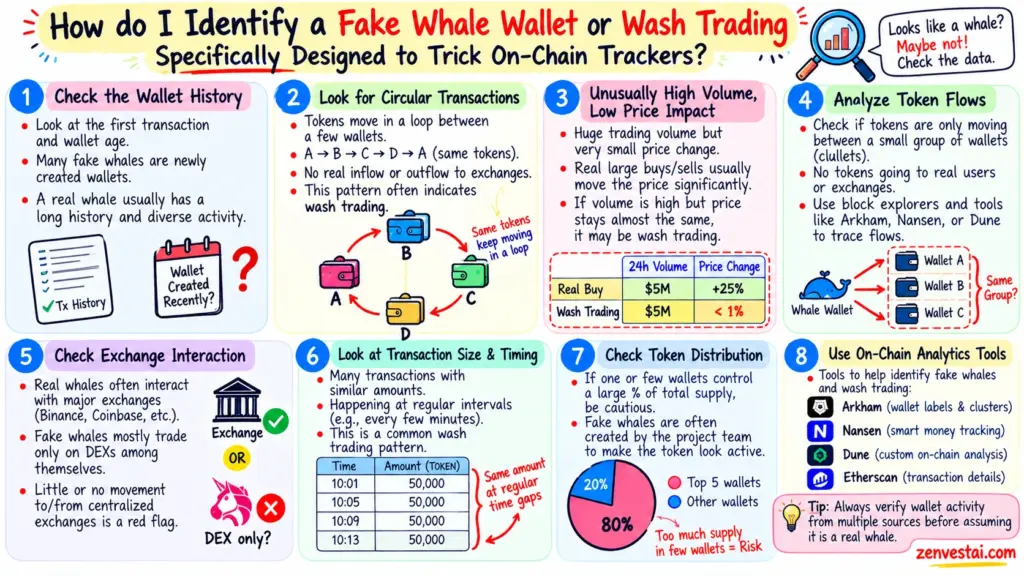
This guide “How do I identify a fake whale wallet or wash trading specifically designed to trick on-chain trackers?” breaks down the architecture of manufactured volume and fake whale accumulation, giving you the practical steps, mathematical checks, and tools needed to protect your capital.
DECEPTIVE WHALE TRAP VS. REAL ACCUMULATION
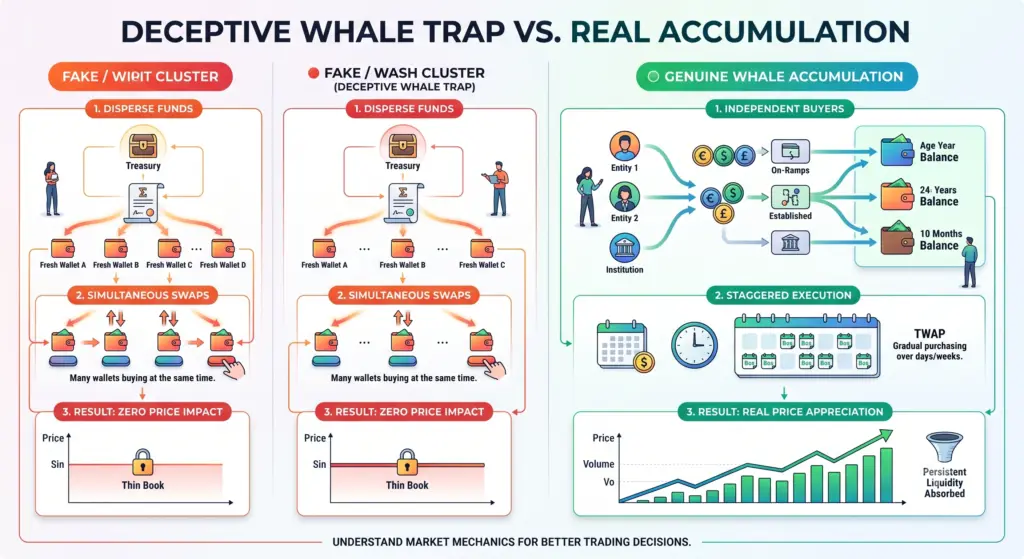
🔴 Deceptive Whale Trap (Fake / Wash Cluster)
- Step 1: Funds originate from a Central Treasury.
- Step 2: A Disperse Contract splits the funds.
- Step 3: Funds land in multiple Fresh Wallets (A, B, C).
- Step 4: Wallets execute Simultaneous Swaps.
- Result: Zero Price Impact and a Thin Order Book.
- Step 1: Funds originate from Independent Entities.
- Step 2: Capital flows through Diverse Fiat On-Ramps.
- Step 3: Funds are held in Distinct Whale Balances (aged/established wallets).
- Step 4: Buyers use Staggered TWAP Execution (Time-Weighted Average Price).
- Result: Real Price Appreciation and Persistent Liquidity Absorbed.
How to Unmask a Fake Whale in Under 60 Seconds
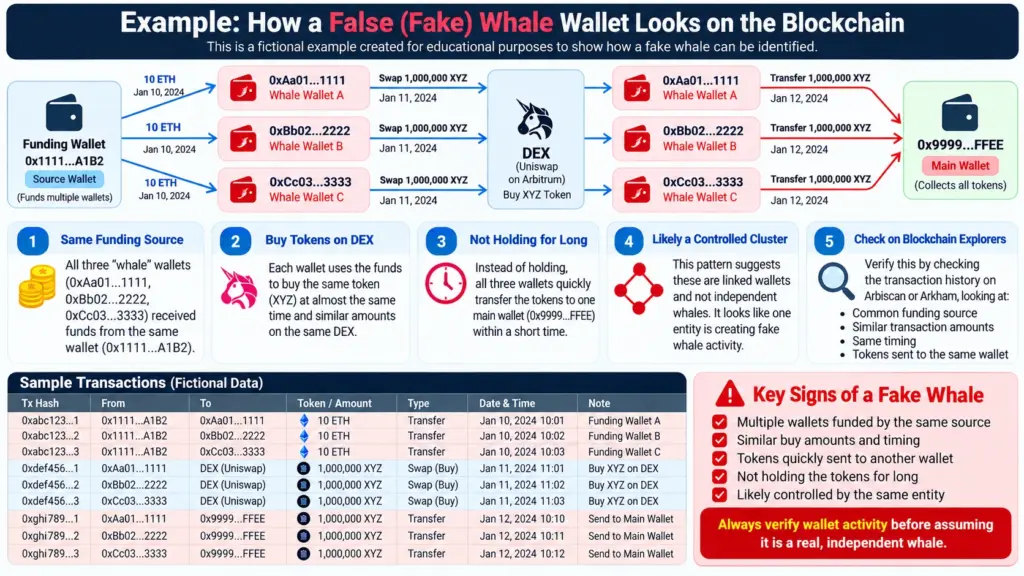
A fake whale is rarely a single wallet; it is a coordinated cluster of disposable addresses controlled by one entity to simulate synthetic volume and organic demand.
To confirm whether a token’s trading surge or whale entry is legitimate, run this rapid three-point verification:
- Verify the Gas Funder: Open the block explorer for any suspicious “fresh whale” and check the transaction hash of its very first native coin balance (ETH, SOL, or BNB). If multiple buyer wallets trace back to the same multi-sender contract, personal address, or centralized exchange deposit address, they are a single Sybil cluster.
- Calculate Price Impact per Volume: Compare the 24-hour reported volume against liquidity pool depth and token price change. If a token shows $2,000,000 in daily volume but price moved less than 2% in a shallow $40,000 liquidity pool, bots are cycling the same tokens in closed loops without beneficial change in ownership.
- Inspect the Trade Roundness: Look at the trade logs on the decentralized exchange. If transactions show identical round figures (such as exactly 5,000.00 tokens or repeated $250.00 trades executed every 12 seconds), the activity is driven by a volume script rather than natural human order flow.
If a token fails even one of these three tests, treat its volume as synthetic and do not commit capital.
What You Need in Your Forensic Toolkit
You do not need expensive proprietary software to detect professional wash trading, but you do need access to raw on-chain data rather than social media dashboards.
Before starting your investigation, keep the following free and freemium resources ready in your browser:
- Primary Block Explorers: Etherscan (for Ethereum and Layer-2 networks), Solscan (for Solana), and BscScan (for BNB Smart Chain).
- Graph & Wallet Clustering Platforms: Arkham Intelligence or Breadcrumbs.app for mapping transaction connections between addresses.
- DEX Liquidity & Chart Trackers: DexScreener or GeckoTerminal to analyze real-time trade logs, pool depth, and spread anomalies.
- Contract Visualizers & Query Tools: Dune Analytics to query cluster distributions and verify strongly connected components in liquidity pools.
Before You Start: Understanding How Automated Trackers Get Tricked
Trackers rely on automated algorithms that scan for specific trigger events: volume surges, fresh wallet purchases, and transactions linked to labeled “smart money” public keys.
Manipulative actors exploit these automated triggers by designing transactions that look organic on the surface:
- Trigger 1: Fresh Wallet Volume: Bots flag sudden purchases from new addresses as potential “insider buying.” Creators bypass this by dispersing funds from a central treasury to dozens of fresh wallets right before deployment.
- Trigger 2: Volume Leaderboards: Tracking sites rank trending tokens by 24-hour volume. Creators buy automated volume-as-a-service packages to run continuous swap loops, keeping their tokens on the front page.
- Trigger 3: Smart Money Alerts: Trackers ping subscribers whenever an address tagged as an elite fund or trader buys an asset. Creators exploit this by sending free tokens to famous addresses or utilizing zero-value transactions to falsify wallet interaction records.
Once you know what triggers these algorithms, you can look beneath the headline alert to check whether the underlying capital is real.
Step 1 Trace the Gas Funding (Shared Control)
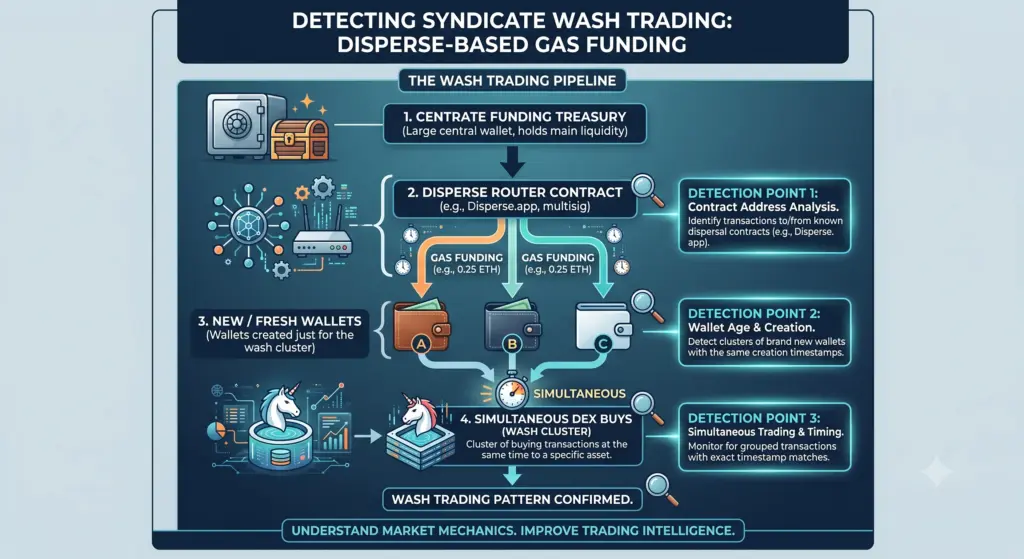
A single syndicate running fifty “independent” buyer wallets faces an unavoidable bottleneck: every transaction on a public blockchain requires native gas (such as ETH, SOL, or BNB) to execute.
| Step | Action | Key Detection Metric |
| 1. Source | Funds move from a Syndicate Funding Treasury (A central, pre-funded wallet). | Monitor high-value, central ‘treasury’ wallets for regular, small outflows. |
| 2. Routing | Capital flows through a Disperse Router Contract (e.g., Disperse.app, Multisig). | Identify interaction with known ‘dispersal’ or batch-payment router addresses. |
| 3. Payouts | The contract executes simultaneous, small ETH payouts (e.g., 0.25 ETH each). | Detect patterns of identical, low-value funding amounts distributed simultaneously. |
| 4. Recipients | Funds land in Multiple Fresh Wallets (A, B, C) created for the scheme. | Use wallet age analysis: These wallets are typically hours or days old, with minimal prior history. |
| 5. Action | Recipients execute Simultaneous ‘Whale’ DEX Buys to pump the asset. | Cluster Analysis: Look for perfect timestamp matches for distinct wallets buying the same asset. |
Manipulators rarely fund fifty wallets manually from fifty different non-custodial accounts. Instead, they use multi-send tools (such as Disperse.app) or transfer gas directly from a central treasury wallet. By examining the birth of a wallet, you can determine if an entire group of buyers is linked.
What should You do now?
- Pick three to five wallet addresses that executed large purchases during the volume spike.
- Paste each address into the search bar of the relevant block explorer (Etherscan for Ethereum/Base or Solscan for Solana).
- Scroll down to the very earliest transaction in the wallet’s history. Click the transaction hash where the wallet received its initial native gas deposit.
- Check the From field. If all five wallets received identical gas allocations (for example, exactly 0.15 ETH or 2.5 SOL) from the same sender address within an hour, you have identified a Sybil cluster.
- If the funding came from a centralized exchange hot wallet, check the deposit memo and look at the wallet’s outward transfers. If multiple suspicious wallets subsequently deposit profits back into the exact same exchange deposit address, they belong to the same operator.
Now that you know whether the wallets share a single funding parent, you need to check how their tokens move after the purchase.
Step 2 Map Circular Transfers (The Loop)
Legitimate market participants buy an asset and either hold it in storage, transfer it to cold custody, or sell it back to an independent buyer.
In wash trading, the underlying economic benefit never leaves the controlling entity. The manipulator must recycle their capital back to their main treasury so they can repeat the process without running out of funds.
Rather than basic two-wallet loops (Wallet A sells to Wallet B, Wallet B sells back to Wallet A), sophisticated syndicates construct cyclic graphs with three to ten intermediaries through smart contracts:
Treasury → Wallet A → AMM Pool → Wallet B → Wallet C → Treasury
CYCLIC MULTI-WALLET RECIRCULATION

        ┌───────────────────────────────┐
        │                               │
        ▼                               │
   [Wallet A] ──(DEX Swap)──► [Wallet B]
                                │
                                ▼ (Direct Transfer)
   [Wallet D] ◄──(DEX Swap)── [Wallet C]
        │
        └───────────────────────────────┘
What should You do now?
- Copy the token contract address and open a visual transaction mapper like Breadcrumbs.app or Arkham Intelligence.
- Load the transaction history of the top three buyer wallets from the recent volume surge.
- Look for closed loops in the visual graph. If tokens or stablecoins move through a chain of intermediaries and consistently return to a single collection address, you have uncovered a strongly connected component (SCC).
- Check the timing of the transfers. Wash trading loops generally execute in tightly coordinated waves, where tokens leave Wallet A, pass through the liquidity pool via Wallet B, and return to the primary reserve in under fifteen minutes.
Once you have verified the flow of tokens between wallets, the next step is to evaluate how that trading activity influences the market price.
Step 3 Compare Volume Against Price Impact
In an authentic market operating under automated market maker (AMM) mechanics, substantial buying volume changes the ratio of assets in the liquidity pool, driving the price upward.
Most decentralized exchanges operate on the constant-product formula:
x · y = k
Where x represents the balance of base tokens in the pool, y represents the quote asset (such as ETH, SOL, or USDC), and k is an invariant constant. Every legitimate purchase removes token x and adds asset y, shifting the spot price:
ΔP ≈ 2 · Δy / y
If a token registers massive daily trading activity while its price stays completely flat, the activity is non-directional wash trading. Manipulators buy and sell equivalent quantities in rapid succession, generating high volume fees for the pool while canceling out directional price movement.
VOLUME VS. PRICE ANOMALY COMPARISON
| Natural Market Buying | Synthetic Wash Trading |
|---|---|
| Volume: $500,000 | Volume: $2,500,000 |
| Liquidity: $100,000 | Liquidity: $40,000 |
| Price Shift: +35% to +80% | Price Shift: +1.2% |
| [Significant Pool Imbalance] | [Matched Buy/Sell Equalization] |
| [Persistent Price Appreciation] | [Flat Price with Artificial Volume] |
What should You do now?
- Open DexScreener and navigate to the token’s overview page.
- Note three primary figures: 24h Volume, Total Liquidity, and 24h Price Change.
- Calculate the Volume-to-Liquidity Ratio (V/L):
V/L Ratio = 24h Trading Volume / Total Available Liquidity - A healthy token on a major DEX typically displays a V/L ratio between 0.5 and 3.0. If a token shows a V/L ratio above 25 (for instance, $3,000,000 in volume on only $60,000 of locked liquidity pool depth) and the price change is under 3%, you are looking at artificial volume designed to place the token on volume trending lists.
- Simulate a small transaction in the swap interface to test order book depth. If a simple $300 purchase causes a 4% price impact, but the chart claims millions of dollars in volume just moved through the pool without moving the needle, the volume was fabricated using offsetting orders.
If the volume numbers do not align with the price chart, inspect the trade log to see how the individual transactions were structured.
Step 4 Check for Unnatural Trade Sizes (The Roundness Trick)
Natural human trading in open financial markets creates uneven, fractional order sizes due to varying portfolio values, slippage tolerances, and decentralized exchange fees.
Wash trading scripts, by contrast, are written for computational efficiency and fixed budget management. When bad actors configure bots to hit specific daily volume targets, the code often executes fixed token quantities or standardized dollar equivalents at regular intervals.
Furthermore, authentic financial transactions naturally follow Benford’s Law. According to this mathematical rule, in naturally occurring numerical datasets, the number 1 appears as the leading first digit approximately 30.1% of the time, followed by 2 (17.6%), decreasing down to 9 (4.6%). Automated wash trading scripts produce unnatural number distributions that deviate sharply from this curve.
BENFORD'S LAW DISTRIBUTION VS. WASH TRADING BOTS

  Digit Frequency (%)
   35% ┤  ██
   30% ┤  ██ (30.1%)
   25% ┤  ██          [Natural Market Distribution: 1 > 2 > 3...]
   20% ┤  ██   ██
   15% ┤  ██   ██   ██
   10% ┤  ██   ██   ██   ██
    5% ┤  ██   ██   ██   ██   ██   ██   ██   ██   ██
    0% └───┴────┴────┴────┴────┴────┴────┴────┴────┴───
          1    2    3    4    5    6    7    8    9   (First Digit)

  Bot-Driven Distribution (Anomalous Spikes):
  Spikes heavily at '5' and '1' due to repeated $500, $5,000, and $1,000 orders.
What should you do now?
- Go to the transaction history or trade stream table on DexScreener or GeckoTerminal.
- Filter the trade log to view the last 100 swaps.
- Check the order sizes in the Total USD or Token Amount columns.
- Scan for repeating numbers. If you see repeated orders of identical values—such as 10,000 tokens bought, then 10,000 tokens sold, or recurring orders of exactly $500.00 every thirty seconds—a bot is running a volume-boosting script.
- Check transaction execution intervals. If trades occur at exact mathematical intervals (for example, exactly every 12 seconds across consecutive blocks), you are observing automated scripts rather than human traders.
Even if trade sizes look moderately varied, there is one more deceptive trick operators use to fake smart-money interest without spending capital.
Step 5 Identify “Address Poisoning” (Zero-Value Spoofing)
Smart-money alert channels regularly monitor the public wallets of well-known venture funds, market makers, and industry figures like Vitalik Buterin or major funds.
Scammers exploit this monitoring through zero-value address poisoning. Under the standard ERC-20 token interface, the transferFrom function allows any caller to transfer 0 tokens from any address to any other address without requiring the private key of the sender:
transfer From(from: Victim Whale, to: Attacker Wallet, amount: 0)
When an on-chain tracker processes this event, it registers a transaction initiated by the whale wallet. Unwary traders see an alert reading “Whale X transferred NewToken,” assume the whale is accumulating, and buy the token.
ZERO-VALUE ADDRESS POISONING MECHANICS

   [Scammer Address] ──► Calls Token Contract
                                │
                                ▼
   transferFrom(from: [Known Whale], to: [Attacker], value: 0)
                                │
                                ▼
   [Block Explorer Logs Event]: "Whale Transferred Token XYZ"
                                │
                                ▼
   [Automated Tracker Ping]: "Smart Money Interaction Detected!"
                                │
                                ▼
   [Retail Buys Scam Token] ──► Attacker Dumps Reserves
What should You do now?
- When you see an alert that a famous whale or smart-money address has interacted with a token, open the specific transaction hash on Etherscan.
- Look at the Value and Tokens Transferred fields.
- Verify whether the transferred quantity is
0or if the actual transaction was broadcast by the whale address itself. If the From line shows the whale, but the transaction was triggered by an unrelated contract or caller address, the transfer was spoofed. - Confirm whether native gas was paid by the whale. If someone else paid the gas fee for the whale’s supposed transfer, the whale did not take that action.
Deceptive Whale Archetypes & Tactics You Must Recognize
Manipulators rely on three main network structures to simulate organic accumulation. Knowing how these models operate helps you spot their deceptive patterns immediately.
1. The Dispersed Multi-Wallet Hub (Sybil Clusters)
- The Illusion: A tracking dashboard flags that fifty new, independent wallets suddenly bought a micro-cap token simultaneously, signaling strong viral interest or an insider leak.
- The Reality: A single deployer funds all fifty wallets simultaneously using a multi-sender contract or gas-optimized sub-routes, bypassing simple linear chain tracking.
- Detection Strategy: Look at the gas origin. Even if the wallets do not interact directly with each other, if their initial funding stems from the same parent address, contract, or mixer deposit within a narrow time window, they represent a single entity.
2. Reciprocal AMM Cycle Mapping
- The Illusion: Automated Market Maker (AMM) pools display high 24-hour volume and rapid trading turnover, placing the token on volume-tracking leaderboards.
- The Reality: The syndicate sets up multi-wallet circular pathways (A → B → C → D → A). The underlying assets never leave the group, meaning there is zero change in beneficial ownership.
- Detection Strategy: Trace the path of tokens using visualization software like Breadcrumbs or Dune Analytics. Search for cyclic graphs where tokens consistently loop back to their original funding sources.
3. Bribed “Copy-Trade” Honeypots
- The Illusion: A labeled “Smart Money” address with a high historical win rate purchases a newly launched token. Copy-trading bots immediately copy the trade, driving up the price.
- The Reality: The token creator transfers tokens to a prominent whale address, or pays an influencer wallet behind the scenes to execute a quick buy. As soon as automated retail copy-bots buy in, the insider dumps their allocation.
- Detection Strategy: Verify whether the purchase was self-funded or if tokens were airdropped by the deployer contract. For actual purchases, review the developer wallet’s interactions to see if an off-market transfer preceded the transaction.
Behavioral Footprints of Advanced Wash Trading
When examining charts and liquidity pools for manipulation, evaluate the token against these four core warning signs:
| Forensic Check | Normal Market Behavior | Deceptive Wash Trading Pattern | Primary Tool |
| Trade Decimal Variety | Uneven decimals (e.g., 1.417 SOL, 0.892 ETH) | Fixed integers or repeated round numbers (e.g., exactly 10,000 tokens) | DexScreener |
| Statistical Distribution | Conforms to Benford’s Law (leading digit ‘1’ ~30%) | Unnatural spikes around specific numbers (‘5’ or ‘1’) | Custom Scripts / Dune |
| Market Depth vs. Volume | Deep order books with balanced slippage | High reported volume alongside a shallow liquidity pool | GeckoTerminal |
| Liquidity Stability | Liquidity stays in the pool across trading blocks | Flash liquidity: added right before a swap and pulled immediately after | Etherscan |
Security and Safety: Protecting Your Capital from Traps
Spotting wash trading is only useful if you use that insight to protect your funds.
Keep these foundational rules in mind when reviewing fast-moving on-chain activity:
- Never Attempt to “Ride” Manufactured Waves: Traders often think, “I know this volume is fake, but I can get in and out before they dump.” This is a costly mistake. Wash-trading syndicates control the liquidity and monitor pool balances in real time. The moment real retail capital enters the pool, the syndicate pulls its liquidity or executes a coordinated sell transaction, leaving you trapped.
- Beware of Flash Liquidity Traps: Check whether the liquidity in the pool is locked using a verified locker contract (such as Team Finance or Uncx Network). If liquidity is unlocked, an operator can remove the pool reserves within a single block.
- Check the Token Contract for Sell Restrictions: Volume bots can trade freely because the token contract owner whitelists them, while retail buyers may face 99% sell taxes or blacklisting functions. Always check the contract code on Token Sniffer or GoPlus Security before buying.
Costs: The Operational Overhead of Forensic Analysis
Uncovering wallet networks requires time and occasionally software subscriptions. Understanding these costs helps you plan your research workflow efficiently.
FORENSIC ANALYSIS COST BREAKDOWN
| Cost Category | Free Tier | Pro / Paid Tier |
|---|---|---|
| Block Explorers | $0 (Etherscan/Solscan) | $199–$499/mo (API Pro) |
| Entity Clustering | $0 (Arkham freemium) | $800+/mo (Nansen Enterprise) |
| DEX Screening | $0 (DexScreener) | $0 (Ad-supported) |
| Security Auditing | $0 (Token Sniffer) | Custom enterprise APIs |
- Free Public Tools: Block explorers (Etherscan, Solscan), basic DEX screeners (DexScreener, GeckoTerminal), and freemium clustering tools (Arkham) cost nothing and provide enough data to identify 95% of basic Sybil clusters.
- Advanced Forensic Suites: Professional tools like Nansen or enterprise-grade Arkham accounts charge monthly subscription fees ($99 to $1,000+ per month). These platforms provide pre-labeled wallet databases and automated cluster discovery, making them suitable for full-time analysts and funds.
- Opportunity & Gas Costs: Validating transactions takes five to ten minutes of research before entering a trade. While you may miss a few rapid momentum pumps, taking that time avoids catastrophic losses on fraudulent tokens.
Common Mistakes Analysts Make When Tracking Wallets
Even experienced researchers can misread transaction data if they do not account for decentralized finance infrastructure.
Avoid these four common analysis errors:
- Confusing MEV Arbitrage with Wash Trading: Maximal Extractable Value (MEV) arbitrage bots execute rapid buy and sell swaps in the same block across different decentralized exchanges to profit from price discrepancies. While these trades generate high volume, they are capturing price differences between pools, not manufacturing volume to trick retail investors.
- Assuming Centralized Exchange Hot Wallets Are Single Whales: When several wallets receive gas funding from the same Binance, Coinbase, or Bybit hot wallet, that does not automatically mean they belong to the same person. Centralized exchanges pool user withdrawals into common hot addresses. Always check the unique deposit address when tracing funds back to an exchange.
- Relying Solely on Top-10 Holder Percentages: Scammers know that tools flag tokens where top wallets hold more than 20% of the supply. To avoid this, creators distribute their holdings across fifty separate wallets holding 0.8% each. Always check the total cluster balance, not just individual wallet rankings.
- Ignoring Smart Contract Proxy Calls: Some volume bots route swaps through custom proxy contracts that disguise the identity of the buyer. If the transaction log shows interaction with an unverified intermediary contract rather than a standard Uniswap or Raydium router, treat the trade as suspect.
Troubleshooting: What to Do When Data Is Obfuscated
Manipulators frequently use privacy tools and intermediate layers to break the transaction trail.
Here is how to proceed when normal tracking paths are blocked:
Problem 1: The Gas Funding Came from a Mixer (e.g., Tornado Cash)
- Why it happens: The creator uses a privacy protocol to break the on-chain link between their main treasury and their disposable wallets.
- How to troubleshoot: While you cannot see through the mixer pool directly, you can analyze timing and deposit amounts. If eight fresh wallets each receive an identical withdrawal from a mixer contract within a thirty-minute window and immediately trade the same newly launched pair, treat them as a single coordinated cluster.
Problem 2: The Block Explorer Shows Multiple Internal Router Transactions
- Why it happens: The operator routes trades through complex smart contracts to conceal direct wallet-to-pool interactions.
- How to troubleshoot: Navigate to the Internal Txns or Logs tab on Etherscan. Look for the underlying transfer events (
Transfer (index_topic_1 address from, index_topic_2 address to, uint256 value)). Track the ultimate recipient of the quote token (ETH or USDC) at the end of the transaction series to identify the controlling address.
Problem 3: The Token Shows High Trading Volume on a Layer-2 Network with Low Fees
- Why it happens: Networks like Base, Arbitrum, or Solana feature negligible transaction fees, allowing bad actors to run millions of dollars in wash volume for very little gas cost.
- How to troubleshoot: On low-fee networks, focus your analysis on liquidity pool depth, price impact, and holder distribution rather than gas expenses. A wash trading operation that would be cost-prohibitive on Ethereum mainnet can run for days on a Layer-2 network for less than $50 in total gas.
Alternative Methods for Verifying On-Chain Demand
If raw wallet tracking is inconclusive, you can use these complementary signals to gauge genuine market interest:
- Social Sentiment & Developer Verification: Genuine on-chain demand is almost always accompanied by authentic social engagement on GitHub, Discord, and X (Twitter). If a token’s trading volume surges while its social channels are dormant, filled with bot comments, or lacking real discussion, the volume is manufactured.
- Cross-DEX Liquidity Distribution: Authentic tokens typically build liquidity across multiple independent pools and decentralized venues over time. If trading activity is confined to a single, tightly controlled pool where the deployer holds most of the liquidity, the market environment is vulnerable to manipulation.
- Dune Analytics Custom Dashboards: You can write or fork SQL queries on Dune Analytics to calculate unique transaction counterparties over time. If a pool shows 5,000 transactions but only fifteen unique interacting addresses, the token is being wash-traded by a small group.
Frequently Asked Questions
How to identify a fake crypto wallet?
Check the wallet address carefully and verify it through a trusted block explorer or the official blockchain/network. Be cautious of wallets connected to suspicious transactions, phishing websites, fake apps, or requests for your seed phrase or private key. Never share your seed phrase or private key.
Can the FBI track a BTC wallet?
Yes, Bitcoin transactions are recorded on a public blockchain, so investigators can analyze transaction histories and trace the movement of funds. However, identifying the real-world person behind a wallet may require additional evidence, such as exchange records, KYC information, or other investigative data.
How to detect a pump and dump cryptocurrency?
Warning signs include sudden price and volume increases, aggressive social-media promotion, promises of guaranteed profits, concentrated token ownership, low liquidity, and anonymous or coordinated promotion. These signs do not prove a pump-and-dump scheme, so transaction and token-holder data should be examined before reaching a conclusion.
Can a Bitcoin scammer be tracked?
A Bitcoin scammer may be traceable because Bitcoin transactions are publicly recorded. Investigators can follow the movement of funds across addresses and may identify individuals when blockchain activity connects to exchanges, payment services, IP evidence, or other information.
Which Bitcoin wallet cannot be traced?
There is no Bitcoin wallet that is inherently completely untraceable. Bitcoin transactions are publicly visible on the blockchain. Privacy techniques can make attribution more difficult, but they do not guarantee that a wallet or transaction can never be traced.
How do you know if you are chatting with a scammer?
Common warning signs include requests for money or cryptocurrency, pressure to act quickly, guaranteed investment returns, refusal to verify identity, suspicious links, requests for passwords or recovery phrases, and attempts to move the conversation to another platform. Multiple warning signs together should be treated seriously.
What should you never say to a scammer?
Never provide your seed phrase, private key, password, one-time password (OTP), wallet recovery code, or sensitive banking information. Avoid sharing personal information that could help the scammer access your accounts or impersonate you.
How to check if a person is real or fake?
Verify the person’s identity through independent sources rather than relying only on information they provide. For online contacts, check whether their profile, photos, claims, contact details, and social accounts are consistent. Reverse-image searches and independent verification can also help identify fake profiles.
What are three excuses a scammer uses?
Common excuses include:
- “I need money urgently.”
- “I cannot verify myself because of a technical or personal problem.”
- “You must pay a fee or tax before you can withdraw your money.”
These statements alone do not prove someone is a scammer, but they are important warning signs when combined with requests for money or cryptocurrency.
What are some common scammer tricks?
Scammers may use fake investment opportunities, impersonation, phishing links, fake customer-support accounts, romance scams, giveaway scams, fake airdrops, account-recovery scams, and promises of guaranteed crypto profits. A common tactic is creating urgency so the victim has less time to verify the claim.
How to test a romance scammer?
Do not send money simply to test someone. Instead, independently verify their identity and look for inconsistencies in their stories, profile information, photographs, location, and communication patterns. Be particularly cautious if someone you have never met asks for cryptocurrency, emergency funds, investment money, gift cards, or help with a financial problem.
What are common scammer phrases?
Examples include “Send crypto to unlock your account,” “Pay a withdrawal fee first,” “Guaranteed profit,” “This opportunity is available for a limited time,” “Keep this secret,” and “Give me your recovery phrase so I can help.” Legitimate crypto services should not need your private key or seed phrase to access or recover your wallet.
The ZenvestAI View
At ZenvestAI, our research shows that data on a public ledger only reflects what occurred—not the true intent behind it. Too many market participants treat every on-chain alert as an immediate buy signal, forgetting that public ledgers are open environments where anyone can manufacture activity for a few dollars in gas.
Long-term survival in decentralized finance requires looking past surface-level volume bars. Real adoption leaves a balanced footprint: distributed holders, natural trade sizes, transparent funding, and market depth that absorbs trading activity without collapsing. When evaluating a new opportunity, look past the initial alert and verify the underlying funding trail.
The Bottom Line on How do I identify a fake whale wallet or wash trading specifically designed to trick on-chain trackers?
A high-volume token with circular wallet transfers, identical order sizes, and shared gas funding is a liquidity trap, not a genuine market rally. Verify where a wallet’s gas originated and confirm that trading activity produces proportional price impact before putting your capital at risk.
Related Intelligence
- How to Read Smart Contract Functions on Etherscan Without Coding Experience
- Understanding Automated Market Maker (AMM) Mechanics and Constant-Product Pricing
- DeFi Security Best Practices: Identifying Honeypots and Malicious Token Contracts
Author & Editorial Information
- Research & Analysis: ZenvestAI On-Chain Crypto Research Team
- Editorial Review: Senior Blockchain Intelligence Analyst, ZenvestAI
- Topic Classification: On-Chain Forensics / DeFi Security / Market Integrity
- Published by: ZenvestAI
Regulatory Disclosures
This article is published strictly for educational and informational purposes under international digital asset guidelines, including standards established by the International Organization of Securities Commissions (IOSCO), the European Union Markets in Crypto-Assets regulation (MiCA), and the U.S. Securities and Exchange Commission (SEC).
Nothing in this content constitutes financial, investment, legal, or trading advice. Cryptocurrencies, decentralized finance tokens, and micro-cap liquidity pools carry significant market volatility and technical risk. Always conduct independent research and never invest funds you cannot afford to lose completely.
Resources & Verified Data Sources
- Chainalysis Crime Report: Suspected Wash Trading and Market Manipulation on Decentralized Exchanges
- National Bureau of Economic Research (NBER): Crypto Wash Trading and Statistical Forensic Distributions
- U.S. Securities and Exchange Commission (SEC): SEC Charges Market Makers for Algorithmic Wash Trading Manipulation
- Blockchain Data Explorers & Visualization Platforms: Etherscan Blockchain Explorer, Solscan Solana Explorer, and Breadcrumbs On-Chain Analytics.