Impermanent loss is the opportunity cost a liquidity provider experiences when the relative prices of tokens in an automated market maker pool diverge from the prices they had when deposited.
It is not necessarily a permanent cash loss taken from your starting balance. Instead, it represents a relative underperformance compared to simply holding (HODLing) those same tokens in a personal crypto wallet. If the exchange rate between the two pooled assets returns to where it started, the paper loss completely disappears.
Providing liquidity to decentralized exchanges can feel like earning passive income until your portfolio unexpectedly lags behind the wider crypto market. Many investors see an attractive annual percentage yield on paper, only to realize later that volatile price swings silently eroded their profits.
Understanding how impermanent loss works before allocating capital helps you protect your principal and make informed decentralized finance decisions.
Key Takeaways
- Impermanent loss is an opportunity cost: It measures your pool performance relative to a passive holding strategy, not necessarily an outright loss of your initial dollar investment.
- Relative divergence is the key driver: Impermanent loss occurs whenever the price ratio between two pooled tokens moves away from its initial state, regardless of whether the broader market trends up or down.
- Pool equations rebalance your capital automatically: Constant-product formulas cause the pool to systematically sell off your outperforming asset and accumulate more of the underperforming one.
- Divergence scales non-linearly: A 2x price shift produces roughly 5.7% impermanent loss, a 3x shift causes about 13.4%, and a 5x shift creates over 25.5% divergence drag in standard constant-product pools.
- Trading fees serve as primary compensation: Net liquidity provider profitability equals accumulated trading fees and incentives minus impermanent loss, gas fees, and rebalancing costs.
- Concentrated liquidity magnifies risk: Narrow custom price intervals improve fee generation efficiency, but they accelerate impermanent loss and require active portfolio management.
- Evaluate the full picture before depositing: Never judge an automated market maker pool by its advertised annual percentage yield alone; always weigh expected price divergence against sustainable trading volume.
Table of Contents
- What Is Impermanent Loss in Crypto?
- How Does Impermanent Loss Happen?
- Impermanent Loss Example
- Why Is It Called “Impermanent” Loss?
- How Is Impermanent Loss Calculated?
- What Causes Impermanent Loss?
- Impermanent Loss vs. Permanent Loss
- Impermanent Loss vs. HODLing
- Do Liquidity Provider Fees Offset Impermanent Loss?
- Which Token Pairs Have Higher Impermanent Loss Risk?
- Concentrated Liquidity and Impermanent Loss
- How to Reduce Impermanent Loss
- How to Evaluate an LP Position Before Providing Liquidity
- Common Misconceptions About Impermanent Loss
- Impermanent Loss FAQ
- ZenvestAI View
- Related Intelligence
- Author and Editorial Information
- Data Sources and Verified References
- Exclusive ZenvestAI Analytical Observations
- Regulatory and Educational Disclosure
What Is Impermanent Loss in Crypto?
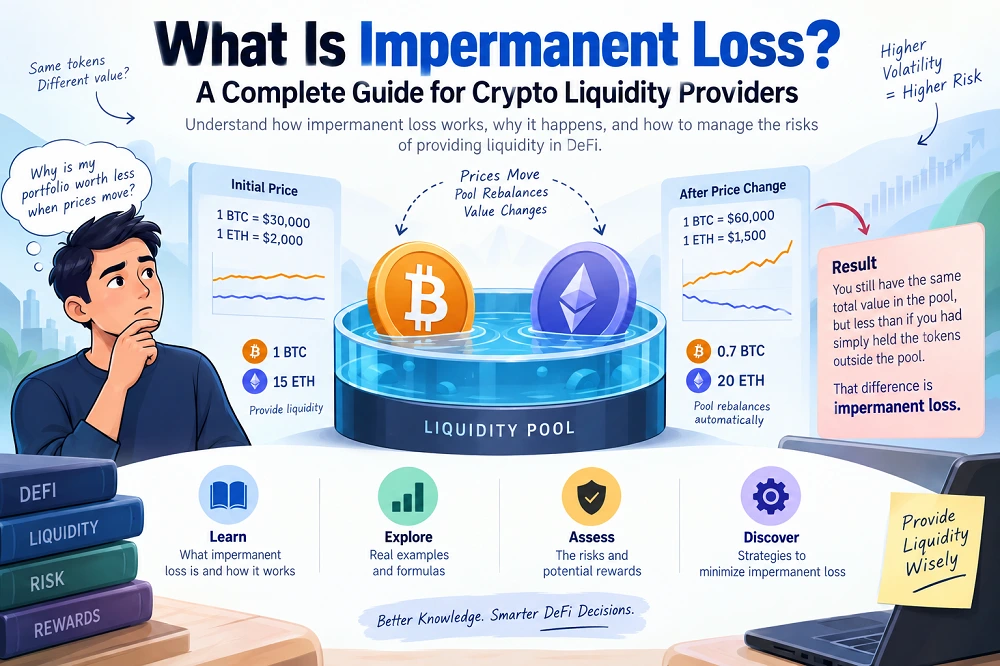
Impermanent loss occurs inside decentralized exchanges that use automated market maker algorithms rather than traditional buyer-seller order books. When you deposit two different digital assets into a liquidity pool, you become a liquidity provider supporting trade execution across a specific token pair.
Traditional financial exchanges rely on market makers who manually place bids and asks on an order book. Decentralized protocols like Uniswap replace human market makers with autonomous mathematical equations that hold pooled reserves of two tokens.
The classic automated market maker mechanism is governed by the constant-product formula:
x × y = k
In this equation, x represents the quantity of the first token, y represents the quantity of the second token, and k is a fixed invariant constant that must remain unchanged during regular swaps.
When traders buy or sell assets against the pool, the protocol adjusts the balance of tokens to satisfy the formula. This mechanical adjustment causes the pool’s internal exchange rate to shift continuously.
The opportunity cost arises because the automated pool is programmed to rebalance your holdings automatically. When one token surges in value, the pool sells off your winning asset to arbitrageurs and loads you up with the cheaper asset.
ZenvestAI Quick Insight
Impermanent Loss (IL): The difference between the current total value of a liquidity provider’s deposited pool share and the value those identical assets would have maintained if they had simply been held outside the pool in a private wallet.
Now that the foundational definition is clear, how does this pricing equation actually trigger token imbalances behind the scenes?
How Does Impermanent Loss Happen?
Impermanent loss unfolds through a predictable chain reaction connecting user deposits, market price movements, external arbitrage trades, and pool rebalancing.
1. You Deposit Two Tokens
You start by depositing an equal market value of two tokens into a liquidity pool. For instance, you might pair an asset like Ethereum with a US dollar stablecoin like USD Coin to support trading activity on decentralized platforms.
2. The Token Prices Diverge
External crypto markets move rapidly based on global news, macroeconomic shifts, and speculative trading. If Ethereum rallies sharply on centralized spot exchanges while your pooled assets sit idle, an immediate price gap emerges between the pool’s internal ratio and the outside market.
3. Traders Rebalance the Pool
Automated market makers do not pull external price feeds or listen to outside order books on their own. Instead, they rely on arbitrageurs—traders who spot price discrepancies across venues. When Ethereum is cheaper inside your liquidity pool than on external markets, arbitrageurs buy the discounted Ethereum from the pool and sell it outside for an instant profit.
4. Your Token Mix Changes
As arbitrageurs purchase Ethereum from the pool, they pay with USD Coin to keep the constant product $k$ balanced. As a result, the pool ends up with less Ethereum and more USD Coin. Because you own a proportional share of the pool, your personal asset allocation shifts into having fewer appreciating tokens and more stable tokens.
5. Compare LP vs HODL
When you finally calculate the market value of your rebalanced token share, it will be lower than if you had simply kept your original tokens untouched in a hardware wallet.
The core economic baseline is defined by this equation:
LP Position Value − HODL Position Value = Relative Performance Difference
That negative difference is the exact financial definition of impermanent loss.
To see this dynamic in action, let us examine a concrete dollar-and-cent breakdown.
Impermanent Loss Example
Walking through a standard deposit illustrates exactly where the performance difference comes from during a major market movement.
Suppose you provide liquidity to an ETH/USDC pool on a constant-product decentralized exchange. You deposit 1 ETH and 2,000 USDC when 1 ETH is trading at $2,000. Your total initial deposit is worth $4,000.
Now assume Ethereum experiences a strong bull run, doubling in price on global markets to $4,000 per ETH.
Arbitrageurs immediately interact with the pool until its internal pricing reflects the new $4,000 benchmark. To maintain the constant product k = 1 × 2,000 = 2,000, the pool’s internal reserves rebalance to approximately 0.7071 ETH and 2,828.43 USDC.
| Metric | Liquidity Provider (LP) Position | Simply Holding (HODL) Strategy |
| Initial Deposit | 1 ETH + 2,000 USDC | 1 ETH + 2,000 USDC |
| Initial Portfolio Value | $4,000 | $4,000 |
| Market Event | ETH price doubles to $4,000 | ETH price doubles to $4,000 |
| Token Quantities After Move | 0.7071 ETH + 2,828.43 USDC | 1.0000 ETH + 2,000 USDC |
| Final Portfolio Value | $5,656.85 | $6,000.00 |
| Net Portfolio Change | +$1,656.85 (+41.42%) | +$2,000.00 (+50.00%) |
| Difference (Impermanent Loss) | -$343.15 (-5.72%) | Baseline Reference |
Notice something remarkable: your total dollar balance increased by $1,656.85. You did not lose money in nominal cash terms.
However, if you had simply held your original 1 ETH and 2,000 USDC in your wallet, your portfolio would be worth $6,000.00.
By serving as a liquidity provider, the pool systematically sold off portions of your appreciating Ethereum as it climbed, leaving you with $343.15 less wealth than the passive investor.
If this shortfall happens in an active portfolio, why does the crypto industry use the gentle term “impermanent”?
Why Is It Called “Impermanent” Loss?
The label impermanent reflects the mathematical reversibility of the deficit as long as your capital remains committed to the smart contract.
When the Loss Can Disappear
Impermanent loss is purely a path-dependent calculation determined by the starting and current price ratios. If Ethereum rises to $4,000, then retreats back to $2,000, the pool’s token ratio shifts back to its original equilibrium.
When the price ratio returns to its exact starting point, the divergence loss shrinks to zero. In that scenario, you retain your original token amounts while having collected trading fees throughout the volatility.
When the Loss Becomes Realized
The loss ceases to be theoretical the exact moment you remove your capital from the liquidity pool.
If you withdraw your liquidity while the price ratio remains divergent, your ownership converts permanently into the altered token quantities. You walk away with less of the outperforming asset, locking in the performance penalty as a permanent accounting loss.
Understanding when this paper deficit becomes permanent naturally leads to the next practical question: how do you quantify your exposure mathematically?
How Is Impermanent Loss Calculated?
For a standard 50/50 constant-product automated market maker, the relative shortfall can be computed using a direct algebraic relationship based on the asset price ratio.
Let r equal the new price ratio divided by the initial price ratio (r = Pₙₑw / Pᵢₙᵢₜᵢₐₗ). The impermanent loss percentage is calculated as:
Notice that impermanent loss is symmetrical across price directions. Whether a token doubles in price (r = 2) or halves in price (r = 0.5), the mathematical divergence produces the exact same percentage penalty against a simple holding strategy.
| Price Ratio Multiplier (r) | Implied Price Movement | Approximate Impermanent Loss |
| 1.25x | +25% or -20% | -0.6% |
| 1.50x | +50% or -33% | -2.0% |
| 2.00x | +100% (2x) or -50% | -5.7% |
| 3.00x | +200% (3x) or -67% | -13.4% |
| 4.00x | +300% (4x) or -75% | -20.0% |
| 5.00x | +400% (5x) or -80% | -25.5% |
Note: These baseline metrics represent classic full-range constant-product pools documented across foundational Uniswap Protocol educational materials. Modern concentrated liquidity setups introduce significantly higher loss curves.
Seeing how sharply the divergence accelerates past a 2x price shift makes it essential to identify the underlying market forces that trigger these shifts in the first place.
What Causes Impermanent Loss?
Impermanent loss is not caused by general market direction, but by asymmetric price action between two pooled assets.
The core market catalysts include:
- Large Relative Price Divergence: The primary driver is any substantial change in the price ratio between the two deposited tokens.
- Elevated Token Volatility: Sharp, sudden price spikes or drops prevent smooth fee accumulation from keeping pace with ratio shifts.
- Uncorrelated Asset Pairings: Pairing a highly volatile utility token with an asset pegged to fiat currency creates persistent divergence pressure.
- Automated Pool Rebalancing: Constant-product equations continuously sell your outperforming token to balance liquidity across the curve.
- Concentrated Liquidity Boundaries: Tightly focused price intervals amplify price ratio shifts, magnifying divergence effects.
- One-Way Market Trends: Sustained directional bull or bear markets create persistent gaps between pool pricing and original deposit valuations.
Because the word “loss” is often misunderstood, it is important to distinguish clearly between impermanent loss and an outright capital loss.
Impermanent Loss vs. Permanent Loss
Investors frequently conflate paper performance deficits with actual destruction of capital.
| Dimension | Impermanent Loss | Permanent / Realized Loss |
| Position Status | Active inside the liquidity pool | Closed or withdrawn from the contract |
| Market Reversibility | Can disappear entirely if the price ratio returns to deposit levels | Irreversible; asset quantities are locked in your personal wallet |
| Baseline Measurement | Measured strictly against passive token holding (HODL) | Measured as an actual net loss against your starting capital |
| Root Cause | Relative divergence between the two pooled tokens | Market crashes, rug pulls, or selling out of balance |
| Portfolio Impact | Opportunity cost / relative performance lag | Concrete capital reduction in net asset value |
Having established how impermanent loss differs from a conventional realized loss, how should a liquidity provider evaluate their performance against a traditional crypto buy-and-hold strategy?
Impermanent Loss vs. HODLing
The choice between becoming a liquidity provider and simply HODLing comes down to balancing active fee yield against passive capital appreciation.
A HODL strategy preserves your initial asset amounts completely. If you hold 1 ETH and 2,000 USDC in cold storage, you retain exactly 1 ETH and 2,000 USDC regardless of market volatility. You capture 100% of any upside if Ethereum surges, and you take on no smart contract risk. However, your dollar balances generate zero organic trading yield.
A liquidity provider strategy surrenders static token preservation in exchange for recurring cash flow. You let automated market makers rebalance your capital dynamically across market cycles in return for a share of all trading fees generated by the pool.
Whenever an investor evaluates an automated market maker position, they must answer one central question:
“Will the trading fees and protocol incentives I collect exceed the relative underperformance caused by price divergence?”
Can trading fees realistically overcome this divergence penalty in live market conditions?
Do Liquidity Provider Fees Offset Impermanent Loss?
Trading fees represent the primary economic compensation offered to liquidity providers for taking on market divergence risk.
The complete profitability equation for any liquidity position can be summarized as:
When trading volume inside a pool is high and price movements remain range-bound, accumulated swap fees can easily outpace impermanent loss, delivering strong net gains.
However, earning trading fees does not stop or remove the mathematical rebalancing inside the pool. If an asset undergoes an explosive upward or downward repricing with low accompanying volume, impermanent loss will quickly overwhelm accumulated fee revenue.
Beyond trading fees and price divergence, liquidity providers must also account for additional real-world expenses:
- Protocol and Gas Costs: High network transaction fees for depositing, collecting yield, and withdrawing can wipe out small LP positions.
- Rebalancing Expenses: Re-centering active positions requires multiple transactions that accrue compounding network fees.
- Smart Contract Risk: Deploying funds into automated market maker protocols exposes your principal to potential smart contract vulnerabilities or exploits.
- Asset-Specific Risks: Algorithmic stablecoins or newly minted tokens can de-peg or lose liquidity completely, leaving the pool holding valueless reserves.
Since fee yields vary dramatically by asset type, selecting the right token pair is your first line of defense.
Which Token Pairs Have Higher Impermanent Loss Risk?
Different token pairs carry vastly different divergence characteristics based on how their prices correlate.
Low Risk: Stablecoin Pairs (e.g., USDC/USDT)
────────────────────────────────────────────────────
Moderate Risk: Correlated Asset Pairs (e.g., WBTC/ETH, wstETH/ETH)
────────────────────────────────────────────────────
High Risk: Volatile / Uncorrelated Pairs (e.g., ETH/USDC, SOL/USDT)
1. Lower Relative-Price Divergence: Stablecoin / Stablecoin Pairs
Pairing two assets pegged to the same underlying currency—such as USDC paired with USDT—produces very low impermanent loss under normal market conditions. Because both tokens are designed to track $1.00, their exchange ratio stays close to 1:1.
Liquidity providers in these pools earn steady trading fees with minimal price divergence risk, though yields are typically lower and de-pegging remains an external threat.
2. Moderate Divergence: Highly Correlated Assets
Pairs that share similar macroeconomic drivers—such as Wrapped Bitcoin (WBTC) paired with Ethereum (ETH), or liquid staking derivatives like wstETH paired with native ETH—tend to move in the same direction over broader market cycles.
While their exchange ratio fluctuates over time, the divergence is usually less severe than pairing a cryptocurrency with a fiat stablecoin.
3. Higher Divergence Potential: Volatile / Uncorrelated Pairs
Pairing an unpegged, highly volatile cryptocurrency with a cash-equivalent asset—such as ETH/USDC or SOL/USDT—carries significant impermanent loss risk.
When the market enters an extended rally or sharp sell-off, the price ratio diverges aggressively. Liquidity providers must generate substantial fee volume to offset the resulting divergence drag.
Correlation, however, is not a guarantee of safety. Even closely matched pairs can decouple during structural market disruptions.
This dynamic becomes even more pronounced when we look at modern concentrated liquidity protocols.
Concentrated Liquidity and Impermanent Loss
Modern decentralized exchange designs have fundamentally transformed how liquidity providers deposit capital.
Traditional automated market makers spread your liquidity across the entire theoretical price spectrum, from zero to infinity. While this ensured continuous liquidity, the vast majority of your capital sat unused in price brackets far away from the current market price.
Protocols like Uniswap v3 and v4 introduced concentrated liquidity. Instead of spreading funds infinitely, providers choose a custom price range within which their capital actively facilitates trades.
This architectural shift introduces critical dynamics:
- Capital Efficiency: Concentrating your liquidity into a tight range allows your capital to earn significantly more trading fees per dollar deposited compared to full-range pools.
- In-Range Liquidity: As long as the spot market trades inside your chosen boundaries, your position earns concentrated swap fees.
- Out-of-Range Positions: If the market price breaks above or below your boundaries, your position becomes 100% composed of the underperforming asset and stops earning fees entirely.
- Steeper Divergence Curves: Concentrated ranges dramatically accelerate impermanent loss. Academic studies examining impermanent loss in Uniswap v3 show that narrowing your liquidity boundaries magnifies price sensitivity, turning minor market shifts into substantial relative drawdowns.
- Active Management Requirements: Providers can no longer simply deposit funds and walk away; they must actively monitor market trends and adjust ranges to remain profitable.
Given these amplified risks, what concrete steps can you take to minimize impermanent loss?
How to Reduce Impermanent Loss
Managing impermanent loss requires active planning, realistic market expectations, and deliberate risk management.
Choose Less Volatile or More Correlated Pairs
Focus your liquidity on pairs that naturally trade within tight historical bands. Liquid staking pairs (such as ETH/stETH) and stablecoin pools offer lower divergence profiles, letting you generate predictable yields without fighting massive ratio shifts.
Evaluate Fee Revenue Against Price Volatility
Before depositing funds, compare the pool’s historical trading volume against its price swings. A high-fee tier in an inactive pool will not protect you from a 50% price divergence, whereas an active pool with consistent volume can generate enough swap revenue to comfortably outpace divergence.
Select Liquidity Ranges Carefully
When providing concentrated liquidity, avoid overly narrow price ranges unless you plan to actively manage the position day to day. Setting broader boundaries provides a buffer against sudden market volatility and keeps your position earning fees over longer periods.
Monitor Positions Actively
Decentralized finance is rarely set-and-forget. Set price alerts around your pool boundaries so you can rebalance, harvest fees, or exit before market momentum leaves your position stranded out of range.
Consider the Full Risk Profile
Never chase advertised annual percentage yields blindly. High headline rates often signal volatile, newly launched tokens where price divergence and smart contract risks can quickly overwhelm any initial yield promises.
To put these strategies into practice, run through a structured evaluation before depositing any capital.
How to Evaluate an LP Position Before Providing Liquidity
Review this step-by-step decision framework to stress-test your strategy before committing funds to an automated market maker pool:
- Assess Token Price Correlation
└─ Do the two assets move together, or does one remain relatively flat while the other trends?
↓ - Analyze Historical Volatility
└─ Has the token pair experienced multi-fold price-ratio shifts over the past 90 days?
↓ - Measure Pool Trading Volume
└─ Is there genuine, sustained daily swap volume generating organic fee revenue?
↓ - Review the Fee Tier
└─ Does the fee tier (e.g., 0.05%, 0.30%, 1.00%) adequately compensate for the pair’s volatility?
↓ - Estimate Expected Fee Revenue
└─ Will your projected fee share outpace the impermanent loss from a potential 25% to 50% price move?
↓ - Define Your Liquidity Range
└─ Is your selected price band wide enough to withstand regular market swings?
↓ - Formulate an Out-of-Range Plan
└─ What is your exit or rebalancing trigger if the market breaks past your range limits?
↓ - Audit Smart Contract Security
└─ Has the underlying decentralized protocol undergone reputable third-party security audits?
↓ - Check Token Liquidity and De-Peg Risk
└─ Are either of the pooled tokens exposed to centralized freeze risks or algorithmic de-pegging?
↓ - Compare Net Expected Return Against HODLing
└─ Does your projected fee yield justify the added operational complexity over a simple cold-storage hold?
Addressing these evaluation steps also helps clear up several common misconceptions that mislead new market participants.
Common Misconceptions About Impermanent Loss
Misunderstanding the mechanics of automated market makers can lead to poor portfolio decisions. Here are five widespread myths clarified:
“Does impermanent loss mean I immediately lose money?”
No. Impermanent loss measures relative performance compared to holding the exact same assets in your wallet. If both tokens rise in value, your total portfolio value can increase substantially even while experiencing impermanent loss.
“Does impermanent loss happen only when crypto prices crash?”
No. Impermanent loss is driven by relative price divergence, not market direction. If one pooled token surges 400% while the other stays flat, your position experiences substantial impermanent loss because the pool continuously sells off the outperforming asset.
“Can trading fees eliminate impermanent loss?”
Trading fees do not alter the mathematical divergence happening inside the pool. They can offset the financial impact of the divergence on your overall returns, but impermanent loss and trading fees remain separate economic forces.
“Does impermanent loss affect every liquidity pool equally?”
No. Pool architecture, token correlation, historical price volatility, and liquidity parameters all play a major role. A stablecoin pool on an invariant curve behaves completely differently from a concentrated ETH/USDC pool.
“Is concentrated liquidity always better for retail providers?”
No. While concentrated liquidity offers higher capital efficiency, research published on the risk profile of liquidity providers shows that narrow ranges experience significantly higher divergence risk. Unmanaged concentrated positions frequently underperform passive holding during volatile trends.
Impermanent Loss FAQ
What is impermanent loss in crypto?
Impermanent loss is the difference in value between depositing tokens into an automated market maker liquidity pool and holding those same tokens in a crypto wallet. It occurs whenever the exchange rate between the two pooled assets diverges from their deposit ratio.
How does impermanent loss work?
Automated market makers use mathematical pricing formulas like x × y = k. When outside market prices change, arbitrageurs trade against the pool until its internal prices match external markets. This rebalances your share toward the lower-performing token, creating a relative performance deficit versus simply holding.
How is impermanent loss calculated?
For classic 50/50 constant-product pools, impermanent loss is calculated using the formula
is the ratio of the new price ratio relative to the initial deposit ratio.
What causes impermanent loss?
Impermanent loss is caused by relative price changes between two pooled tokens. Rapid price appreciation, market corrections, uncorrelated pairings, and automated pool rebalancing all drive the divergence.
Is impermanent loss an actual loss?
It is an opportunity cost while your funds remain in the pool. Your dollar balance may still be higher than your starting principal if the broader market rallied, but your total return will lag behind what you would have earned by simply holding the tokens outside the pool.
When does impermanent loss become permanent?
Impermanent loss becomes permanent the moment you remove your liquidity from the pool while the price ratio remains divergent. Once withdrawn, the altered token quantities are locked into your wallet.
Can trading fees offset impermanent loss?
Yes. Every swap through the pool generates a transaction fee paid to liquidity providers. If trading volume is high enough over time, accumulated fee revenues can exceed the impermanent loss penalty, resulting in a positive net return over holding.
Which crypto pairs have the highest impermanent loss risk?
Volatile, uncorrelated pairs carry the highest risk. Pairing a newly launched or highly volatile digital asset with a fiat stablecoin (such as a volatile altcoin paired with USDC) creates significant exposure to sustained price divergence.
How does concentrated liquidity affect impermanent loss?
Concentrated liquidity allows providers to focus capital within a specific price band. This boosts fee earnings when the market trades inside the range, but significantly steepens the impermanent loss curve if the price moves toward the boundaries.
Can impermanent loss be avoided completely?
It cannot be avoided entirely in standard volatile pools, but it can be minimized. You can provide liquidity to correlated asset pairs (such as stablecoin pools or liquid staking tokens), select broader price bands, or deploy capital during sideways market conditions.
ZenvestAI View
Decentralized exchanges have permanently changed how global markets access liquidity, allowing everyday market participants to act as their own market makers. However, providing liquidity without modeling impermanent loss is one of the most common pitfalls in decentralized finance.
Headline yields often advertise gross fee distributions without accounting for divergence drag. In trending crypto markets, holding high-conviction assets outright often outperforms active pool management.
Liquidity provision works best as a disciplined cash-flow strategy during range-bound, sideways market regimes, or across closely correlated asset pairs where divergence risk is inherently contained.
The Bottom Line on What Is Impermanent Loss? A Complete Guide for Crypto Liquidity Providers
Impermanent loss is the price you pay for earning yield in an automated market maker. If the swap fees you collect do not exceed the cost of the pool selling your winning assets, you would have built more wealth by simply holding your tokens in your own wallet.
Related Intelligence
- Automated Market Maker Architecture: Deep dive into constant-function algorithms, invariant curves, and liquidity curves across decentralized protocols.
- Concentrated Liquidity Optimization: Practical playbooks for setting active price ticks, managing volatility bands, and automating rebalancing on modern decentralized platforms.
- Decentralized Finance Yield Analysis: How to calculate real yield by subtracting gas expenses, impermanent loss, and token inflation from gross protocol returns.
- Stablecoin Peg Stability and De-Risking: Assessing reserve backing, counterparty exposure, and systemic risks in decentralized trading pairs.
Author and Editorial Information
ZenvestAI Editorial Research Team
Published for Global Decentralized Finance Education
Our editorial standards require primary source verification, direct mathematical modeling, and objective risk analysis. We break down complex decentralized systems into actionable, transparent insights so market participants can allocate capital with confidence.
Data Sources and Verified References
The mathematical models, protocol glossary definitions, and empirical data in this guide were verified against primary documentation and peer-reviewed research:
- Uniswap Support: What Is Impermanent Loss? — Core definitions, deposit mechanics, and foundational loss curves.
- Uniswap Developer Documentation: Protocol Glossary — Official technical definitions for swap fees, ticks, ranges, price impact, and liquidity reserves.
- Uniswap Protocol Architecture: What Is Uniswap? — Constant product market maker formula $x \times y = k$, reserve ratios, and decentralized execution.
- arXiv Research: UNISWAP: Impermanent Loss and Risk Profile of a Liquidity Provider — Quantitative analysis of payoff profiles, volatility drag, and return distributions for automated market makers.
- arXiv Research: Impermanent Loss in Uniswap v3 — Empirical examination of constant function market makers, concentrated liquidity boundaries, and LP profitability.
- European Securities and Markets Authority (ESMA): Markets in Crypto-Assets Regulation (MiCA) — Regulatory standards for crypto-asset transparency and retail disclosures.
Exclusive ZenvestAI Analytical Observations
- The Volatility Drag Asymmetry: In modern decentralized pools, upward divergence typically costs liquidity providers more in real terms than downward divergence. When a token surges, the pool sells off an asset that may continue appreciating for months, creating an unrecoverable structural opportunity cost even if token prices stabilize later.
- The Fee-to-Divergence Ratio (FDR): Rather than evaluating pools by raw annual percentage yield, our research models suggest tracking the ratio of daily fee revenue to 30-day realized volatility. Pools with an FDR below 1.2 rarely generate enough organic volume to offset impermanent loss during major macroeconomic shifts.
- The Range Rebalancing Paradox: Retail providers using concentrated liquidity who re-center their ranges frequently often lock in impermanent loss at market extremes. Every manual re-center effectively sells the outperforming token at its lowest relative pool price while taking on fresh transaction fees, turning paper divergence into realized underperformance.
Regulatory and Educational Disclosure
This article is published strictly for educational and informational purposes by ZenvestAI.com. It does not constitute financial, investment, legal, or tax advice, nor does it represent an endorsement or recommendation of any digital asset, automated market maker, protocol, or investment strategy.
Under international financial regulatory standards—including guidance from the International Organization of Securities Commissions (IOSCO), the U.S. Securities and Exchange Commission (SEC), and the European Union’s Markets in Crypto-Assets Regulation (MiCA)—engaging with decentralized liquidity pools involves significant financial risk. These risks include asset price volatility, impermanent loss, smart contract vulnerabilities, liquidity shortfalls, and the potential loss of your deposited principal. Market participants should conduct independent due diligence and consult licensed financial professionals before allocating capital.
