Many crypto traders become interested in decentralised exchanges after facing problems with centralised platforms. It could be a sudden withdrawal suspension, unexpected exchange downtime, an account restriction, or difficulty accessing their own funds. These experiences highlight an important point: when you keep your cryptocurrency on a centralised exchange, you are relying on that platform to safeguard your assets and allow you to withdraw them when needed.
This is where Uniswap offers a different approach.
Uniswap is a decentralised cryptocurrency exchange (DEX) that allows people to swap one cryptocurrency for another directly from their own crypto wallets, without relying on a traditional exchange to hold their funds or process their trades. It uses smart contracts and automated market makers (AMMs) to facilitate trades through liquidity pools rather than a conventional order book.
When using Uniswap, you remain in control of your wallet and assets. You don’t need to create a traditional exchange account or deposit your cryptocurrency with a centralised company. However, you are still responsible for wallet security, transaction approvals, network fees, and smart contract risks.
This does not mean every centralised exchange is unsafe. It simply highlights the difference between trusting a company to hold your assets and interacting directly with blockchain-based smart contracts.
In this guide, we’ll explore how Uniswap works, starting with the basics. Whether you want to make your first token swap, understand the purpose of the UNI token, or provide liquidity to earn a share of trading fees, we’ll break everything down in simple terms. We’ll also look at the mathematics behind automated market makers (AMMs), how liquidity pools operate, and the risks you should understand before using the platform.
ZenvestAI Explains
Uniswap is a decentralised trading protocol that allows people to exchange cryptocurrencies without relying on a traditional broker or centralised exchange. Instead of matching buyers and sellers through a conventional order book, it uses smart contracts and mathematical formulas to manage trades through shared reserves of tokens called liquidity pools.
When someone makes a trade, Uniswap’s smart contracts automatically calculate the exchange rate based on the available tokens in the pool and execute the transaction on the blockchain. This allows users to swap cryptocurrencies directly from their personal wallets without depositing their funds with a centralised exchange.
A Simple Example:
Imagine you want to exchange ETH for USDC. You connect your crypto wallet to Uniswap and enter the amount of ETH you want to swap. Uniswap finds a suitable ETH/USDC liquidity pool and calculates how much USDC you can receive based on the available reserves and current trading conditions.
Once you approve the transaction, the smart contract processes the swap on the blockchain. Your ETH goes into the pool, and the corresponding USDC is transferred to your wallet, after applicable fees and price impact.
In simple terms, Uniswap replaces much of the traditional exchange infrastructure with blockchain-based smart contracts, allowing users to trade cryptocurrencies in a more open and transparent way.
Related Article:- GIFT City to Global Standards: Why Institutional Crypto is Gaining Ground in India
What Is Uniswap? Complete Guide to UNI, AMMs, Liquidity Pools & DEX Trading
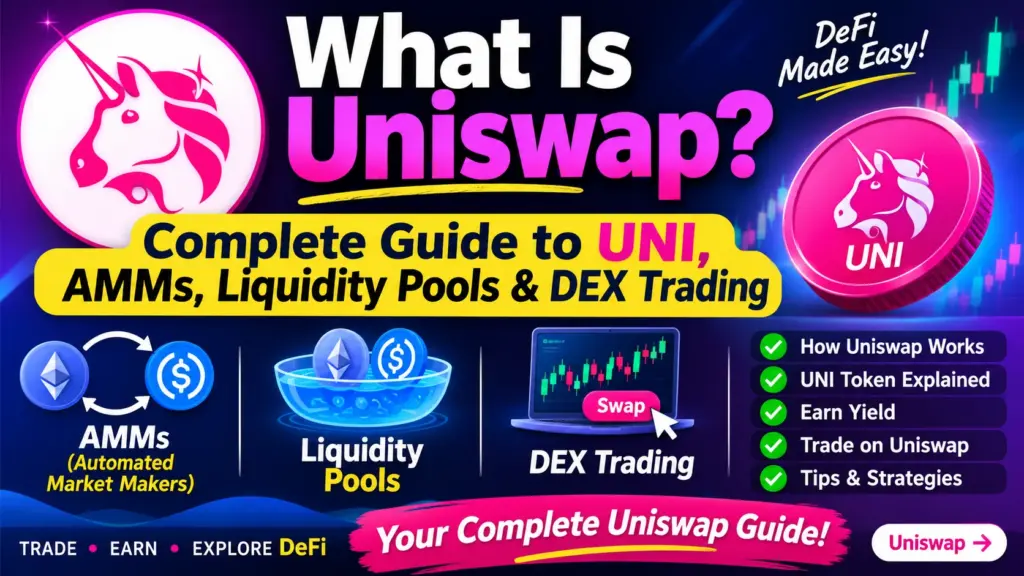
Understanding Uniswap is a good starting point for learning how decentralised finance (DeFi) works. It introduces an entirely different way of trading cryptocurrencies, where users can exchange tokens directly through blockchain-based smart contracts instead of depending on a centralised exchange.
But before using the platform or investing in its native token, UNI, it is important to understand how the system works, where its liquidity comes from, how trading prices are calculated, and what risks users should consider.
Key Takeaways
- Self-Custodial Trading: You can trade directly from your personal Web3 wallet without depositing your cryptocurrency into a centralised exchange.
- Automated Market Maker (AMM): Uniswap uses mathematical formulas and liquidity pools to determine token prices instead of relying on a traditional order book.
- Open Liquidity Provision: Anyone can contribute supported token pairs to liquidity pools and receive a share of eligible trading fees.
- Impermanent Loss: Providing liquidity involves risk. If token prices move significantly relative to each other, your position may be worth less than simply holding the original tokens.
- UNI Governance: UNI is Uniswap’s governance token, giving eligible holders the ability to participate in decisions about the protocol.
Uniswap at a Glance
| Feature | Details |
|---|---|
| Protocol type | Decentralised Exchange (DEX) |
| Trading model | Automated Market Maker (AMM) |
| Founder | Hayden Adams |
| Initial launch | November 2018 |
| Blockchain networks | Ethereum, Arbitrum, Base, Optimism and others |
| Native token | UNI |
| Token standard | ERC-20 |
| Liquidity model | Smart contract-based liquidity pools |
| Main purpose | Decentralised cryptocurrency swapping |
Uniswap has also recorded substantial trading activity over its lifetime. The article’s cited 2026 DeFiLlama figure is over $2.2 trillion in cumulative volume; this is a historical metric that should be checked against the latest dashboard before publication.
Now let’s understand what Uniswap actually is and why it has become such an important part of the DeFi ecosystem.
What Is Uniswap?
Uniswap is one of the best-known decentralised cryptocurrency exchanges (DEXs). Launched in November 2018 by Hayden Adams, it introduced a different way for people to exchange digital assets without depending on a traditional exchange to match buyers and sellers.
Unlike centralised platforms such as Binance or Coinbase, Uniswap operates through smart contracts deployed on blockchain networks. These contracts manage token swaps and liquidity pools according to predefined rules.
One of its biggest differences is that users do not need to deposit their cryptocurrency into a centralised exchange account before trading. Instead, they connect their own Web3 wallet and interact directly with the protocol.
For example, if you want to exchange ETH for USDC, you can connect your wallet, select the tokens, review the quoted exchange rate, and confirm the transaction. The smart contracts handle the swap, and the received tokens are sent to your wallet.
Uniswap is designed to be permissionless, meaning users generally do not need traditional exchange registration or account approval to interact with its public contracts. However, network access, local regulations, wallet compatibility, and supported assets still matter.
So, how does Uniswap manage to process trades without a conventional order book?
How Does Uniswap Work?
Traditional cryptocurrency exchanges generally use an order book to connect buyers and sellers. Buyers place orders showing how much they are willing to pay, while sellers indicate the price at which they want to sell. The exchange’s matching engine brings suitable orders together.
Uniswap follows a different approach. It uses an Automated Market Maker (AMM) model, where users trade against token reserves held in liquidity pools rather than waiting for another trader to take the opposite side of their order.
These pools are managed by smart contracts. When someone makes a swap, the contract calculates the exchange rate using the pool’s token balances and applies the rules of that particular pool.
Understanding the Constant Product Formula
One of the best-known mathematical principles behind Uniswap’s original AMM model is the constant product formula:
x × y = k
In this equation:
- x represents the reserve balance of Token A in the liquidity pool.
- y represents the reserve balance of Token B in the liquidity pool.
- k represents the constant product of the two token reserves.
The basic idea is simple: when someone takes one token out of the pool, they must add another token to it. This changes the balance of both assets and affects the price.
For example, when a trader buys ETH using USDC, the pool receives USDC and releases ETH. As the ETH reserve decreases and the USDC reserve increases, the price of ETH within the pool rises.
This mathematical relationship allows Uniswap to calculate trades automatically, even when there is no individual buyer or seller waiting on the other side.
Note: This constant-product formula is a simplified explanation of the original AMM model. Modern Uniswap versions, particularly v3 and v4, also support concentrated liquidity and other pool configurations.
A Simple Example of How AMM Pricing Works
Let’s understand the formula using an easy example.
Imagine a liquidity pool contains:
- 10 ETH
- 30,000 USDC
The initial product of the two reserves is: 10 × 30,000 = 300,000
Here, the value of k is 300,000.
The initial exchange price implied by these reserves is: 30,000 ÷ 10 = 3,000 USDC per ETH
Now suppose someone wants to buy ETH by adding 3,000 USDC to this pool.
The USDC reserve increases: 30,000 + 3,000 = 33,000 USDC
To keep the constant product at 300,000, the new ETH reserve becomes: New ETH Reserve = 300,000 ÷ 33,000 = 9.0909 ETH
The amount of ETH released from the pool is: 10 − 9.0909 = 0.9091 ETH
So, the trader adds 3,000 USDC and receives approximately 0.9091 ETH.
The effective execution price is: 3,000 ÷ 0.9091 ≈ 3,300 USDC per ETH
Why is this higher than the initial price of 3,000 USDC?
Because the trade changes the balance of the pool. As ETH becomes less available in the pool, its price increases. This difference between the initial quoted price and the average execution price is related to price impact and slippage.
This example ignores trading fees and assumes the basic constant-product model. Actual trades can produce different results depending on pool fees, liquidity, routing, and network conditions.
The important lesson is that the size of your trade matters. A large trade against a small liquidity pool can have a much greater effect on the execution price.
Related Article:- Stop Being the Exit Liquidity: How to Monitor Smart Money and Market Maker Wallets Before the Chart Moves (Follow the Coin, Not the Crowd)
Main Components of the Uniswap Protocol
Uniswap depends on several important components that work together to make decentralised trading possible.
1. Liquidity Pools
Liquidity pools are smart contracts that hold reserves of two or more supported tokens, depending on the pool design. These reserves provide the assets that traders use when swapping cryptocurrencies.
2. Liquidity Providers (LPs)
Liquidity providers are people or organisations that deposit tokens into liquidity pools. In return, they may receive a share of the trading fees generated by their liquidity position, depending on the pool and its fee arrangements.
3. Router Contracts
Routing contracts help execute swaps by directing trades through suitable liquidity pools. In some cases, a trade may pass through multiple pools to find a better overall exchange rate.
4. UNI Governance Token
UNI is the governance token associated with Uniswap. Eligible token holders can participate in governance proposals and vote on certain decisions affecting the protocol’s development and treasury.
5. Smart Contracts and Protocol Versions
Smart contracts contain the rules that govern swaps, liquidity positions, and other protocol functions. Different Uniswap versions have introduced improvements to how these contracts manage liquidity and trading.
Uniswap Versions: From v1 to v4
Uniswap has developed considerably since its first release. Each major version introduced changes designed to improve trading flexibility, liquidity management, and capital efficiency.
Uniswap v1 (2018)
The first version introduced the basic AMM model. It supported ETH-to-ERC-20 token swaps and demonstrated how smart contracts could facilitate decentralised trading without a traditional order book.
Uniswap v2 (2020)
Version 2 expanded the trading model by supporting direct ERC-20-to-ERC-20 swaps. It also introduced features such as flash swaps and time-weighted average price (TWAP) oracles.
Uniswap v3 (2021)
Version 3 introduced concentrated liquidity. This allowed liquidity providers to choose specific price ranges in which their capital would be used for trading.
The idea was to make liquidity more capital-efficient by allowing providers to focus their funds around price ranges where trading activity was expected.
However, this also made liquidity management more involved because positions could move outside their selected price ranges.
Uniswap v4 (2025 onward)
Uniswap v4 introduced a more modular architecture built around a single singleton contract and a feature called Hooks.
Hooks allow developers to add custom logic to different stages of a pool’s lifecycle. Depending on how they are designed, they can support features such as dynamic fees, customised trading rules, and on-chain limit-order-style functionality.
This gives developers more flexibility to build different types of trading experiences using Uniswap’s liquidity infrastructure.
Benefits of Trading on Uniswap
Uniswap offers several advantages over traditional exchange models.
Self-Custody: Users interact with the protocol through their own wallets rather than depositing funds into a centralised exchange account. They retain control of their private keys.
Permissionless Access: Users can generally interact with supported pools without applying for a traditional exchange account or waiting for token-listing approval.
Global Availability: Anyone with a compatible wallet and access to a supported blockchain network can generally use the protocol, subject to local laws and network restrictions.
Transparent Transactions: Swaps and smart contract interactions are recorded on public blockchains, allowing transactions to be independently examined.
Composability: Developers can integrate Uniswap’s liquidity into other DeFi applications, including lending platforms, portfolio tools, and other blockchain-based financial services.
These features make Uniswap an important building block for decentralised finance.
Related Article:- Is Crypto Legal in India in 2026? The Ultimate Guide to Taxes, FIU Rules, and VDA Laws
Risks and Limitations to Understand
Although Uniswap provides an alternative to centralised exchanges, it is not risk-free. Users should understand the following limitations before trading or supplying liquidity.
1. Impermanent Loss
Liquidity providers face a risk known as impermanent loss. It occurs when the prices of the tokens in a liquidity pool change relative to each other.
For example, if ETH rises significantly in value compared with USDC, an ETH/USDC liquidity provider may end up with a position worth less than simply holding the original ETH and USDC.
Trading fees may help offset this difference, but they do not guarantee a profit.
2. Network Gas Fees
Every on-chain transaction requires a network fee. On Ethereum Mainnet, these fees are generally paid in ETH.
During periods of heavy network activity, gas costs can increase substantially. This can make smaller trades less economical.
Layer-2 networks such as Arbitrum and Base can offer lower transaction costs, although fees and conditions vary.
3. Fake Tokens and Scams
Because Uniswap allows permissionless pool creation, almost anyone can create a trading pool for a token.
This also creates opportunities for scammers to launch counterfeit tokens using names and symbols similar to established cryptocurrencies.
Always verify the official token contract address before trading. A familiar token name or ticker does not guarantee authenticity.
4. Smart Contract Risks
Uniswap’s core contracts have undergone security reviews and audits, but this does not eliminate all risks.
Vulnerabilities can exist in smart contracts, third-party integrations, custom hooks, and individual tokens. A technical failure or malicious contract could result in financial losses.
5. Price Impact and Slippage
The amount of liquidity available in a pool affects how much a trade can move its price.
If you place a large order in a pool with limited liquidity, you may receive fewer tokens than expected. Always review the quoted output and slippage settings before confirming a transaction.
Uniswap vs Centralised Exchanges
Both decentralised and centralised exchanges allow users to trade cryptocurrencies, but they work in different ways.
| Comparison | Uniswap (DEX) | Centralised Exchange (CEX) |
|---|---|---|
| Asset custody | User-controlled wallet | Generally held by the exchange |
| Account registration | Usually not required | Generally required |
| KYC | Not generally required at protocol level | Usually required |
| Trading mechanism | AMM and liquidity pools | Primarily order-book matching |
| Trade execution | Blockchain smart contracts | Exchange-operated infrastructure |
| Main risks | Smart contracts, token scams, wallet security | Exchange custody, operational and counterparty risks |
| Transaction fees | Network fees and applicable pool fees | Trading fees and possible withdrawal fees |
Neither model is automatically better in every situation. Centralised exchanges may offer simpler interfaces and familiar trading tools, while Uniswap gives users more direct control over their assets and access to permissionless on-chain markets.
The right choice depends on the user’s experience, security preferences, trading needs, and understanding of the risks.
ZenvestAI View
Uniswap has changed the way people think about financial markets. It has shown that buying, selling, and exchanging digital assets don’t always need traditional intermediaries, centralised exchanges, or institutions holding users’ funds. Instead, smart contracts and blockchain technology can make these activities more open, transparent, and accessible.
However, Uniswap still faces challenges, including regulatory uncertainty, transaction costs, and MEV-related risks. Its continued development, particularly through Uniswap v4’s flexible hooks and UniswapX’s intent-based trading approach, shows that the protocol is still evolving. These developments could help make decentralised trading more efficient and flexible.
At ZenvestAI, we see Uniswap as more than just a decentralised exchange. It is an important example of how blockchain technology is reshaping financial infrastructure and creating new possibilities for open finance.
Investor Takeaway: Uniswap has established a strong position in decentralised finance, but its long-term success will depend on continued user adoption, trading activity, protocol security, competition, and its ability to adapt to regulatory changes. Investors should also understand that the success of the Uniswap protocol does not automatically translate into higher value for the UNI token. UNI’s governance role, token economics, and potential value-accrual mechanisms deserve separate consideration before making an investment decision.
Slippage is the difference between the price you expect to pay for a cryptocurrency and the actual price at which your trade is completed.
Simple Example:- Imagine you want to buy ETH using USDC.
- You see a price of $3,000 for 1 ETH.
- You place an order to buy ETH worth $3,000.
- Before your transaction is completed, the price changes.
- You finally receive ETH at an effective price of $3,030.
The extra $30 is the result of price movement and execution differences.
In simple terms, slippage means you receive slightly more or fewer tokens than you originally expected because the price changes while your trade is being processed.
Why does slippage happen on Uniswap?
- Large trades compared with the available liquidity in a pool.
- Sudden changes in cryptocurrency prices.
- High trading activity and market volatility.
- Changes in token reserves while your transaction is waiting for confirmation.
ZenvestAI Tip: Always check the expected amount of tokens you will receive before confirming a swap. Setting an appropriate slippage tolerance can help prevent a transaction from executing at an unacceptable price, although it cannot eliminate market risk.
Related Article:- How to Read Crypto Market Cap and Liquidity (Beginner Crypto Metrics Guide)
The Bottom Line on What Is Uniswap? Complete Guide to UNI, AMMs, Liquidity Pools & DEX Trading
Uniswap offers a different way to trade cryptocurrencies by allowing users to swap tokens directly through smart contracts and liquidity pools, without relying on traditional brokers or centralised exchanges to hold their funds.
It gives users greater control over their assets, but that control also comes with responsibility. Understanding wallet security, checking token contract addresses, reviewing transaction fees, and managing slippage are all important when using the platform.
The key takeaway is simple: Uniswap makes decentralised trading more accessible, but using it safely requires knowledge, careful decisions, and an understanding of the risks involved.
References & Verified Data Sources
- Uniswap Protocol Documentation & Whitepapers
- DeFiLlama DEX Analytics & Volume Metrics
- Ethereum Foundation Grants & Research Archives
Regulatory Disclosure
Educational Content Only. This article is published solely for educational purposes by ZenvestAI.com and does not constitute financial, investment, or legal advice. In compliance with global regulatory standards (including IOSCO principles, US SEC guidelines, and the EU MiCA framework), readers are advised that decentralized protocols carry technical and market risks. Always conduct independent research before interacting with smart contract protocols.