More than half of all cryptocurrency projects launched since 2021 have collapsed, not because of sudden market crashes, but because their underlying economic architecture was fundamentally broken from day one.
As we know, when an asset is programmed to mint trillions of new units without genuine demand, or when early venture investors hold massive locked allocations that dump onto the market, failure is guaranteed.
Tokenomics is a combination of “token” and “economics”. It is the foundational blueprint that dictates how a digital asset is created, distributed, supplied, and utilized within a blockchain network. It is enforced automatically by programmable smart contracts rather than human discretion.
Tokenomics function as both the monetary policy and the operational balance sheet of a decentralized ecosystem.
Understanding tokenomics is the single most critical skill required to separate genuine blockchain innovations from predatory designs.
This article “Tokenomics Explained: What Is Tokenomics in Crypto and How Does It Work?” provides a full information on how tokenomics operates, and their working fundamentals.
Key Takeaways
Tokenomics is the programmed monetary policy and operational economic structure of a crypto project, executed autonomously by smart contracts on a public blockchain.
Over half of historical project failures originate from structural economic design flaws, such as excessive emissions and unaligned insider allocations, rather than broader market volatility.
Scrutinizing the relationship between circulating supply and fully diluted valuation protects market participants from deceptive low-float traps.
Sustainable long-term value requires verifiable utility and effective economic sinks, such as transaction fee burn mechanisms, to absorb inflationary supply pressure. Nominal staking yield must always be calculated net of systemic network inflation, protocol fees, and lockup liquidity risks.
Tokenomics Explained: What Is Tokenomics in Crypto and How Does It Work?
At ZenvestAI, we make tokenomics easy to understand. We guide you through the five core pillars of token design, explain why a cheap token price doesn’t mean a project is undervalued, and explore the real-world trends shaping the future of digital assets.
So, what questions should you ask before buying any token?
Table of Contents
- How Does Tokenomics Work Behind the Scenes?
- Why Is Tokenomics the Single Most Critical Survival Metric?
- The 5 Core Pillars of Sustainable Tokenomics
- How Tokenomics Differs From Token Price (The Market Cap Trap)
- A Simple Real-World Tokenomics Model in Action
- Global Developments and Strategic Trends Shaping Modern Tokenomics
- Frequently Asked Questions
- ZenvestAI View
- Related Intelligence & Data Sources
- Author & Editorial Disclosure
How Does Tokenomics Work Behind the Scenes?
Tokenomics functions through unalterable software code deployed directly onto a blockchain. In traditional fiat economies, central banks adjust interest rates and manipulate currency supply based on subjective human analysis. In contrast, decentralized networks execute monetary rules automatically through predefined smart contracts.
These automated rules manage emission rates, schedule token releases, and govern network behavior without intermediary intervention. When a user submits a transaction on a layer-1 network, the network protocol dictates whether that transaction fee is transferred to a node operator, distributed to stakers, or permanently burned. Every economic action from minting new rewards to penalizing malicious actors is dictated by open-source algorithms that anyone can audit in real time.
Because these rules are set in code, they create predictable economic environments. Market participants can calculate an asset’s exact inflation rate for the next decade, observe wallet concentrations on a public ledger, and track token unlocks well before they occur.
If economic transparency is programmed into the blockchain, why do so many projects still end in total failure? The answer lies in structural flaws within the economic model itself. This is where tokenomics becomes critical.
📚 Tokenomics Complete Guide Series
This article is part 1 of our comprehensive series on Crypto Tokenomics. Explore the rest of the guide here:
- Part 1: What Is Tokenomics in Crypto and How Does It Work? (📍 You are here)
- Part 2: Crypto Token Supply Explained: Circulating, Total, Max Supply, Market Cap & FDV
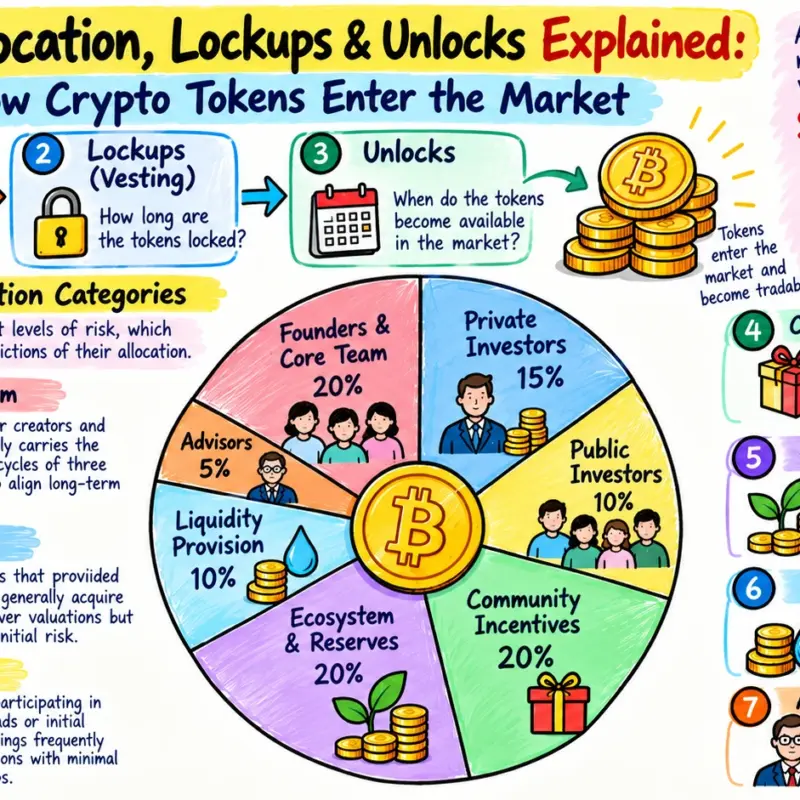
- Part 3: Token Allocation, Lockups & Unlocks Explained
- Part 4: Token Utility, Emissions & Burns
Why Is Tokenomics the Single Most Critical Survival Metric?
Tokenomics dictates long-term survival because market hype eventually fades, leaving only supply and demand fundamentals to determine value. Even a protocol using breakthrough technology and tens of thousands of active users will experience price collapse if its circulating supply increases tenfold within a few months without matching capital inflows.
A common problem in decentralized finance is the low float, high FDV trap. In this situation, a project releases only a tiny fraction such as 5% to 10% of its total token supply to the public during launch. This artificial scarcity inflates the token’s trading price and creates an astronomical Fully Diluted Valuation (FDV). However, large blocks of locked insider tokens inevitably unlock on predetermined schedules. When these newly liquid tokens enter secondary markets, overwhelming sell pressure crushes retail buyers.
Sustainable projects avoid this dynamic by designing aligned incentives where token emissions directly correlate with network utility, cash generation, and protocol resilience.
To evaluate whether a project possesses a sustainable economic model, you must inspect the five core pillars supporting every token.
The 5 Core Pillars of Sustainable Tokenomics
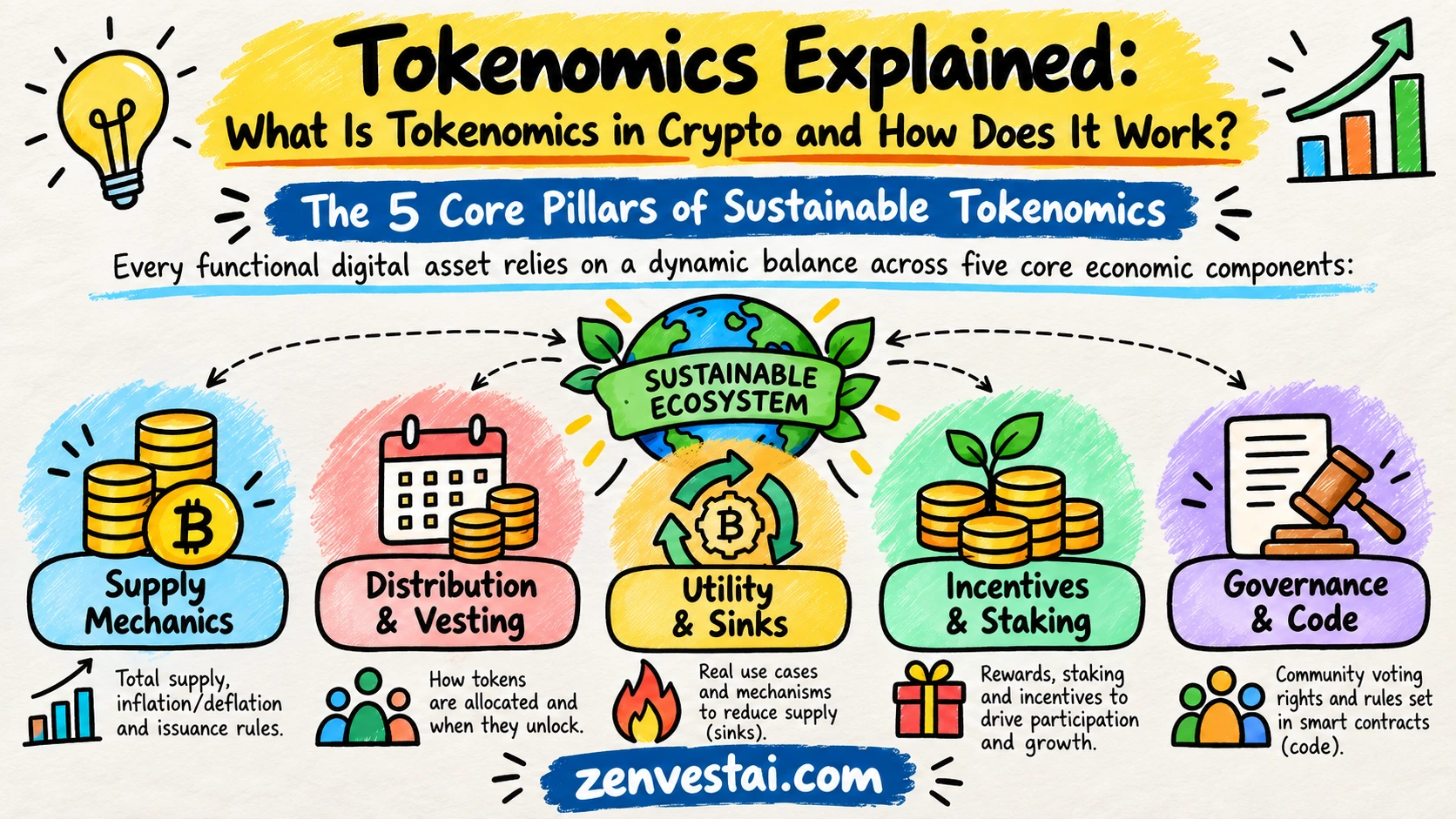
Every functional digital asset relies on a dynamic balance across five core economic components:
Mechanics
& Vesting
& Sinks
& Staking
& Code
1. Token Supply Mechanics
Supply mechanics govern an asset’s programmatic scarcity and inflation schedule. Evaluating supply requires analyzing three distinct metrics:
Circulating Supply represents the exact volume of tokens currently unlocked, freely tradeable, and actively moving through the open market.
Total Supply denotes the entire quantity of tokens minted to date, including locked treasury balances, escrowed tokens, and unvested team allocations, minus any tokens permanently burned.
Maximum Supply (Hard Cap) defines the absolute theoretical ceiling of tokens that will ever exist in a network’s lifetime. For example, The Bitcoin Whitepaper established a strict maximum supply of 21 million BTC, creating an unchangeable mathematical ceiling.
Conversely, networks like Ethereum utilize a dynamic supply model without a rigid cap, balancing proof-of-stake issuance against continuous transaction fee destruction.
2. Distribution, Allocations, and Token Unlock Schedules
Token distribution reflects who controls the network’s wealth at launch. A project typically divides its supply among founders, private seed investors, public participants, ecosystem grants, and community treasuries.
Healthy token architectures implement multi-year unlock schedules combined with strict lockup periods called cliffs. A standard tier-one distribution structure includes a 12-month cliff followed by linear monthly vesting over 36 to 48 months. This design prevents early insiders from liquidating their positions before the underlying product achieves measurable product-market fit.
3. Token Utility and Economic Sinks
A token must have real functional demand to support its long-term value. Basic speculative trading does not constitute structural utility. Common uses include paying transaction fees (gas), providing collateral for loans, or paying for computing resources.
To counterbalance ongoing reward emissions, sustainable models incorporate token sinks. Token sinks are programmatic mechanisms that permanently or temporarily remove tokens from circulation.
Under Ethereum Improvement Proposal EIP-1559, a baseline portion of every transaction fee is permanently destroyed (burned), directly reducing open-market supply as network activity increases. Similar sinks include buyback-and-burn protocols financed by real platform revenues.
4. Incentive Allotments and Net Yield Reality
Tokens rely on reward distributions to bootstrap liquidity and decentralize network security. Layer-1 networks mint new tokens to compensate miners or validators for processing transactions and maintaining ledger integrity.
However, high staking returns often mask severe dilution. Protocol participants must distinguish between gross staking yield and net yield.
If a Proof-of-Stake network offers a 15% annual staking reward, it may look attractive. But suppose the token supply also grows by 20% each year.
In that case, people who do not stake their tokens may see their share of the network’s value decrease. Sustainable rewards should come from real protocol activity, such as transaction fees. They should not depend mainly on creating new tokens and increasing the supply.
5. Transparent Governance and Decentralized Treasuries
Governance tokens give holders voting rights in a protocol. Instead of having a central board make every decision, some decentralized protocols let token holders vote on important changes.
These decisions can include changing fees, upgrading smart contracts, and deciding how to use funds from the community treasury.
Effective governance frameworks establish quorum thresholds and time-lock delays to prevent flash-loan attacks, ensuring protocol treasuries cannot be drained by malicious actors accumulating temporary voting majorities.
With these five pillars in place, there is one common mistake many beginners make: assuming that a low token price means the project is undervalued.
How Tokenomics Differs From Token Price (The Market Cap Trap)
A low token price does not mean an asset is cheap, and a high token price does not mean an asset is expensive. Novice investors frequently fall victim to “unit bias,” purchasing tokens trading for fractions of a cent under the mistaken belief that reaching a price of one dollar is easily achievable.
An asset’s valuation is governed by two fundamental formulas:
Market Capitalization = Current Token Price × Circulating Supply
Fully Diluted Valuation (FDV) = Current Token Price × Maximum Supply
Consider two hypothetical assets:
Token A trades at $100 with a circulating supply of 1,000,000 tokens, resulting in a market capitalization of $100,000,000.
Token B trades at $0.001 with a circulating supply of 1,000,000,000,000 tokens, resulting in a market capitalization of $1,000,000,000.
Although Token B appears cheaper on a per-unit basis, its network is actually valued ten times higher than Token A. If Token B were to reach $1.00, its market capitalization would need to reach $1 trillion surpassing the gross domestic product of many industrialized nations. Evaluating tokenomics requires analyzing market capitalization and FDV relative to circulating float, never unit price in isolation.
How does unmanaged dilution impact token holders in real numbers? Let us walk through a practical scenario.
A Simple Real-World Tokenomics Model in Action
To observe how supply expansion impacts market value, consider a realistic launch scenario:
A new decentralized exchange launches its governance token, “Alpha,” at a listing price of $1.00 per token.
Initial Circulating Supply: 10,000,000 Alpha tokens (10% of total supply)
Total/Maximum Supply: 100,000,000 Alpha tokens
Initial Market Capitalization: $10,000,000 ($1.00 × 10,000,000)
Initial Fully Diluted Valuation (FDV): $100,000,000 ($1.00 × 100,000,000)
Twelve months later, the project’s insider and investor cliff expires, releasing an additional 40,000,000 Alpha tokens into active circulation over the following month. The new circulating supply reaches 50,000,000 tokens.
If total investor demand and net liquidity remain steady with market capitalization holding at $10,000,000, the new equilibrium price per token must adjust:
New Token Price = Total Market Capitalization ÷ New Circulating Supply
New Token Price = $10,000,000 ÷ 50,000,000 = $0.20
Despite the project experiencing zero operational bugs or security breaches, early holders experience an 80% decrease in token price purely due to supply dilution. For the token to simply maintain its initial $1.00 price, new capital inflows would have had to expand the market capitalization from $10,000,000 to $50,000,000.
How are institutional developments altering this mathematical reality? Let us examine modern global trends.
Global Developments and Strategic Trends Shaping Modern Tokenomics
The digital asset industry is shifting rapidly away from purely speculative yield models toward cash-flow-driven institutional utility.
Real-World Asset (RWA) Tokenization
Institutional financial instruments are migrating directly onto distributed ledgers. According to verified analytics on RWA.xyz Institutional Data, the total value of tokenized real-world assets including short-term sovereign debt, commercial real estate, and private credit has expanded to roughly $34 billion. This shift bridges native on-chain tokenomics with tangible off-chain tokenization, transforming governance tokens from speculative instruments into claims on productive real-world assets.
AI Agent-to-Agent Micro-Transactions
The rise of autonomous software systems has created demand for frictionless machine-to-machine financial rails. Autonomous artificial intelligence agents require programmatic micro-payments to purchase distributed compute, data storage, and machine-learning inference at millisecond speeds.
High-throughput blockchains like Solana have seen over 400,000 real-world asset accounts interact with micro-settlement channels, establishing an entirely new structural utility for high-speed layer-1 tokens.
Global Regulatory Alignment Overhaul
Jurisdictions worldwide are enforcing rigorous disclosure frameworks that mandate clear economic accountability. Under the European Union’s comprehensive Markets in Crypto-Assets (MiCA) Framework, digital asset issuers must publish standardized whitepapers disclosing exact allocation structures, lockups, and dilution risks.
Concurrently, in the United States, proposed updates to small-business securities exemptions under SEC Regulation A Tier 2 maintain a $75 million cap, pushing decentralized builders to align token allocations with transparent enterprise revenue structures rather than predatory insider distributions.
Frequently Asked Questions
Can a project alter its tokenomics after launching on mainnet?
Yes, but only if the network architecture supports protocol upgrades. In decentralized networks, changing supply caps or emission schedules requires formal governance proposals and a supermajority node consensus. In centralized projects, administrator keys or multisig contracts can modify smart contract parameters directly, which presents severe centralization risks for token holders.
What is considered a healthy circulating-to-total supply ratio at launch?
A robust token launch typically features a circulating supply between 20% and 40% of total supply, accompanied by a multi-year linear vesting schedule for early insiders. Launches featuring less than 10% circulating supply carry elevated risks of severe dilution once lockup cliffs expire.
What is the primary difference between a hard cap and a dynamic supply?
A hard cap establishes an immutable mathematical ceiling on total tokens that will ever be minted, as seen in Bitcoin’s 21 million limit. A dynamic supply has no absolute ceiling; instead, it relies on algorithmic balancing between block reward issuance and transaction fee burning to manage inflation or achieve deflation dynamically.
What is the most reliable way to verify a project’s vesting schedule?
Never rely solely on marketing presentations or visual roadmaps. Dedicated blockchain data platforms, protocol documentation, and audited smart contract code provide the definitive source of truth regarding token lockup addresses, cliff dates, and linear release rates.
ZenvestAI View
At ZenvestAI, our research desks evaluate tokenomics through the lens of productive corporate finance rather than speculative momentum. The early era of crypto rewarded aggressive inflationary yield bootstrapping, where protocols printed unbacked governance tokens to subsidize temporary user activity. That model has proven unsustainable.
The next generation of digital assets will be evaluated on economic surplus: Does the protocol generate measurable fee revenue? Does it produce real cash flows that exceed its operational emissions?
Does its token design align the long-term wealth of founders with secondary market participants? When evaluating any digital asset, disregard short-term price charts until you have audited the supply schedule, team lockup parameters, and underlying cash-flow mechanisms. If the tokenomics fail the test of basic mathematics, no amount of marketing will sustain the asset over time.
The Bottom Line on Tokenomics Explained: What Is Tokenomics in Crypto and How Does It Work?
Tokenomics is the economic foundation of a cryptocurrency project. It explains how a token is created, distributed, used, and supplied. If these basic rules are poorly designed, even a project with good technology may struggle to succeed.
Related Intelligence & Data Sources
Bitcoin Whitepaper: A Peer-to-Peer Electronic Cash System — Architectural blueprint for algorithmic monetary scarcity and hard-cap economics.
Ethereum Improvement Proposal EIP-1559 Specification — Official technical documentation for dynamic base-fee burns and circulating supply contraction.
RWA.xyz Institutional Real-World Asset Dashboard — Comprehensive institutional analytics tracking on-chain tokenized sovereign debt, credit, and real-world assets.
ESMA Regulatory Framework: Markets in Crypto-Assets (MiCA) — Official European Securities and Markets Authority regulatory standards for asset disclosures and token whitepapers.
U.S. Securities and Exchange Commission Regulation A Guidelines — Federal statutory rules governing exempt securities offerings and capital formation thresholds.
Author & Editorial Disclosure
Editorial Desk: ZenvestAI Digital Asset Research Group
Author : Deepak Kumar
Regulatory Notice: This article is published solely for informational and educational purposes under global standards outlined by the International Organization of Securities Commissions (IOSCO), the U.S. Securities and Exchange Commission (SEC), and the European Securities and Markets Authority (ESMA). Nothing contained herein constitutes financial, legal, investment, or tax advice. Past protocol performance and mathematical tokenomic projections do not guarantee future market outcomes. Always perform independent due diligence before interacting with digital asset protocols.