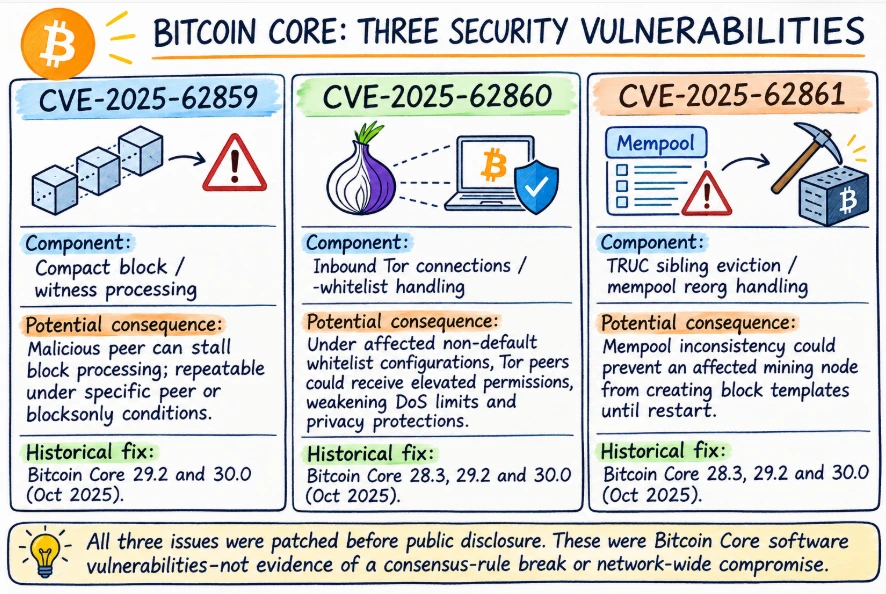
Bitcoin Core has disclosed three security vulnerabilities that affected how certain Bitcoin nodes processed blocks, handled incoming Tor connections and created mining block templates. One of the vulnerabilities was rated high severity, while the other two were rated medium severity.
The disclosures, published on November 10, 2026, have attracted attention because they involve three important parts of Bitcoin’s infrastructure: network privacy, transaction processing and mining operations.
However, there is an important detail behind the headlines. These were not three newly discovered attacks happening across the Bitcoin network in November 2026.
The vulnerabilities were reported to developers during 2025, and fixes were released in October 2025. Bitcoin Core disclosed their technical details after the last affected 29.x software release reached its end-of-life date in October 2026.
This distinction matters. A security vulnerability in the software used by Bitcoin nodes does not automatically mean that Bitcoin’s blockchain, monetary supply or users’ wallet balances have been compromised.
To understand the real significance of this disclosure, we need to look beyond the word vulnerability. We need to understand what went wrong, and how an attacker could have used these weaknesses.
And also, we need to understand which Bitcoin participants were exposed and what the fixes tell us about Bitcoin’s security model.
ZenvestAI Research Framework: Three Layers of Bitcoin Security
Bitcoin security is built on three interconnected layers: Consensus Security, Node Security and Operational Security. Each layer protects a different part of the network. Understanding this distinction helps explain why a software vulnerability affecting an individual Bitcoin node does not necessarily threaten Bitcoin’s consensus rules or the entire network.
| Security Layer | Core Question | What It Protects |
|---|---|---|
| Consensus Security | Are transactions and blocks valid under Bitcoin’s rules? | The integrity of the ledger, transaction validity and Bitcoin’s monetary rules. |
| Node Security | Can a computer safely process and verify blockchain information? | Bitcoin Core software, peer-to-peer communication, local data and the machine running the node. |
| Operational Security | Can miners and infrastructure providers continue working reliably? | Mining operations, hardware, electricity, internet connectivity and service availability. |
Why These Three Layers Matter
Consensus Security protects the rules that determine which transactions and blocks Bitcoin accepts. Full nodes independently enforce these rules, while Proof-of-Work helps secure the ordering of transaction history.
Node Security protects the software and computers that verify and relay blockchain information. Vulnerabilities in Bitcoin Core can affect how an individual node processes network messages, manages connections or performs certain operations.
Operational Security protects the physical and technical infrastructure supporting Bitcoin. Mining facilities, network providers and other services can experience outages without necessarily causing a consensus failure.
How This Framework Relates to the Bitcoin Core Vulnerabilities
The three vulnerabilities discussed in this article primarily concern node software behaviour and network-level reliability, rather than a confirmed failure of Bitcoin’s core consensus rules.
- A vulnerability involving Tor connections can affect how a node handles network connections and associated privacy or access protections.
- A vulnerability involving block processing can affect a node’s ability to process certain peer-to-peer data reliably.
- A mempool or block-template issue can affect the operation of an affected mining node without automatically stopping the wider Bitcoin network.
ZenvestAI Insight: A Bitcoin software vulnerability should be judged by what it allows an attacker to affect: transaction validity, an individual node’s verification and network behavior, or the availability of mining and infrastructure services. These are different security risks, and confusing them can lead to an exaggerated understanding of the actual threat.
Read It- What Will Drive Crypto and Stocks’ Next Rebound? The Dollar, Liquidity, and Buyer Triggers Explained

Now, understanding the concept of Bitcoin Core Discloses Three Security Vulnerabilities one by one:-
What Exactly Did Bitcoin Core Disclose?
First we need to know that what is Bitcoin Core? Bitcoin Core is the open-source software implementation that allows computers to participate in the Bitcoin network as full nodes. It helps computers receive transactions, verify blocks, maintain a copy of the blockchain and communicate with other Bitcoin nodes.
On November 10, 2026, Bitcoin Core published three security advisories covering the following vulnerabilities.
| CVE identifier | Severity | Main vulnerability |
|---|---|---|
| CVE-2025-62859 | Medium | A malicious peer could delay block processing |
| CVE-2025-62860 | Medium | Incoming Tor connections could receive unintended whitelist permissions |
| CVE-2025-62861 | High | A mempool inconsistency could prevent affected mining nodes from creating valid block templates |
The three issues affected different parts of Bitcoin Core. They were not one combined vulnerability, and they did not all create the same type of risk.
CVE-2025-62859 involved compact block processing. It could allow a malicious peer to delay a node’s ability to process blocks under specific conditions.
CVE-2025-62860 involved Tor connections and Bitcoin Core’s optional whitelist configuration. It could give incoming Tor peers permissions intended for trusted connections, weakening certain denial-of-service and privacy protections.
CVE-2025-62861 involved TRUC transaction rules and mempool management during a blockchain reorganization. It could leave the mempool in an inconsistent state and prevent an affected mining node from creating valid block templates.
The third issue received the high-severity classification because of its potential effect on mining operations.
The important point is that all three vulnerabilities concerned Bitcoin Core’s software behaviour. Understanding that distinction will help us assess whether the disclosure represents a direct threat to Bitcoin holders or a problem affecting particular network participants.
Sources of information taken from here: CVE-2025-62859 · CVE-2025-62860 · CVE-2025-62861.
Why These Vulnerabilities Matter to the Bitcoin Network
To understand the topic Bitcoin Core Discloses Three Security Vulnerabilities it is important to understand that Why These Vulnerabilities Matter to the Bitcoin Network. So let’s discuss this point…
As we know, Bitcoin is often described as a decentralized financial network that does not depend on a central bank, payment company or single server. But decentralization does not mean that the network operates without software or technical infrastructure.
Every full node depends on software to verify transactions and blocks. Miners depend on software to prepare candidate blocks. Network participants depend on communication systems to exchange blockchain information.
A weakness in any of these areas can affect how individual participants interact with the network.
Consider three simple examples:
- If a node cannot process new blocks properly, it may fall behind the rest of the network.
- If a privacy configuration gives unexpected permissions to incoming connections, the node may become more exposed to malicious activity.
- If a mining node cannot create a valid block template, the mining operation using that node may be interrupted.
These examples show why Bitcoin security is not limited to private keys and wallet protection.
Network security also depends on the reliability of the software that connects nodes, processes transactions and supports mining.
The three disclosures provide a useful opportunity to understand these less visible parts of Bitcoin’s infrastructure.
Now, this has been cleared that Why These Vulnerabilities Matter to the Bitcoin Network.
You may like to read it- The TradFi List for Crypto Users: Stocks, Bonds, Dividends, Yield, Collateral, Spreads and More Explained
Let’s move on the next point in this discussion:-
CVE-2025-62860: How Incoming Tor Connections Received Trusted Permissions
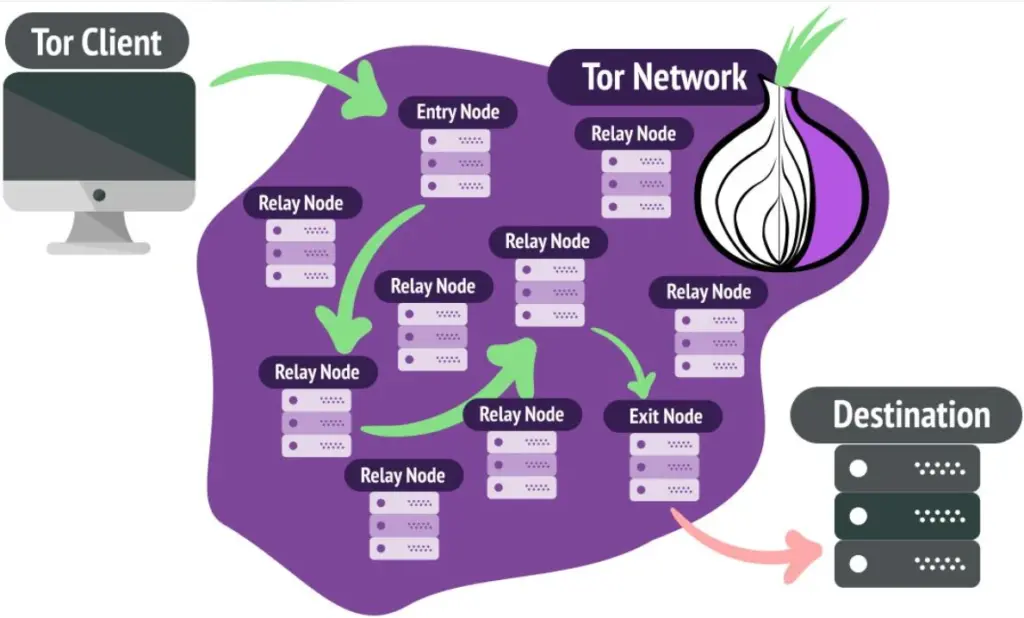
The Tor-related vulnerability is particularly interesting because it involves a feature many Bitcoin users rely on for additional network privacy.
Before discussing on this point we need to understand What is Tor, and why do Bitcoin users use it?
What is Tor, and why do Bitcoin users use it?
Tor is a network designed to make it harder to connect internet activity with a user’s original IP address. It routes traffic through multiple relays rather than sending it directly from the user’s computer to the destination.
Some Bitcoin node operators use Tor to reduce the amount of network information they reveal when communicating with other peers.
For example, imagine someone running a Bitcoin full node from a home internet connection. If the node communicates directly with other computers, its public IP address may become visible to those peers.
Using Tor changes how that communication takes place. Other peers generally see a Tor-related connection rather than the operator’s original public IP address.
This can improve privacy, but it also introduces another software component into the connection process.
Now, its clear that What is Tor, and why do Bitcoin users use it?
Moving to next point in the discussion…
What is Bitcoin Core’s whitelist setting?
Bitcoin Core includes an optional configuration called -whitelist. It allows node operators to identify certain peers as trusted. Depending on the configuration and software version, whitelisted connections can receive different treatment from ordinary incoming connections.
These permissions can relax some denial-of-service limits and privacy-leak protections.
The purpose is to support particular network arrangements where the operator wants to give selected peers additional privileges.
The problem arose when Bitcoin Core incorrectly identified some incoming Tor connections as belonging to a trusted IP range.
How did the Tor vulnerability happen?
A Tor daemon usually runs on the same computer as Bitcoin Core or somewhere on the same local network.
When an external peer connects through Tor, Bitcoin Core may see the connection as coming from the local Tor proxy rather than seeing the original external IP address.
Some software providers bundled Bitcoin Core with a Tor daemon and configured the optional -whitelist setting to include the IP range used by that Tor daemon.
Bitcoin Core then applied whitelist permissions to incoming Tor connections because the proxy’s local IP address matched the configured range.
The software was effectively treating incoming Tor peers as trusted connections, even though the individual external peers had not been selected as trusted participants.
This was the central weakness behind CVE-2025-62860.
Related Article:- Anthropic IPO: Pricing Confusion, Valuation Concerns and What It Means for the AI and Crypto Markets
What could an attacker do with these permissions?
The problem was not simply that an unknown computer could connect to a Bitcoin node.
Bitcoin nodes are designed to accept connections from other network participants. The security issue was that some incoming connections received additional permissions they should not have received.
Those permissions could weaken certain protections against denial-of-service attacks and privacy leaks.
A denial-of-service attack attempts to disrupt a computer or service by consuming its resources or interfering with normal operations.
Privacy protections, meanwhile, help limit information that a node reveals to other peers.
If these protections are relaxed for an untrusted connection, the node may become more exposed than its operator intended.
Bitcoin Core reported that thousands of reachable Bitcoin mainnet nodes were affected by configurations used by certain software providers.
However, this number should be understood correctly. It describes nodes that were applying whitelist permissions to incoming Tor connections. It does not mean that thousands of nodes were successfully attacked or that thousands of Bitcoin wallets were compromised.
Now, the most important point come is Who was affected?
Who was affected?
Nodes that did not use the non-default -whitelist configuration were not affected by this specific issue.
The vulnerability was relevant to particular setups in which the Tor proxy’s address matched an IP range configured as trusted.
Bitcoin Core fixed the issue so that incoming Tor connections received on an onion bind would not be incorrectly whitelisted.
The wider lesson is that using a privacy tool does not automatically guarantee that every part of a software configuration is private or secure. The interaction between Tor, local network settings and Bitcoin Core permissions also matters.
Source of Information taken from here: Bitcoin Core: CVE-2025-62860.
CVE-2025-62859: How a Malicious Peer Could Delay Bitcoin Block Processing
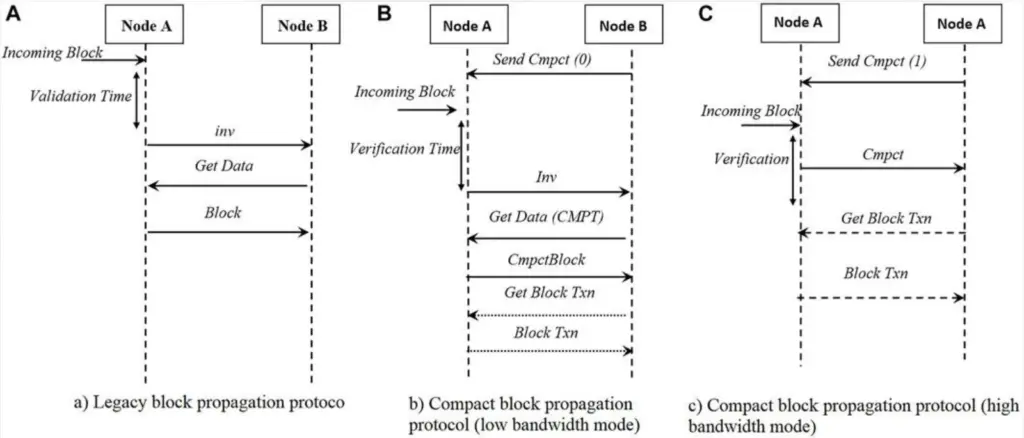
The second vulnerability affected how Bitcoin Core received and reconstructed compact blocks. It demonstrates why even a small error in the order of software checks can affect a node’s ability to stay updated with the blockchain.
Now, we understand…
First, what is compact block relay?
Bitcoin blocks contain transactions that have been confirmed by miners. Every full node needs to receive and verify these blocks to maintain an accurate copy of the blockchain.
However, sending an entire block to every node can require unnecessary network traffic.
Bitcoin therefore supports compact block relay, which allows nodes to exchange a smaller representation of a block and reconstruct it using transaction information they may already have.
For example, imagine a new Bitcoin block contains 2,000 transactions. A receiving node may already have many of those transactions in its memory pool.
Instead of downloading every transaction again, the node can use the compact block information and request only the missing transactions.
This saves bandwidth and helps new blocks travel through the network more efficiently.
What went wrong in Bitcoin Core?
The vulnerability involved a process called witness malleation checking.
A Bitcoin transaction includes witness data, which contains information used to verify certain transaction signatures. Witness data is also included in the block’s commitment structure.
A malicious peer could announce a compact block containing altered witness information that would fail the required check during reconstruction.
In affected Bitcoin Core versions, the software cleared the block’s download state after reconstructing the compact block but before completing the witness malleation check.
When the check failed, the node requested the complete block from the same peer using a GETDATA message.
The important problem was the waiting period.
The node could wait up to 10 minutes for that peer to provide the block before moving forward with the fallback process.
A malicious peer could use this behaviour to delay the victim’s block processing.
Could the attack continue repeatedly?
Yes, under specific conditions described in the official advisory.
The attack could be repeated indefinitely if either:
- The attacker controlled all three of the victim’s high-bandwidth peers.
- The victim node was operating with the
-blocksonlyconfiguration.
High-bandwidth peers are selected connections that a Bitcoin node uses to receive new blocks efficiently.
The -blocksonly setting tells Bitcoin Core not to relay unconfirmed transactions in the usual way. It is a particular operating mode, not the default configuration for every node.
These conditions matter because they explain why the vulnerability was classified as medium severity rather than being described as an unrestricted attack against every Bitcoin node.
What could this mean for Bitcoin users?
A node that cannot process incoming blocks promptly may temporarily fall behind the active blockchain.
For a normal node operator, this could mean delayed blockchain synchronisation and reduced confidence in the freshness of locally available blockchain information.
For infrastructure providers that depend on their own nodes, delayed processing can also affect applications that use those nodes to retrieve blockchain data.
However, this does not mean that Bitcoin miners across the network would stop producing blocks.
Other nodes could continue receiving and processing blocks normally. The issue concerned the affected node and its peer connections.
Bitcoin Core addressed the vulnerability in the 29.2 and 30.0 releases.
Source of information taken from here: Official CVE-2025-62859 advisory.
CVE-2025-62861: The High-Severity Bug That Could Stop Mining Nodes From Creating Block Templates

The third vulnerability is especially important because it affected a process used by miners to prepare new Bitcoin blocks.
Unlike the Tor issue, which involved incoming connection permissions, this vulnerability concerned how Bitcoin Core managed transactions when the blockchain’s active history changed.
To understand it, we need to examine three connected concepts: the mempool, TRUC transactions and chain reorganisations.
Why does Bitcoin need a mempool?
A mempool, short for memory pool, is where a Bitcoin node temporarily stores valid unconfirmed transactions.
When someone sends BTC, the transaction is broadcast to the network. Nodes check it against Bitcoin’s rules and may keep it in their mempools while waiting for a miner to include it in a block.
Miners use transactions from their mempools to prepare candidate blocks.
Not every node necessarily has an identical mempool because transaction arrival times, network connections and local transaction policies can differ.
The mempool is therefore an important part of transaction relay and mining operations, but it is not the blockchain itself.
What are TRUC transactions?
TRUC stands for Topologically Restricted Until Confirmation.
These are version 3 Bitcoin transactions that follow additional mempool policy restrictions.
Under these rules, a TRUC transaction can have no more than:
- One unconfirmed ancestor.
- One unconfirmed descendant.
An ancestor is an unconfirmed transaction that must be confirmed before another transaction can be completed.
A descendant is a transaction that depends on an earlier unconfirmed transaction.
These restrictions help control the relationships between unconfirmed transactions and support more predictable transaction replacement.
It is important to understand that TRUC restrictions are mempool policy rules, not Bitcoin consensus rules.
This distinction becomes central to understanding the vulnerability.
A transaction structure that is not accepted under ordinary mempool policy may still be valid when included in a block, provided it follows Bitcoin’s consensus rules.
What is sibling eviction?
Bitcoin Core introduced a mechanism called sibling eviction in version 28.0.
Imagine a parent transaction with an existing unconfirmed child transaction. Another child transaction is then submitted, creating a second unconfirmed child.
This would exceed the TRUC descendant limit.
Bitcoin Core’s sibling-eviction logic can treat the existing child as a replacement candidate. If the new transaction satisfies the required fee conditions, the existing child can be removed under replace-by-fee rules.
This mechanism helps manage competing transaction relationships within the mempool.
Under normal circumstances, this is a transaction-management feature.
The problem appeared when Bitcoin Core needed to restore transactions after a chain reorganisation.
How did a chain reorganisation trigger the problem?
A chain reorganisation, often called a reorg, happens when the active Bitcoin blockchain changes from one valid chain to another.
This can happen when competing blocks are discovered and one chain becomes the preferred chain under Bitcoin’s rules.
When a reorganisation disconnects previously confirmed blocks, transactions from those blocks may need to return to the mempool if they remain valid and unconfirmed.
Bitcoin Core has a special process for this.
It re-adds those transactions using a setting called bypass_limits=true.
The purpose is to restore transactions faithfully without applying ordinary mempool limits and anti-denial-of-service restrictions in the usual way.
However, the sibling-eviction logic was not properly excluded from this special restoration process.
As a result, TRUC restrictions could still be applied while transactions were being returned to the mempool.
How did this create an inconsistent mempool?
Consider a simplified example.
A parent transaction has two child transactions that become part of a valid confirmed block.
Later, a chain reorganisation disconnects that block.
Bitcoin Core needs to restore the relevant transactions to the mempool.
The original block may have contained a transaction relationship that is valid under Bitcoin consensus rules but does not fit the ordinary TRUC mempool restrictions.
During restoration, sibling eviction could remove one transaction while leaving its dependent transactions in the mempool.
Those remaining transactions could then refer to outputs that were no longer available because the transaction that created them had been removed.
This produced an inconsistent mempool.
The problem was not that Bitcoin suddenly accepted invalid coins. It was that the node’s internal transaction pool no longer represented a consistent set of transactions.
Why could this stop mining block-template creation?
A miner needs a valid block template before it can construct and work on a candidate Bitcoin block.
A block template contains the transactions selected for inclusion, along with the information needed to construct the block.
When an affected node attempted to assemble a template from its inconsistent mempool, the resulting template could fail its validity check.
Consequently, the node could no longer successfully create new block templates.
According to the official advisory, a node that entered this state needed to be restarted. Restarting allowed Bitcoin Core to reload the mempool in a consistent state.
This is why the vulnerability was rated high severity.
It could interrupt the block-production work of affected mining infrastructure.
However, it is important not to confuse a mining node failure with a Bitcoin network failure. The advisory does not say that the entire global mining network stopped or that Bitcoin’s consensus rules were broken.
How was the mining vulnerability fixed?
Bitcoin Core corrected the problem by ensuring that TRUC sibling-eviction checks would not run during the special transaction-restoration process using bypass_limits.
This allowed transactions disconnected during a chain reorganisation to be restored without incorrectly applying the ordinary sibling-eviction logic.
The fix was included in Bitcoin Core 28.3, 29.2 and 30.0.
Niklas Goegge was credited with discovering and responsibly reporting the vulnerability.
Source of information: Official CVE-2025-62861 advisory.
Coming to the point Did These Vulnerabilities Put Bitcoin’s Blockchain or BTC Holdings at Risk?
Did These Vulnerabilities Put Bitcoin’s Blockchain or BTC Holdings at Risk?
This is probably the most important question for people who own Bitcoin but do not operate full nodes or mining infrastructure.
The short answer is that the three disclosures do not demonstrate a direct compromise of Bitcoin ownership, private keys or the network’s monetary supply.
However, understanding why requires separating three different layers of Bitcoin security.
1. Wallet and ownership security
Bitcoin ownership is controlled through private keys.
A private key allows its holder to authorise transactions spending the corresponding funds.
The three disclosed vulnerabilities were not described as methods for extracting private keys, bypassing wallet authentication or directly transferring BTC from another person’s wallet.
Therefore, ordinary Bitcoin holders should not interpret these advisories as evidence that their wallet balances have been exposed.
2. Node and network security
Full nodes communicate with other peers and independently verify blockchain data.
The three vulnerabilities affected this operational layer.
They could interfere with block processing, weaken certain protections for incoming Tor connections or create an internal mempool inconsistency.
These are real security concerns, but they do not automatically invalidate the Bitcoin blockchain.
3. Bitcoin consensus security
Consensus rules determine which transactions and blocks are valid under Bitcoin’s protocol.
Full nodes independently check these rules rather than simply accepting whatever a miner or another peer sends them.
The TRUC restrictions involved in CVE-2025-62861 were mempool policy rules, not consensus rules. The vulnerability affected transaction-pool management and block-template creation, not the fundamental rules governing Bitcoin issuance or transaction validity.
This is an important technical distinction.
A software bug can affect a node’s operation without changing the rules that every valid Bitcoin block must follow.
The Bitcoin Core security policy itself distinguishes critical vulnerabilities that threaten the fundamental integrity of the network from high- and medium-severity issues with more limited effects. Bitcoin Core security policy.
The most important point is When Were the Vulnerabilities Discovered and Fixed?
When Were the Vulnerabilities Discovered and Fixed?
One detail makes this disclosure different from a typical breaking security incident: the vulnerabilities were fixed more than a year before their technical details became public.
The original reports were submitted to Bitcoin Core developers during 2025.
| Date | Development |
|---|---|
| April 28, 2025 | CVE-2025-62859 reported |
| September 12, 2025 | CVE-2025-62860 reported |
| September 26, 2025 | CVE-2025-62861 reported |
| October 2025 | Security fixes released in Bitcoin Core updates |
| October 27, 2026 | Bitcoin Core 29.x reached end of life |
| November 10, 2026 | Three vulnerabilities publicly disclosed |
Sources of information: Individual Bitcoin Core security advisories.
Now, coming to the next point of discussion Why did developers wait until November 2026?
Why did developers wait until November 2026?
Bitcoin Core follows a responsible security disclosure process.
When developers receive a vulnerability report, they assess its severity, develop a fix and make the updated software available to node operators.
Publicly releasing detailed information too early can give attackers information about weaknesses that some users have not yet fixed.
According to Bitcoin Core’s disclosure policy, medium- and high-severity vulnerabilities are generally disclosed two weeks after the last affected software release reaches end of life.
This explains the timing of the November 10 disclosure.
The policy is designed to give users time to update their software before detailed technical information becomes public.
It also explains why the CVE identifiers contain the year 2025 even though their public disclosure happened in 2026. The identifiers relate to the vulnerabilities, not necessarily the year in which their details became public.
Source of information: Bitcoin Core Security Advisories and Disclosure Policy.
Read It- What Is Uniswap? Complete Guide to UNI, AMMs, Liquidity Pools & DEX Trading
Now, the question arises here, What Should Bitcoin Node Operators Do After This Disclosure?
What Should Bitcoin Node Operators Do After This Disclosure?
For people running Bitcoin Core, the most practical response is to check their software version and update it where necessary.
The vulnerabilities have already been fixed in historical releases, including Bitcoin Core 28.3, 29.2 and 30.0, as applicable to the individual issue.
However, these are historical fix versions, not a recommendation to install an older release today.
Bitcoin Core recommends running the latest maintenance release of the most recent major version that an operator can upgrade to.
The following checks are useful:
| Type of operator | What to check |
|---|---|
| Full-node operators | Confirm that Bitcoin Core is running a supported release |
| Tor users | Review incoming connection and whitelist configurations |
| Node service providers | Check bundled Tor and Bitcoin Core configurations |
| Mining operators | Monitor mempool consistency and block-template creation |
| Bitcoin application developers | Check whether applications depend on affected node infrastructure |
Official resources:
Ordinary BTC holders do not need to assume that their funds are compromised simply because these vulnerabilities were disclosed. The immediate software-update guidance is primarily relevant to people operating Bitcoin Core infrastructure.
Now we will go through the point What Do These Three Vulnerabilities Reveal About Bitcoin’s Security Model?
What Do These Three Vulnerabilities Reveal About Bitcoin’s Security Model?
The three disclosures provide a useful way to understand how Bitcoin depends on different parts of its technical infrastructure.
The Tor vulnerability demonstrates that network privacy depends on correct software configuration, not simply on using a privacy tool.
The compact block vulnerability demonstrates that a node’s ability to receive and process blockchain information depends on how it handles messages from other peers.
The mining vulnerability demonstrates that transaction management and block-template creation are closely connected. Even when the underlying blockchain rules remain intact, an error in the mempool can interrupt a miner’s ability to prepare blocks.
There is also a broader lesson about open-source development.
Bitcoin Core is maintained through public code review, testing, bug reports and contributions from developers around the world. This does not make the software immune to vulnerabilities. It provides a process through which weaknesses can be reported, investigated and corrected.
For a decentralised network, this process matters because there is no single central operator responsible for updating every participant’s computer.
Each node operator has a role in maintaining their own infrastructure.
Bitcoin’s security is therefore not just about the strength of its cryptography. It also depends on the quality of the software, the reliability of network communication and the ability of independent participants to maintain their systems.
You may like to read- GIFT City to Global Standards: Why Institutional Crypto is Gaining Ground in India
Frequently Asked Questions
1. What are the three Bitcoin Core vulnerabilities disclosed in November 2026?
Bitcoin Core disclosed CVE-2025-62859, CVE-2025-62860 and CVE-2025-62861. They affected compact block processing, incoming Tor connection permissions and mining block-template creation, respectively.
2. Which Bitcoin Core vulnerability was rated high severity?
CVE-2025-62861 was rated high severity. It involved a mempool inconsistency triggered by TRUC sibling eviction during a chain reorganisation. It could prevent an affected mining node from creating valid block templates.
3. What is the Bitcoin Tor vulnerability?
CVE-2025-62860 involved Bitcoin Core incorrectly applying whitelist permissions to certain incoming Tor connections. It could weaken denial-of-service protections and privacy safeguards for affected nodes.
4. Could the Bitcoin Core vulnerabilities cause BTC theft?
The three disclosed vulnerabilities do not establish a direct method for stealing BTC, extracting private keys or changing wallet balances.
5. Could the mining vulnerability stop the entire Bitcoin network?
No such network-wide shutdown was established by the advisory. The vulnerability could prevent affected mining nodes from creating valid block templates. Other unaffected mining operations could continue.
6. What is the relationship between TRUC and Bitcoin’s mempool?
TRUC introduces additional transaction relationship restrictions for version 3 transactions under mempool policy. These rules help manage unconfirmed transaction structures but are not Bitcoin consensus rules.
7. Have the Bitcoin Core vulnerabilities been fixed?
Yes. Fixes were released in October 2025. The relevant historical fixed versions include 28.3, 29.2 and 30.0, depending on the vulnerability. Operators should use a currently supported release.
8. Why were the vulnerabilities disclosed in 2026 if they were discovered in 2025?
Bitcoin Core delayed public disclosure under its security policy. Medium- and high-severity vulnerabilities are generally disclosed two weeks after the last affected release reaches end of life.
9. Does running Bitcoin Core through Tor automatically make a node vulnerable?
No. The Tor vulnerability required a particular configuration involving the optional -whitelist setting and the Tor proxy’s IP address. Nodes without that non-default setting were not affected by this specific issue.
10. Should Bitcoin investors be worried about this disclosure?
Investors should understand the difference between software security risks and a compromise of Bitcoin’s monetary or consensus rules. These disclosures highlight infrastructure risks but do not establish that Bitcoin ownership or the blockchain’s monetary system was compromised.
ZenvestAI View: Bitcoin Security Depends on More Than the Blockchain
The November 2026 Bitcoin Core disclosures highlight an important part of cryptocurrency security that often receives less attention than price movements, institutional adoption and mining economics.
Bitcoin’s security depends on several connected systems working correctly.
Its consensus rules determine which transactions and blocks are valid. Full nodes independently verify that information. The peer-to-peer network allows blockchain data to move between participants. Miners use node software and transaction information to prepare new blocks.
A weakness in one of these systems can affect individual operators without necessarily threatening the entire network.
The three vulnerabilities demonstrate this difference clearly.
The Tor issue concerned network permissions and privacy. The compact block issue concerned the timely processing of blockchain information. The mining issue concerned the consistency of transaction data used to create block templates.
For ZenvestAI, the important takeaway is that Bitcoin’s decentralisation should be evaluated through its complete operating infrastructure, not only through its protocol design or the number of miners and holders.
Continuous software maintenance, independent verification and responsible security reporting remain essential to the network’s long-term reliability.
The Bottom Line
Bitcoin Core disclosed three previously patched vulnerabilities involving Tor connection permissions, block processing and mining operations.
One was rated high severity and two medium severity. Their fixes were released in October 2025, before the technical details became public on November 10, 2026.
The vulnerabilities exposed weaknesses in particular software operations, not a demonstrated failure of Bitcoin’s monetary system or consensus rules.
The central lesson is simple: Bitcoin can have a strong underlying protocol and still require continuous improvements to the software that keeps its decentralised network operating.
Educational disclosure: This article is intended for educational and informational purposes. It does not constitute investment, financial, cybersecurity or legal advice. Readers operating Bitcoin infrastructure should consult official documentation and qualified technical professionals before making configuration or security changes.
Official Sources From Content Taken
- Bitcoin Core – CVE-2025-62859: Block Processing Stall
- Bitcoin Core – CVE-2025-62860: Tor Whitelist Permissions
- Bitcoin Core – CVE-2025-62861: Mining Block-Template Vulnerability
- Bitcoin Core – Security Advisories and Disclosure Policy
- Bitcoin Core – Software Life Cycle
- Bitcoin Improvement Proposal 431 – TRUC Transactions