The Invisible Gatekeepers: Who Actually Checks Your Crypto?
When you send cryptocurrency to a friend, no bank teller approves the transfer, and no centralized server updates your account balance. This absence of a central authority triggers an immediate question: who actually verifies that you have the funds, confirms your cryptographic signature, and ensures you cannot spend those same digital coins twice?
The entire operation relies on thousands of independent computers running globally around the clock. These computers are called blockchain nodes, and they act as the distributed referee system for decentralized finance. If you have ever wondered why transactions take a few minutes to confirm, or why fraudulent transactions are stopped instantly before entering the permanent ledger, nodes hold the answer.
In this fourth installment of our foundational blockchain series, we strip away technical jargon to explain how nodes receive, inspect, validate, and broadcast transactions across the network.
Before You Begin: You Are Reading Part 4
This article is the third installment in the ZenvestAI foundational blockchain series, designed to take you from core mechanics to advanced network defense. To extract the deepest value from this guide, you should review the two foundational guides that precede it:
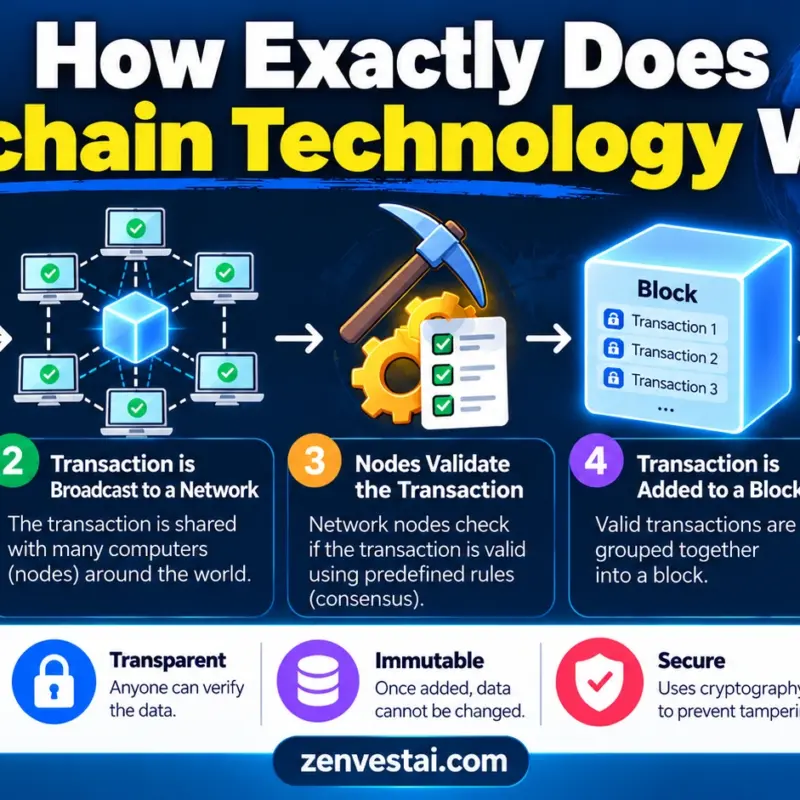
- Part 1: How Exactly Does Blockchain Technology Work? breaks down decentralized networks, distributed nodes, and peer-to-peer consensus without central servers.
- Part 2: What Is a Blockchain Block and How Does It Store Transactions? examines the anatomy of a block, block headers, payload capacities, and Merkle trees.
- Part 3: How Do Hashes and Cryptography Secure a Blockchain?
ZenvestAI Quick Answer: What Is a Blockchain Node?
A blockchain node is any computer connected to a peer-to-peer blockchain network that runs specialized software to enforce the network’s protocol rules. Rather than acting as passive devices, nodes actively communicate with one another, maintain copies of the shared ledger, and verify every proposed data update.
Think of a node as an automated customs officer standing guard at the ledger’s border. Whenever a new transaction arrives, the node evaluates the data against an unyielding checklist of cryptographic mathematics and historical records. If the transaction satisfies every single protocol rule, the node passes it along; if the transaction violates even a single rule, the node drops it on the spot.
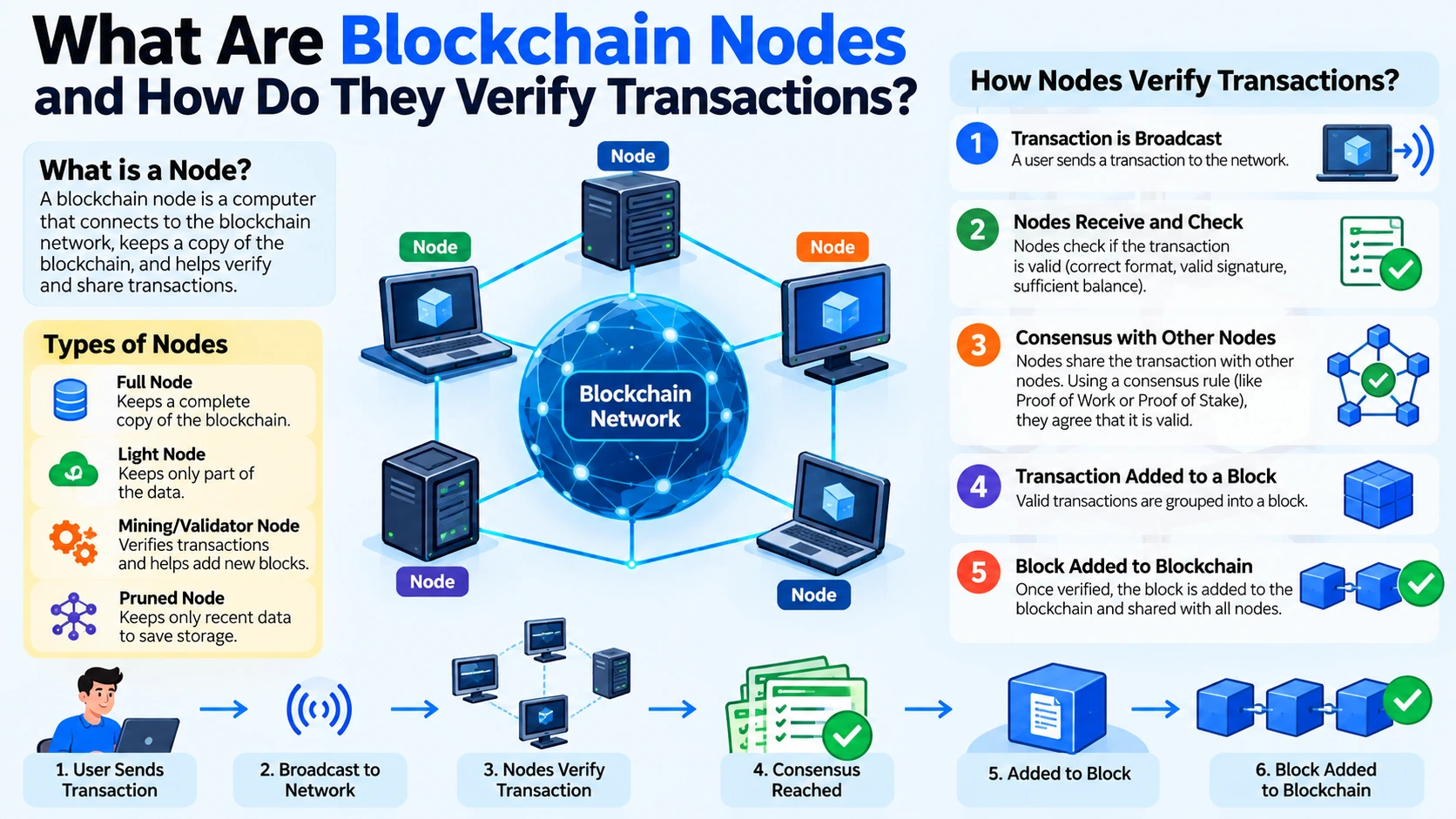
What Are Blockchain Nodes and How Do They Verify Transactions?
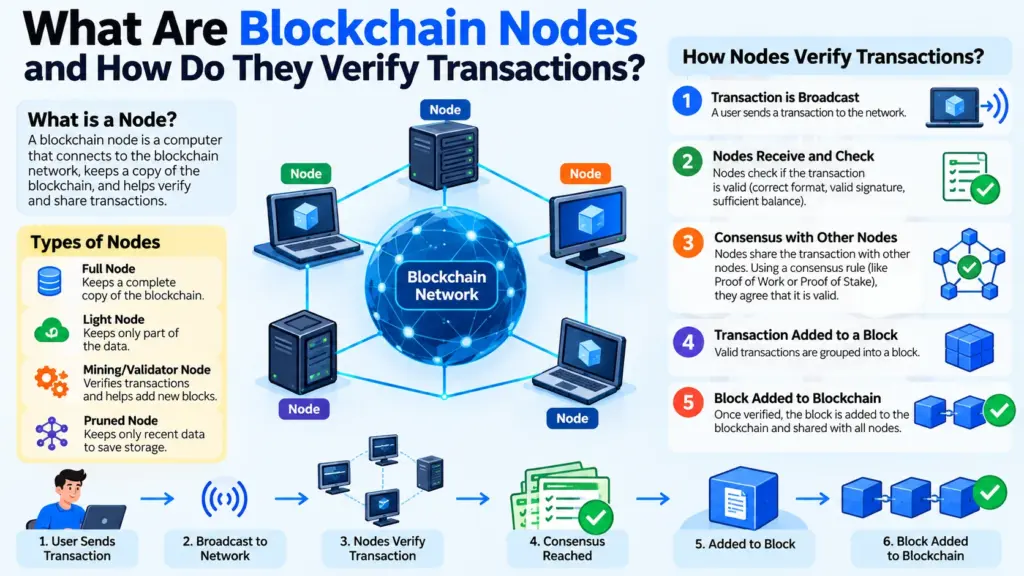
So why does a decentralized network require thousands of separate computers to do this instead of just one fast server?
Why Blockchains Cannot Exist Without Nodes
Blockchains need nodes because decentralization requires eliminating single points of failure and centralized points of control. If a single corporate server controlled transaction verification, an attacker, rogue administrator, or regulatory body could alter balances, reverse valid transfers, or censor specific wallet addresses at will.
Nodes distribute that operational authority across thousands of independent operators in different countries, jurisdictions, and hosting environments. Because every full node stores its own local copy of historical transactions, no single entity can rewrite history. If a malicious actor alters records on their own computer, the remaining nodes compare that altered record against their local ledgers, spot the discrepancy, and ignore the rogue machine.
This collective independence guarantees system resilience. Even if half of the world’s computers suddenly lose power, the remaining nodes keep the network operating smoothly without data loss.
Now that we understand why nodes are indispensable, let us follow a transaction from the exact moment you click “Send” to see how nodes process it step by step.
Step-by-Step: How Nodes Receive, Audit, and Share Transactions
Every crypto transfer undergoes a precise sequence of technical hurdles before becoming part of a finalized block.
Step 1: Receiving the Broadcast in the Mempool
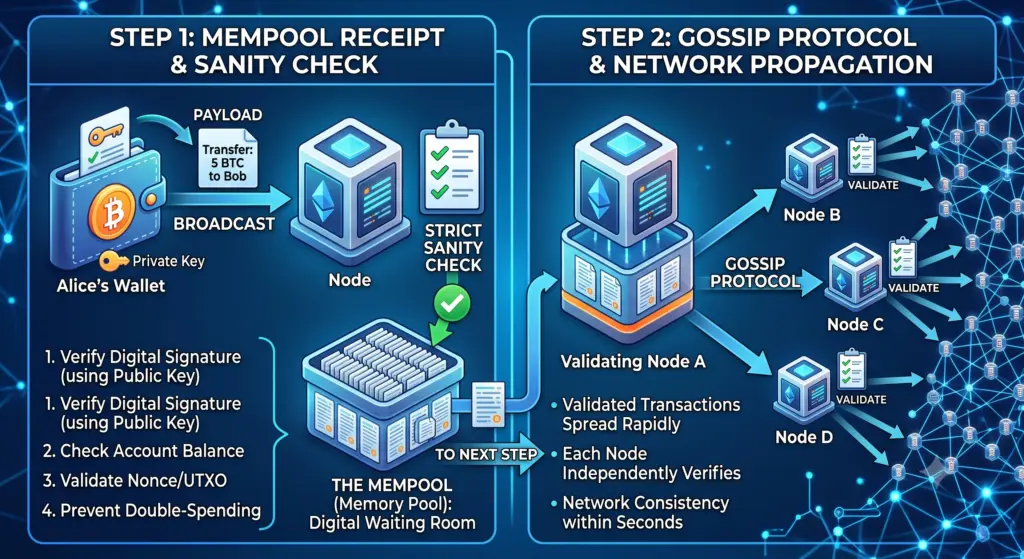
Your transaction begins its journey when your crypto wallet signs a transfer payload with your private key and broadcasts it to nearby peers. The recipient nodes receive this raw data payload and immediately place it into a temporary holding area called the mempool (memory pool).
The mempool is essentially a digital waiting room for unconfirmed transactions. At any given moment, a node’s mempool contains thousands of pending transfers waiting for inclusion in an upcoming block. However, a transaction does not get into the mempool automatically; the receiving node immediately subjects it to a strict sanity check.
Step 2: The Cryptographic Sanity Check
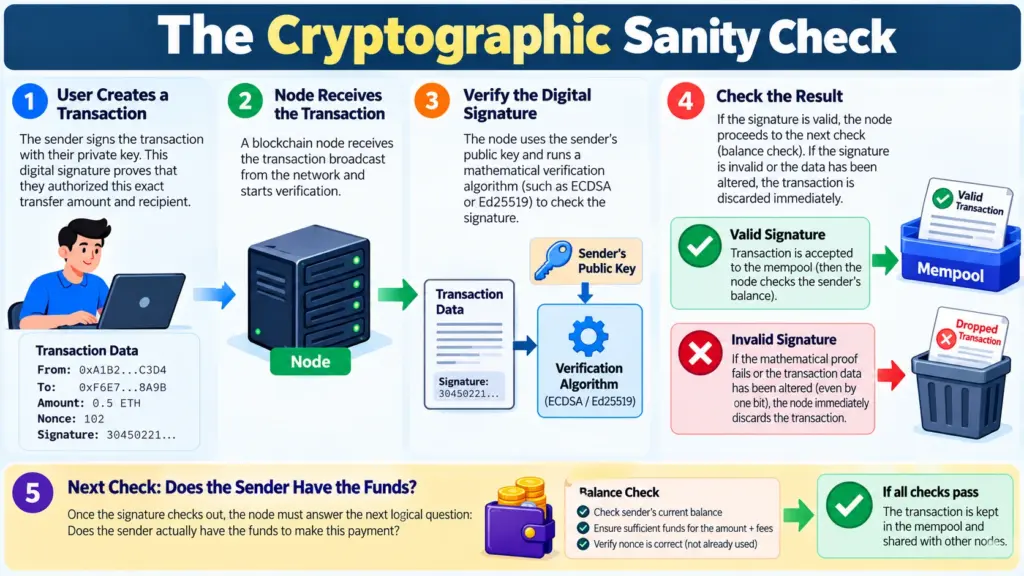
Before keeping a transaction in its mempool, the node verifies the sender’s digital signature. Using the sender’s public key, the node executes a mathematical verification algorithm (such as ECDSA or Ed25519) to prove that the holder of the corresponding private key genuinely authorized this exact transfer amount and recipient address.
If the mathematical proof fails, or if the transaction payload has been altered by even one bit during transmission, the node immediately discards the data. Once the signature checks out, the node must answer the next logical question: does the sender actually have the funds to make this payment?
Step 3: Checking Account Balances, Nonces, and Double-Spending
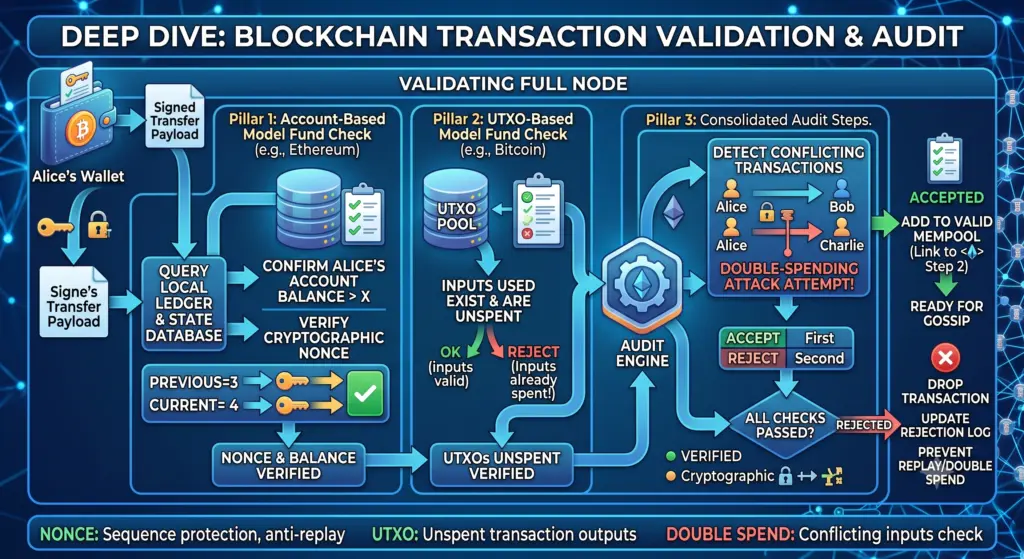
The node queries its own copy of the ledger to confirm that the sending address possesses sufficient unspent funds. In an UTXO model (used by Bitcoin), the node checks that the input coins exist and have not already been referenced by another spending transaction. In an account-based model (used by Ethereum), the node checks the sender’s account balance and verifies the cryptographic nonce, an incremental counter that ensures transactions execute in exact sequential order and prevents replay attacks.
If an account attempts to spend money it does not have, or tries to broadcast two conflicting payments using the same funds—known as a double-spending attack—the node instantly rejects the invalid transaction.
Step 4: Propagating Through the Gossip Protocol
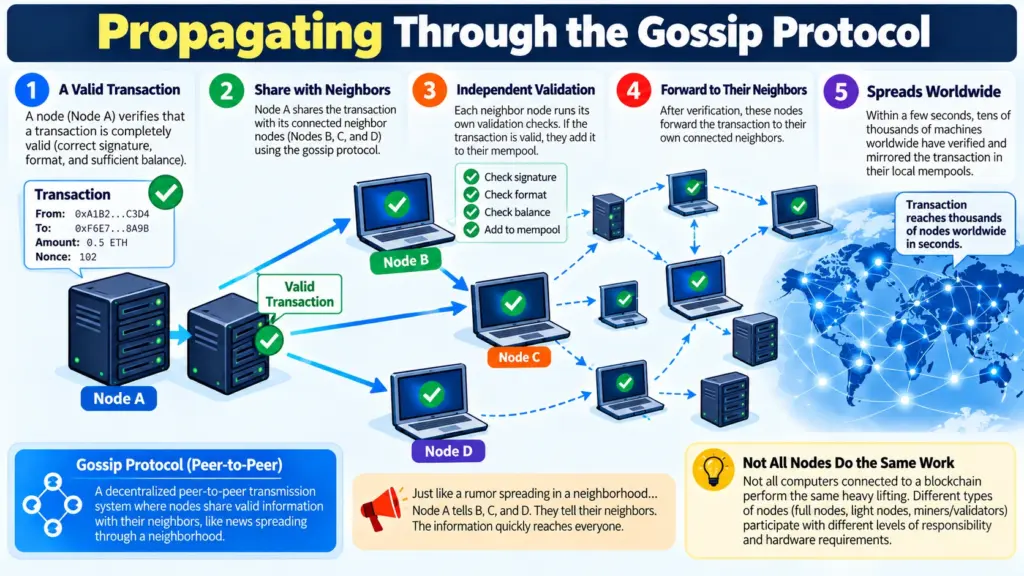
Once a node certifies that a transaction is completely valid, it shares the transaction with its connected neighbor nodes. Blockchains accomplish this through a peer-to-peer transmission system called the gossip protocol.
Much like news spreading through a neighborhood, Node A informs Nodes B, C, and D of the new transaction. Those nodes each run their own independent validations, and upon verification, forward the transaction to their respective neighbors. Within a few seconds, tens of thousands of machines worldwide have verified and mirrored the transaction in their local mempools.
Yet, not all computers connected to a blockchain do the same heavy lifting. How do different machines participate without equal hardware?
Full Nodes vs. Light Nodes: Understanding the Balance of Power
Different devices serve distinct functions based on their hardware resources, storage capacity, and security goals.
Full Nodes: The Complete Archive and Rulebook
A full node downloads, parses, and validates every single block and transaction since the genesis block of the network. Because a full node maintains the entire history and state of the chain locally, it never relies on external servers for truth.
When a full node processes incoming data, it checks every rule against its own local copy of the blockchain. Full nodes form the true backbone of network security and sovereignty because they enforce the consensus rules without trusting anyone else. Running a full node requires substantial hard drive space (often several hundred gigabytes or terabytes), reliable bandwidth, and continuous uptime.
Light Nodes: Fast Verification for Everyday Users
A light node (or Simplified Payment Verification client) does not download the entire blockchain ledger. Instead, it downloads only the block headers, which contain compact cryptographic summaries known as Merkle roots.
When a light node needs to verify that a specific transaction occurred, it requests a cryptographic proof from a nearby full node. Light nodes allow smartphones, browser extensions, and lightweight hardware wallets to interact with blockchains securely without needing vast storage arrays. They trade complete self-sovereignty for day-to-day usability.
This brings us to a major industry point of confusion: does every node create new blocks?
The Essential Distinction: Validating Nodes vs. Block Producers
A widespread misconception in crypto is that every blockchain node creates blocks and earns mining or staking rewards. In reality, block creation and node validation are two fundamentally different roles.
Regular full nodes only validate and store data. They do not assemble blocks, solve cryptographic puzzles, or stake collateral to produce blocks. Instead, they act as independent monitors.
Block producers called miners in Proof-of-Work systems or validators in Proof-of-Stake systems are specialized nodes that perform computational work or lock up economic stake to propose new candidate blocks. Once a miner or validator constructs a block from pending mempool transactions, it broadcasts the candidate block out to the rest of the network.
The ordinary validating nodes then inspect the candidate block. If the block producer included an invalid transaction, or awarded themselves illegal fees, the non-producing full nodes reject the block entirely. The validating nodes hold the ultimate veto power over block producers.
How do these thousands of independent monitors maintain agreement on a global scale?
How Nodes Reach Consensus and Maintain Network Consistency
When a candidate block arrives, every full node verifies the block’s internal structure before committing it to permanent storage.
Verifying the Candidate Block
A node verifies that the block references the correct cryptographic hash of the preceding block, ensuring that the chain remains unbroken. The node also recalculates the Merkle root of all transactions contained within the block and confirms that all included transfers adhere strictly to the network’s consensus rules. In Proof-of-Stake systems, the node checks the cryptographic signatures of the attesting committee to confirm proper voting thresholds.
Only when every transaction inside the block passes inspection does the node write that block to its local database, update its state balances, and clear the corresponding transactions from its mempool.
What Happens When a Node Rejects a Block?
If a block producer attempts to include a fraudulent transaction, or violates protocol parameters such as the maximum block size limit, validating nodes discard the candidate block immediately. The rogue block is never written to valid ledgers, and the node refuses to forward it to any peer machines.
The dishonest block producer loses time, electricity, or staked capital, while the rest of the network continues on the canonical chain without hesitation. This mechanical rejection is what keeps the entire network coordinated, honest, and secure without any corporate board or central regulator directing traffic.
Real-World Resource Requirements for Running a Node
Operating an independent node provides maximum privacy and eliminates third-party reliance, but it involves clear hardware and maintenance commitments.
| Typical Hardware & Bandwidth Profile for Popular Full Nodes (Estimates) | ||
|---|---|---|
| Metric | Bitcoin Core Full Node | Ethereum Execution Node |
| Storage Capacity | 1 TB SSD recommended | 2 TB NVMe SSD required |
| RAM | 8 GB minimum | 16 GB – 32 GB minimum |
| CPU | Dual-core modern CPU | 4-core fast modern CPU |
| Internet Download/Up | 50 GB down / 200 GB up/mo | High-speed unmetered |
While running a standard Bitcoin validating node is feasible on modest mini-PCs, platforms with higher transaction throughput demand high-performance solid-state storage to handle rapid state growth and intensive read-write cycles.
Common Misconceptions About Blockchain Nodes
- “Running a node automatically pays you rewards.” Simple full validating nodes earn zero financial yield; their primary return is total financial self-sovereignty, direct verification, and private transaction broadcasting.
- “All nodes must stay online 24/7 to remain functional.” If your personal full node goes offline for maintenance, it simply queries connected peers upon reconnecting and rapidly downloads the missing blocks to catch up.
- “A node can modify rules to give its owner extra coins.” If you alter your node software to grant yourself unbacked tokens, every other node on the network will evaluate your blocks as invalid and disconnect your machine.
Frequently Asked Questions
What happens if my personal node crashes?
The global blockchain continues processing transactions without interruption. When you reboot your node, it requests the latest block hashes from neighboring peers, downloads missing data, verifies the intermediate blocks, and resumes active validation.
Can a blockchain survive if most nodes go offline?
Yes. As long as a small group of nodes holding an accurate copy of the ledger remains operational, the network preserves its history and can reconstruct the peer-to-peer mesh as additional operators reconnect.
Is my software wallet a blockchain node?
Most standard browser, desktop, and mobile wallets are light clients or web interfaces connected to third-party node providers (such as Infura or Alchemy), rather than self-hosted full nodes.
Do full nodes see my identity or personal details?
No. Nodes only observe cryptographic addresses, numerical balances, nonces, timestamps, and cryptographic signatures. They possess no built-in knowledge of your legal name, real-world location, or email address.
ZenvestAI View
The true metric of a blockchain’s decentralization is not its transaction-per-second marketing benchmark, but rather how simple and affordable it is for an ordinary person to run a validating node at home.
When running a node requires enterprise-tier data centers, validation concentrates into fewer institutional hands, weakening the anti-censorship guarantees that make cryptocurrency valuable in the first place.
The Bottom Line on What Are Blockchain Nodes and How Do They Verify Transactions?
A blockchain node is an independent, rule-enforcing computer that protects the network by verifying every cryptographic signature and balance before recording transactions to a permanent shared ledger.
Related Intelligence
Continue building your comprehensive foundation in blockchain architecture through our previous deep-dive guides:
- How Exactly Does Blockchain Technology Work? — Learn the high-level architecture of distributed networks.
- What Is a Blockchain Block and How Does It Store Transactions? — Discover how data payloads and block headers fit together.
- How Do Hashes and Cryptography Secure a Blockchain? — Explore the mathematical underpinnings that nodes use to verify every transaction.
Editorial Standards and Regulatory Disclosure
ZenvestAI produces independent, educational research designed to clarify decentralized systems and digital asset mechanics. In accordance with guidance from international financial authorities (including IOSCO, the U.S. SEC, and the European Union’s Markets in Crypto-Assets regulation), this content is published strictly for informational, educational purposes and does not constitute financial, investment, legal, or professional advice.